
Robert Colescott Influenced a Generation of African American Artists. Now, a Major Retrospective Puts His Irreverent Art Front and Center
Robert Colescott’s paintings feel
very 2019. Slipping between trippy figuration and
allegorical satire, offbeat art history references and Jim Crow-era
stereotypes, Colescott’s dynamic canvases reckon with the issues
that have defined cultural discourse for the last decade: racial
tension and class disparity; the decolonization of the canon; the
elusiveness of truth; debates over appropriation and who is allowed
to tell someone else’s story.
These works were not, of course,
painted recently. Colescott, who passed away in 2009, enjoyed a
lengthy career from the late 1960s through to the 2000s, turning
art’s own past against itself and reflecting, through art, on what
it meant to be a black man in the 20th century. “No American
painter of the late 20th century made such telling use of
painting’s European past to lambaste the painful contradictions of
the American present,” Roberta Smith wrote in her obituary of the
artist.
Yet, despite Colescott’s
continued relevance and critical favor, his work hasn’t received
much in the way of institutional attention over the last two
decades. Why?

Robert Colescott, 1919 (1980). ©
2019 Estate of Robert Colescott / Artists Rights Society (ARS), New
York. Courtesy of the Estate and Blum & Poe, Los Angeles/New
York/Tokyo. Photo: Joshua White.
The question over his legacy was
the driving force behind “Art and Race
Matters: The Career of Robert Colescott,” the first comprehensive retrospective
dedicated to the artist, which opened last week at the Contemporary
Arts Center (CAC) in Cincinnati and brings together 85 works that
span Colescott’s 53-year career. The only other major American
museum exhibition dedicated to Colescott’s work was mounted at the
San Jose Museum of Art in 1987, before it also traveled to the CAC,
making the new show a fitting return.
“Yes, Colescott was critically
acclaimed, but there was also not a lot of writing about him,
especially compared to other contemporaries,” CAC director Raphaela
Platow told artnet News ahead of the opening. “There just wasn’t
much about him at all.”
Platow, who co-curated the
exhibition with Lowery Stokes Sims and Matthew Wesely, was struck
by the gap between Colescott’s reputation and his status. In the
years leading up to the CAC show, she and her team assembled a
number of academics, curators, and museum directors in panels and
seminars, looking at this enigma.
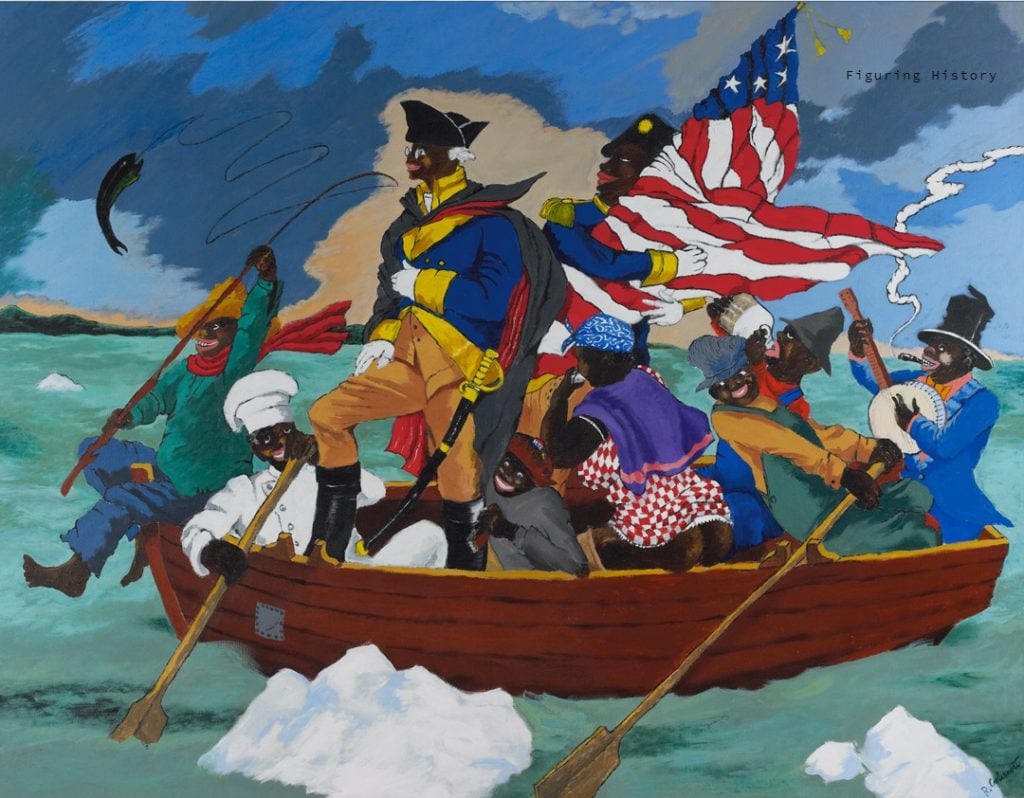
Robert Colescott, George Washington
Carver Crossing the Delaware: Page from an American History
Textbook (1975). © 2019 Estate of Robert Colescott / Artist
Rights
Society (ARS), New York. Photo: Jean Paul Torno.
“We got a lot of answers from a
lot of different perspectives,” Platow explained. “Some said it was
the potency of the work, perhaps, or the way he lived his life.
Maybe it was simply the subject matter and the fact that he always
put things in the most subversive way possible—he always put his
finger in the wound. But
nobody was able to give me a straightforward reason.”
Stokes Sims, a longtime friend of
the artist, isn’t so mystified.
“He misbehaved,” she explains
matter-of-factly. “He did not conform to any of the canonical ideas
about painting, about depictions, about points of view—he just
misbehaved and we’re all better for it.”
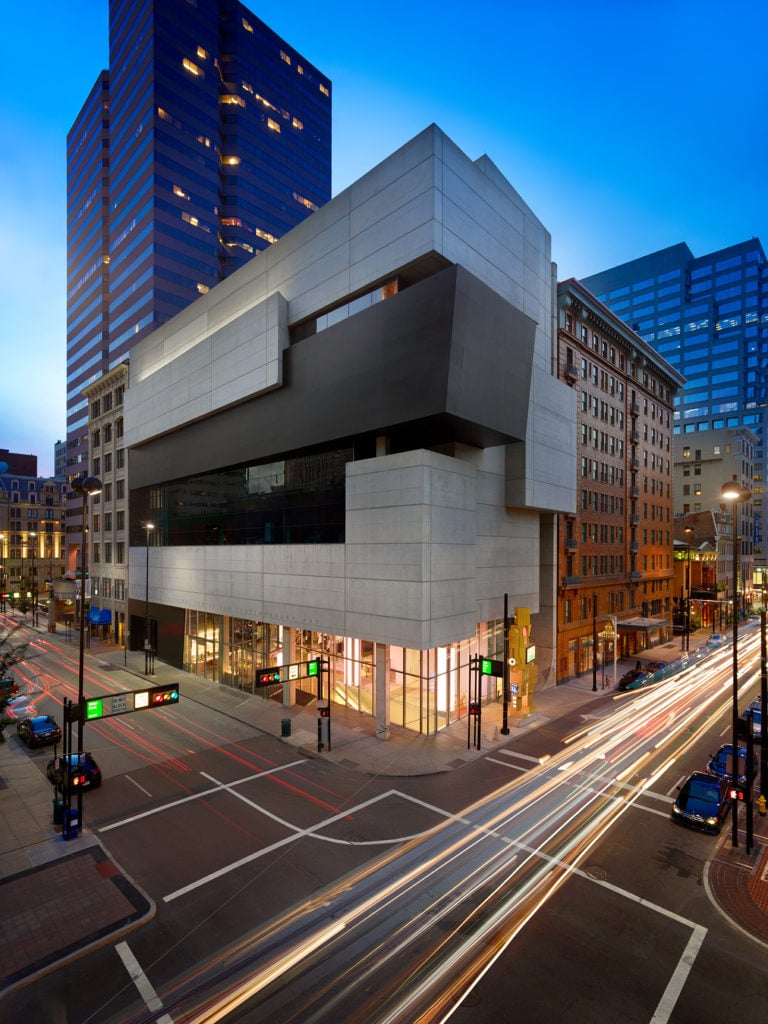
The Lois and Richard Blumenthal
Center
for Contemporary Art
Courtesy Contemporary Arts Center © Ryan Kurtz.
Colescott was born in Oakland in
1925 and spent most of his life on the West Coast. After a tour in
the army during World War II, he studied drawing and painting at UC
Berkeley. He taught for nearly a decade at Portland State
University before moving back to California in 1970, where he went
on to take positions at places like Cal
State, San Francisco Art
Institute, and his own
alma mater.
He completed many of his
best-known works during the mid-to-late ’70s, wryly reimagining
canonical classics with African American characters. In 1975, for
what is among his most well-known works, he took on Emanuel
Leutze’s Washington
Crossing the Delaware,
replacing the former president with inventor George Washington
Carver. That same year, he made his own version of Van
Gogh’s The Potato
Eaters, with an all-black
cast. In the top right
of the picture is the painting’s title: “Eat Dem
Taters.”
“This is very unapologetic work,”
says Stokes Sims. “Yet, even at its most outrageous, his work is
very earnest and serious about making a point.”
Stokes Sims first came across
Colescott’s work at Semaphore Gallery in the 1970s, when she was
working at the Met. “I looked at those paintings and went, ‘Oh my
God,’” she recalls. “They just took every truism, habit, nicety,
and tradition in life and blew them away. I loved it. They changed
my life.”
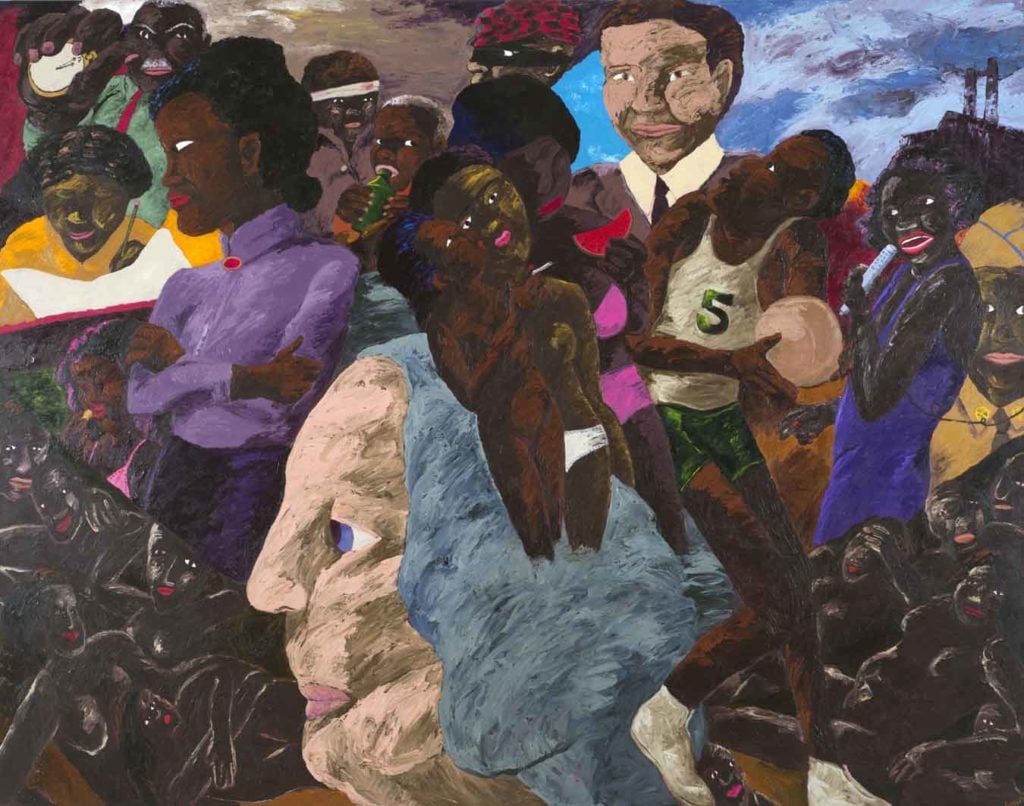
Robert Colescott, Knowledge of the
Past is the Key to the
Future: The Other Washingtons (1987). © 2019 Estate of Robert
Colescott / Artist Rights Society (ARS), New York.
Whether because of bad timing,
bad luck, or a conscious refusal of current trends, she notes that
Colescott’s work often seemed to exist on a pole opposite the trend
cycles of the art world. In the 1970s, he was playing with the
limits of figuration while the art world was focused on idea-based
art and conceptual practices. In the ’80s, Colescott was making
paintings rife when symbolism while the famous artists of the era
were all reverting back to manly abstraction.
Even within the sphere of black
artists, he operated on a different frequency.
“The kind of black figuration
that was accepted at that time was about this polemic about black
liberation,” says Stokes-Sims. “Colescott was kind of about a
liberation, but a liberation from the strictures of stereotypes and
conformity and good behavior. He brought an irreverence to that
polemic.”
Colescott’s brand of cultural
critique loomed large for the generation that followed his. Stokes
Sims and Platow point to artists like Kerry James Marshall, Kara
Walker, and Joyce Scott as people who followed his lead in
appropriating stereotypical black imagery to funny, absurd, and
moving ends. Aesthetically, the echo of Colescott’s brand of
“lumpy figuration” (Stokes Sims’s phrase for it) can be seen
everywhere in galleries right now.
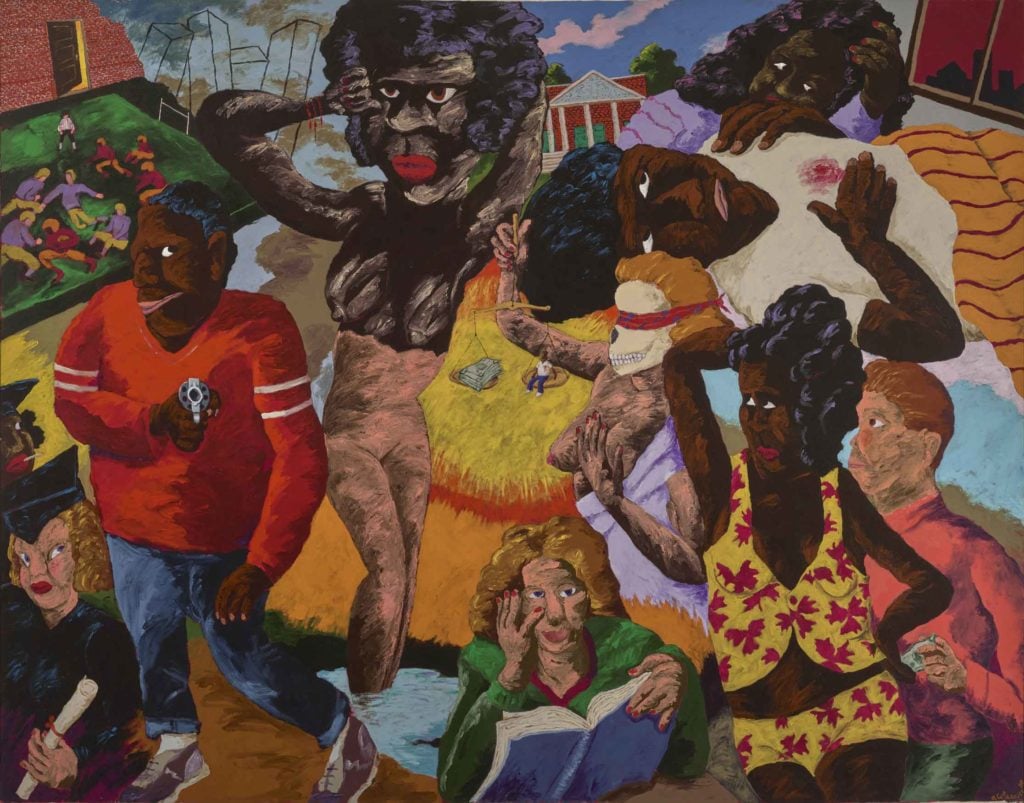
Robert Colescott, The Bilingual
Cop (1995). © 2019 Estate of Robert
Colescott / Artists Rights Society (ARS), New York. Robert
Colescott. Photo: Pablo Mason.
Mounting an exhibition dedicated
to a deceased artist is relatively uncommon for the CAC, which
focuses mostly on living contemporary artists. Yet, for Platow, the
opportunity to enter the conversation about Colescott’s legacy was
one she couldn’t pass up.
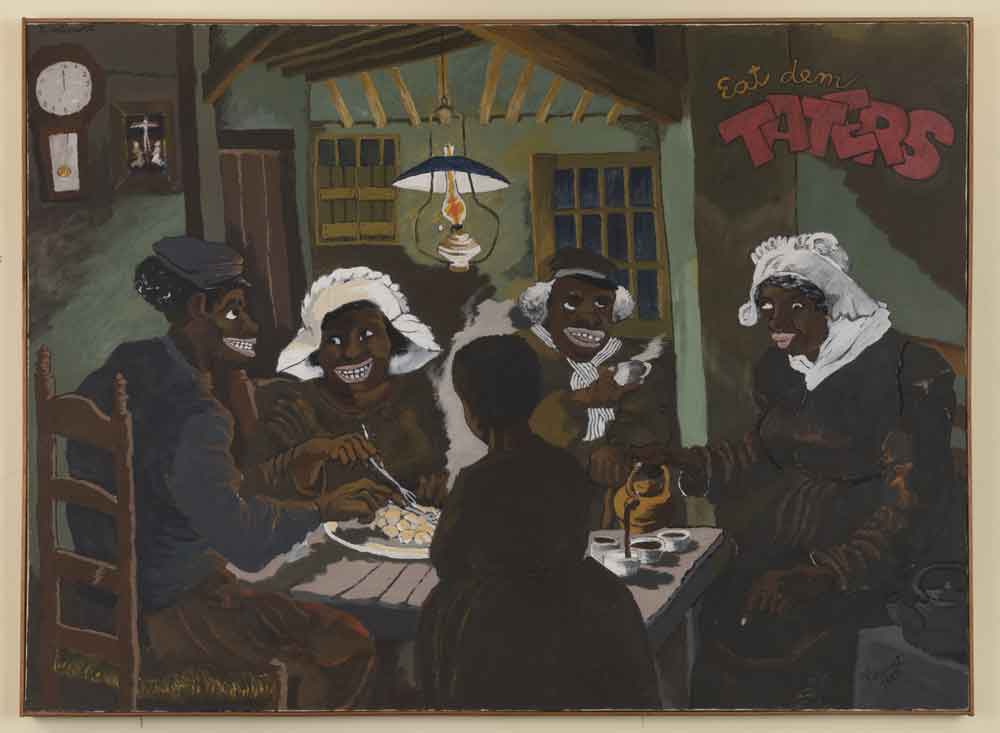
Robert Colescott, Eat Dem Taters
(1975). © 2019 Estate of Robert Colescott /Artists Rights
Society (ARS), New York. Photo: Adam Reich.
“We felt that Robert Colescott
was one of the protean figures that was so influential on peers and
younger artists, and in a way that hadn’t been uncovered or talked
about or acknowledged,” she says. “He was a living, breathing contradiction to so
many people. He looked with great reverence to art history for
source material, and then at the same time he did something so very
different than anything that had ever been done before,
content-wise. There were just so many things that didn’t make
sense, that couldn’t be easily packaged: the gaudiness of the brush
strokes, the bluntness of it, the in-your-faceness of it. I think
he just confounded people.”

Robert Colescott,Shirley Temple Black
and Bill Robinson White (1980). © 2019 Estate of Robert
Colescott / Artists Rights Society (ARS), New York.
“Art and Race
Matters: The Career of Robert
Colescott” is on
view at the Contemporary Arts
Center through
January 12, 2020.
The post Robert Colescott Influenced a Generation of African
American Artists. Now, a Major Retrospective Puts His Irreverent
Art Front and Center appeared first on artnet News.
Further reading


Leave a comment