
‘I Was a No One’: How Kamel Mennour Went From Art-World Outsider to Star Paris Dealer
The sonorous boom of the former
soccer star Eric Cantona’s voice fills a dark room in an upscale
Paris art gallery, a stone’s throw away from the Notre Dame. The
regional accent of the French actor and former Manchester United
player, who was once a forward for France’s national team, might
feel out of place, but Cantona is buddies with the gallery’s owner.
The art dealer in question, Kamel Mennour, is a big soccer fan, and
he called in the special favor to welcome a new artist to his
roster.
“We’re extremely close,” Mennour
said. “I called Eric and said that Neïl Beloufa wanted to use his
voice for a project. He asked ‘what for?’ and I said, ‘I don’t
know, but are you in or out?’ and he was in.” And so the soccer
legend ended up lending his voice to a dreamlike, anti-capitalist
fable created by Beloufa for his gallery debut.
I get the sense that the
53-year-old art dealer is a man who knows how to get things done.
Over the past two decades, Mennour has become one of
the most respected art dealers in Europe, with
three space in Paris, another in London, and he is a regular at
leading art fairs.
I’m speaking to Mennour in one
of his three Paris spaces as the gallery celebrates its 20th
anniversary with a group show. He is sleekly dressed, and so tall
that he would be intimidating if he were not so completely affable.
He gesticulates as he talks, and enthusiastically punctuates his
stories by clapping his hands together and snapping his
fingers.
An Outsider in Paris
Although he is now one of the
most connected figures in Paris, working with some 40 in-demand
artists, Mennour did not have an easy route into the art world. He
comes from an ordinary Algerian family, and he got his start in art
while studying for a degree in economics. To pay his way through
university in Paris, he got a part-time job selling etchings
door-to-door. “I was fed up with studying, but I was in love with
art, and totally devoted to becoming a gallerist,” he
says.
After he graduated, it took him
the better part of a decade before he opened his first space, a
small photography gallery on Rue Mazarine in 1999. He had a
difficult time breaking into the closed art world in Paris, having
had no mentors who could open doors for
him. “I was a no one,”
he recalls, “not even lucky enough to clean up, or to bring a
coffee to the gallerists of the older generation.”
Two decades later, he represents
artists such as Alicja Kwade, Daniel Buren, Anish Kapoor, and
the estate of Alberto Giacometti. Jeff Koons is in his address
book, too. Asked about the secret of his success, Mennour says,
“It’s a miracle.” His advice to young gallerists is down to earth?
“You need to believe in your dreams, work harder and harder every
day, and not listen to the people who are telling you that you
can’t do it,” he says.
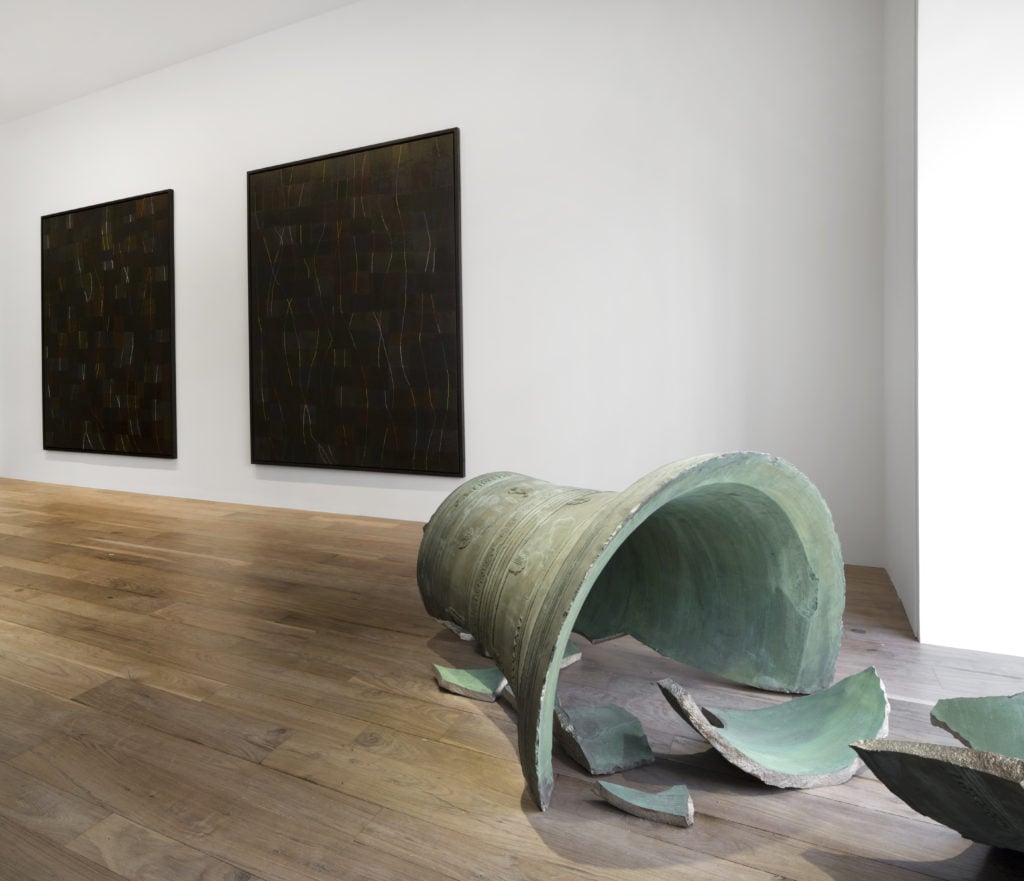
Installation view of “Spring and Fall:
Latifa Echakhch” Photo: Julie Joubert.
To become a successful dealer
you also need to be prepared to roll up your sleeves. Once, he
tells me, when art handlers from a top company were stumped at how
to move a pair of 1,500-pound bells by Latifa Echakhch into the
gallery, a crew of workers from the hotel next door stepped in and
lent a hand. “Being a gallerist is that,” he says. “You need to
find solutions. When there’s a moment, you need to seize it.
Because it’s a moment, and the artist is not waiting.”
Supporting the Next Generation
While some art dealers might use
their gallery’s birthday as an opportunity to boast about their
highest-profile names Mennour chose to put some of the gallery’s
younger stars in the spotlight. “This is really the DNA of the gallery, we take
on the unknown, and we grow with our artists,” Mennour
says.
Neïl Beloufa is a case-in-point.
The 34-year-old joined the gallery last year after leaving a
smaller Paris dealer, Balice Hertling, for the gallery with greater
resources to carry out his increasingly ambitious projects.
Speaking to artnet News, the French-Algerian artist explains that
of all the big names who approached him, he went with Mennour
because of his more humble background.
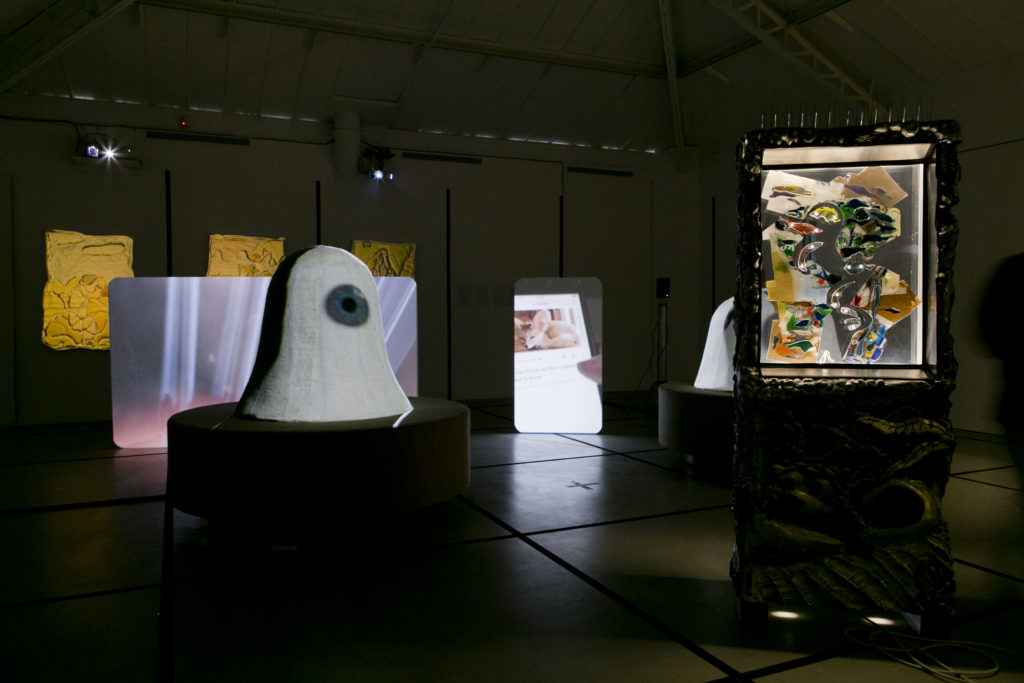
Installation view, “Neïl Beloufa: The
Moral of the Story” (2019). © Photo: archives Kamel Mennour.
Courtesy of the artist, and Kamel Mennour, Paris/London.
Beloufa joins Kwade, as well as
Camille Henrot, Mohamed Bourouissa, and Petrit Halilaj. Work by
Beloufa as well as another artist on the
roster, Cameron Jamie, were included by Ralph Rugoff in
his main exhibition at this year’s Venice Biennale.
The dealer explains that he also
wanted to use his gallery’s birthday to champion the exciting
emerging scene in the French capital. “I wanted to show what Paris
is now, because Paris was nothing 20 years ago. Nothing. It was
broken,” Mennour says. “When I started, I was flying to New York or
Berlin or London, and when I told people that I came from Paris it
was like if you would say today that you are coming from Oman. It
was weird. Paris was something in the ‘40s and ‘50s, but the scene
collapsed. 1964 was the end of the game, when Rauschenberg
won.”
He’s talking about the year the
then 39-year-old Robert Rauschenberg won the Golden Lion at the
Venice Biennale, the first US artist to do so, after which the
scene largely decamped to New York. “After that, Paris was
restaurants, museums, fashion, but not art,” Mennour
says.
A Generous Philanthropist
Mennour is a passionate
philanthropist. Since 2015, he has been organizing an annual
charity auction to aid the Imagine Institute, a research hospital
for children with genetic illnesses. The last edition raised €7.2
million (nearly $8 million), a figure which he hopes to increase at
next year’s event.
The quiet philanthropy is a
stark contrast to some of the more flashy charity work that has
been going on in Paris lately. In the wake of the devastating blaze
at Notre Dame, there were high-profile pledges by France’s biggest
billionaires François Pinault and Bernard Arnault (and Larry
Gagosian chipped in, too).
Mennour watched the “brutal”
sight of the cathedral burning from his children’s schoolyard in
the local neighborhood. For his part, he is in favor of rebuilding
the monument with a new look. “We need to move with time,” he says.
“I’m maybe too modern, but I say don’t re-copy it, maybe keep the
same shape but a different material, like steel. Why use wood
again?”
With the FIAC fair also around
the corner, another topic on the minds of many in Paris is the
planned unveiling of Jeff Koons’s controversial gift to the city in
the wake of terror attacks.
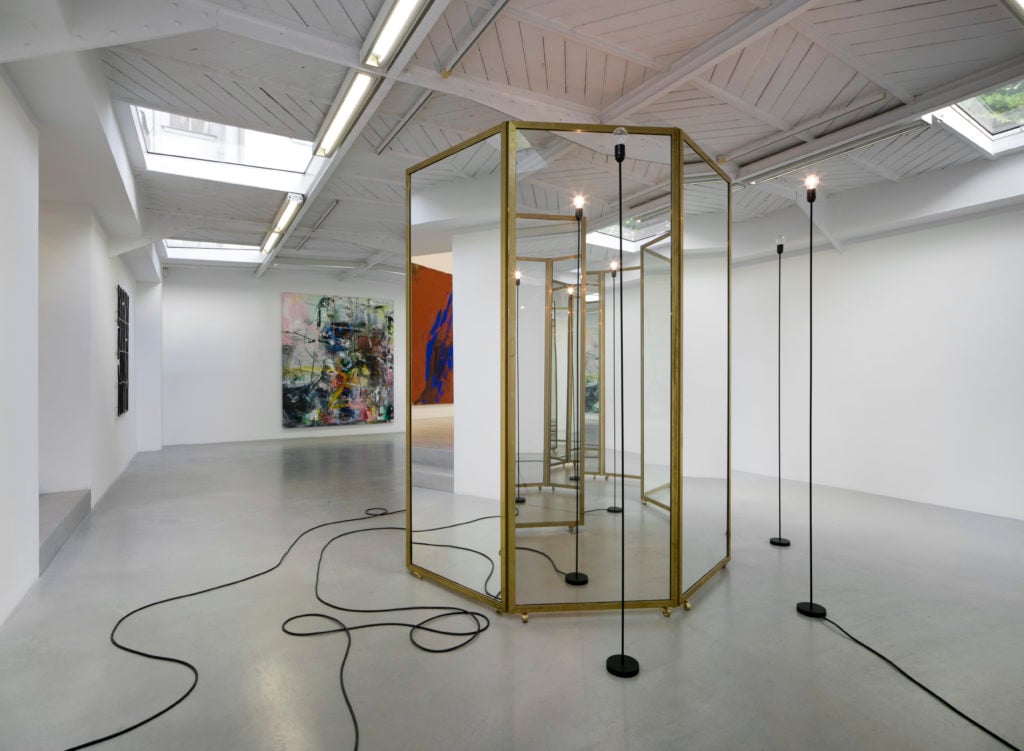
Installation view of “Indian Summer.”
Photo: archives Kamel Mennour. Courtesy the artists and Kamel
Mennour, Paris/London.
“I think what was very hard for
French people was that they were asked to pay for this gift, and
secondly, that it was in front of the museum,” Mennour says,
referring to the original site at the Palais de Tokyo. “Don’t
forget that we were a big country of art, and it collapsed. Art
went to New York in ‘65. So it might have felt a bit like the
Americans were rubbing the more important artist in the faces of
the French.”
Mennour was in the Stade de
France with his youngest son when one of the attackers blew
themselves up outside in November 2015. “I heard the boom and I didn’t imagine it was a
bomb. It was horrible. A big nightmare for us,” he says. As for his
own opinion on Koons’s Bouquet of Tulips, Mennour keeps diplomatically silent. “I won’t
say anything because I know some of the gallerists. I know Jeff.
They had a dream and wanted to bring it to life,” Mennour says.
“There are people who like it, people who don’t, but with art it is
always like that.” The artist’s controversial sculpture is due to
be unveiled on October 4 outside of the Petit Palais in central
Paris.
Opening in Brexit London
It was a long time before
Mennour decided to open up a space outside of the French capital.
Despite London and New York being the world’s biggest art market
hubs, he felt that showing at art fairs and visiting biennials was
enough to grow his international contacts. He finally decided to
open a space in London just before the UK’s fateful EU referendum,
which opened the Pandora’s box of Brexit.
In the end, London won out
because of its proximity to Paris. Mennour is a family man, who has
been married for 30 years. “I wanted to be really active and really
tough and research players, but I also wanted to have a
relationship with my 5-year-old son, my 17-year-old son, my three
daughters,” Mennour explains. The convenience of the Eurostar train
allows him the freedom to take his kids to school in the morning in
Paris, make a quick trip to London, and be back in time to tuck
them into bed at night.
Amid the turmoil caused by
Brexit, some are banking on Paris making a comeback at London’s
expense. David Zwirner is opening a space in the French capital and
Gagosian expects his Paris spaces will be even busier. Asked
whether he sees Brexit as an opportunity for Paris to seize,
Mennour says, “you can’t build something based on the weakness of
something else. You believe in your own ideas, and play to your
strengths, and never mind what someone else is doing.”
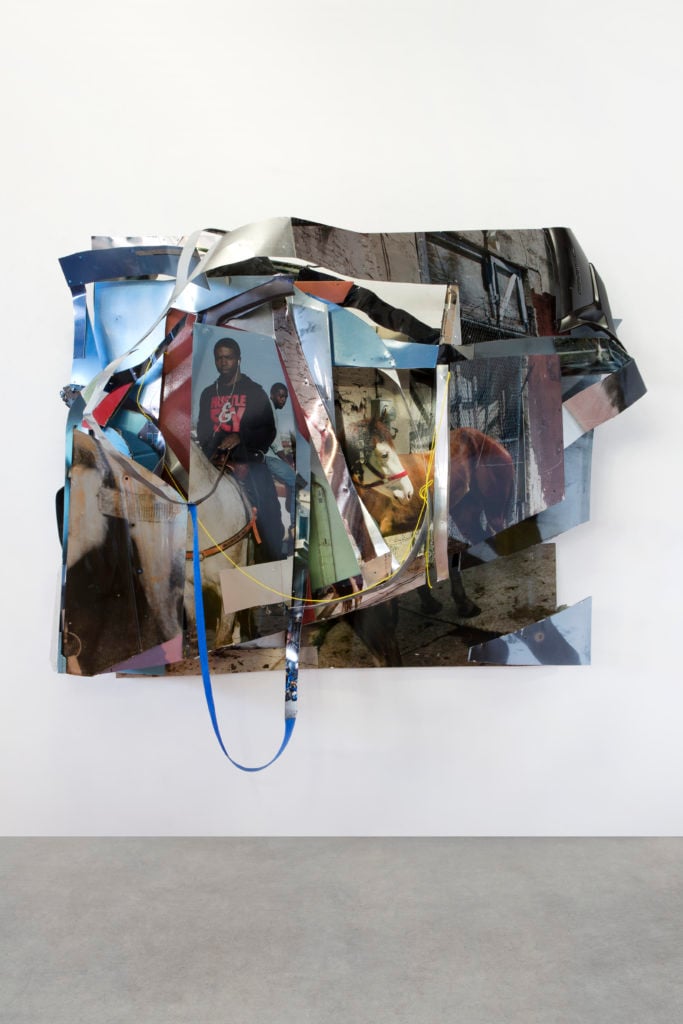
Mohamed Bourouissa,Yacin (2019).
©ADAGP Mohamed Bourouissa Photo: archives Kamel Mennour. Courtesy
the artist, and Kamel Mennour, Paris/London.
Although he has given up his
apartment in London’s Grosvenor Square, and has moved some art out
of the city as a precaution, he is not pulling his investment in
London. “I would be lying if I said that London is booming at the
moment, I am very sad with this situation,” he says. “But we don’t
know what is to come.”
In the meantime, he is already
preparing for this year’s Frieze London and Frieze Masters. He says
he prefers to make a statement with his fair presentations rather
than “prostitute” himself for individual sales.
This year Mennour is bringing a
solo presentation by Beloufa. At Frieze Masters, he will present a
survey of the late French artist Gina Pane in collaboration with
her estate, which will include some works not on sale that are on
loan from museums.
It is a “calculated risk,” but
he would rather his stands be memorable. And the risk has often
paid off, as with the much-talked about bronze tree by Tatiana
Trouvé that he showed at Frieze London last year. The 1.2-ton work
(which was available at the fair for €650,000) now stands in the
garden of a “very important” US collector, Mennour says, naming no
names. One can only hope as much for the busy fair season
ahead.
The post ‘I Was a No One’: How Kamel Mennour Went From
Art-World Outsider to Star Paris Dealer appeared first on
artnet News.
Read more https://news.artnet.com/art-world/kamel-mennour-interview-1657057
Further reading


Leave a comment