
Would You Buy a Performance? A New Brussels Fair Tries to Make Art’s Most Elusive Medium Appealing to Collectors
Would you like to own an artwork in which a woman plays with
assorted objects laid out on a table? Or perhaps you might be
interested in acquiring an industrial fan that delicately balances
a balloon in mid-air?
These are among the wares on offer at A Performance Affair, a
young art fair in Brussels dedicated to performance art. The medium
has long been a tough sell—and to the uninitiated, it can sometimes
seem like an art-world parody. But the fair’s founders, Liv
Vaisberg and Will Kerr, are hoping to help build a sustainable
market around the genre.
The small event opened its second edition in Brussels on
Thursday (it runs through Sunday, September 8), coinciding with
Brussels Gallery Weekend. In its sophomore year, the fair has
expanded and tweaked its structure in an effort to better define
what, exactly, is for sale; how you can buy it; and under what
terms you can show it.
The 30 participants (up from 23 last
year) are exhibiting by way of a timed schedule, as opposed to in
more traditional booths. In the lobby area, a faux-analog panel
referencing an airport departures screen tells visitors where and
when performances are happening, and whether each on is “on time.”
(Ongoing performances are “en route.”)
For the first time this year, the fair has also created new
protocols that require each gallery to prepare answers
to key questions about how the work can be
reactivated once acquired or whether the objects used in the
performance are included with purchase.
“It is the only way for collectors to feel that
they actually acquire more than an idea or a gesture that
disappears as it is created—something that they can keep and
transmit to others,” says founding committee member and
prominent Belgian
collector Frédéric de Goldschmidt.
Performance Grows
Performance has never had much of a market. But
it has been slowly gaining traction and visibility in recent years.
At this year’s Venice Biennale, curator Ralph Rugoff
established a new performance
program that invited artists to take up temporary residence on
a small stage or meandering the graveled path of the Giardini
grounds.
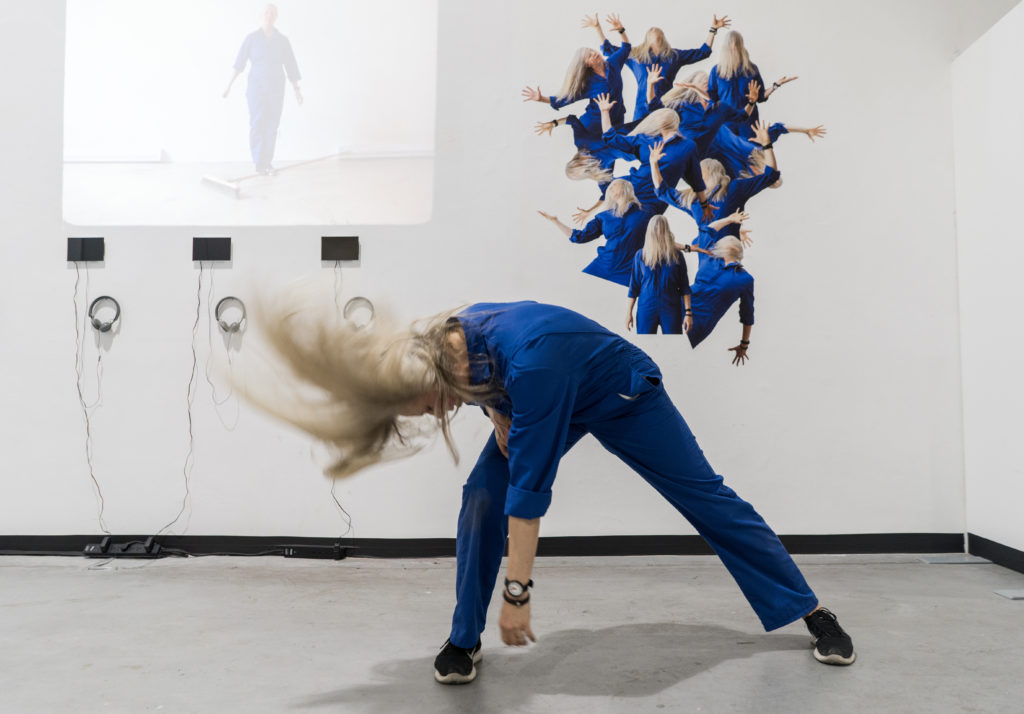
Evann Siebens. Platforms Project
performance, Athens, Greece, May 2019 © Alexandra Masmanidi.
On the commercial side, Pace recently announced the hiring of
Mark Beasley, a performance art curator formerly at the
Hirshhorn Museum, leading to speculation that the gallery will
enhance its live art programming. (There is a rising need, Beasley
said recently, for “an unmediated encounter that isn’t experienced
through a filter or a screen.”)
By now, several prominent fairs already include
some performance component, though it tends to be a supplemental
program rather than the main event. While waiting in line for
coffee in Frieze’s big white tent in London last year, for example,
you might have witnessed an opera singer suddenly begin belting out
words as a part of a work by Laure Prouvost from the fair’s Live
program.
At Independent’s Brussels edition last year,
meanwhile, curator Vincent Honoré made live art a much more
central part of the event with a program of live events,
performances, and talks held in the atrium of the Vanderborght
building, as sales orbited them. But it remains to be seen whether
a market event that puts performance at the forefront can be
sustainable. Independent Brussels announced that it would not continue
after this most recent edition.
Will People Buy It?
There is an important distinction between wildly popular art
experiences—like Random International’s Rain Room, or
Yayoi Kusama’s Infinity Room (which could conceivably make money
from ticket sales rather than a more transitional purchase)—and
quieter art performances like those in Venice and at Independent
and A Performance Affair, which don’t translate particularly well
to Instagram and still hold relatively niche appeal. For these live
artworks, sales remain the most viable avenue for support. And
until a new method is found, an art fair feels like the most
realistic way to build the market.
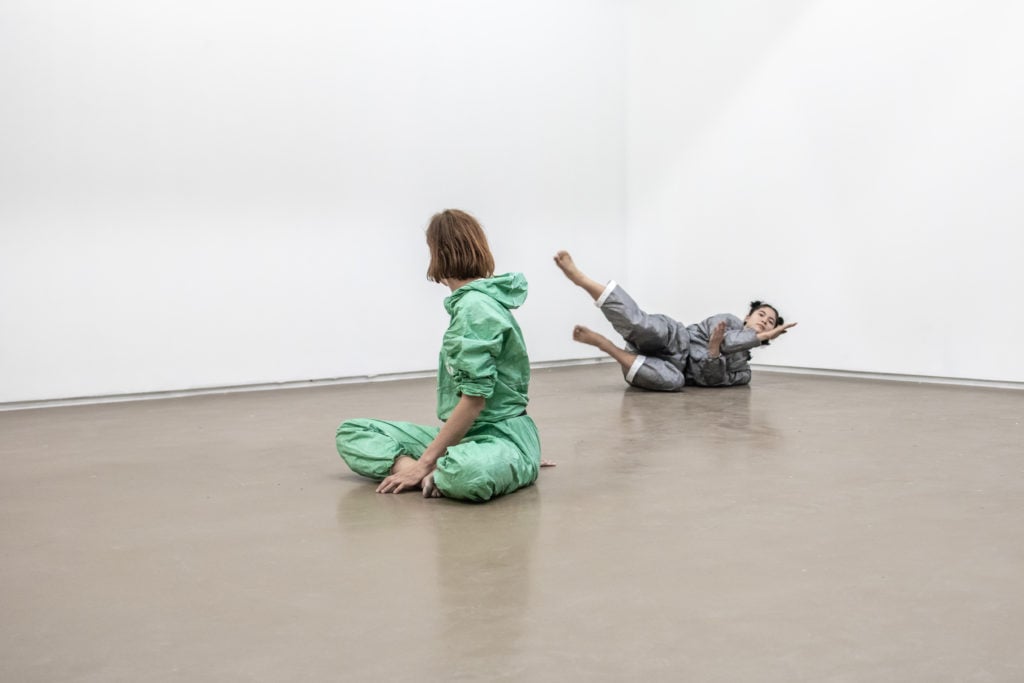
Elena Bajo (Galeria Garcia/Annex 14).
Photo: Jeroen Verrecht.
“It’s essential to have initiatives
to signal that this is an important format,”
says Amsterdam-based art dealer and fair committee member
Ellen de Bruijne, who has dealt performance art for the past two
decades. “I have worked hard to bring
the performance artist into the gallery situation. I became an
expert in making a performance salable without minimizing it, by
trying to find the ‘spine’ of the performance and translating that
into a certificate or script, different kinds of things that you
can hand over.”
This year, de Bruijne is showing a
performance by Amsterdam-based artist Maria Pask: an instructive
dance performance called I can’t bend that far that
features three performers mirroring accelerating dance moves over a
’90s club track. It’s available for €6,500.
The new protocol put in place by the fair ensures that dealers
can answer any questions that might arise about the transaction.
(Such questions might include: Will the collector or the artist be
tasked with hiring performers for future activations? Are the
costumes included?) Guidance like this makes acquiring
performance feel less like a blind act of patronage and more like a
transaction.
“I have only acquired two immaterial
works so far, and I have not managed yet to get them
performed,” Frédéric de Goldschmidt
said. “This could have been different indeed with
better defined protocols.”
What Are You Buying?
Walking around the fair’s two-floor space, which has been
cordoned off into sections to host individual works, unactivated
performances read as a bit confusing—their props cannot stand
alone. Portuguese artist Diogo Pimentão’s promising performative
drawing with graphite, scheduled for today, consisted on Thursday
of some paper on the ground and chairs, waiting to be used.
Similarly, Ofri Cnaani’s ASMR performance—in which the artist
makes sound with props into a microphone—is only intended for one
person at a time, leaving the rest of us awkwardly watching, but
not experiencing the work fully. When the performance is over, a
large table of stuff, including a handheld vacuum cleaner, a ball
of twine, and a crucifix, might leave a latecomer guessing as to
what is supposed to be going on.
The props associated with unactivated
performances, however confusing they might look, may be the
essential objects for sale. While the
performance matter lying around may fall flat to the average
fairgoer, de Bruijne says that the fair has still managed to
attract a strong contingent of Belgian curators and collectors.
Last year, she placed a work by Jeremiah Day into an institutional
show at Museum M in Leuven. Although no dealers immediately
reported sales on the first day of this year’s edition, many note
that performance purchases are often the result of a longer
conversation that begins at the fair.
To be sure, there is no strong
signal here that a format like this could become a big, flashy new
mainstream. But that may be okay for its purposes. “Financial
success always starts with spreading a rumor,” de Bruijne
says.
As part of Brussels Gallery
Weekend, A Performance Affair is on
view at the Vanderborght Building until September 8, 2019. Access
is free to the public.
The post Would You Buy a Performance? A New Brussels Fair
Tries to Make Art’s Most Elusive Medium Appealing to Collectors
appeared first on artnet News.
Read more https://news.artnet.com/market/brussels-performance-affair-2019-1639030
Further reading


Leave a comment