
Why Some Photographs Transcend the Moment in Which They Were Taken and Transform Movements Into Icons
The best historic photographs
don’t just document events but carry a residue of the mood. Some
even become an emblem of a cause—they become iconic.
Elaine Mayes’s photographs of
the 1967 Monterey Pop Festival, for example, taken on assignment
for the teen music magazine Hullabaloo, capture not only the intensity and style of
the diverse performers—Janis Joplin wailing, a suave Otis Redding,
Jimi Hendricks grimacing, a sacral Ravi Shankar—but also the
peaced-out crowd, the flower children assembled for what would
become the pinnacle of hippie culture’s highest moment: a tribal
weekend of social transformation, real or imagined.
Monterey was the first of the
music festivals, preceding Woodstock and Altamount, and it was the
most positively generative (Monterey produced musicians, Woodstock
produced agents, someone later said). Mayes now gently disparages
her own body of work as “commercial,” but still says the experience
of Monterey was blissfully transformative—“a vision for a way of
life.”
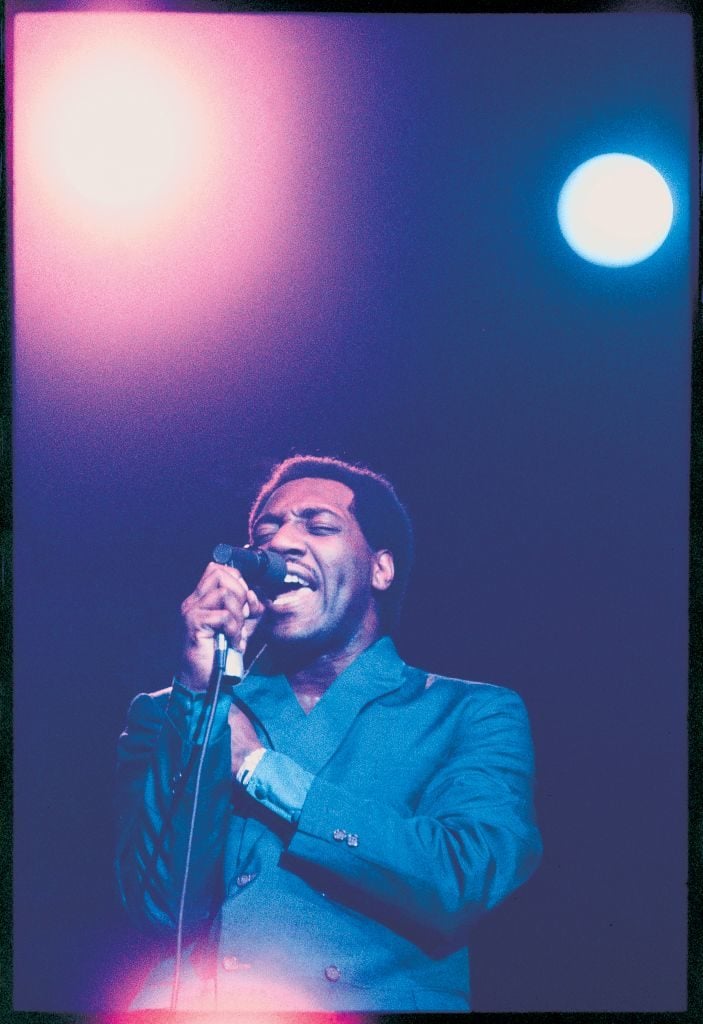
Singer Otis Redding performing at the
Monterey Pop Festival at the Monterey Country Fairgrounds on June
17, 1967 in Monterey, California. (Photo by Elaine Mayes/Getty
Images)
Some images transcend the
circumstances out of which they were born, expressing an almost
otherworldly, fantasy version of events that took
place. Dorothea Lange’s Migrant Mother (1936)
encapsulated in familiar Madonna-and-child format the hardship
endured by men and women during the Great
Depression. Such
images, usually created as reportage for mass circulation, quite
literally have a job to do, in the sense that they are created to
show what is going on in the world and—if they are very
effective—can even incite real political
action. Lewis
Hine’s Sadie Pfeiffer, a
Cotton Mill Spinner (1908)
was created to expose child labor and contributed to various
legislative reforms.
Now, at the tail end of this
terrible spring of 2020, we find ourselves embroiled in layers of
crises, starting with a pandemic that has killed more than 100,000
Americans; nationwide protests sparked by the killing of George
Floyd by Minneapolis police; and a President and administration
either at a loss to manage the chaos or skillfully taking advantage
of it, depending on how one looks at it.
While the COVID-19 pandemic has
not produced many iconic photographs, the recent protests against
police brutality have delivered a variety of alarming and inspiring
contenders as instant icons of the times.
A protester carries a U.S. flag upside-down,
a sign of distress, next to a burning building early Friday, May
29, 2020, in Minneapolis. Protests over the death of George Floyd,
a black man who died in police custody Monday, broke out in
Minneapolis for a third straight night. pic.twitter.com/mH6Iy8fbDj— Julio Cortez (@JulioCortez_AP) May 29, 2020
Images of crowds holding signs
with slogans such as “We Can’t Breathe,” “Justice for Floyd,” and
“No Justice No Peace,” have provided a density of visual material
to help us better understand the scope and sentiment of the
protests. More invitingly, other photographs have delivered
condensed moments of heightened drama: Julio Cortez’s dramatic photograph of a
protestor triumphantly hoisting an upside-down American flag in
front of a burning storefront, taken on May 28 in Minneapolis, graphically conveys the
turn to violence and its apparent justification in a malfunctioning
nation.
On the more contemplative front,
Paul Fischer’s photograph of the White House with its lights off,
taken at night on June 1 as protests got hot outside the
President’s home, presents a powerful symbol of abandoned
leadership. As Fischer wrote in a Twitter post: “This is a
resignation. It should be taken as resignation. If your country is
in crisis, your cities are burning, your police forces are
assaulting, murdering, and kidnapping people, and you turn the
lights off and hide? You’re not the President. You’ve resigned your
duties.”
For me, the most concise yet
complex photograph to emerge is one by Mark Clennon of a shirtless
Black man, seen from behind, shaking a fist at Trump Tower. The
image, taken during a peaceful protest on May 30, has already circulated widely, both in the US
and overseas. Black anger
confronts the ultimate symbol of white power: the Trump brand in
bold brass signage. The photograph also suggests the larger meaning
of the moment: we are witnessing something more than Black lives
taking a stand against police brutality; the whole of democratic
citizenry is standing up against an increasingly authoritarian
government, controlled by a few.
.@TIME https://t.co/xwNixiyfxH
— MARK CLENNON. (@thisismarkc) June 2, 2020
Which of these photos may help lead to real change? It is a difficult question to answer, and
perhaps not the right one to ask. In some ways, events become
inseparable from images, and what was once a widespread expectation
of documentary photography—to show the world images of shocking
poverty, brutality, or tragedy, and thus to spark action—has become
a matter of disinterest. And
this does not even take into account our gross desensitization to
images of violence and suffering in an accelerating and
image-clogged world. Overwhelmed and distracted by the quotidian
humdrum, we turn away. As Susan Sontag wrote in
Regarding the Pain of
Others (2003), “Wherever
people feel safe… they will be
indifferent.” Thinking
back to Monterey, hippie culture’s most obvious legacy was not
political change but lifestyle consumerism and Whole
Foods.
But even then, there is at least one remarkable exception: a
Catskills summer camp for handicapped children that was formed in
the early 1970s, which is the focus of the recent documentary
film Crip Camp: A Disability Revolution, directed by Nicole
Newnham and former camper Jim Lebrecht. At the camp, disabled
youngsters—left largely to their own devices to smoke, have
affairs, and do all the things ordinary adolescents and teenagers
do—went through a transformative experience. Many, such as
Judy Heumann, went on to fight for disability rights during the
1970s, staging sit-ins in New York, San Francisco, and Washington,
DC.
The film’s remarkable period film footage (shot by members of
the People’s Video Theater) shows disabled kids playing
baseball, flirting, and gathering for afternoon chats, and
serves as an archive of a quiet
revolution. Perhaps this is the real lesson of lived experience and
documentary imagery: sometimes actions inspire or warrant
documentation, or are even sparked by it. But we must remember that
potent experiences—especially those that change us and inspire us
to create change for others—ultimately need no documentation at
all.
Kevin Moore is the New York-based artistic director and
curator of FotoFocus in Cincinnati.
The post Why Some Photographs Transcend the Moment in Which
They Were Taken and Transform Movements Into Icons appeared
first on artnet News.
Read more https://news.artnet.com/opinion/protest-photography-kevin-moore-1882857
Further reading


Leave a comment