
What Can Contemporary Photography Tell Us About China Today? Here Are 7 of the Most Arresting Images at Photofairs Shanghai 2019
Cai
Dongdong
A Hundred Years (2019)
Leo Gallery – Shanghai, Hong Kong
Price: $81,785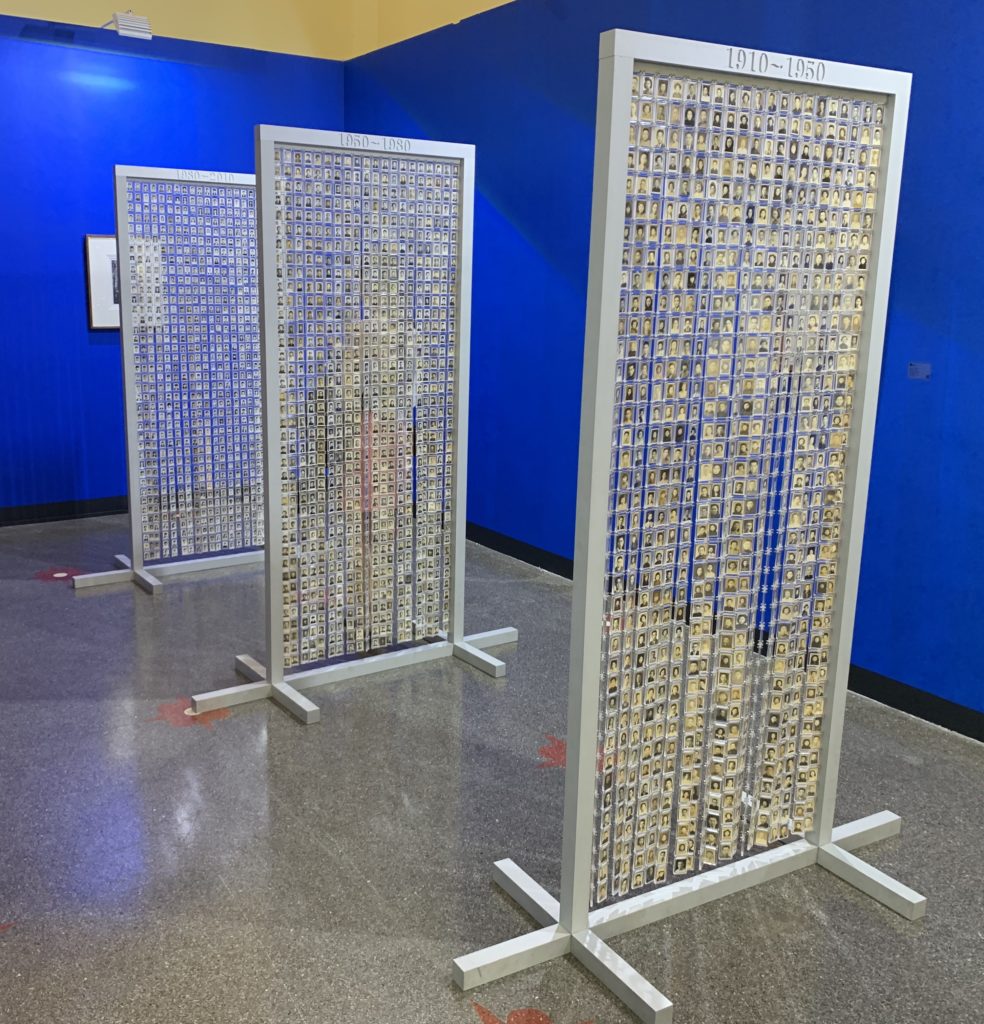
China’s breathtaking political and cultural changes
over the past century are captured intimately in Cai Dongdong’s
A Hundred Years, an installation featuring three doors that
are each strung with 780 portraits of Chinese people, first from
the years 1910 to 1950, then 1950 to 1980, then 1980 to 2010. Each
door tells an epic story. Approaching the work, one sees a mix of
men and women alternately wearing mandarin collars and cheongsam,
respectively, or European-style formalwear—a stylistic variance
that captures the complex era, which spans the establishment of the
Western-leaning Republic of China in 1912 to the birth of the
communist party to civil war to the Second Sino-Japanese war and,
ultimately, to Mao’s rise to power as the head of the People’s
Republic of China in 1949.
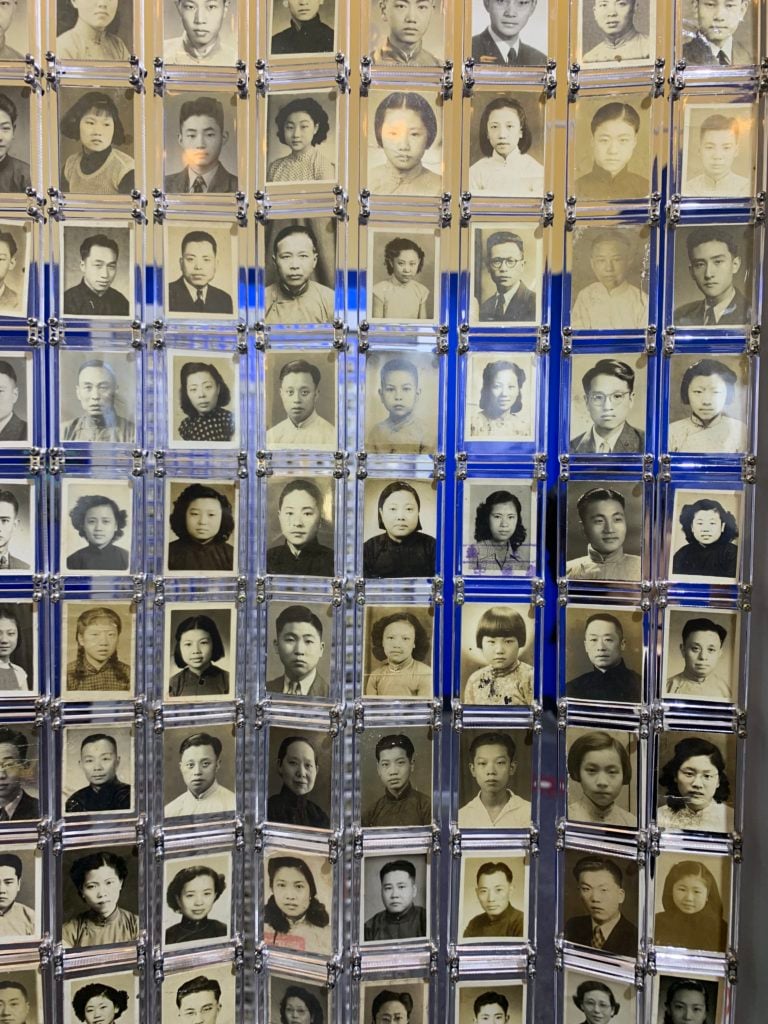
The years 1910-1950.
The second door, replete with military uniforms,
charts the devastating, internecine years of the Great Leap Forward
and the Cultural Revolution, culminating with Mao’s death in 1976.
The third door, where the clothes more or less conform to the
Western fashions of the period, covers the heady opening up of the
country (which saw the birth of China’s contemporary art scene),
the traumatic crackdown of Tiananmen Square, and, in 1979, the
return of Hong Kong from England to China. Incredibly, across all
the photos, apart from the clothing and hairstyle changes, people
more or less project the same range of demeanor: happy, awkward,
diffident, quirky—offering little more than a hint of the seismic
transformations happening around them.
Cheng
Xinhao
Hunting No. 1 (2016)
Tabula Rasa Gallery – Beijing
Price: $2,538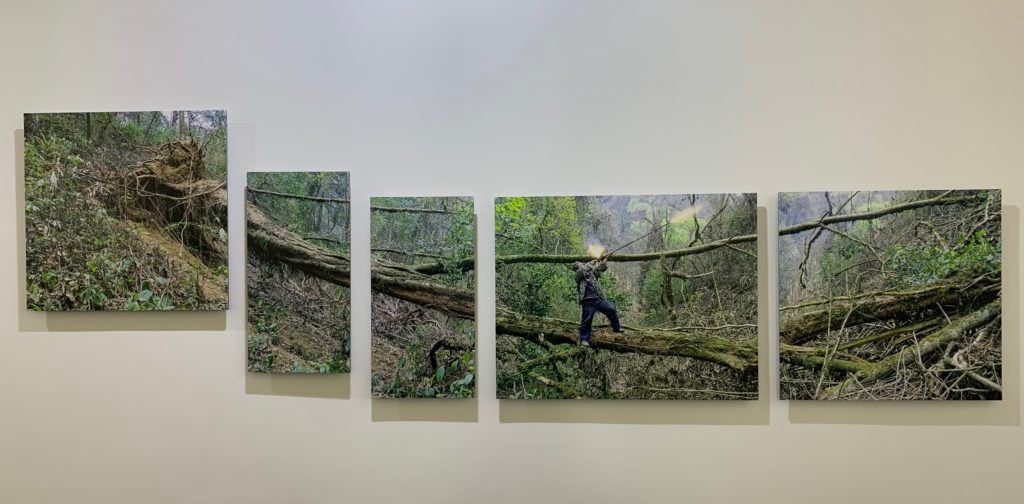
In 2013, Cheng Xinhao earned a PhD in chemistry from
Peking University, but he hasn’t really done much with it. Instead,
he has largely remained focused on his ongoing 15-year photographic
research project into the Hmong people of Western China, an
indigenous population that can trace its roots back to before the
country’s ancient birth. Mercilessly persecuted during the Qing
Dynasty, where they were targeted for genocide, they do not occupy
their own branch in China’s 56 acknowledged ethnic groups but are
instead categorized under the one known as the Miao (or
“savage”).
Today, around 700 live in the country—the rest,
around 4,000, live in Vietnam. They subsist mainly off of hunting
and gathering in the forested mountains, and in a strange twist,
they are among the only people in China allowed to own guns, an
antique kind of self-made flintlock rifle that they once used
against French colonists in Indochina but which they now use for
hunting. As part of his research project, Cheng Xinhao spends days
following members of the Hmong as they go on long hunts and other
activities, including the subject of this photo, who he also once
documented as he went to work for a stint in a Shenzhen
factory.
Wang
Ling
One Kilometer (2009)
Gaotai Gallery – Xinjiang
Price: $2,256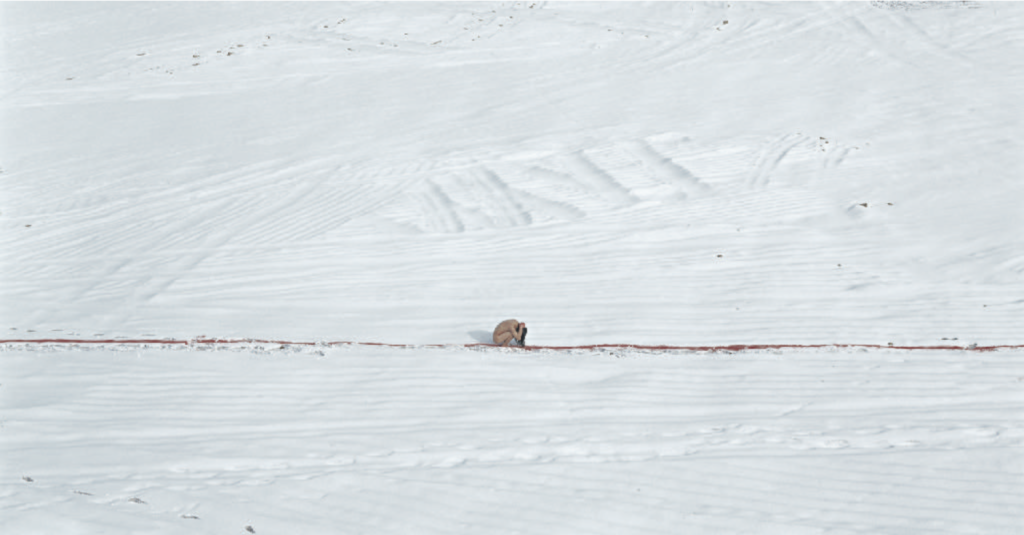
Born in the Hebei province circling Beijing, the
photographer Wang Ling today splits his time between the Songzhuang
artist village in China’s capital city—which is the country’s
artistic as well as political nucleus—and the far-western Xinjiang
province, where he attended art school. In this performative
photographic series, where he uses red powder to demarcate a
one-kilometer-long line in the snow, the artist is signifying a
spiritual dividing line between the two places, one of them
signifying government rule and the other, Xinjiang, signifying a
vibrant mixture of religious life picked up across its frontier
borders, from Tibetan Buddhism from the south to the Islam
practiced by the Uyghur people. (The region is also known as the
Xinjiang Uyghur Autonomous Region.)
Brought to the fair by Gaotai Gallery, a brand-new
contemporary-art incubator that is the first gallery of its kind to
be based in Xinjiang, Wang Ling has also made significant work
chronicling the fraught situation of the Uyghurs, who in recent
years have been the target of a comprehensive Mandarin re-education
campaign by the Chinese government, which has banned the Uyghur
language and is cracking down on the culture generally, in part due
out of fear that it could give birth to the kind of militant
Islamic groups that are roiling the Middle East.
Leila
Alaoui
“Portraiture series” (2010–14)
Galleria Continua – Beijing, San Gimignano, Les Moulins,
Havana
Price: $50,000 apiece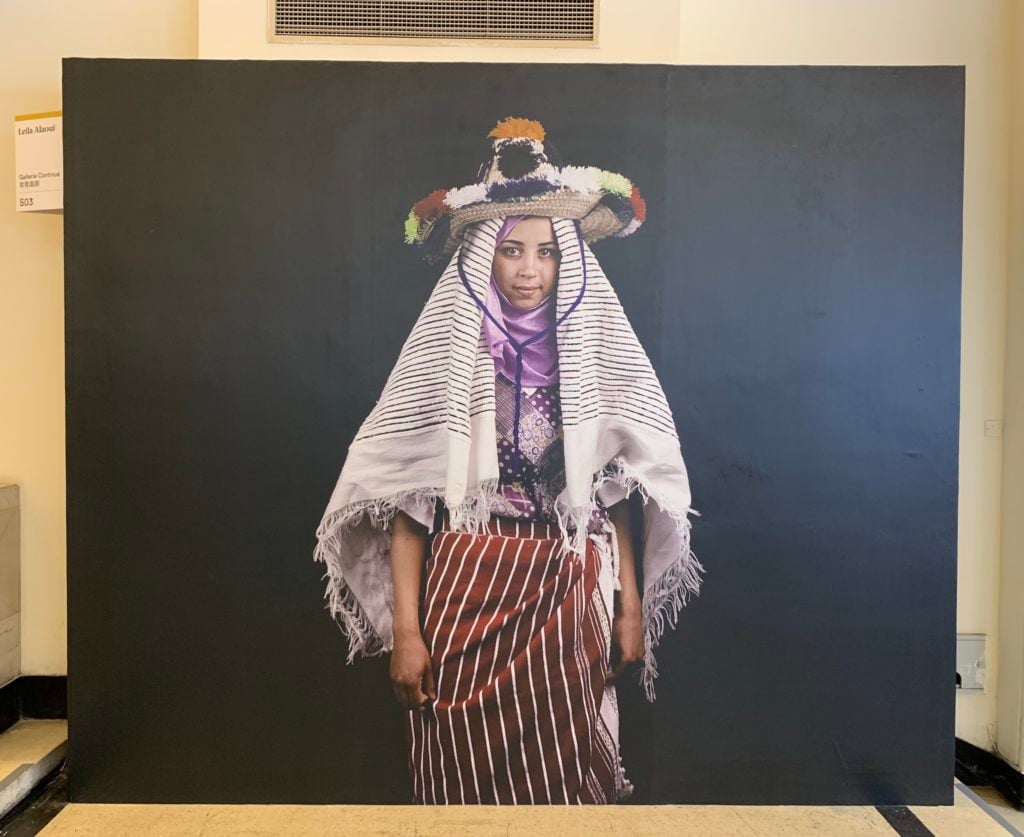
Between the years of 2010 and 2014, the
French-Moroccan photographer Leila Alaoui set up a simple
studio—basically a backdrop of black cloth—in the center of a souk
in her hometown of Marrakech and persuaded passersby to sit down,
relax, chat, and then have their portrait taken. Inspired by Robert
Frank’s “Americans” series, which documented postwar society in the
US, Alaoui set out to record the thrilling diversity of Morocco,
bringing to light its many narratives of cultural identity—and
historical displacement—through the dress and appearance of her
remarkably charismatic sitters.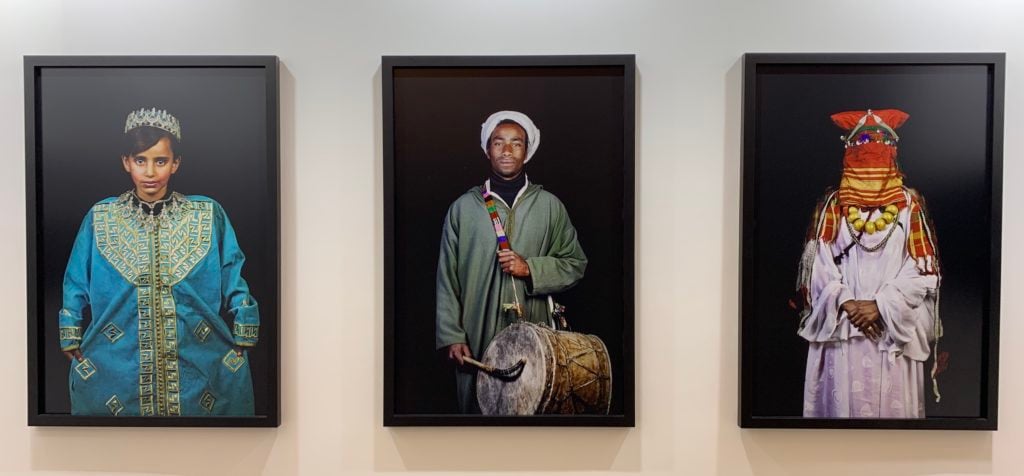
Tragically, Alaoui’s work was cut short in 2016,
when, at the age of 33, she was killed when a terrorist opened fire
on a cafe in Ouagadougou, Burkina Faso, as she was inside. That
year the 6th Marrakech Biennale was dedicated in her honor, and
today her family operates the Leila Alaoui Foundation to promote
her values and her artistic work, which is in the collection of the
Qatar Museum.
Long
Chin-san
A Lakeside View in the Fall (1939); Deer in
Forest (1956)
M Art Center – Shanghai
Price: Not for sale, but roughly $30,000 to $50,000
apiece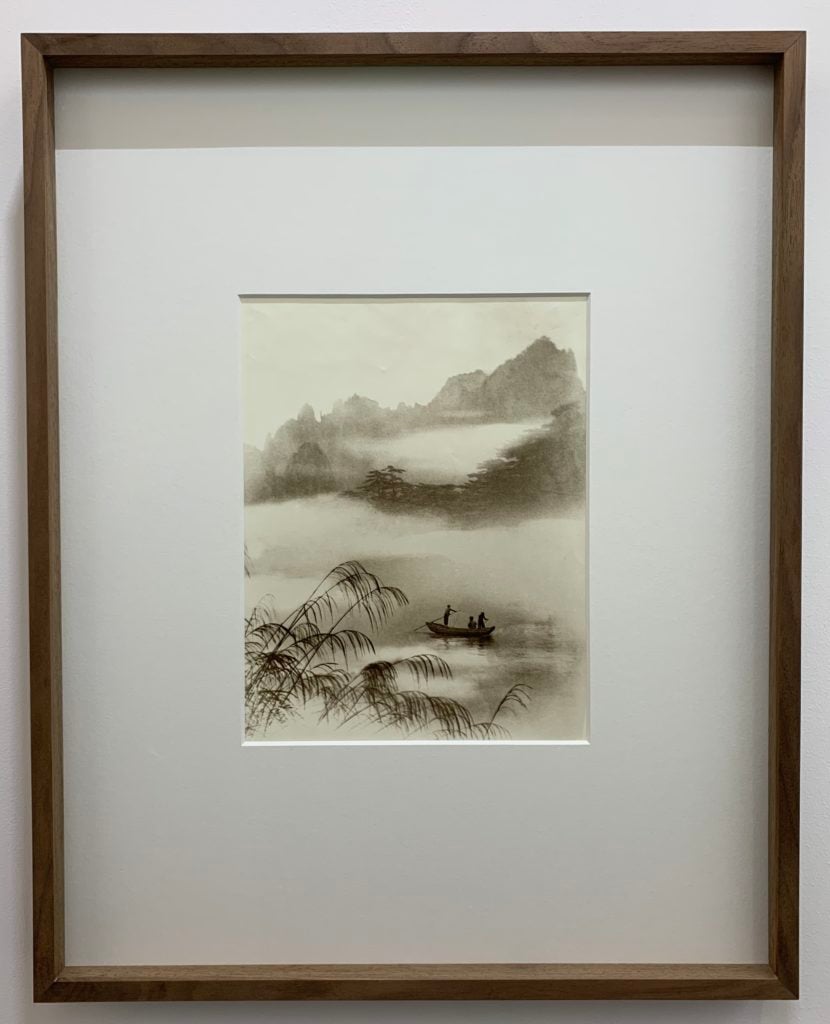
Sometimes known as the “father of Asian photography,”
Long Chin-san (also written Lang Jingshan) was a pioneering figure
who brilliantly combined the novel Western tool of the camera with
traditional Chinese visual idioms. Born in 1892, he became of the
country’s first photojournalists, working for the Eastern
Times, and went on to break new ground in art, taking what is
considered the earliest surviving Chinese nude photograph in 1928,
a portrait of a woman recumbent on a divan, titled
Meditation.
More significantly, Long Chin-san is known for his
modernist approach to fusing Eastern and Western aesthetic styles
through darkroom practices, overlapping multiple photographs in one
print to create images reminiscent of classical Chinese painting
that he would then often embellish further by drawing on additional
scenery in ink. At the fair, one image featuring a Disney-esque
landscape populated by spotted Bambis was the product of 18
separate darkroom alterations.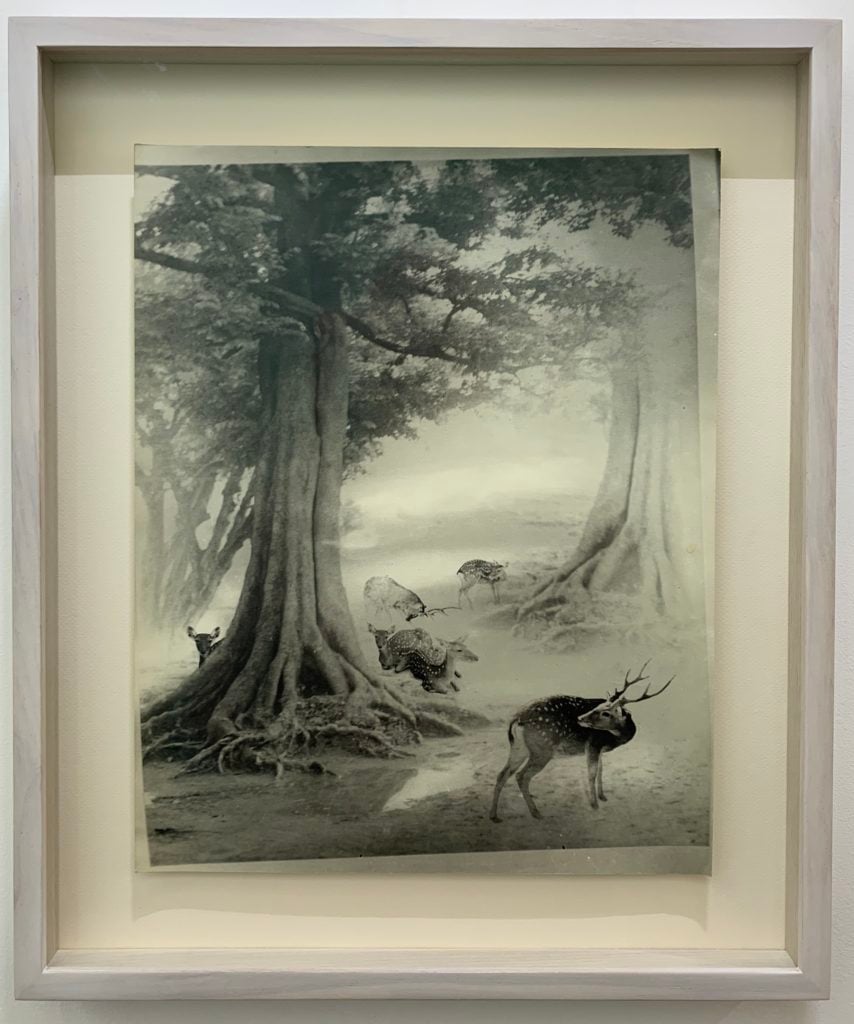
A photographer who met and was influenced by Picasso,
Long Chin-san is widely acknowledged as a major figure in 20th
century Chinese art history, but he remains undervalued in the art
market—primarily because he fled to Taiwan in 1949 during the
Sino-Japanese war, thus becoming overlooked by Chinese collectors.
Today his record for a single lot at auction is $105,000, hammered
at Sotheby’s Hong Kong in 2017 for a collaborative photographic
work with the legendary painter Zhang Daqian.
Jin
Yongquan
Nuo (1995)
Nine Art Space – Shanghai
Price: $4,230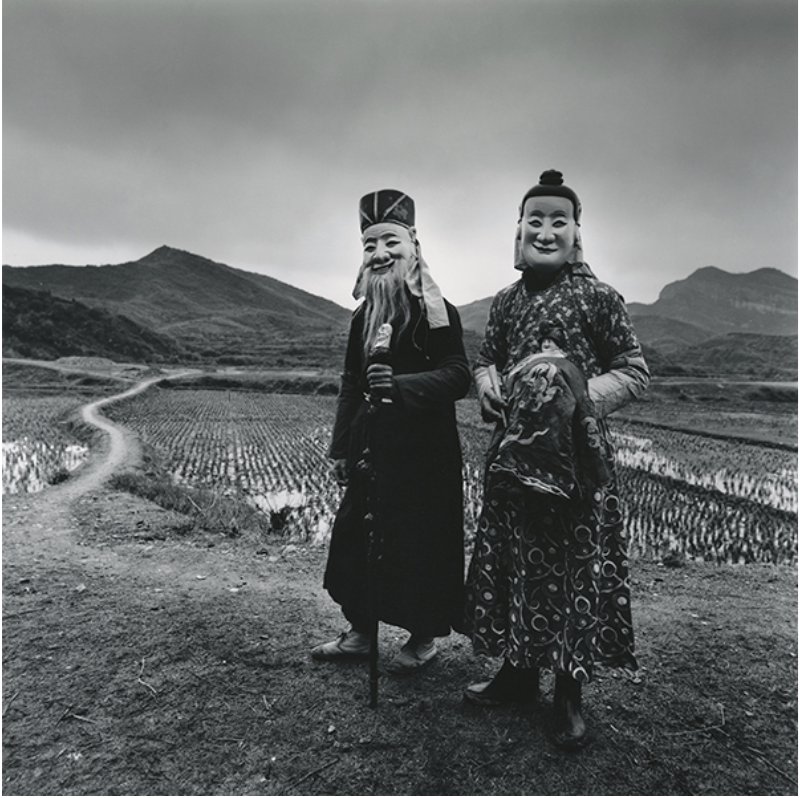
A classic image by the photojournalist and writer Jin
Yongquan, this photograph shows prominent villagers from Shiyou, in
the Jiangxi province, who were chosen to enact male and female Nuo
gods in an ancient dance ceremony believed to promote heath,
happiness, and good fortune. Taken nearly a quarter century ago by
one of China’s leading photographers of the time, it documents a
facet of traditional Chinese culture that has since vanished, a
casualty of the country’s headlong rush into modernity.
Xiomara
Bender
Pyongyang 2018 | Glorious
Country (2018)
OstLicht Gallery – Vienna
Price: $6,600, but offered for $5,000 in the
fair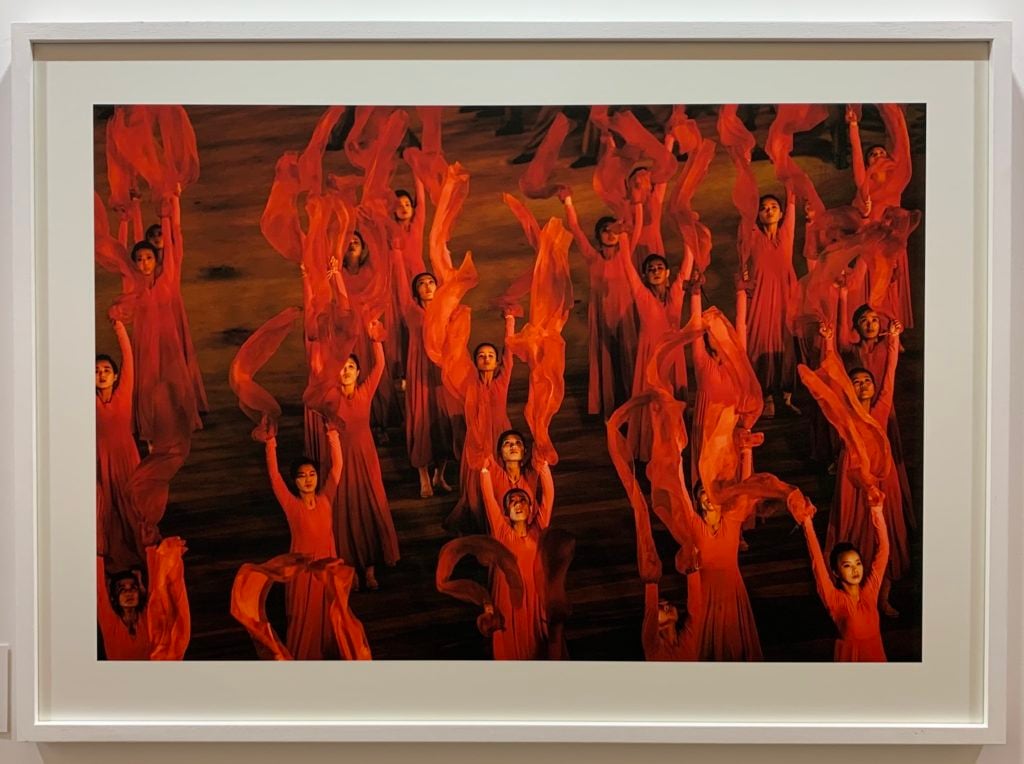
The 30-year-old German photographer Xiomara Bender is
well-known in North Korea—her father, the head of a travel agency
specializing in exotic locales, had spent 30 years visiting the
hermetic dictatorship neighboring China, and she has been there
herself 10 times. In 2018, she went on a photographic expedition to
the country with her dealer, OstLicht Gallery founder Peter Coeln,
in tow, and they hoped to pay a visit to one of the so-called “mass
gymnastics” performances in Pyongang’s May Day Stadium. The largest
stadium in the world, it has a capacity for 114,000 people, of whom
an astonishing 90,000 are made up of the performers—who stage
precisely choreographed pageantry—while the rest are North Korea’s
elite.
One day, Kim Jong-un proved unable to attend the
spectacle, so authorities auctioned off his two tickets for €800
apiece, and Bender and Coeln snapped them up. (However, they were
prevented from taking photos, so this picture was captured on a
different visit.) According to Coeln, the event was immensely
impressive—until he paid a visit to the training camps where
kindergarteners are drilled in the dance moves with military rigor,
at which point it became immensely depressing.
Also in the fair, this photograph by Bender calls back, once
again, to Robert Frank—and the emotional story it tells cuts to the
heart:
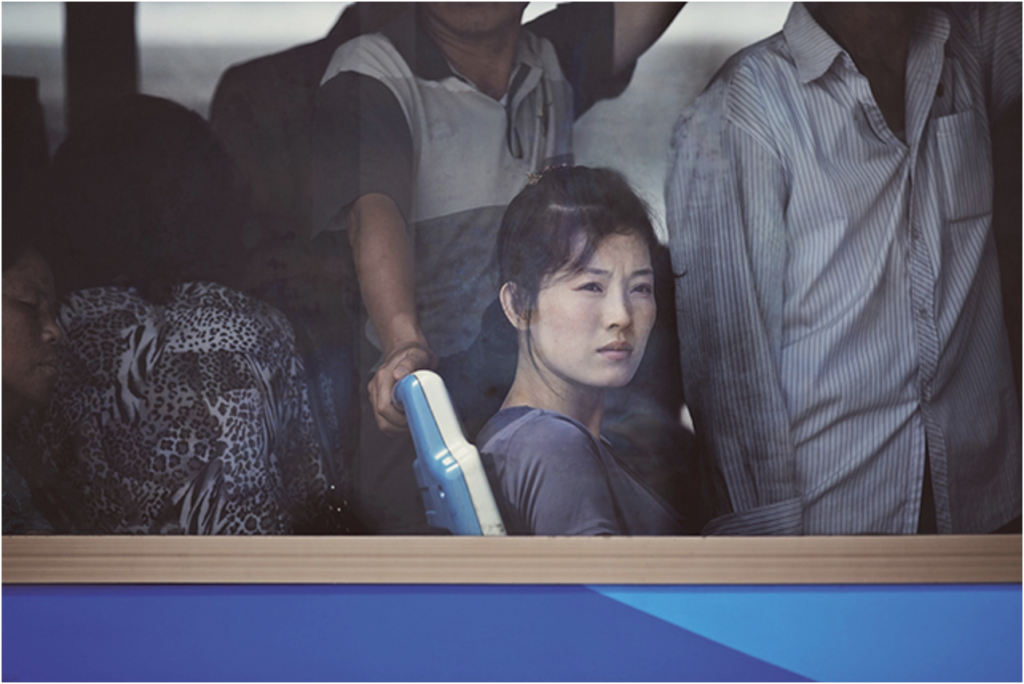
Xiomara Bender, Pyongang 2015 | Kim
Il-sung Square, 2015
The post What Can Contemporary Photography Tell Us About
China Today? Here Are 7 of the Most Arresting Images at Photofairs
Shanghai 2019 appeared first on artnet News.
Read more https://news.artnet.com/market/shanghai-photofair-2019-1658422
Further reading


Leave a comment