
The US Government Likely Won’t Step Up With a New Deal for Art. But We Can Create Our Own With Public Art (and Private Sponsorship)
Recently, I spoke to an artist
friend about his experience of coronavirus-enforced isolation. Just
a few weeks ago, he was working with several assistants in a large
studio, looking forward to a move into an even bigger space. Now
that he finds himself alone, he does not regret the opportunity for
reflection—but he still longs for his work to be seen, not only
virtually, but physically.
While this longing is no doubt
common to most artists, the sentiment is compounded, for many, by
crushing economic anxiety. Activity in the art market, though not
halted, has precipitously declined,
and art-handling and other part-time work—a lifeline for creative
professionals—has dried up. A new
survey of 10,000 American artists conducted by Artist Relief
found that 62 percent are
now fully unemployed.
Amidst this dire news, many have
looked to history for inspiration, recalling how the US government
stepped in to support artists across the country with the Federal
Art Project of the Works Progress Administration during the Great
Depression. Thousands of struggling artists were thrown a lifeline
with commissions to create everything from public art to posters.
Communities were adorned with significant works, artistic careers
were nurtured, and the course of American art history was
changed.
It would be equally significant
to see a national art strategy modeled after that of the New Deal
today. But it is unlikely that such an endeavor could be achieved
under the current administration. Plus, time is of the essence:
artists need help now.

Philip Guston sketching a mural for the
WPA Federal Art Project in 1939. Photo: David Robbins via Wikimedia
Commons.
That’s why I propose a different
kind of collaboration—one that aligns artists, museums, local
governments, and foundations—to reinvigorate public
art.
Why Public Art?
Across the country, shuttered
museums have pivoted to online programming. Much of it is
excellent, but it is not—or, at least, not yet—remunerative. Layoffs have become common, of
part-time employees in particular (many of whom are artists). For
some institutions, projected losses from all lines of revenue are
catastrophic.
To make matters worse, it is
becoming increasingly clear that these challenges are not
short-term. When institutions are able to reopen, attendance will
likely be restricted for months, if not years, to come. Until
people can again feel safe gathering in large numbers, the model
many museums have come to rely on—temporary traveling exhibitions
that drive attendance and donations—will not be operable. Instead,
museums are likely to re-examine their permanent collections, as
they have done in previous moments of financial duress. But even if
this tactic draws interest from the public, social-distancing
guidelines will likely force restricted attendance, and many
visitors will remain leery of public spaces until a vaccine or
effective treatment becomes available.
Still, there is room for
innovation. Just as COVID-19 links artists and museums in a common
crisis, it’s possible that a common endeavor could facilitate their
survival. Museums may be closed or offering restricted visitation,
but there is still ample opportunity for the creation of public
art. Sculpture, painting, performance, video projection,
social-practice work, and more can all be made for public space,
transforming communities while providing income and employment for
artists.
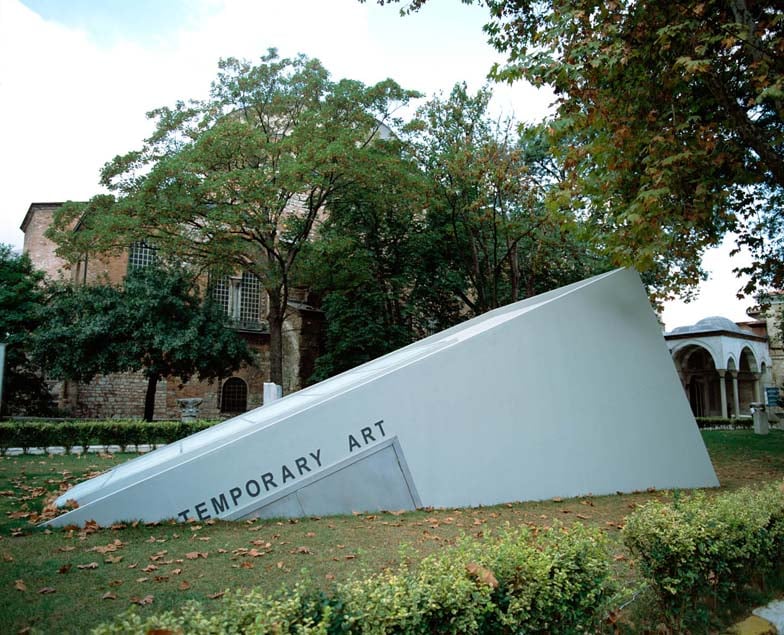
Elmgreen & Dragset, Traces of a
Never Existing History (2001). Photo courtesy of the Nasher
Sculpture Center.
Museums, for their part, are
well positioned to organize those efforts. Their ranks include
curators with extensive relationships with artists; education teams
prepared to facilitate interpretation and engagement; registrars to
organize the transportation and procurement of work; conservators
to advise on materials; and facility managers with experience in
construction.
How could such an initiative be
funded? States, counties, and municipal governments—which are at
this time proving more responsible and effective than the federal
government even as they cope with reduced tax revenues and greater
demand for social services—may find that it is in their long-term
economic interest to prop up their leading cultural institutions in
a time of great need and to sustain the creative forces that make
their communities vibrant. And while public funding may be
understandably stretched thin, such a collaboration could also be
supported by foundations, corporations, and individuals who might
otherwise underwrite exhibitions at museums.
Looking for Models
There’s precedent for the
engagement of museums in the production of public art. In 2013, the
Nasher Sculpture Center, where I serve as director, marked its 10th
anniversary with a citywide exhibition of public art inspired, in
part, by the history of its founding collection. Beginning in the
1970s, Patsy and Raymond Nasher placed important works from their
holdings in NorthPark, the shopping center that they opened a few
years earlier.
In that spirit, for our 10th
anniversary, the Nasher Sculpture Center invited nine artists and
one collective—international, national, and local—to temporarily
site works in neighborhoods across the city. The project,
dubbed Nasher
XChange, involved
partnerships with community organizations and businesses across
Dallas. With efforts like a series of bus tours and a dedicated app
that featured extensive didactic information and turn-by-turn
directions, the city-spanning project offered a chance not only for
the public to experience 10 very different approaches to public
art, but also for the city to discover itself in a new
way.
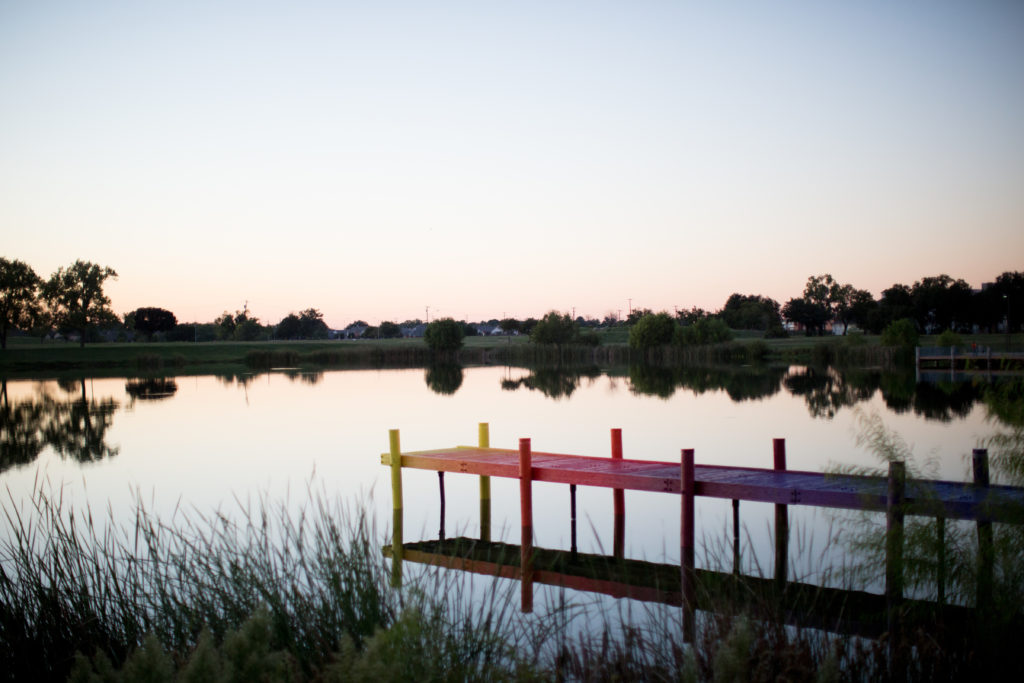
Ugo Rondinone, Dear Sunset, part
of Nasher XChange. Photo by Allison V Smith for the Nasher
Sculpture Center.
A more durable model is offered
by Buffalo’s Albright-Knox Art Gallery, which in 2013 launched a
public art initiative in partnership with the County of Erie and
later the City of Buffalo in an effort to foster community and
social engagement through public art while enhancing the region as
a cultural destination.
With seed money from the county,
the Albright-Knox hired a curator of public art and set about
commissioning works throughout the community. Since then, the
museum’s public art department has commissioned more than 40 works,
both permanent and temporary. While the county and city are the
overall sponsors of the Public Art Initiative, funding for
individual works has come from both in-kind support from local
businesses and private donations. Importantly, the Public Art
Initiative’s commissions are independently facilitated by the
museum and not subject to political oversight.
Adapting a model like this for
our current moment could both enhance civic life and offer a
lifeline to museums and artists. It makes sense: museums offer
unparalleled expertise in exhibition production. And since
visitation will likely be limited over the next year or two, public
art offers them a way to fulfill their missions while giving their
audiences a safe (and socially distanced) way to engage. As
recipients of commissions, artists would find both compensation and
a way to access viewers in person. Furthermore, additional tax
benefits are being offered for donations to nonprofits as part of
the CARES Act, which might further incentivize those able to
support such a public art program.
A New Deal-style national
initiative might be ideal. But a patchwork of state, local, and
private programs, working through museums, could have a significant
impact on American cultural life, revitalizing the landscape of
communities as they emerge from their homes, longing for
inspiration.
Jeremy Strick has served as
director of the Nasher Sculpture Center in Dallas, Texas since
2009.
The post The US Government Likely Won’t Step Up With a New
Deal for Art. But We Can Create Our Own With Public Art (and
Private Sponsorship) appeared first on artnet News.
Read more https://news.artnet.com/opinion/new-deal-art-may-unrealistic-create-public-art-1850631
Further reading


Leave a comment