
The Troubling Stories Behind Five Monuments Around the World That Came Down in Recent Days—and Why Their Removal Was Long Overdue
The monuments were made across centuries and continents—and now
their time is up.
In the past weeks, as Black Lives Matter protesters made their
way through cities from Boston to Bristol, statues of historical
figures once revered and now reviled have been taken down, either
by direct action or through quickly organized official
removals.
In the US, the dismantling of Confederate monuments in the
American South have garnered most of the media attention, though
global public ire is mounting against a whole trove of historical
characters, from Christopher Columbus to Edward Colston—and with
good reason.
Oftentimes, the histories of these monuments are far more
complicated and insidious than they seem. They do not simply
reflect an outdated ethos. Many of them, instead, speak to the
far-reaching cruelties of slavery and colonialism, and the
present-day legacies of white supremacy.
Below, we take a closer look at the histories of five recently
removed monuments.
Monument of Jefferson Davis,
Monument Avenue, Richmond, Virginia
Removed June 10, 2020
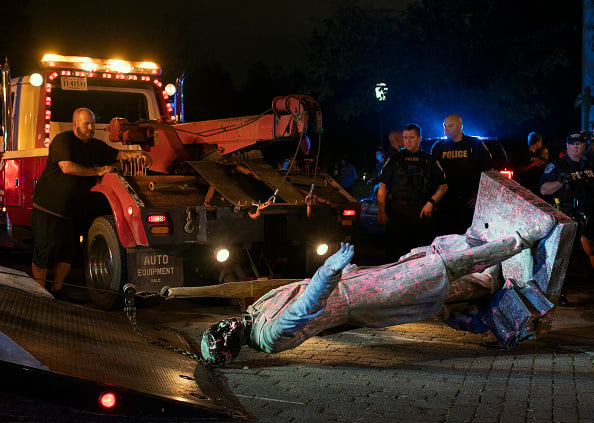
A statue of Confederate President
Jefferson Davis is loaded onto a tow truck after it was pulled down
off of its pedestal on Monument Avenue in Richmond, Virginia, on
June 10, 2020. Courtesy of Getty Images.
The Man In Question: Jefferson Davis was the
President of the pro-slavery Confederate States of America from
1861 to 1865. Before the secession of the Southern states, Davis
was a member of the Democratic Party and represented Mississippi in
the Senate and the House of Representatives. He owned a cotton farm
where he had 113 slaves. In contrast to Abraham Lincoln, he is
regarded as an uncharismatic leader and was faulted in his day for
the many failures of the Confederacy, even though he was later
hailed as a hero by Confederate apologists.
Statue Facts: The 8-foot bronze figure on
Richmond’s Monument Avenue was erected in 1907 by a Confederate
heritage group. Like many Confederate monuments, this one was
erected well after the Civil War had ended, beginning in the
post-Reconstruction era of the 1890s, when the romanticization of
the so-called “Lost Cause of the Confederacy” emerged. The “Lost
Cause” reimagined the war as a battle for independence rather than
recognizing it for what it was: a clash over the institution of
slavery. The rise of Confederate monuments continued well into the
20th century, and became a tactic of repression during the
integration era.
The Takedown: The work had been slated for
removal by city leaders in the coming months, but demonstrators
refused to wait, tying ropes around the statue’s legs and toppling
it from its plinth.
Monument Avenue: Richmond has been the site of
numerous statue topplings, with damage done to Confederate
monuments along the city’s so-called Monument Avenue. Among these
is the city’s most infamous: a state-owned equestrian statue of
Robert E. Lee, the commander of the Confederate army, which
Virginia’s Governor, Ralph Northam, had promised to take down. That
order, however, has been temporarily blocked by a local court. The
city’s mayor, Levar Stoney, has similarly vowed to remove other
municipally owned monuments, including the since-removed Jefferson
monument. Kehinde Wiley’s monumental bronze
sculpture, Rumors of War, also lines the avenue
and is a direct response to such Confederate statues. The statue
shows a young African American man, clad in street wear, heroically
riding a bucking horse.
Monument to Christopher
Columbus, North End, Boston
Removed June 11, 2020
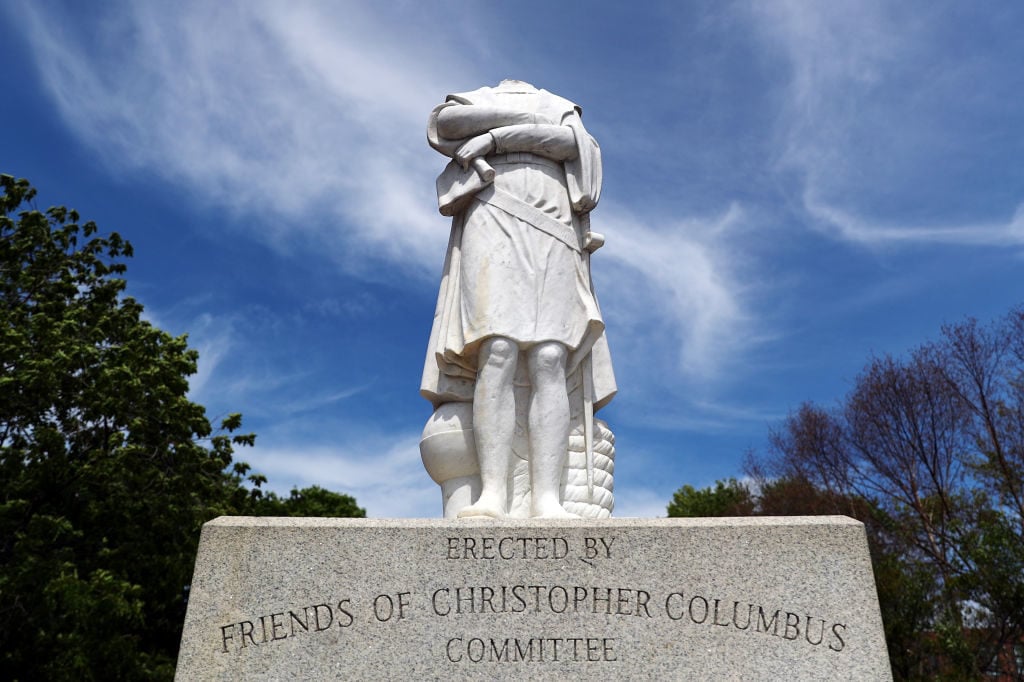
A statue depicting Christopher Columbus
with its head removed at Christopher Columbus Waterfront Park on
June 10, 2020, in Boston, Massachusetts. Photo: Tim Bradbury/Getty
Images.
What Transpired: In Boston on June 9, in the historically
Italian neighborhood of the North End, a marble monument to
Columbus was beheaded in a park named for the supposed
discoverer of the Americas.
Statue Facts: This statue was erected in 1979 and
was installed, like many other Columbus monuments, as a symbol of
Italian American pride.
Not The First Time: This isn’t the statue’s first
decapitation—it happened once before, in 2006. In 2015, the
monument was doused in red paint and the words “Black Lives Matter”
were spray-painted on its base.
Other Columbuses: In Richmond, Virginia, this week,
another statue of Columbus was set aflame, then pulled from its
base by nearly 1,000 protestors, who hurled into a nearby lake.
That sculpture, which was commissioned by local Italian American
residents and completed by Ferruccio Legnaioli, was erected in 1927
as the first depiction of Columbus in the American South. (Also
this week, in Minnesota, Native American protestors led the removal
of yet another Columbus monument.)
Why It Needed to Come Down: Long-heralded as the
discoverer of the Americas, Columbus is now understood to have
initiated the trans-Atlantic slave trade and to have opened the
Americas to European colonialism. He also is known to have raped
indigenous women and notoriously pushed his own crew to force
indigenous people into servitude.
Future Fate: Boston’s mayor, Marty Walsh, said that
statue would be put into storage. It may or may not be
restored.
Monument to Leopold
II, Ekeren district, Antwerp
Removed Tuesday,
June 9
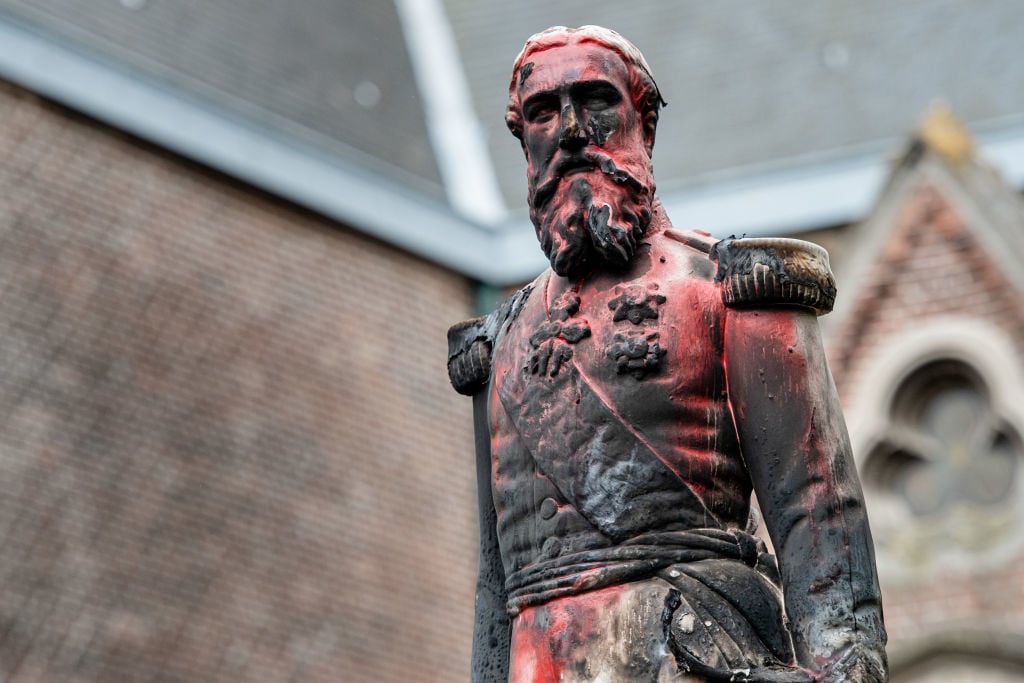
A statue of King Leopold II of Belgium
is pictured on June 4, 2020 in Antwerp after being set on fire the
night before. Photo by Jonas Roosens/Belga/AFP via Getty
Images.
Statue Facts: The notoriously brutal Belgian King
Leopold II assumed the throne in 1865 and held it until 1909,
making him the longest-reigning monarch in Belgian
history. This particular statue, in Antwerp’s Ekeren district,
was erected 150 years ago, during his reign.
Crimes Against Humanity: During his
kingship, Leopold II founded and owned the Congo Free State, a
region of land he claimed in Central Africa for his private
enterprise. He had publicly claimed that the venture was an attempt
to “civilize” and improve the lives of the native inhabitants; in
reality, it was an exploitative and ruthless colonial mission to
loot ivory and extract the valuable resource of rubber to fund
Leopold’s lavish construction projects in Europe. During his
mercenary rule of the Congo Free State, from 1885 to
1908, an estimated 10 million Congolese died (though a precise
number is unknown) and countless others were brutally maimed. The
term “crime against humanity” was first used in reference to his
atrocities.
Back Story: Monuments to King Leopold II have been hotly
debated in Belgium since the 1980s, with petitioners demanding that
the monuments be removed. Yet Belgium has been slow to grapple with
its colonial legacy. During recent protests, this statue, along
with other depictions of the monarch throughout the city, were
splattered with red paint. Protestors climbed on another statue of
Leopold and raised a flag of the Democratic Republic of Congo.
The Takedown: After protestors subsequently set the
monument aflame, city officials intervened, sending a crane to
remove the monument on Tuesday, June 9.
Future Fate: Officials in Antwerp removed a statue of the
monarch and transferred it to storage in the Middelheim Museum. The
statue, importantly, has not officially been deinstalled, but only temporarily removed due to damage
inflicted by protestors, though it may be quite a while before it
sees the light of day.
Monument to Mayor Frank Rizzo,
City Hall, Philadelphia
Removed June 4,
2020
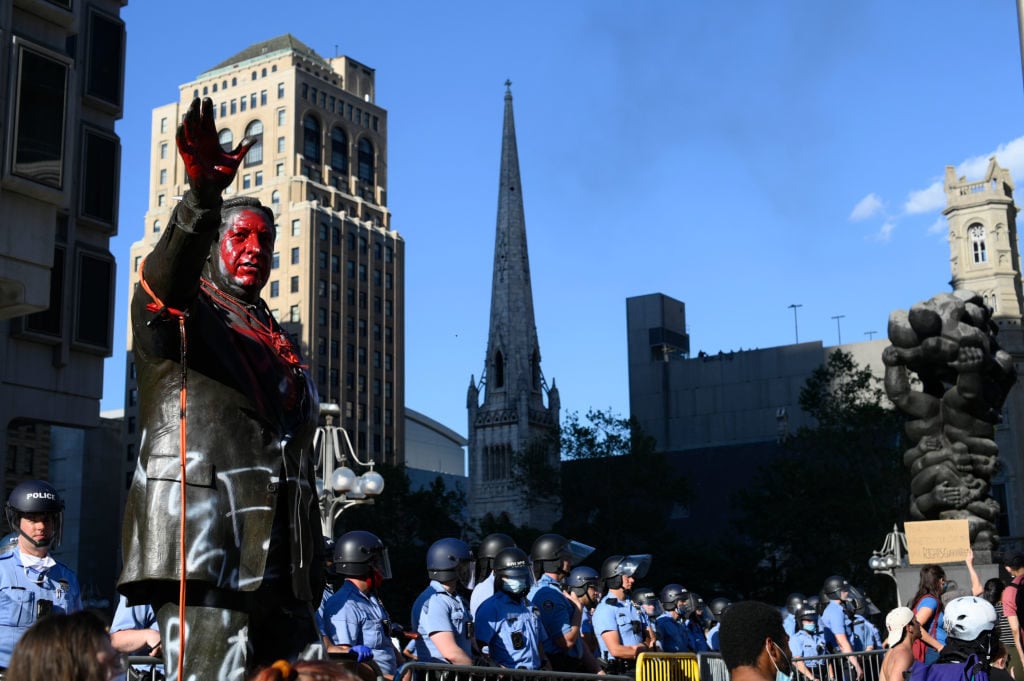
Police officers guard the controversial
Frank Rizzo statue as protestors clash with police near City Hall,
in Philadelphia, PA on May 30, 2020. Photo by Bastiaan
Slabbers/NurPhoto via Getty Images.
Statue Facts: Frank Rizzo acted as Philadelphia’s police
commissioner from 1968 to 1971 and was subsequently mayor of the
city from 1972 to 1980. The 10-foot likeness of the mayor was
erected in 1999, in front of Philadelphia’s City Hall.
Why It Needed to Come Down: Rizzo was
widely acknowledged to be a bigot and a bully, and during his
tenure in his official positions, he encouraged officers to use
excessive force, particularly against Black communities. Moreover,
he stood against the desegregation of schools, and, while stumping
on this third mayoral campaign, infamously encouraged
Philadelphians to “Vote White.” In a statement, current
Philadelphia mayor Jim Kenney said: “The statue is a deplorable
monument to racism, bigotry, and police brutality for members of
the Black community, the LGBTQ community, and many others.”
Backstory: The 10-foot-tall statue has long been on the
radar of activists and social-justice reformers who have called for
its removal for years, labeling it as a symbol of police brutality
and racism. The statue has seen its fair share of vandalism. On May
30, during a Black Lives Matter protest, a crowd lit the statue on
fire and attempted to pull it down.
What Transpired: On June 3, 2020, Mayor Kenney signed an
immediate order mandating that the city’s managing director
remove the statue. At approximately 2 a.m. the next morning, a
crane arrived to remove the statue, as crowds cheered on. Even the
statue’s sculptor, the artist Zenos Frudakis agreed with the
decision, telling the Daily Philadelphian that when he
realized what the statue symbolized to the Black community, he knew
“it had to come down.” On June 7, the city also painted over a
mural of Rizzo in Philadelphia’s Italian Market neighborhood.
Future Fate: After removing the sculpture, the city
announced it would be placed in storage by the Department of Public
Property for the time being. Any future plans for the statue will
need to be approved by the Philadelphia Art Commission.
Monument to Edward
Colston, City Center, Bristol
Removed June 7,
2020
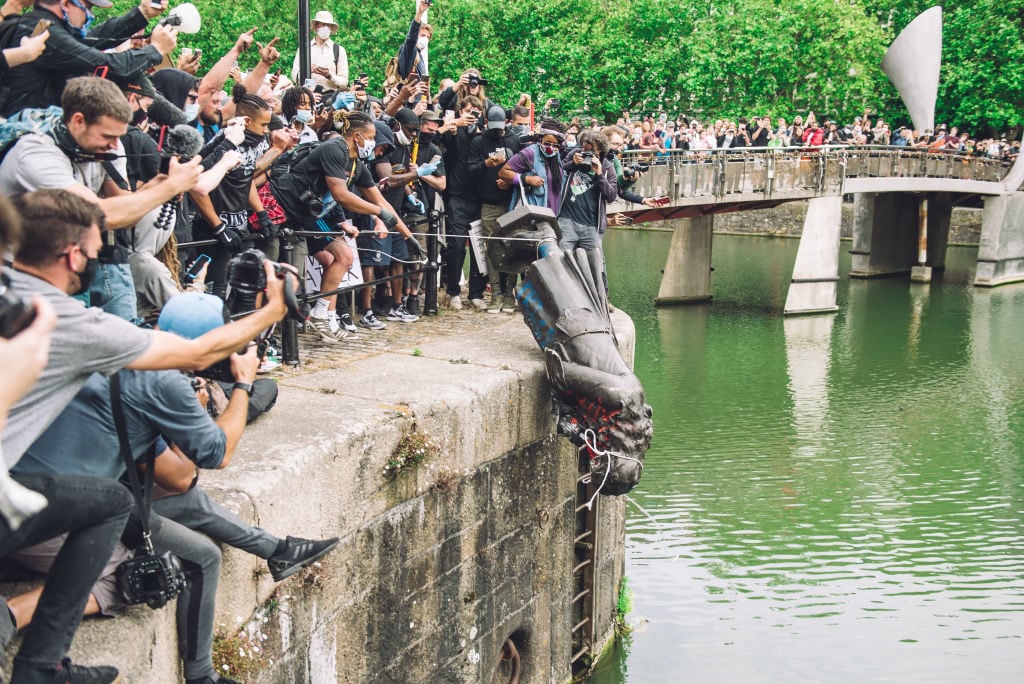
The statue of Colston is pushed into the
river Avon. Photo by Giulia Spadafora/NurPhoto via Getty
Images.
Statue Facts: Edward Colston was born in Bristol in
1636. An English merchant and member of Parliament, he began his
career trading fruits and textiles between Europe, Africa, and the
Americas, but later became involved in the Atlantic slave trade
through his affiliations with the Royal African Company, which
dominated the English trade of slaves. The statue of Colston,
designed by John Cassidy, was commemorated in 1895, some 174 years
after Colston’s death, and erected in the Bristol city center as a
monument to his contributions to the city.
Slave-trader: Colston’s involvement with the Royal
African Company lasted from 1680 to 1692. Though the amount of
money Colston earned through the slave trade is not known, it is
estimated that during his tenure, the company transported
approximately 85,000 men, women, and children to the Americas and
the Caribbean, of whom 19,000 died on the journey.
Lasting Legacy: Colston’s name is part of Bristol’s urban
fabric. He used much of his wealth to fund philanthropic endeavors
in his home city, including schools, almshouses, hospitals, and
churches, although he enabled those to whom he gave his charitable
donations to deny services to those who did not share his religious
and political views. Many of these institutions survive to this
day.
The Takedown: On June 7, 2020, after tagging the monument
with spray paint, demonstrators toppled the statue and pushed it
into Bristol Harbour. According to the BBC, the city’s mayor, Marvin
Rees, said he felt “no sense of loss” over the statue, Rees, who is
of Jamaican descent, remarked: “I cannot pretend it was anything
other than a personal affront to me to have it in the middle of
Bristol, the city in which I grew up.” Prime Minister Boris
Johnson meanwhile described the dismantling as a “criminal
act”.
Future Fate: The Bristol City Council pulled the statue
from the harbor four days later and took it to a secure location.
Officials say it will one day be sent to a museum. The
mayor is now calling on historians and academics to help
inform that city as to best practices for how to move forward.
The post The Troubling Stories Behind Five Monuments Around
the World That Came Down in Recent Days—and Why Their Removal Was
Long Overdue appeared first on artnet News.
Read more https://news.artnet.com/art-world/5-monuments-why-they-came-down-1885071
Further reading


Leave a comment