
The Remarkable True Story of Raúl Giansante, Uber Driver, Master Frame-Maker, Comrade of Dalí, and Zelig of the Art World
I first came upon Raúl Giansante as one of the faces of the
crisis—or, rather, one of the voices. One month ago,
the New York Times’s
Daily podcast presented interviews with New Yorkers on the eve
of the city’s lockdown. Raúl, gently affable, was interviewed in
the car that he was then still driving for Uber.
Why was he still working when the city was shutting down, the
reporter asked? “Because to tell you the truth, because the
retirement in the United States is so low that it’s not enough to
buy food,” he explained. “So I have to work.”
On the podcast, Raúl mentioned in passing that he had previously
worked in making hand-carved frames for artists. After some web
searching, I found a website featuring his work. I also
found that he had a much more interesting backstory than anything I
could have imagined.
I decided to call him up. And, having talked to him, I decided
to tell you his story.
In 1969, at the age of 21, Raúl Giansante fled his native
Argentina, which was wracked with violence in the
wake of a rightwing coup d’etat. He already identified as an
artist, and the climate was increasingly fraught. So he headed to
Mexico City, where he lived in a collective house for
intellectuals. An attached woodworking shop allowed him to hone his
skills with the material.
The house drew Mexico’s artists. One, the famous painter Rufino
Tamayo, would set Raúl on what would be his lifelong path. Visiting
the house, he glimpsed the young Argentine carving a sculpture of
Don Quixote, and asked him to make a hand-carved frame for him.
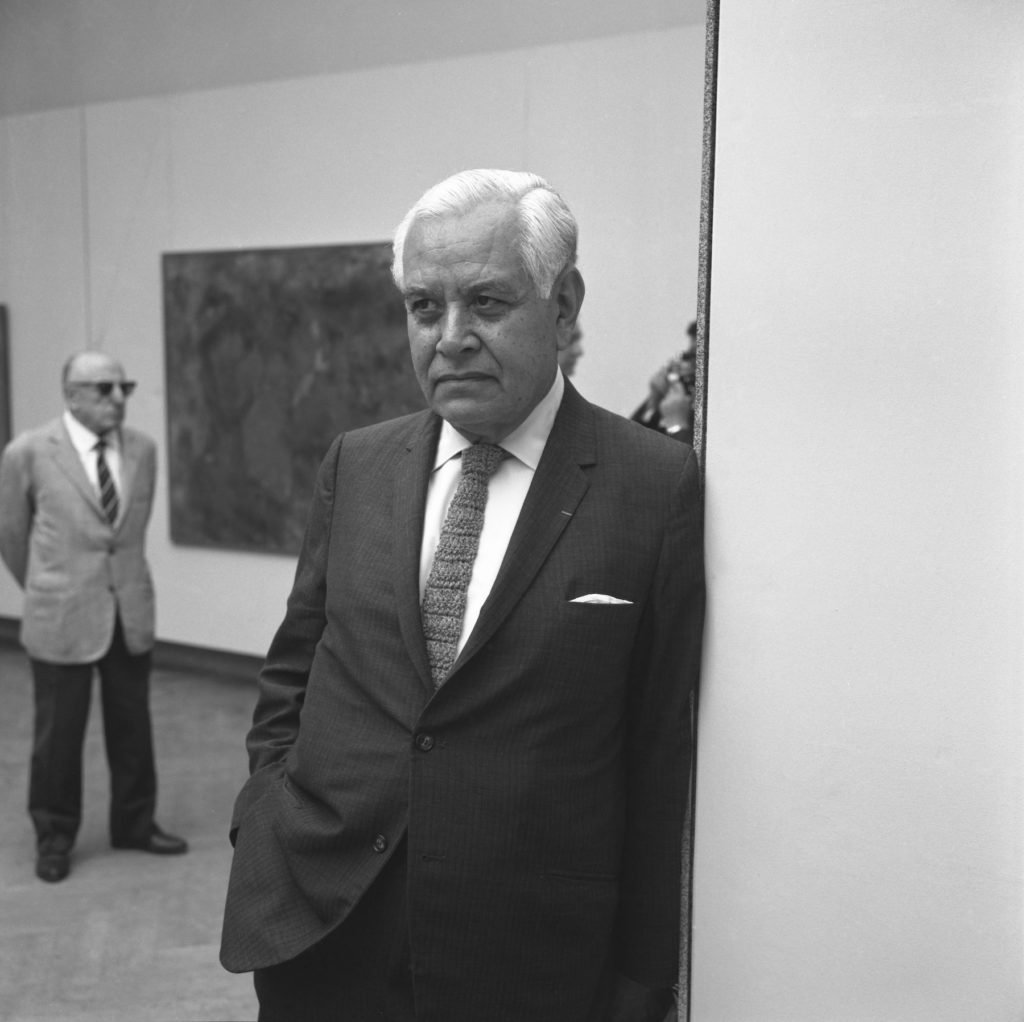
Mexican painter Rufino Tamayo at the
Venice Biennale, 1968, shortly before the time he met Raúl
Giansante. Photo by Archivio Cameraphoto Epoche/Getty Images.
“I told him, ‘I don’t know what I can do for you,’” Raúl
remembered. “’You are the master. I’m just a regular carver.’”
Tamayo insisted, even taking the young artist to a carpenter to
learn how to construct a profile for a frame.
It took a month to make those first two frames, Raúl remembers.
Tamayo liked the results, and asked him to create more handmade
frames for his paintings going forward. “He was the one who invited
me into this world.”
Through Tamayo, Raúl was introduced to other artists working in
Mexico, including the Costa Rican painter Francisco Zúñiga. But his
most important encounter came when the flamboyant Spanish
surrealist Salvador Dalí, then in the late bloom of his
international celebrity period, sought him out at the house,
bringing two wrecked French style frames he hoped to use in a show
at the Palacio de Bellas Artes. Raúl, of course, had no idea how to
fix the antiques, so Dalí asked if he could fabricate new ones
instead.
“That was a Monday,” Raúl says. “I asked him when he needed
them. He said, well, I need them Friday because Saturday is the
opening day of the show. I spent five days almost not sleeping to
get them done.”
Dalí was impressed with the young woodworker’s hustle. “He said
to me, ‘You know, in Spain they take about three months to make two
frames and they do it wrong. But you, in five days, have made me
this beauty.’ [Dalí] said, ‘Come with me to Spain—I need you.’”
Raúl was 23 years old at the time. He couldn’t pass up on the
opportunity.
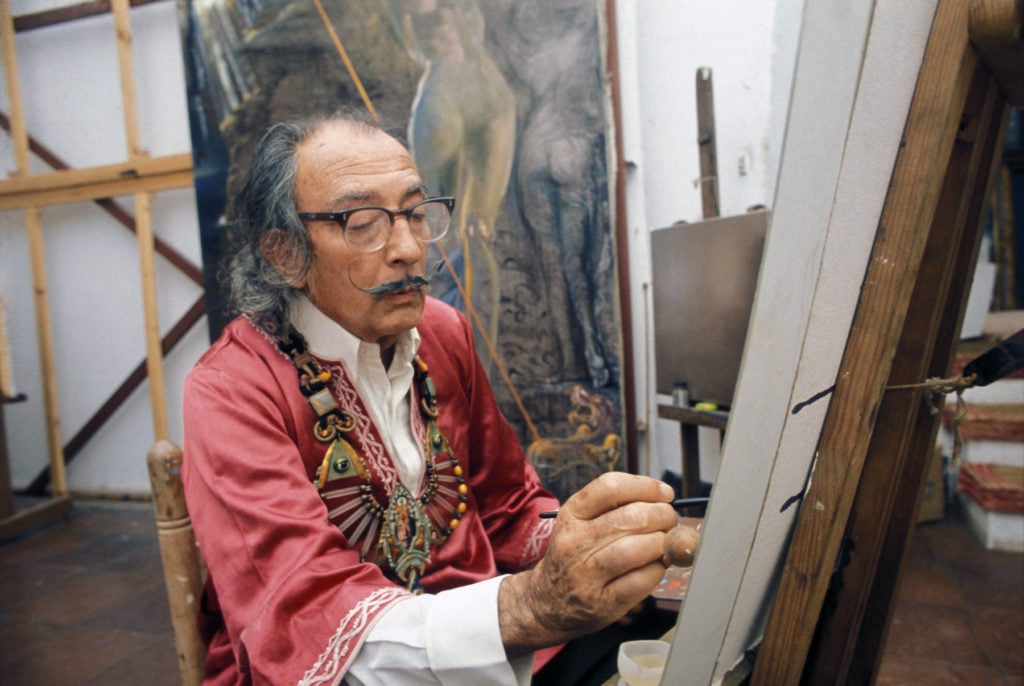
Salvador Dalí painting in his studio in
Spain, circa 1970. (Photo by Etienne Montes/Gamma-Rapho via Getty
Images.
For the next decade, until Dalí passed away from Parkinson’s in
1981, Raúl worked with the Spanish painter, growing a framing
business from his shop next to the artist’s studio in Cadaques. The
association brought other more famous artists his way. His
hand-carved frames came to adorn the work of the likes of Joan Miró
and Francis Bacon.
Dalí’s globetrotting lifestyle saw him spend six months in Spain
and six months in New York each year. That’s what brought Raúl to
the States, where he would later become a citizen. Eventually, he
was running workshops in both the US and Europe.
Raúl’s business grew with the consolidation of New York’s
downtown scene, which would yield SoHo’s so-called “decade of
decadence” in the 1980s. Through Francis Bacon, he was
introduced to Marlborough Gallery, where he served as the official
framer until the start of the new millennium.
He also did framing for the legendary gallerist Leo
Castelli. For six years, he did shadow boxes and stretched
silk for Andy Warhol. He was close with the Op artist Victor
Vasarely, who ran his own dedicated showroom, the Vasarely Center,
on Madison Avenue. He knew well Tony Rosenthal, creator of Astor
Place’s beloved black cube sculpture, and worked with film
star-turned-painter Anthony Quinn.
At his peak, Raúl’s workshop in Brooklyn occupied 16,000 square
feet on the corner of Third Avenue and Third Street, essentially a
factory, employing 75 people. “We were framing for about 50 to 60
galleries in New York, Chicago, all over.”
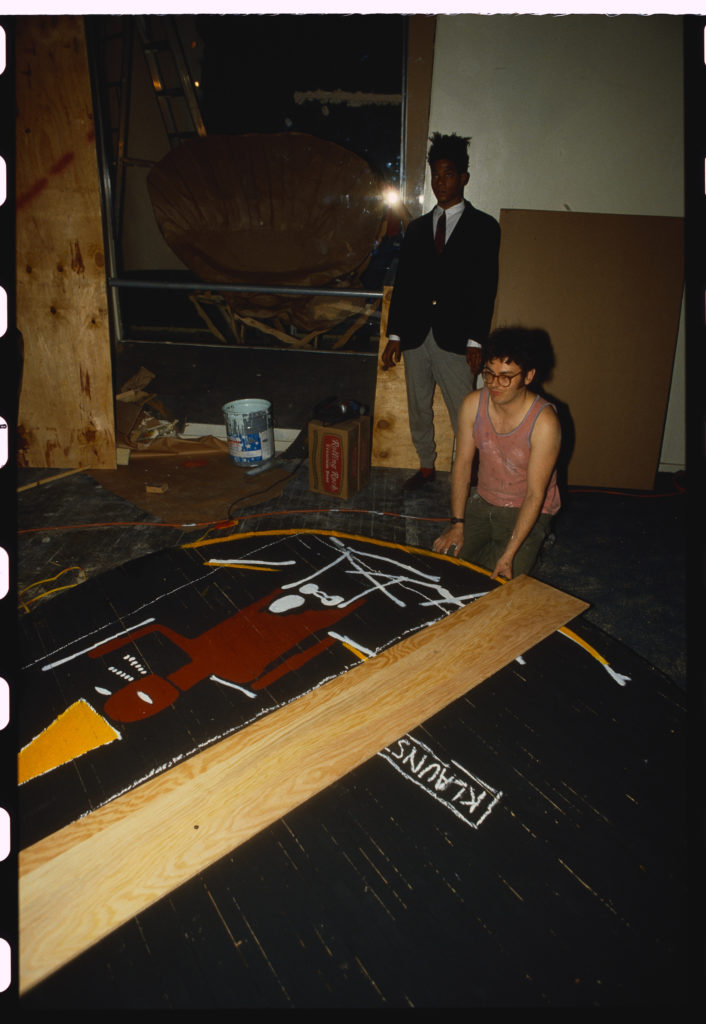
Jean-Michel Basquiat looks on as one of
his artworks is inspected at Area, a Manhattan nightclub, in
January 1980. Photo by Nick Elgar/Corbis/VCG via Getty Images.
It was in the Brooklyn studio that he met the young Jean-Michel
Basquiat, who became a friend. “Basquiat used to come all the
time,” he remembers. “He discovered that I had been working for
Dalí for many years, and he wanted me to introduce him to
people.”
The young artist, pre-fame, would make art at Raúl’s Brooklyn
framing studio. “We never kept it because Jean-Michel Basquiat was
nobody. He was doing graffiti on the street. He used to come and
paint the windows, the doors, every day. When he found spray paint
or crayons, he would just paint all over. In the winter, he would
do the floors inside.”
In the subsequent decades, New York’s art community shifted in
ways that changed what Raúl did.
“To tell you the truth, I was friends with most of the artists I
worked with,” he said. “In order to make a frame, I have to know
the person. That way, I know that the artist is going to like it
and I’m going to like it. But most of my friends passed away. AIDS
took care of many, many of my friends.” (Through Basquiat, he also
knew Keith Haring, who died of complications of AIDS in 1990.)
Bigger economic shifts in the business were afoot as well.
Carved frames were definitively displaced by industrially produced
frames from China. About this Raúl is matter of fact. “I understand
the collectors: a frame costs me $2,000 to make, and you can get
something similar for $250 on the street,” he says. “It’s not the
same, but you don’t want to show the frame anyway. You want to show
the painting. The framing business, at least in New York,
disappeared.”
He has, however, shifted and adapted. With his family, he now
runs a small studio in the Bronx where he makes bespoke hand-carved
furniture, MarGian Studio. (The name is a
synthesis of the first name of his wife, Maria Antonieta, who
serves as studio manager, and his own last name.) Each piece is
unique and made with rare materials. He insists on calling them
“sculptures.”
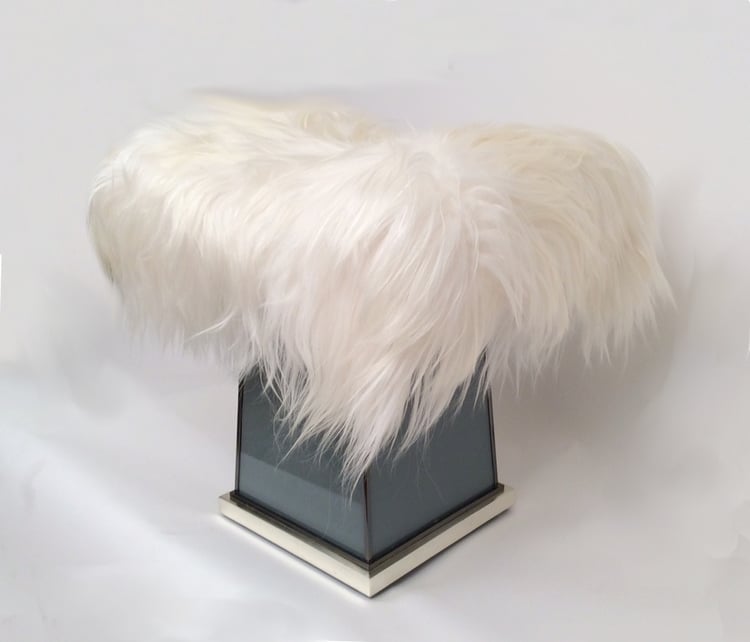
The Mongolian Longhaired Stool from
MarGian Studios. Image courtesy MarGian Studios.
Glimpsed online, MarGian Studios’s wares brim with multifarious
personality. In some, like his shaggy Mongolian Longhaired Stools,
witty Origami Swan Sidetable,
or intricate Which Direction Sideboard, you
might even get a flash of Dalí’s influence shining through.
A few years ago, Raúl had an accident. It left him with a
herniated disk, and his left leg suffers debilitating pain if he
spends too much time on his feet. “I don’t know when this will be,
but I need surgery,” he says. Given the pandemic, it will not be
anytime soon.
Now he can’t work unless he is sitting down, aside from doing
general design for the studio. That’s what led him to take up
driving. “I’ve come to know more of New York City than I knew in
all the years that I have been in the United States,” he says. “I
can talk to people, look around, distract myself. Whenever I’m in
pain, I try to drive a taxi.”
In March, when he spoke with the Times on the cusp
of the city’s shutdown, Raúl was still driving, even as life in the
rest of New York slowed to a halt. The intensity of the pandemic
gripping the city has now made him think that was unwise. Years of
working with wood dust, marble dust, and chemicals have left him
with chronic bronchitis. He no longer feels he can risk it ferrying
passengers around the city.
“I’m 75 years old,” he says gently. “I plan to live many more
years.”
I’m tempted to make some kind of bigger point about the meaning
of this narrative. Somehow, Raúl Giansante’s story does seem to
serve as a reminder about a lot of invisible work, a lot of lives
sustained out of the Klieg lights trained on art’s center stage. It
also passes through an astonishing cross section of the twists and
turns of the last three quarters of a century, from Argentina’s
political ruptures to the heady highs of New York in the ‘80s
to the losses of the AIDS crisis to the dislocations and
reinventions of the decades defined by globalization and, finally,
to the difficulties of coronavirus.
Mainly, though, if I’m honest, I’m telling you Raúl’s story
because he’s an interesting person I wouldn’t have come into
contact with if it weren’t for this time of turmoil and isolation.
And that serves as a tiny beacon to me that some new sense of
connection might be snatched from the jaws of a terrible
moment.
I look forward, some time in the future, to getting on the
subway again, heading up to the Bronx to see his workshop, and
greeting him in person.
The post The Remarkable True Story of Raúl Giansante, Uber
Driver, Master Frame-Maker, Comrade of Dalí, and Zelig of the Art
World appeared first on artnet News.
Read more https://news.artnet.com/art-world/raul-giansante-salvador-dali-framer-uber-driver-1842816
Further reading


Leave a comment