
The Gray Market: Why Inigo Philbrick’s Arrest Doesn’t Mean the Art Market Is Done With Him Yet (and Other Insights)
Every Monday morning, Artnet
News brings you The Gray Market. The column decodes important stories from the
previous week—and offers unparalleled insight into the inner
workings of the art industry in the process.
This week, abandoning sales
comps for criminality comps…
ONE WAY OFF THE ISLAND
On Friday afternoon, a new
chapter opened in the most breathlessly followed art-world scandal
of the past year as American federal agents arrested fugitive
dealer Inigo Philbrick on the Pacific island of Vanuatu. Authorities
subsequently transported Philbrick to Guam, where he will appear in
court immediately to face charges stemming from what the US
Department of Justice termed “a multi-year scheme to defraud various
individuals and entities in order to finance his art
business.” And although this
remains a developing story, I think it’s instructive to analyze
where Philbrick fits into the art-crime history books
today.
My colleague Eileen Kinsella
(who has been reporting the hell out of this story, in
text
and in audio, since it broke in fall 2019) relayed that the
DOJ’s case against Philbrick currently involves more than $20
million in allegedly fraudulent transactions. Calling that a modest
amount of criminality would be as much of an understatement as
saying I thought it was “mildly amusing” that Philbrick was
ultimately found hiding out on the island from season nine of the
reality-TV eco-endurance challenge Survivor. (I can only hope host Jeff Probst will appear
after the verdict in the eventual trial to solemnly announce,
“Inigo, the tribe has spoken.”)
And yet, the accusations against
Philbrick could be worse—a
lot worse, it turns out!
Below is a chart I threw
together that stacks up the dollar value of Philbrick’s alleged
fraud, according to current federal
charges, against the
amounts accumulated by other recent art-market rogues. To keep the
parallels as bad-apples-to-bad-apples as possible, the figures here
strictly come from the criminal charges against the dealers in question; trying
to incorporate all the different civil actions against them spins the comparison out
of control.
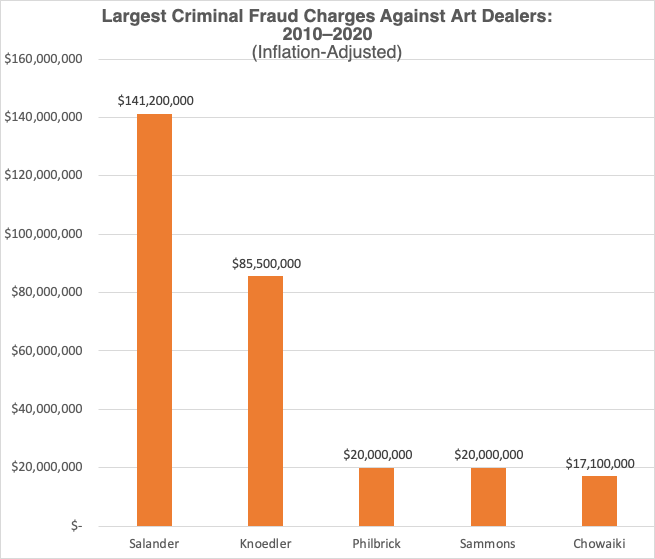
Chart by Tim Schneider. © 2020 Artnet
News.
At publication time, then, the
Philbrick scandal was only about one-seventh as severe as the one
traced back to disgraced dealer Larry
Salander in 2010, and
less than one-quarter as heinous as the infamous Knoedler forgery
saga in 2016. (The total
alleged frauds at the time reached about $120 million and $80
million, respectively, in the two cases, but my pathological lack
of chill meant that I had to adjust everything for
inflation.)
As the chart shows, the two
closest comps I could find for Philbrick were British
charlatan Timothy
Sammons and New York con
man Ezra
Chowaiki. In 2019,
Sammons was charged with bleeding clients of somewhere “between $10
million and $30 million” in sales and financing deals for works by
various canonical Modernists. (Since the charges were never pegged
to a definitive figure, I chose the midpoint of the range.)
Prosecutors charged Chowaiki with defrauding buyers and business
partners of more than $16 million between 2015 and
2017—just over $17 million
after inflation—primarily by
selling stakes in works he didn’t own and pocketing collectors’
cash for works he never actually bought on their
behalf.
To me, this comparison
foregrounds two points. First, it’s notable that Philbrick is
currently only sharing the bronze medal for art-dealing knavery in
the 2010s. This makes criminality look like just one more area
where the art market’s totals
have stagnated in the
past 10 years.
Second, the Sammons and Chowaiki
trials should help set expectations for what kind of punishment
Philbrick might be facing if convicted on all current counts.
Sammons earned four to 12 years in prison for his crimes; Chowaiki
was hit with an 18-month
prison sentence, a bill for $12.9 million in damages, and a
forfeiture order for 25 artworks he once partly or wholly owned. At
33, Philbrick is still young enough that even a high estimate for
any possible jail sentence would leave him with plenty of time to
try to launch a second act after release.
But both of those points still
hinge on one variable that is still very much a free
radical.
A courtroom setup awaiting a witness.
Photo: Friso Gentsch/dpa (Photo by Friso Gentsch/picture alliance
via Getty Images)
THE NEXT EPISODE?
For anyone who hasn’t been
bingeing on legal procedurals since the shutdown, I should
emphasize that the initial charges that land a defendant in court
will not necessarily be the only charges on the docket by the time
their trial actually starts.
In general, a good prosecutor
will refuse to order an arrest until they’re all but sure they can
convict the alleged culprit on their initial charges. After a
defendant is in custody, though, they will try to expand and
strengthen the case with additional evidence that can lead to
additional counts of criminality. One popular strategy for doing
this: questioning and charging the defendant’s potential
accomplices with related crimes to try to compel them to flip on
the kingpin.
This is why the nature of
Philbrick’s alleged fraud, not just its current dollar value, is
important to consider. What separates the accusations against him
from those against earlier art-market fraudsters is the purported
complexity of the deals. According to previously reported
allegations, this wasn’t just a case of one man selling artworks he
didn’t own to individual clients (as Salander did), or even
collaborating with a small, tight circle of accomplices to peddle
forged works (as dealer Glafira Rosales did in
the Knoedler case).
Exterior image of Reading Prison. Photo:
Morely von Sternberg, courtesy Artangel.
Instead, Philbrick regularly
relied on complex art-financing deals and sales partnerships with
various offshore entities and shell corporations, most of whose
founders tended to be looking to flip blue-chip art for a big
profit. (Eileen Kinsella wrote the most thorough
accounting of the machinations you’ll find.)
The more layered and more
profitable the con, the higher the likelihood that someone else
involved at least knew what the perpetrator was really doing, if
not materially aided them. It also stands to reason that the
central perpetrator in one con might have evidence of other
wrongdoing that they would be happy to divulge to authorities in
hope of improving their own situation if caught.
By no means am I suggesting that
all, or even most, of the people who did business with Philbrick
were criminals. Every con has legitimate victims. My colleague
Kenny Schachter, for instance, has publicly unspooled (on
both Artnet
News and elsewhere) his tale of how Philbrick leveraged their
years-long friendship into a scheme that he claims robbed him of
“well over $1 million.” I’m just saying that I doubt I’m the only
one who wondered whether part of the reason Philbrick managed to
evade the law for so long was that some of his former associates
preferred he quietly disappear rather than land in an interrogation
room.
For those reasons, I think it’s
still too early to say we understand the full scope of the
Philbrick case. “More than $20 million” in fraud may be only a
solid starting point for prosecutors, and the list of defendants
for related charges could still expand.
His inclusion in the pantheon of
crooked art dealers is already secure. All that’s left is to
determine his proper placement in the hierarchy.
That’s all for this week. ‘Til
next time, remember: everything ends eventually.
The post The Gray Market: Why Inigo Philbrick’s Arrest
Doesn’t Mean the Art Market Is Done With Him Yet (and Other
Insights) appeared first on artnet News.
Read more https://news.artnet.com/opinion/gray-market-inigo-philbrick-arrest-1886871
Further reading


Leave a comment