
The Gray Market: Why Chef Gabrielle Hamilton’s Reckoning Offers an Important Example for Gallery Owners (and Other Insights)
Every Monday morning, Artnet
News brings you The Gray Market. The column decodes important stories from the
previous week—and offers unparalleled insight into the inner
workings of the art industry in the process.
This week, slicing down to the
essentials, even when it hurts…
TABLE FOR TWO
On Thursday, the New York Times
Magazine published a
poignant—and pointed—essay by Gabrielle Hamilton, chef and founder
of the New York bistro Prune, titled “My Restaurant Was My Life for
20 Years. Does the World Need It Anymore?” Her thoughts on her
place in the food scene after the shutdown contain a jarring amount
of crossover with the existential crisis now facing many gallery
owners. And her conclusions stand as a bracing reminder that
succeeding, not just surviving, on the other side of this mess may
demand questioning everything about why, and how, we all do what we
do.
In Hamilton’s mind, Prune has
now reached an inflection point familiar to many dealers whose
spaces debuted nearer to Y2K than the onset of the
social-distancing era. She describes opening her restaurant in the
East Village in October 1999, years
before the foodie scene as we know it today existed
(even in New York), because she
was “driven by the sensory,
the human, the poetic and the profane—not by money or a thirst to
expand.”
And yet, expand she did. First,
Hamilton almost impulsively actualized what she labeled the “dreamy
proposition” of adding weekend brunch. The meal’s runaway
success generated enough
capital for her to buy out her investors roughly nine years after
launching Prune. She
contrasts that choice with the more calculated one she made a few
years later to start serving lunch on weekdays primarily so she
could offer her staff health insurance. While the latter move may have been partly
(even largely) altruistic, it’s also entrepreneurially sensible:
good businesses understand the value of continuity, meaning they do
what they can to keep good employees in place if the math
works.
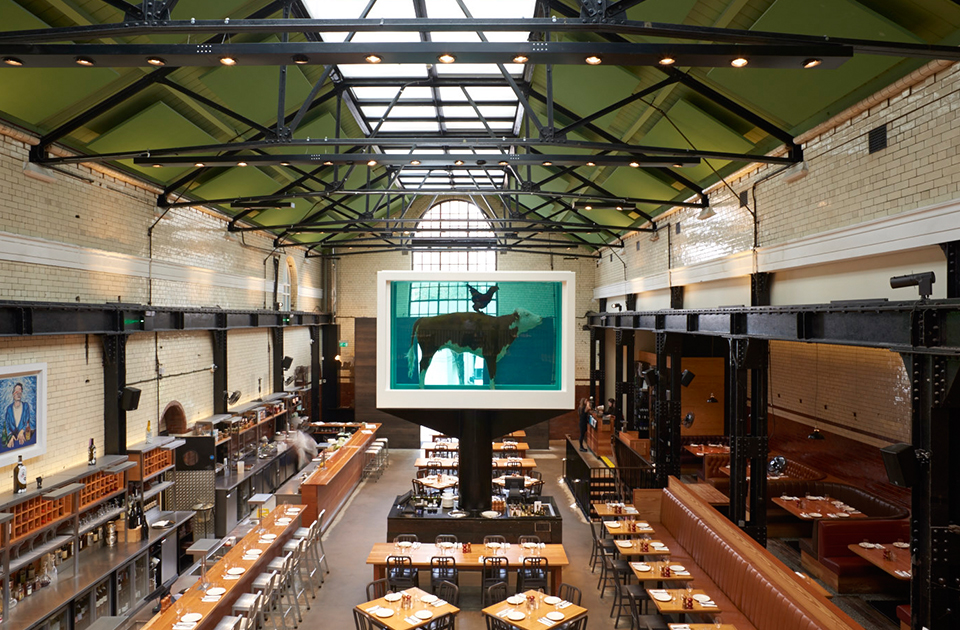
Damien Hirst’s Cock and Bull
(2012) in Hix’s ‘Tramshed’ restaurant. Photo: Hix Restaurants.
However, the feel-good success
of Prune’s first decade dissipated during its second, and the story
its founder tells locks into eerie alignment with the farewell
announcements and op-eds we’ve seen from a wave of small and
modestly sized art dealers since the 2008 recession. Here’s
Hamilton:
But Prune at 20 is a
different and reduced quantity, now that there are no more services
to add and costs keep going up. It just barely banks about exactly
what it needs each week to cover its expenses. I’ve joked for years
that I’m in the nonprofit sector, but that has been more direly
true for several years now.
She goes on to recount a moment
of clarity that arrived last summer: lying face down on Prune’s
floor in coveralls soaked through with food waste, at age 53, using
a garden hose to blast a mixture of bleach, dish soap, and
degreaser behind the sauté station. Her margins had gotten too
parchment-thin to allow her to outsource such a thankless cleaning
job, let alone shutter the restaurant for 10 days to do more
thorough repairs, as she used to do every July. Prune simply needed
every single day’s cash too desperately to slow down or
subcontract.
Many, if not most, owners of
modest galleries have undoubtedly experienced similar come-to-Jesus
moments in the years leading up to the shutdown: exhibiting at yet
another art fair that they couldn’t afford to do, but felt they
could afford to miss even less; undertaking a precarious install or
a punishing art move alone because the budget is somehow even
tighter than it used to be; feeling pressure to close a deal with a
client or intermediary they don’t trust purely because turning down
any transaction, no matter how suspect, might mean the end of the
line.
Even the most profitable
businesses continually face tough choices and narrow margins for
error—narrower than outsiders tend to realize. But when the
hardships increase the longer you endure, any striver in any
industry arrives at the same dilemma Hamilton did in those grimy
coveralls: “It had always been hard, but when did it get
this hard?”
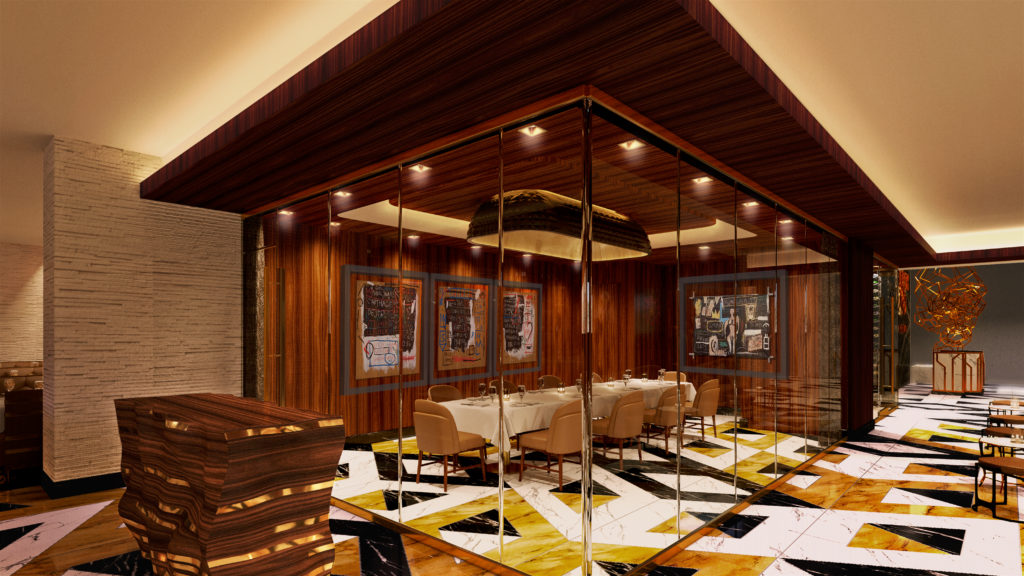
Works by Jean-Michel Basquiat at the
Scotch 80 Prime steak restaurant. Photo: Courtesy of the Palms
Hotel and Casino.
RESERVATIONS AND REIMAGININGS
Since the “grow or
go” dynamic has been
rigorously analyzed inside and outside
the art market for years, I’m not
interested in dredging the past for a literal answer to Hamilton’s
question here. Instead, like her, I’m more concerned with what
comes next in our respective industries.
Given the increasingly
unforgiving circumstances of the food-and-beverage space, Hamilton
goes on to question whether concerned observers will even be able
to tell how many eateries lost during the lockdown met their
fate because
of the lockdown. Even
without a mass stay-at-home order, she argues, a substantial number
would have gone under within 16 months from “lack of wherewithal or
experience.” Current events will also provide cloud cover for any
“weary veteran chef” who finally decides to “quietly walk out the
open back door of a building that has been burning for a long time”
due to a brutal real-estate market, an ever-growing stampede of
competitors, and so much more.
The extraordinary circumstances
will obscure outcomes in the gallery sector in the same way. And as
she describes in her own case, those who bow out may be just as
motivated by a sense of placelessness and inferiority as by hard
costs and sacrifices:
In economic terms, I don’t
think I could even argue that Prune matters anymore, in a
neighborhood and a city now fully saturated with restaurants much
like mine, many of them better than mine—some of which have
expanded to employ as many as 100 people, not just cooks and
servers and bartenders but also human-resource directors and
cookbook ghostwriters.
Of course, from hundreds-strong
staff sizes to a cadre
of specialists who would have seemed unthinkable two decades
earlier (think:
directors of
special (publishing) projects and social-media managers), these specifics are
a fact of life in the dealer sector, too. And while I’d argue that
growth is not inherently bad—every gallery run well enough to move
out of a shoebox is as much a testament to this notion as Prune’s
first decade was—they can quickly become unsustainable when larger
market forces turn expansion into a nonstop necessity.
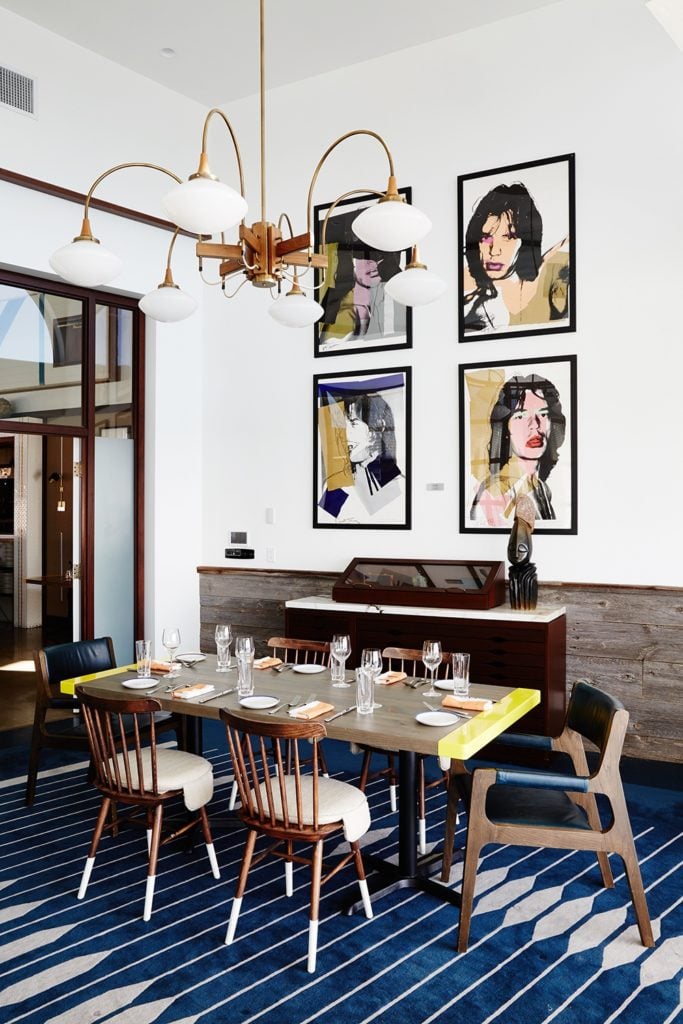
Four of Andy Warhol’s Mick Jagger screen
prints inside the restaurant at Bermuda’s Hamilton Princess Hotel &
Beach Club. Photo by Nicole Franzen. Courtesy the Hamilton Princess
Hotel & Beach Club.
Not every aspect of Hamilton’s
narrative, or the restaurant business in general, maps onto the art
world. The early backing of a consortium of investors, commercial
success based on volume service, the physiological reality that
people need food in a way they don’t need art—all of these, and more, separate the two
industries in undeniable ways.
Yet the business of small
restaurants doesn’t need to be identical to the business of small
galleries in order to be instructive. Hamilton’s passion and
economic circumstances will resonate with almost anyone striving
for a career in the arts. And
that’s why the perspective she reaches at the end of the piece
should be, too.
Weeks of reckoning with Prune’s
history during the shutdown have led Hamilton to begin envisioning
a dramatically different future for her
restaurant—one
born out of equal parts romanticism
and realism. She describes her cravings to parachute out of the
weekend-brunch-industrial complex she unwittingly helped build; to
exchange every minuscule two-top table for a more communal setup;
to rearrange opening hours and reconstitute her business to
recapture the sense of connection with regulars and food that drove
Prune’s founding back in 1999.
In short, she’s ready to shred
the entire pre-crisis blueprint for what a New York restaurant
should be—and as a result,
to confront the prospect that there may no longer be a place for
Prune in the third decade of the 21st century. If there is, though,
she’s fully embraced that it will come from radical
transformation.
I think every independent
gallery owner now has to confront these same prospects, too.
Whether by choice or against their will, not every one of them will
return. But when the world reopens, those with the best chance of
finding their footing and rhythm again will be those who were
willing to re-evaluate every aspect of the way things are done. And
as Hamilton proves, that metamorphosis has to start
now.
That’s all for this week. ‘Til
next time, remember: sometimes it takes the prospect of losing
everything to feel like you’re free to do anything.
The post The Gray Market: Why Chef Gabrielle Hamilton’s
Reckoning Offers an Important Example for Gallery Owners (and Other
Insights) appeared first on artnet News.
Read more https://news.artnet.com/opinion/gray-market-gabrielle-hamilton-prune-1845531
Further reading


Leave a comment