
The ‘Banality’ Bailout? In a Locked-Down Art World, Jeff Koons Chases Government Cash, Flippers Persist, and Kenny Schachter Takes It Easy
The live Instagram Stories that are
proliferating under lockdown are the equivalent of anything-goes
public-access television—an unprofessional stream of blather with
horrible video and worse audio quality, not to mention the general
banality of content. I’ve admittedly guested on more than my share
of these broadcasts, and even staged an interview myself with
British artist Tim Noble of Noble & Webster fame, who has since
left that market-darling combo to essentially start over as an
emerging solo artist. (Good timing.)
Today, May 5th, at 4 p.m. EST, I will
make another contribution to the burgeoning muck-and-mirth genre
with Irish artist Sean Scully—and, if you read my review of the BBC
documentary on him, published a year ago today and quoting him
as calling himself “the Donald Trump of the art world,” you
can be certain it will be, um, spritely, at the least. The things
we do to keep occupied during this seemingly interminable COVID
crisis.
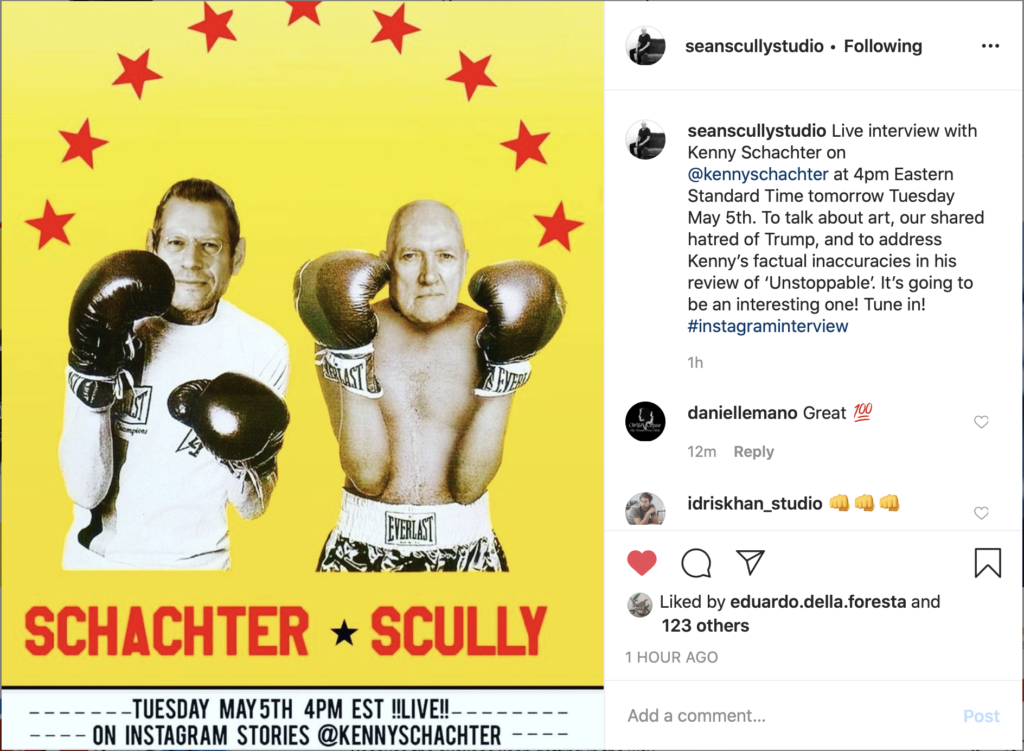
Sean Scully and me! Tuesday May 5th EST
on Instagram Stories live; speaking of which, I hope I survive in
one piece. Courtesy of Kenny Schachter.
Since the earth stopped spinning on
its axis and things took a turn for the… awkward, I’ve been living
in a fog—literally, since every time I venture out in a mask my
glasses cloud up. (As if I wasn’t dazed and confused enough
already.) A few days ago, I felt like a character adrift in a
“Twilight Zone” episode and actually had to google the day and
date. Mainly, I’m at a loss as to how, when, and from where I will
earn the next dollar or two now that my School of Visual Arts stint
is over and selling art is only possible on a wing and a prayer, at
least for me. You see, I’ve got no online viewing room to hang in
(excuse the pun) and hawk my wares, though I did manage to sell one
of my own artworks to a collector in Miami off Instagram for a
not necessarily whopping, but much appreciated nonetheless,
$6,000.
The More Things Change…
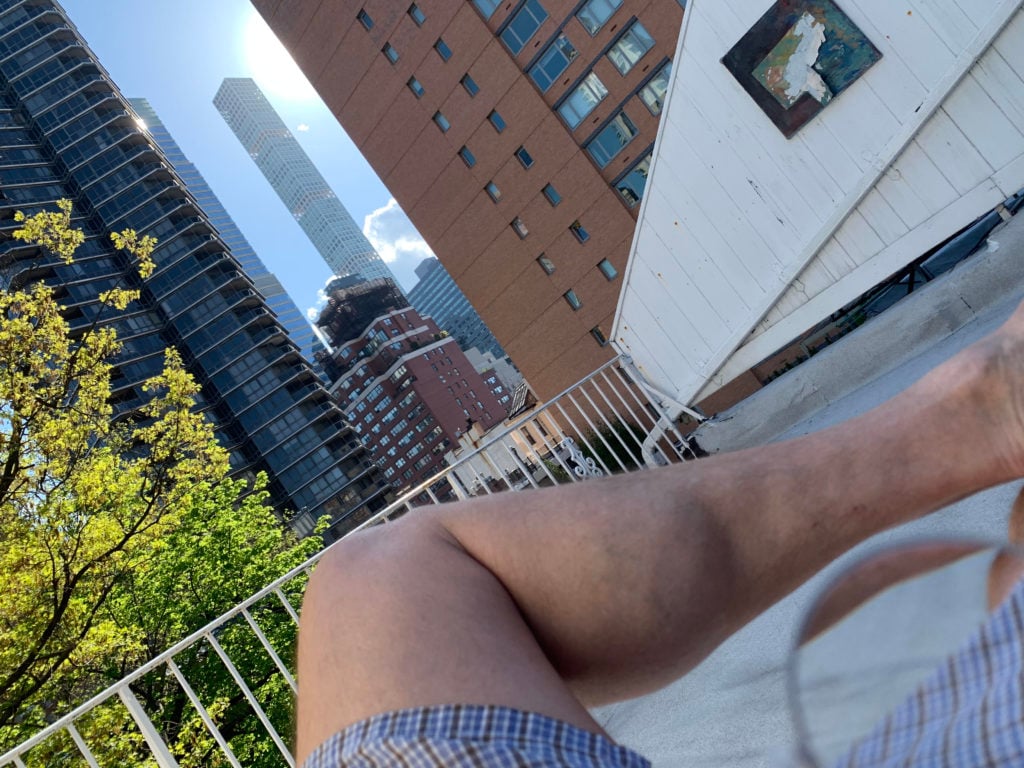
Art fairs? What art fairs? Courtesy of
Kenny Schachter.
On the bright side, ever since the end
of the age of the mad rush, when everyone was racing nowhere fast,
I’ve stopped bothering to wear a watch—it’s the longest I’ve stayed
put in more than 20 years, and I’m glad to be off the treadmill of
what artist Adam Pendleton called our “hurry-up culture” in a
recent New York Times article. On the other
hand, the art world, as resistant to change as ever, is still
firmly stuck in its old habits, as in the case of spec-u-lector
Jeremy Larner who spoke of selling off the younger artists in his
“collection” in favor of buying more blue-chip works because “some
of the emerging artists may no longer be in fashion.”
From bad to worse, Larner—who’s not a
terrible guy, just probably in the wrong business—went on to
recount flipping art bought directly from the Ghanian sensation
Amoako Boafo, who he befriended (what are art friends for?), in
order to buy works by Cecily Brown, Joan Mitchell, and Christopher
Wool that he thinks he can resell at a profit. In his own words,
told to Bloomberg: “I’d
rather spend $1.5 million on an artwork than $60,000. It’s a safer
bet.” I asked him to define what art is, but he couldn’t—for him,
it may as well be widgets. To each their own, I guess.
Basel, Cologne, Brussels, Chicago,
Buenos Aires, and a few others I am forgetting are musing about
staging rescheduled fairs
in early fall, not to mention Frieze and FIAC being slated as
usual for October, which is at best wistful thinking—they should
all make like Fred Astaire and Ginger Rogers in the 1937 film
Shall We Dance, belting out “Let’s Call the Whole Thing
Off” on roller skates, and stop kidding themselves. I love
patronizing art fairs as much as the next gal, but at the risk of
death? As my kids would say, no thanks, I’m good.
MCH, Art Basel’s holding company, was
teetering on the brink before the onset of the pandemic—I wouldn’t
be surprised to see it shifted into the hands of a private equity
firm. (Too bad the art-crazed Saudis are sitting on so much oil
worth all of nothing today or I’m sure they’d have jumped right
into that Messeplatz-shaped void.) The only viable art fair for the
foreseeable future is one structured around acceptable social
distancing, which rules out every convention center on the planet.
They can always adopt the model of the Skulptur Projekte Münster,
launched by Kasper König and Klaus Bussmann in 1977, where
sculptures by international contemporary artists are spread far and wide
throughout the city of Münster in public locations
viewable on foot or by bike.
In an alarmist article on Artnet News
last week penned by gallerist Magda Sawon of Postmasters, where I
happened to have curated a 1992 group show on ethics (fitting
enough) entitled “Morality
Café,” the veteran dealer spoke of the financial crisis
enveloping galleries worldwide, railing in a fit of hyperbole that
“[t]he current virus may well be the equivalent of the
asteroid that killed the dinosaurs. Because sometimes, the system
has to be destroyed in order to be liberated—and to make room for
evolution.” I am afraid to say that, with all due respect,
this is bullshit—or rather, in her case, a pipe dream. Granted, the
hamster wheel has ground to a violent halt, the likes of which we
have never seen before, ever.
But still, unlike anything else, art
has the unique ability to satisfy all seven of the deadly sins in
one go. And who is better suited to survive, and thrive, by serving
them up on a platinum platter than the mega-biggies, Larry G.,
David Z., Hauser & Wirth, Pace, Lévy Gorvy, and Acquavella?
And as troubled as fairs are, they’ll fare fine in the long run,
also contrary to Sawon’s beliefs (or hopes). Don’t shoot the
messenger.
Its abundantly clear that we inhabit
an art world rife with hypocrisy. I can’t complain, it fuels my
writing, and I’m not above admitting to a certain degree of
complicity myself. In that regard, next week will see another kind
of auction—that for the movie and documentary rights for my New
York magazine article about the epic
alleged (by me and everyone else) art fraudster Inigo Philbrick.
But I digress.
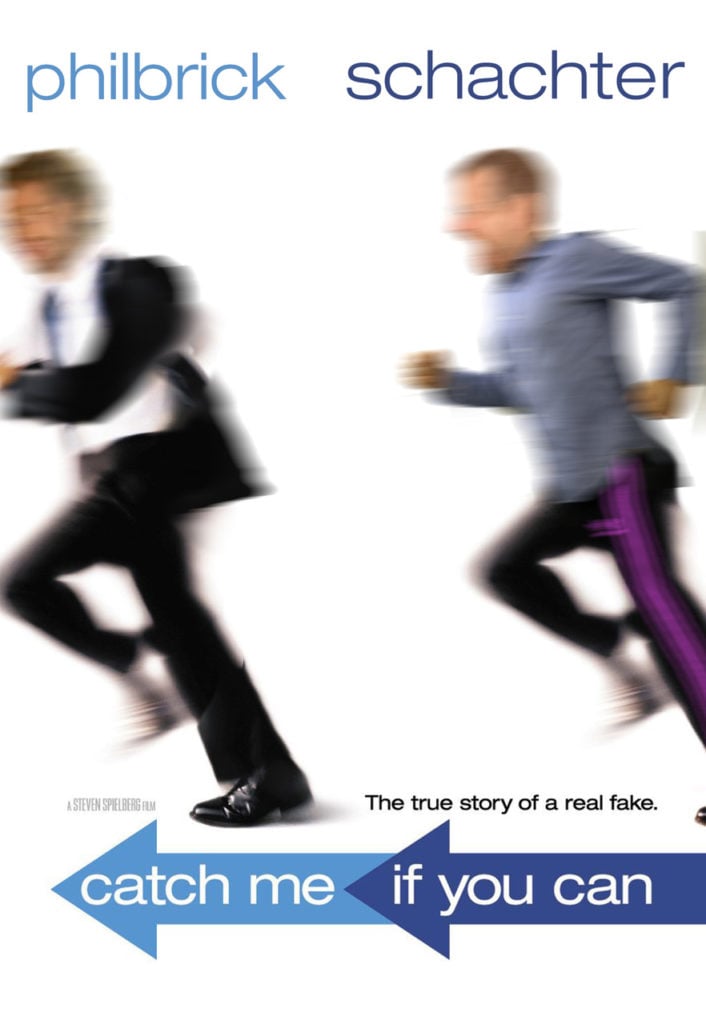
Getting much closer to a theater near
you! Courtesy of Kenny Schachter.
The “Banality” Bailout
Back to non-me-related news, here’s a
sobering eye-opener regarding the practices of another bloated art
business, that of Jeff Koons LLC, the art-star enterprise long
linked to the Mnuchin family, with Koons having exhibited at Bob
Mnuchin’s gallery at least six times since 2001.
According to the U.S. Department of
the Treasury, headed by Bob’s son Steve Mnuchin, “the Paycheck
Protection Program established by the CARES Act, is implemented by
the Small Business Administration with support from the Department
of the Treasury. This program provides small businesses with funds
to pay up to 8 weeks of payroll costs including benefits. Funds can
also be used to pay interest on mortgages, rent, and utilities.”
And guess who is said to be the recipient of just such payroll
payola? None other than Jeff Koons, an artist personally worth
hundreds of millions of dollars, who is well known for replacing as many of
his employees by robots as (post)humanly possible.
Koons’ studio spokeswoman has yet to
respond to my email query at the time of publication, but several
past and present employees have personally related to me that Koons
is mean and mercurial and hasn’t raised wages in at least four
years. In other words, don’t be fooled by the sweet saccharine
platitudes that pour from the artist’s mouth for the media,
preaching cultish gobbledygook drivel about happiness and
transcendence that obviously doesn’t apply when it comes to his own
staff.
In conclusion (for now anyway), I
can’t really complain about much other than the financial
insecurity. Thankfully my son Adrian has recovered from his
six-week battle with a light case of corona, and I’ve been catching
up on years of missed sleep, and I’m no longer the TV and movie
illiterate I once was. Since the administration keeps harping on
the notion that the virus originated in a Chinese laboratory, I
wonder if it was all part of a nefarious conspiracy to make the
developed world more morbidly obese than it already is. Besides
that caveat, who in their right mind is going to want to go back to
the harried pace of the past?
I’m kind of getting used to going
nowhere fast, or rather slowly. Call it turtling. Courtesy of Kenny
Schachter.
I will particularly miss my weekly SVA
class, which acted as a steady signpost in an unclear, uncertain
world—something to look forward to, to organize my life
around. Though I almost quit the day before it began in the
midst of the pandemic—I’m hopeless at technology and had an acute
case of zoomaphobia—it was just about the best art experience
I’ve had to date. By the way, here’s the short essay I
wrote for the Instagram show I curated as a gift for my
students. And. on that note, I’m looking for similar such teaching
work… unless SVA will have me back next semester, whether in class
or in the ether.
Some Parting Words
SAVE
STRENGTH
Use weakness as a way to people, not strength.
It’s a way of moving
I want to cry, but keep laughing.
– Paul Thek’s
sketchbook, page 1969
In these tragic times, where we exist under a global lockdown,
in an unprecedented state of fear (even more than usual), with
countless lives prematurely lost, Paul Thek and his notions of art
are more relevant than ever. Yes, we are universally compromised,
but out of the heartrending upheaval and sickness the stream of
creativity continues unabated (or, at least, only partially
abated). The Instagram show of the School of Visual Art students
from my senior studio workshop is proof that, despite the
COVID-driven cancellation of their final academic exhibition, we
can still wend our way to an audience.
Though Instagram and online viewing
rooms are in general a (very) weak substitute for looking at art,
to quote Malcolm X: “By any means necessary.” The SVA students’
works were crafted in bedrooms, in hallways, in showers, and on
stovetops (literally) but nevertheless were completed despite the
students being robbed of physical studio space. In art schools 20
years from now, I can imagine an assignment simulating quarantine
and forcing students to make do with nothing more than what
surrounds students at home. The art they created is characterized
by love and blind faith—conviction and devotion make for some
mighty effective art supplies.
This class has been a revelation for someone like me, mired in
the daily machinations of fairs, auctions, and the market in
general. Being self-taught (in what, don’t ask), this is the first
studio class I’ve ever been a part of, let alone taught. Typically,
in the art business, no one wants to hear about art, only who’s
buying, selling, and showing it. I will surely miss the class and
students and hope it won’t be the last.
The post The ‘Banality’ Bailout? In a Locked-Down Art World,
Jeff Koons Chases Government Cash, Flippers Persist, and Kenny
Schachter Takes It Easy appeared first on artnet
News.
Read more https://news.artnet.com/opinion/kenny-schachter-on-jeff-koons-studio-bailout-1852125
Further reading


Leave a comment