
The Art Market Is Hoping a Crush of Post-Lockdown Art Fairs Will Come to the Rescue This Fall. But Many Collectors Say They Won’t Go
This September, according to current plans, the postponed
edition of Art Basel will come to the picturesque Swiss city on the
Rhine, a few months late but very much welcome after a long period
of global lockdown. The night before the VIP preview, collectors
and gallery honchos will check into the Grand Hotel Trois Rois and
belly up to the bar for €40 martinis. Ducking outside to gaze at
the river, cigars in hand, the art-world cognoscenti will notice
the air is just a tad chillier than it is in June, when
the fair is normally held. And the next morning, billionaires will
swarm the Messeplatz at 11 a.m. sharp, ready to jostle for art in
person after months of staring at it on a screen.
To which you might be saying: Fat chance. A
close-quarters bar at a grand hotel of Old Europe is tough to
conjure from the cramped apartment where you may be reading this.
And yet Art Basel and other fall fairs—including Expo Chicago, the
Dallas Art Fair, Frieze London, and Paris’s FIAC—are still
technically scheduled to proceed, with the fairs in Dallas and
Basel pushed from their originals slots in April and June.
But even the once-bullish fair runners admit that the situation
is up in the air. In an unusually candid letter to exhibitors sent
Tuesday, Art Basel directors Marc Spiegler, Adeline Ooi, and Noah
Horowitz openly floated the idea
of cancelling not just Art Basel in September, but also Art Basel
Miami Beach in December.
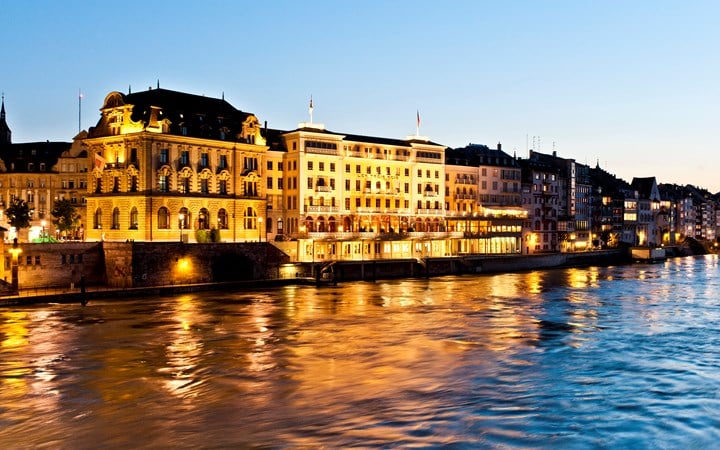
The Grand Hotel Trois Rois, referred to
colloquially as the Three Kings. Photo courtesy: Leading Hotels of
the World.
“When will there be significant confidence among collectors,
museum professionals, and other members of the art world when it
comes to traveling and congregating?” the letter asked.
In an attempt to answer such a question, at least with regard to
the fair schedule in September and October, I spoke with a dozen
advisors, collectors, dealers, and insiders, and something of a
consensus emerged. It’s bleak.
Many were certain that the fall fairs would have to be postponed
further or cancelled outright—and if they aren’t, they are likely
to be far emptier than usual. “It’s completely unlikely that anyone
will accept the risk, before a vaccine or cure, to put 500 people
until one roof,” said Alain Servais, the collector and
investment banker who once upon a time attended more than a dozen
fairs and biennales each year. Looking ahead, he has booked travel
to attend exactly zero.
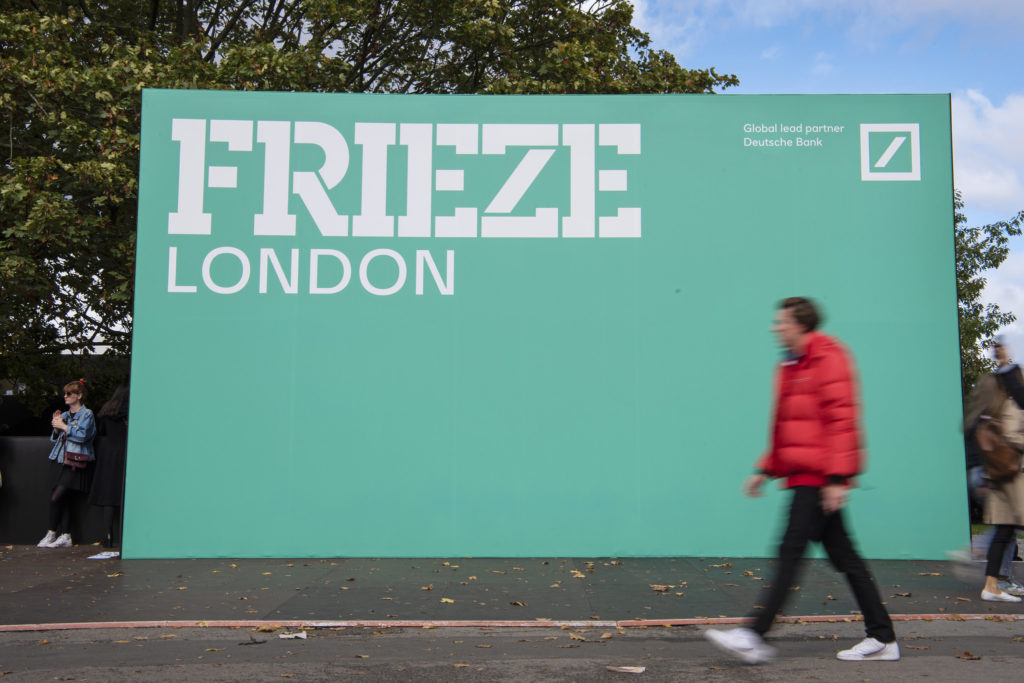
Frieze Art Fair 2019, London, UK. Photo
by Linda Nylind.
Hypothetically Speaking
Long-term, the black-slapping ways of the art market will have
to change dramatically. It’s a handshake-deal business in a
post-handshake world. Whenever fairs reopen, they’ll be contactless
and fear-filled, a much more sterile, sober jaunt than the chummy
camaraderie of years past.
“We will have to give up the three kisses we are used to in
Switzerland,” said Eleanor Cayre, the Manhattan-based art advisor.
“I can picture the galleries sponsoring hand sanitizers and masks
instead of the usual tote bags. Maybe latex gloves with your
favorite gallery’s logo printed on it?”
Cayre has her usual Basel digs booked at the Dorint, and will
“happily” go if the fair is held. She’s already had the virus—with
antibodies, there’s no need to worry about contributing to its
spreading or contracting, at least for a few months—and what’s
more, she said she’s been moving pretty significant works
lately.
“If the quality of the work being offered is high, like it
usually is in Basel, then I think galleries have potential to do
well,” she said. “The treasure hunters are out in force right
now.”
Likewise, the dealer and advisor Paul McCabe, based in Milan but
quarantined in St. Moritz, said he would make the trek to Basel if
the fair’s still on, though, admittedly he has less of a trip to
make than most. “It’s hard to keep me out of the ring,” he said. “I
must find good works for the clients, even with a face mask and
sunglasses.”
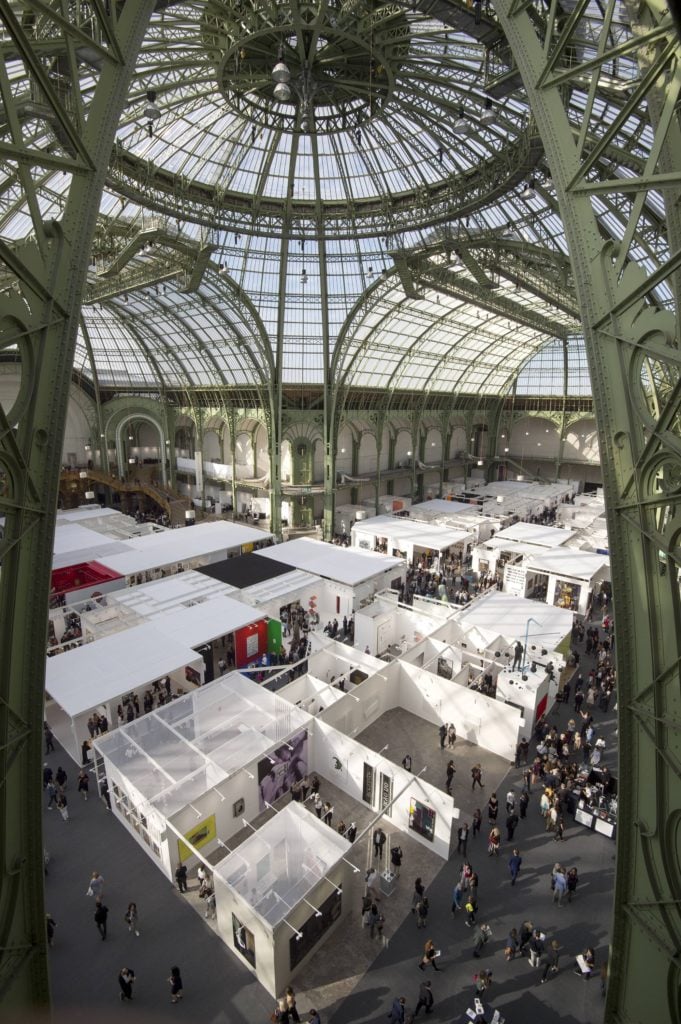
FIAC at the Grand Palais. Photo by Marc
Domage.
But many others said that, for a variety of reasons, they would
not attend the upcoming fairs even if leadership decides to move
forward.
Cash-poor galleries don’t have the financial muscle to plan for
overseas travel. Reps at established shops (who wish to remain
nameless) have run the numbers and think it doesn’t make sense to
trek around the world if clients—many of who are elderly, and at
risk—largely won’t show up.
Some buyers say international art fairs feel increasingly
discordant with a moment when they want to focus on buying locally.
“Putting aside all the unknowns that make international travel a
safety and logistical issue, I think people are going to feel a
sense of responsibility to their local economies and communities,”
said the advisor Alex Glauber. “In an environment like this,
transacting with a local business is a literal and figurative vote
for them to stay open. The thirst for culture and community has a
local solution that doesn’t require an international flight to an
art fair.”
For others, the optics alone would be tantamount to
self-sabotage. Flying to a fancy art fair? In this economy?
“Candidly, I’d be embarrassed to admit to partaking,” collector
Scott Lorinsky said. “Consider how entirely ridiculous it would
sound returning to your office afterward!”
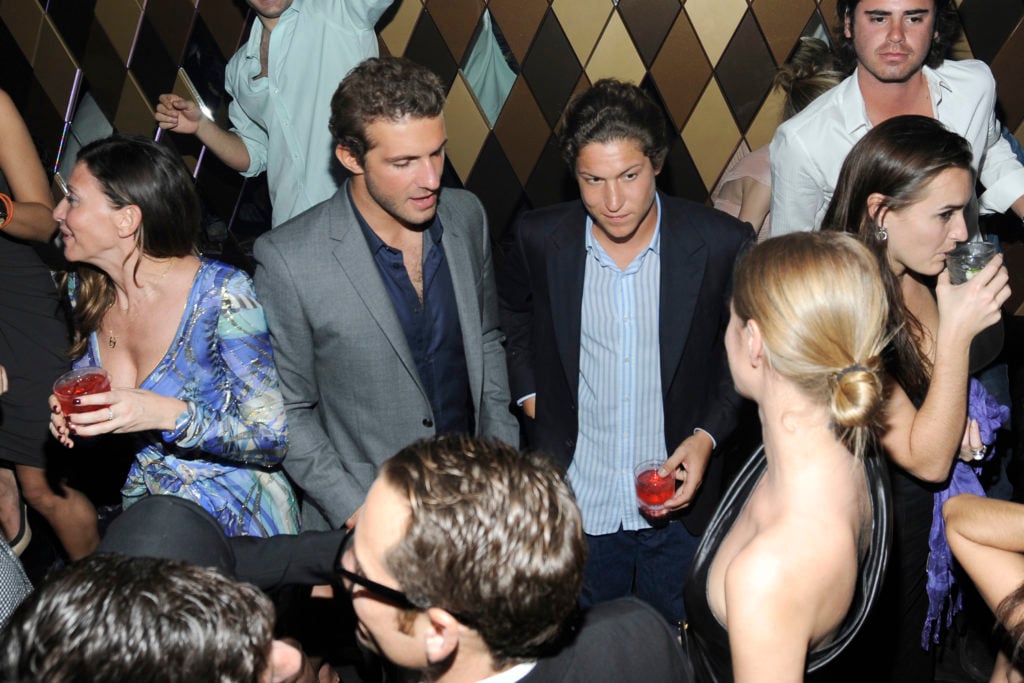
Stavros Niarchos and Vito Schnabel
attend Party at WALL at the W SOUTH BEACH on December 3, 2009 in
Miami Beach, Florida. (Photo by BILLY FARRELL/Patrick McMullan via
Getty Images)
Elegy to Schmoozing
The art world has long been a deeply social milieu, one where
wealthy patrons are drawn in by the promise of proximity to
artistic minds—and, perhaps more than anything, exclusive VIP
access to glamorous international art fairs and parties. And if a
social-distance-ified fair cuts out the vigorous networking and
shoulder-rubbing, some say it’s not worth going. You can’t drink
champagne with a face mask on.
“A social distance art fair defeats the purpose of an art fair,”
said Daniel Oglander, an art advisor based in New York who
regularly attends fairs in Los Angeles, Hong Kong, and across
Europe. “They are social events, and I for one am not looking
forward to more half-assed elbow taps and heel clicks.”
Even the more agoraphobic collectors are getting misty-eyed over
the lack of triple-booked evenings spent popping canapés during
fair weeks. In 2011, the collector, dealer, and writer Adam
Lindemann penned a viral article for the New York Observer
proposing a boycott of Art Basel Miami Beach due to the
infiltration of hangers-on who never even make it to the fair. “Let
them sell us nothing this year, and we’ll watch with glee as the
whole circus dries up and shrinks right down to the size of a pup
tent,” read one of the tamer lines of the column.
Now, even the author of “Occupy Art Basel Miami Beach, Now!” is
pining for the halcyon days of Magic City madness.
“I was making fun of the way the social aspect of the art fair
had taken over the art fair, but in retrospect, we’ll take ’em
however we can get ’em,” Lindemann said recently. “Over half of the
art world’s appeal is the social appeal. You take the social aspect
out of the art fair, were going back 30 years.” (Online fairs
were not considered a viable solution. “How much art can you look
at online?” Lindemann asked. “There’s a saturation point.”)
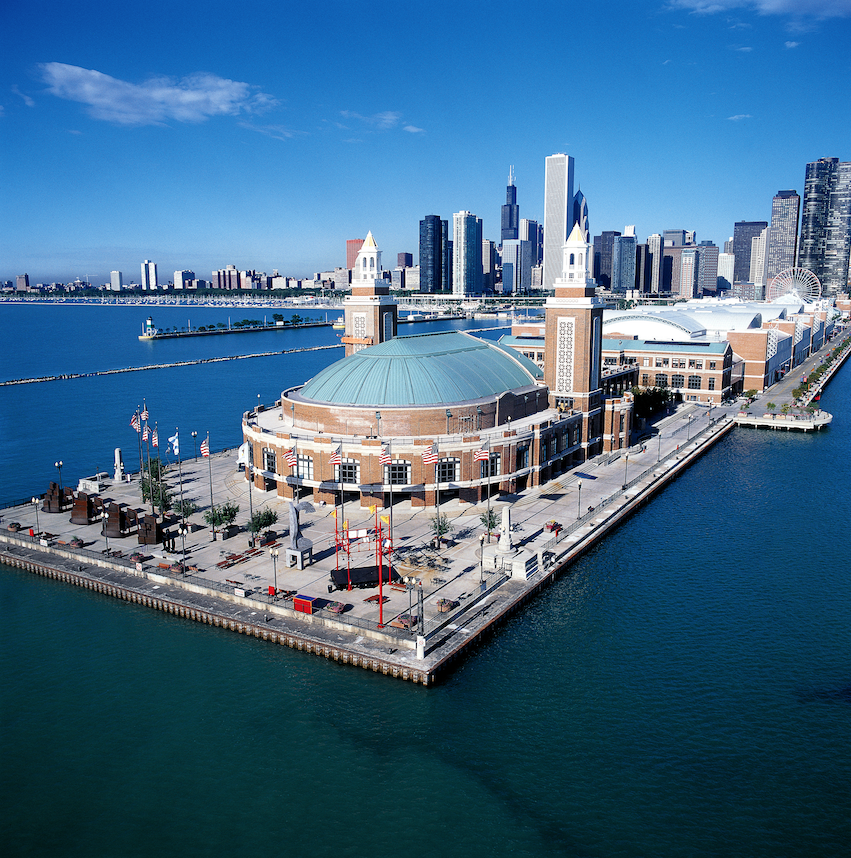
Navy Pier on Lake Michigan in Chicago,
the home of Expo Chicago. Courtesy Chose Chicago.
What stings for Lindemann the most is that, after years of
trying—and decades of attending as a collector—he scored his
gallery Venus Over Manhattan a coveted spot at Art Basel. He
planned to make his debut on the art market’s grandest stage with a
glorious display of large works on paper by Peter Saul, who was set
to travel to Switzerland to boot.
After years of waiting, he might have to wait one more.
“When you get onto the waiting list it’s like the hazing at a
fraternity or getting into a club,” Lindemann said. “So for us to
not go to Basel is a terrible disappointment.”
Lifting the Bans
All these reasons to avoid fairs will be moot if the fairs
themselves are cancelled. And there’s a good chance that,
logistically, fairs can’t exist for quite some time. The World
Health Organization has classified conferences as mass gatherings,
putting them in the same category as the Olympics, which was pushed
to 2021—but now might be pushed
back until 2022, or canceled outright. In the US, states will
determine individually when to permit gatherings of more than 50
people, which have been categorized by the Trump Administration as
part of phase three of the reopening process. But there’s no
indication that, say, Illinois will have lifted the restriction in
time for Expo Chicago to open in September.
And in Europe, French president Emanuel Macron has proposed
extending the ban on foreign travel into the Schengen Area through
September, which would make it impossible for any American or Asian
collector or dealer to come to Basel for the fair. Extend the ban
another month, and the same goes for Frieze London and FIAC. If
Trump extends his ban on travel from Europe, collectors and dealers
over there can’t get to Dallas or Chicago.
Even when the borders are open up, fear of flying is likely to
be so pervasive that perhaps only an, um, particular tax bracket
could even come. “Those who came on a private plane, they
feel computable,” said Lindemann. “It’s their aircraft and their
crew.”
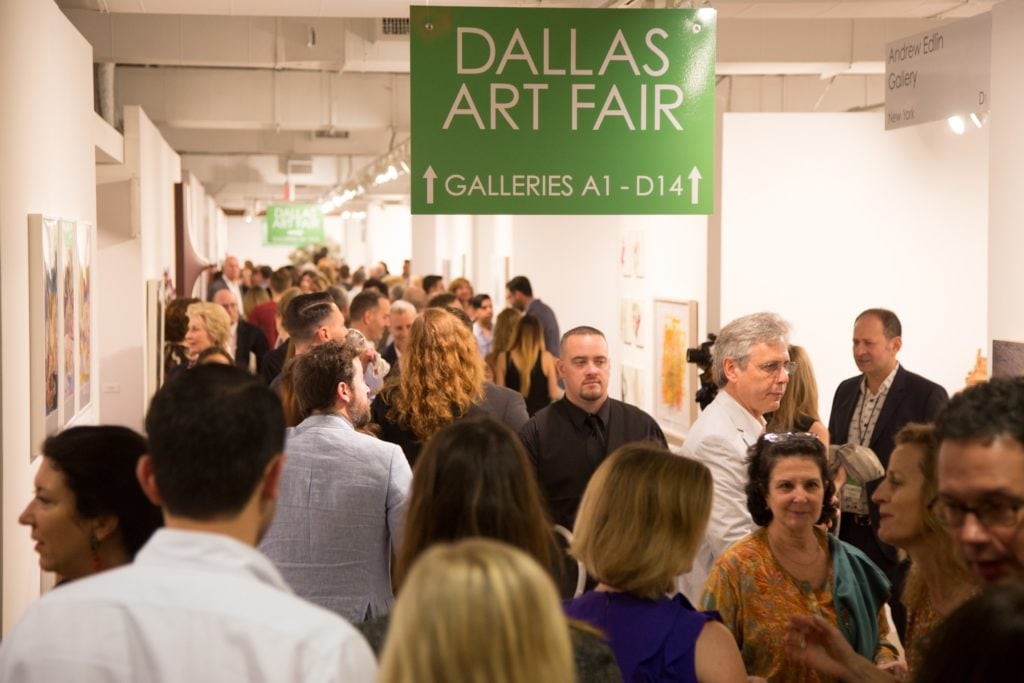
Photo: Dallas Art Fair.
The one moment of real optimism in Basel’s recent letter came
when the fair’s leaders mentioned that Switzerland is getting ready
to open up some retail stores, and soon, galleries would be able to
let in limited numbers of visitors. In Berlin, galleries are taking
appointments for pairs of people to book 30-minute viewing
slots. These signs of life, with more than four months until the
fair in Basel, are encouraging data points for those who want to
believe that these fairs will still happen.
But as many pointed out, there’s a difference between social
distancing in an empty gallery and a convention center where
everyone’s breathing the same air. Servais said he’s excited to
start going to galleries as early as May, but cannot bring himself
to consider attending something like Art Basel.
“We all want to go back to a normal life, but we’re all aware of
the risks—this is a real shit sickness,” he said. “It’s hitting
whoever. We all want to go, but we have to say to ourselves: ‘Why
am I gonna take a risk?’”
The post The Art Market Is Hoping a Crush of Post-Lockdown Art
Fairs Will Come to the Rescue This Fall. But Many Collectors Say
They Won’t Go appeared first on artnet News.
Read more https://news.artnet.com/market/death-of-art-fairs-1847514
Further reading


Leave a comment