
Ten Years Ago, Artist Jeffrey Gibson Almost Quit the Art World. Here’s How He Found the Will to Keep Striving
In the light-filled gymnasium of
an old schoolhouse in Hudson, New York, a punching bag adorned with
neon beads and tassels hangs near a long-forgotten basketball hoop.
A totemic sculpture stands in a carpeted classroom and masks are
strung through the woodshop.
This is the studio of Jeffrey
Gibson, a Choctaw-Cherokee artist known for his signature hybrid
of Native American
iconography and materials with late-capitalist aesthetics. It’s
Indigenous Futurism, to borrow a label posited by Anishinaabe
writer Grace L. Dillon: the regalia of pow-wows meets that of ‘90s
rave culture, while quilted tapestries are patterned with Op
art.
“People think I know what’s
going to happen when I produce a new body of work, but I don’t,”
Gibson says, sitting at a desk in what was, presumably, the
principal’s office. “For someone who works across as many materials
and formats as I do, I have no idea how something is going to
resonate when I’m producing it. I just don’t. And that’s
okay.”
Gibson, a professor at Bard
College, purchased the schoolhouse back in 2016. A team of
roughly a dozen assistants are stationed throughout the building,
each working on different projects dreamed up by the artist. They
talk about Gibson less like a boss and more like a father figure—or
maybe a fun uncle. And there’s plenty to keep them
busy.
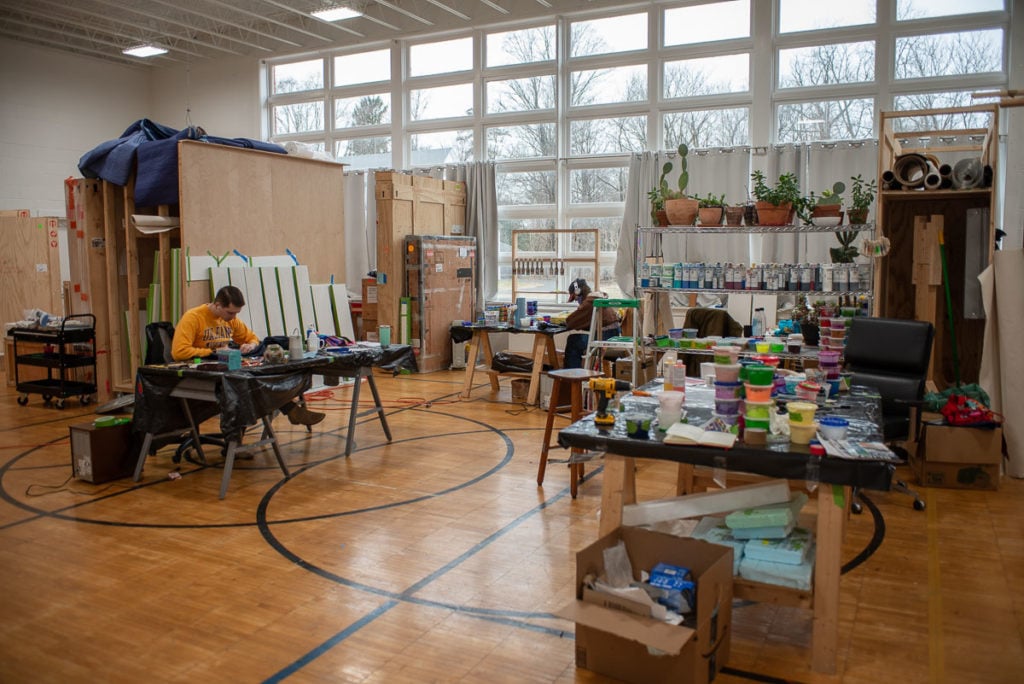
Gibson’s studio. Photo: Taylor
Dafoe.
Over the past few years, Gibson
has had separate solo shows at more than a half dozen museums,
including a major mid-career survey that traveled to four venues.
He was awarded a MacArthur genius grant, an honorary doctorate, and
included in the 2019 Whitney Biennial. Today, his calendar is
busier than ever.
The artist, who turns 48 this
month, currently has a show at the Brooklyn Museum and a series of
works on billboards in Times Square. And over the course of the
next year, he will open exhibitions at Roberts Projects in Los
Angeles and Sikkema Jenkins in New York and will be included in
shows at the Parrish Museum, Socrates Sculpture Park, and several
other venues.
Yet 10 years ago, Gibson
considered giving up art altogether.
Shortly after the opening of his
exhibition at the Brooklyn Museum, Gibson invited Artnet News to
his studio to talk about the evolution of his practice and the
critical juncture in his career when he went from nearly quitting
the art world, to being one of its most buzzed-about
artists.
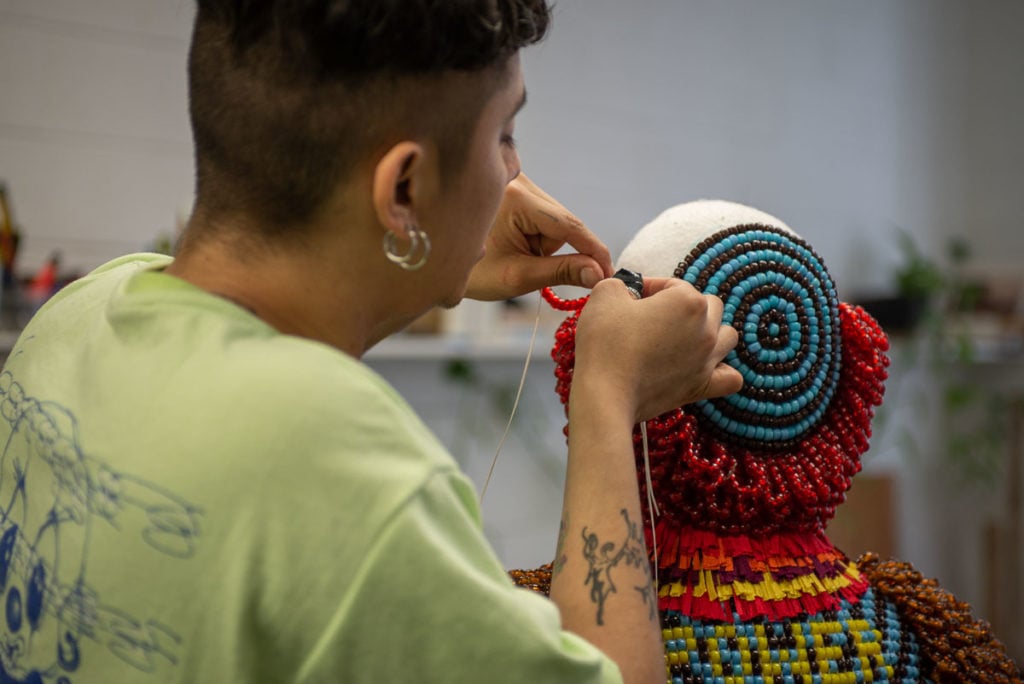
An assistant working in Gibson’s studio.
Photo: Taylor Dafoe.
You’ve lived and worked in this area since 2012. What was
your studio like before that?
I had a small studio space in
the Brooklyn Navy Yard. It was less than 300 square feet. You could
probably fit two and a half of them in this room.
Around 2010, I went out to San
Francisco to teach at the California College of the Arts. From
there, my husband and I really didn’t know what we were going to
do. We were looking for change, so we moved to France for about
half a year. Then we decided we wanted to come back to the East
Coast, but not necessarily to New York City. I got the position at
Bard, and we were just like, “Well, let’s just give it a go. We’ll
move to Hudson and we’ll see how it goes.” For the first five
years, it was a check-in. “What do we think? Is this someplace we
could stay?” Then it just kind of unfolded from there. We had kids
and bought our house and bought this building. It seems to be the
right mix of things for us.
I imagine the move had a big impact on your practice, if for
no other reason than the immense difference in size and
space.
It did. Living in Brooklyn at
the time, I kind of felt like I was experiencing what I could
imagine experiencing there for another 20 years. You show your
work, you might sell some of it every now and again, you might get
a grant occasionally. But really, I felt like we had hit a sort of
ceiling of potential due to the cost of living, the limited space,
all of that sort of stuff. I also wanted to minimize distractions.
I felt like, with the development of myself as an artist, I really
needed space—both physical space and mental space—to be able to
think through ideas and develop them. Voices get in my head very
easily. I just had to remove them for myself.
New York City tends to hold
people in a somewhat infantile place. Moving up here, immediately
it was like someone turned on the switch where you get to move into
the rest of your life. I think that has, for one, made me a
happier, calmer person. It’s also given me a perspective to think
in a much larger way. I think the work will follow that. It is
following that.
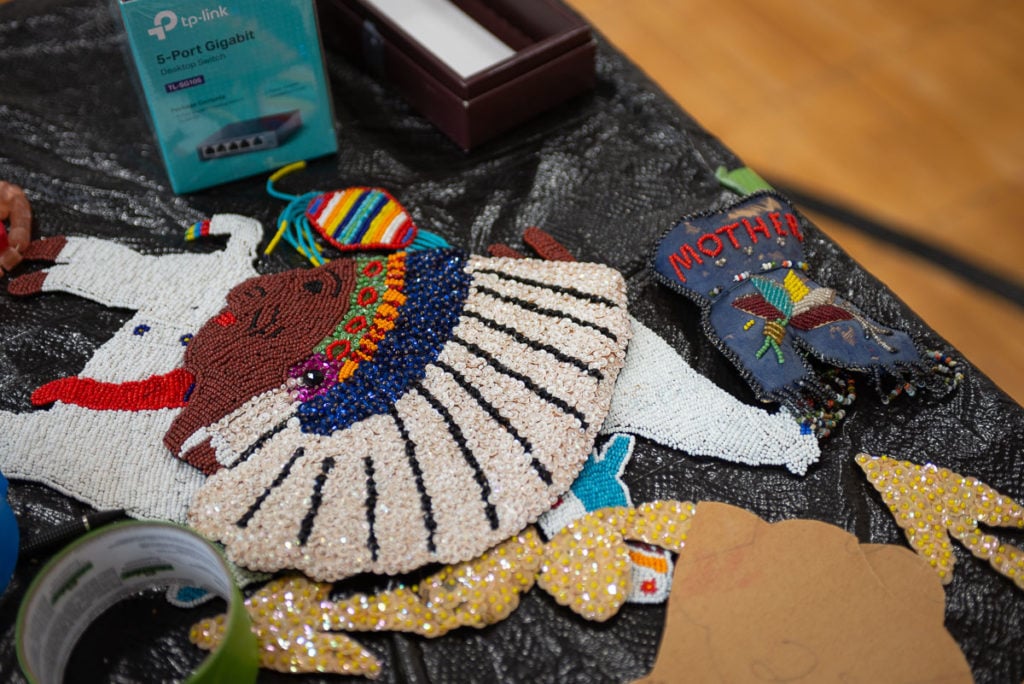
Details from Gibson’s studio. Photo:
Taylor Dafoe.
In its invocation of craft and traditional forms of
art-making, your work emits a sense of intimacy—it feels like it
was labored over by the artist’s own hand. How do you maintain that
feeling while working with a team of
people?
It’s really what necessitates
having a team. I realized early on that I’m drawn to handcrafted
objects. There’s an intimacy that’s triggered just by looking at
them. There’s something
about the labor and the detail that is seductive. I knew that I
couldn’t put out only six pieces a year and expect to accomplish
what I wanted to. So that’s where the studio team started being
assembled.
I sought people who enjoy
handcraft and who understand the meditative quality of it. I don’t
want to overemphasize how much craft is connected to trauma and
healing, but you find handcraft in a lot of situations where people
need to refocus and find transformation. Doing it, you really build
the skill of being able to conceive, initiate, and complete. That
was something that I was drawn to and would speak about. Especially
when I would visit more traditional makers in native communities,
people’s attachment to sewing, beading, quell work, any of those
things—it really is a meditative, cathartic process of making
something. I wouldn’t say that’s necessarily me wholly, but it was
at the beginning and now it’s transformed into something else. Even
when I think about concepts now, I think about the craft of
concepts.
When I first started assembling
the team of people who work here, I talked to them very clearly
about the goals of the studio and one of them was that I can’t be
sitting there doing beadwork work anymore because I need to be able
to do research and experiment. I need to be able to fail. By this
point, the studio team is very skilled and our communication is
remarkably fluid.
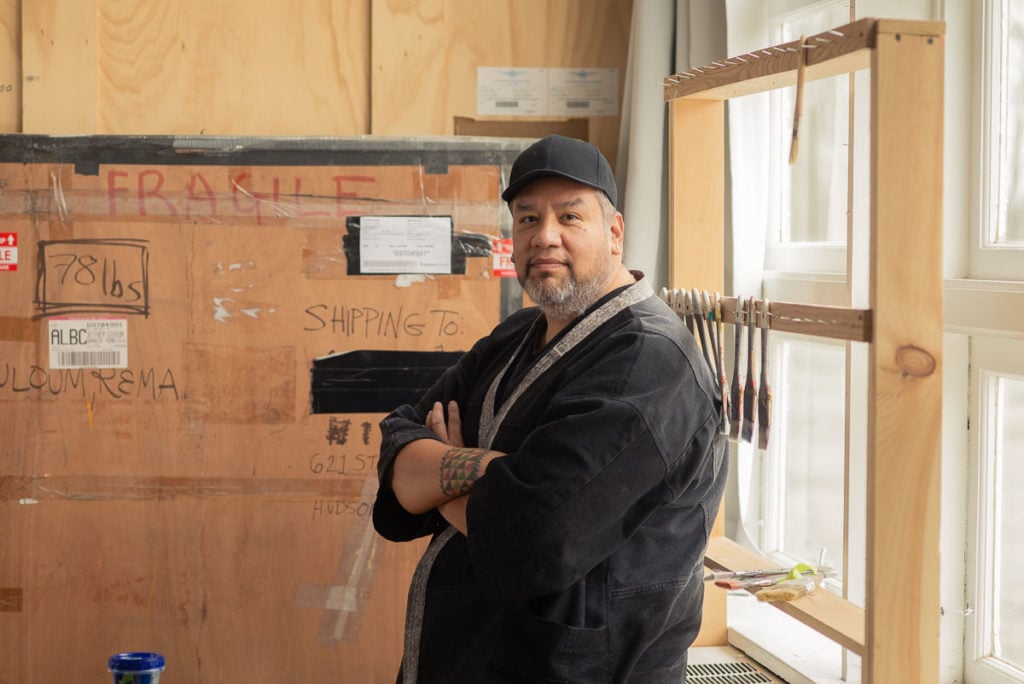
Jeffrey Gibson in his studio, 2020.
Photo: Taylor Dafoe.
There was a time when you considered giving up your practice
altogether, right?
Yes, in 2010 and ’11, I was
trying to decide if I wanted to continue being an artist. I was
just fed up. When we were in Europe and when I was in San
Francisco, I did not allow studio visits. I was really trying to
discipline myself not to consider what the art world wanted but
instead think about what it was that I wanted to make. What was it
that I thought was important to exist?
Then, while traveling in Europe,
I got a call from Lia Gangitano at Participant gallery. I always
thought it was a brilliant space and that she is amazing. And I
said to myself, “If I was ever going to do a solo show, that’s
where I would want to do it.” So when she called and said I’d like
to do something together, I was thrilled. And Matthew Dipple, who
then ran a space called American Contemporary, also contacted me,
and so we ended up doing two shows that opened on the same night in
early 2012. It really was the first time, in my opinion, the work
really resonated with an audience. They finally got it. They got
the mix of materials, the mix of narratives. And there was a really
great review that came out. So after wanting to walk away from
being an artist, it was the exhibition that showed me it was
possible to work with the art world and talk to its
audiences.
Do you feel that was more to do with the evolution of your
practice or the evolution of the audience?
I don’t really know what the
circumstances were that allowed that to happen, but it did.
My training is as a painter and my
love is process-based abstraction. To try to combine narratives
about Native American material culture and history into that kind
of abstraction—no one has ever been able to show me how to do that,
nor have I ever really seen it. So I think when I exited New York
for that period, that’s what I was figuring out. One of the
realizations I came to was that I have to use language that people
can comprehend. If it’s so subjective, it may be great and
cathartic for myself, but it won’t be legible to
others.
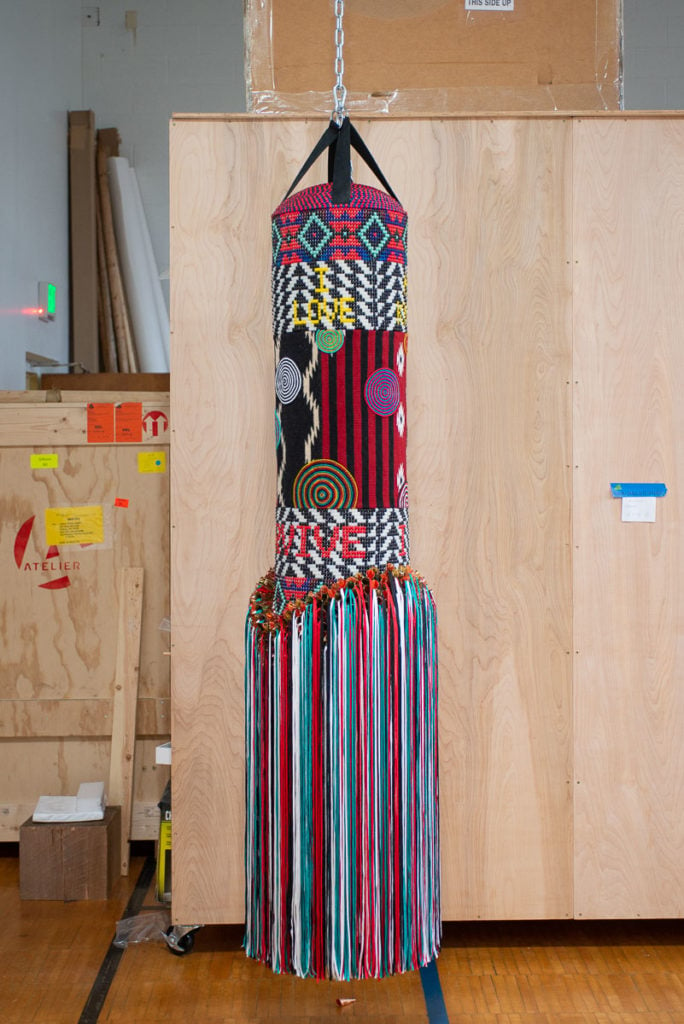
Details from Gibson’s studio. Photo:
Taylor Dafoe.
Do you ever feel pressured to perform identity politics in
your work? Or do you get frustrated that people put that narrative
onto it?
I know that people will put it
on it. I just take that as a given circumstance. I learned that
growing up. You honestly cannot be a brown person in a white
environment and not be asked, “Where are you from? What are you?
Where’s your family from?” People have thought that I strategically
use the label Native American. They’ll ask me, “Why would you
identify as a Native artist?” And I say, “Because I’m always going
to get asked.” And I truly am drawn, for instance, to beadwork and
quilt work and that kind of design and material use. The problem I
had when I was painting was that I was somehow translating those
very specific references into abstraction, and in that translation,
the whole narrative was lost for anyone who wasn’t with me. So
that’s when I started asking okay, “How can you trim down the
references and be more direct with what you’re talking
about?”
It’s about being very aware of
the circumstances that art exists in. It goes back to the
communication thing. I want people to pull things out of the work.
There’s an openness to a lot of the texts that I use that I think
people can project themselves and their own experiences onto, which
is the way that pop music works and one of the reasons it sticks
around. There’s something about it that makes it feel like it’s
just about you in that moment. That’s one of the things that I
really shoot for. And I’ve always counted on the fact that there
have to be more people like me in the world. Yes, I’m unique, but
I’m not so unique that other people are not like me. We all
experience hybridity. We all experience vulnerability, love,
fear.
See more photos from Gibson’s studio below.
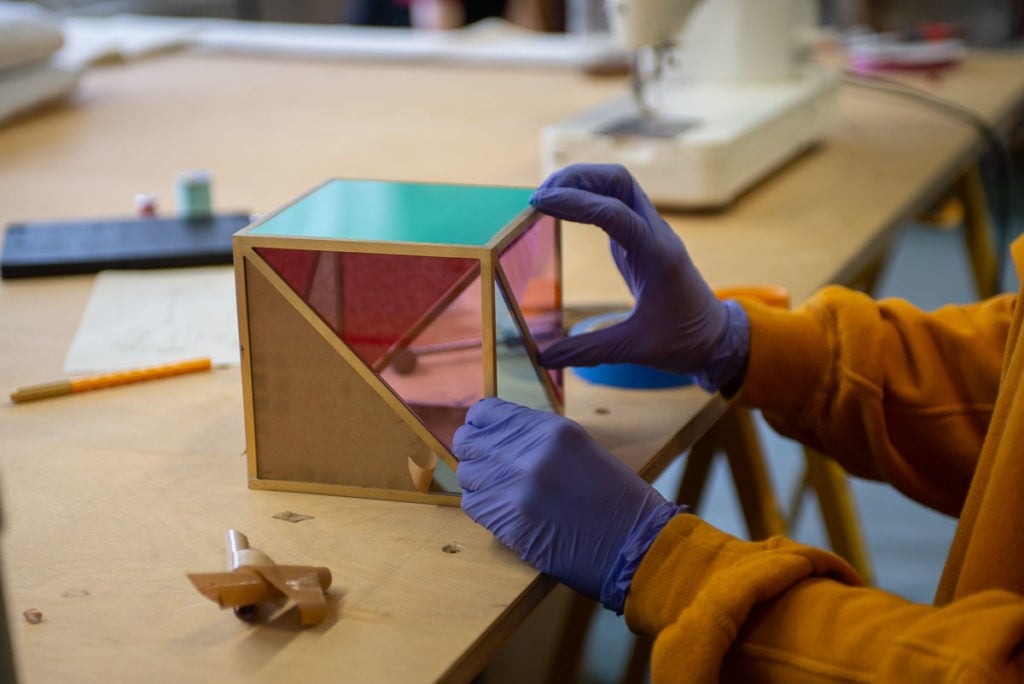
An assistant working in Gibson’s studio.
Photo: Taylor Dafoe.
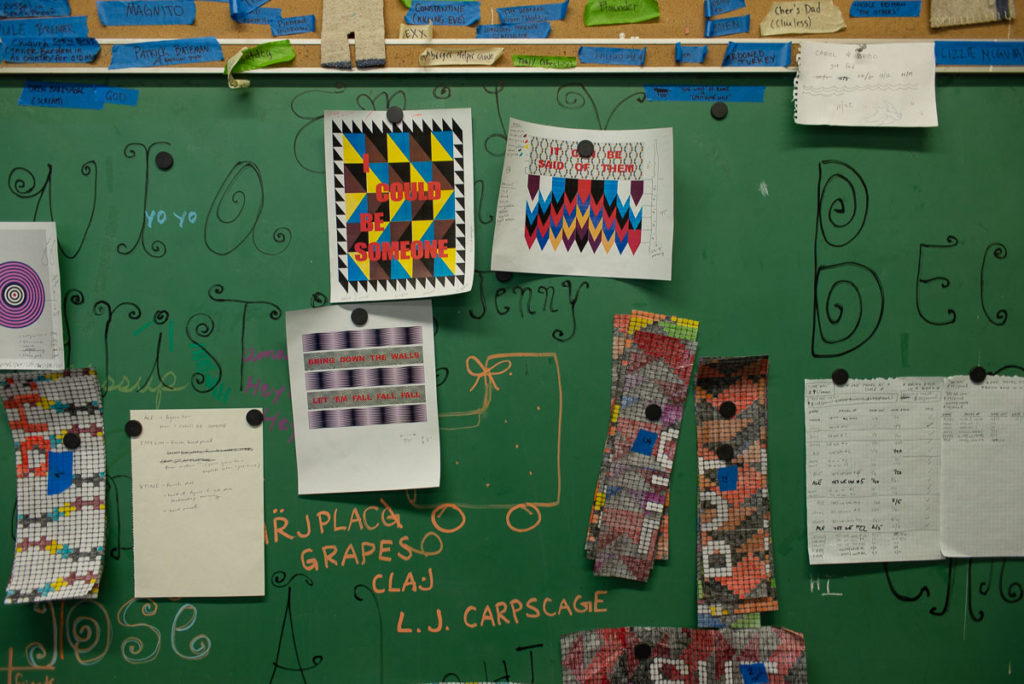
Details from Gibson’s studio. Photo:
Taylor Dafoe.
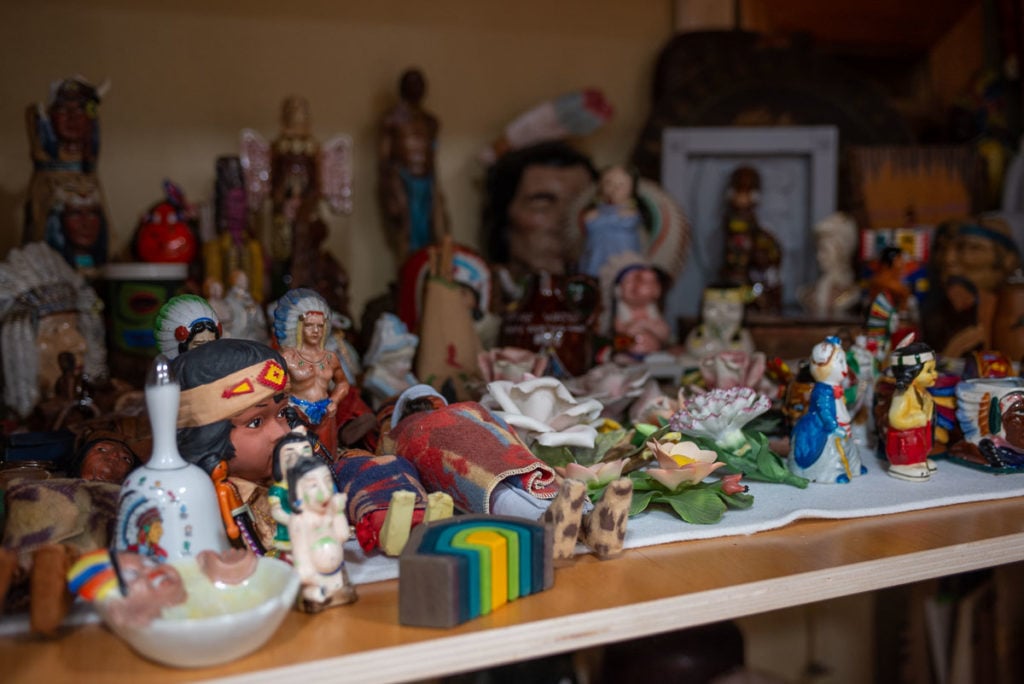
Details from Gibson’s studio. Photo:
Taylor Dafoe.
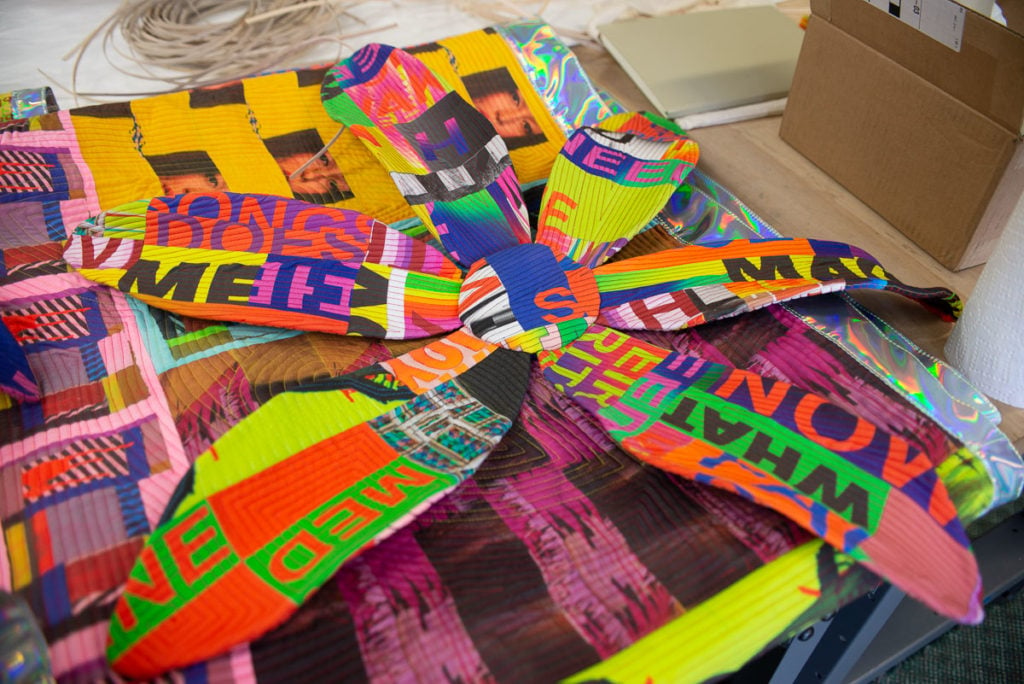
Details from Gibson’s studio. Photo:
Taylor Dafoe.
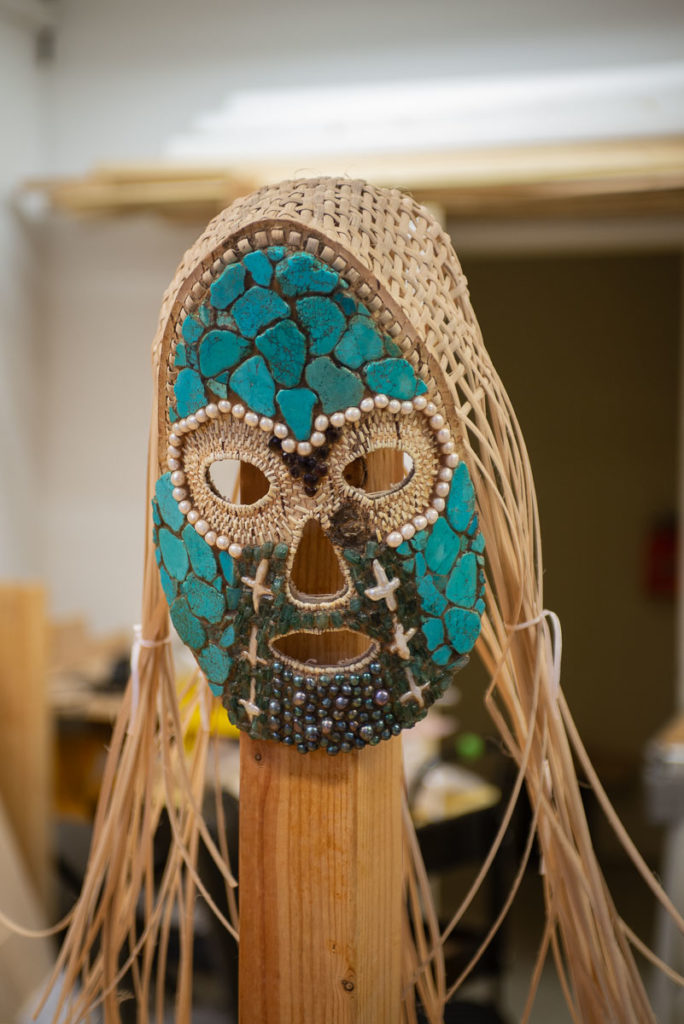
Details from Gibson’s studio. Photo:
Taylor Dafoe.
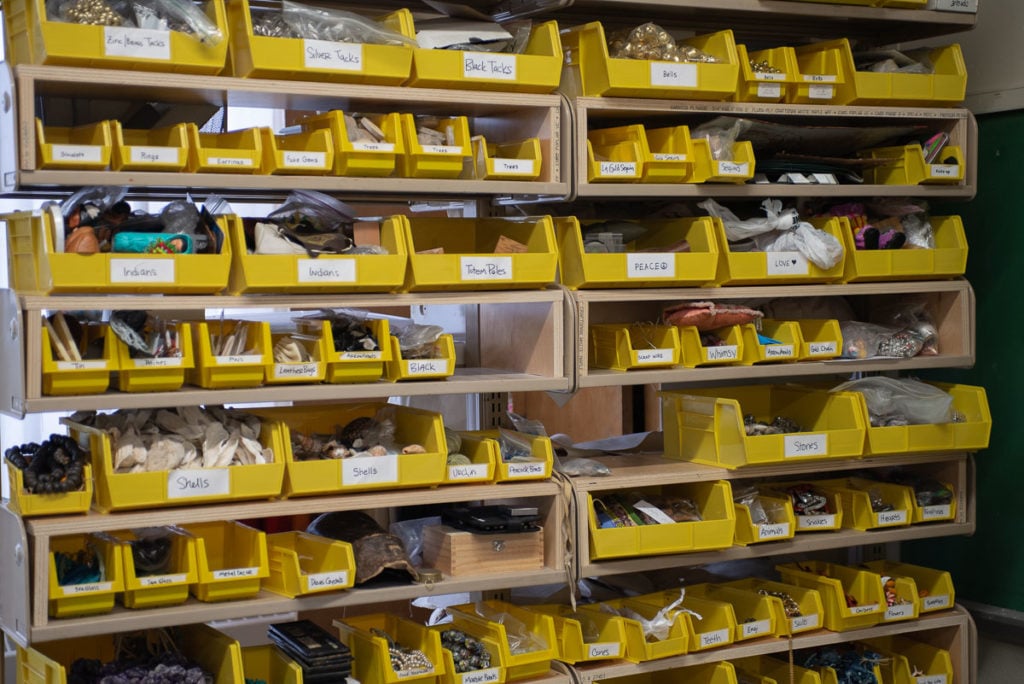
Details from Gibson’s studio. Photo:
Taylor Dafoe.
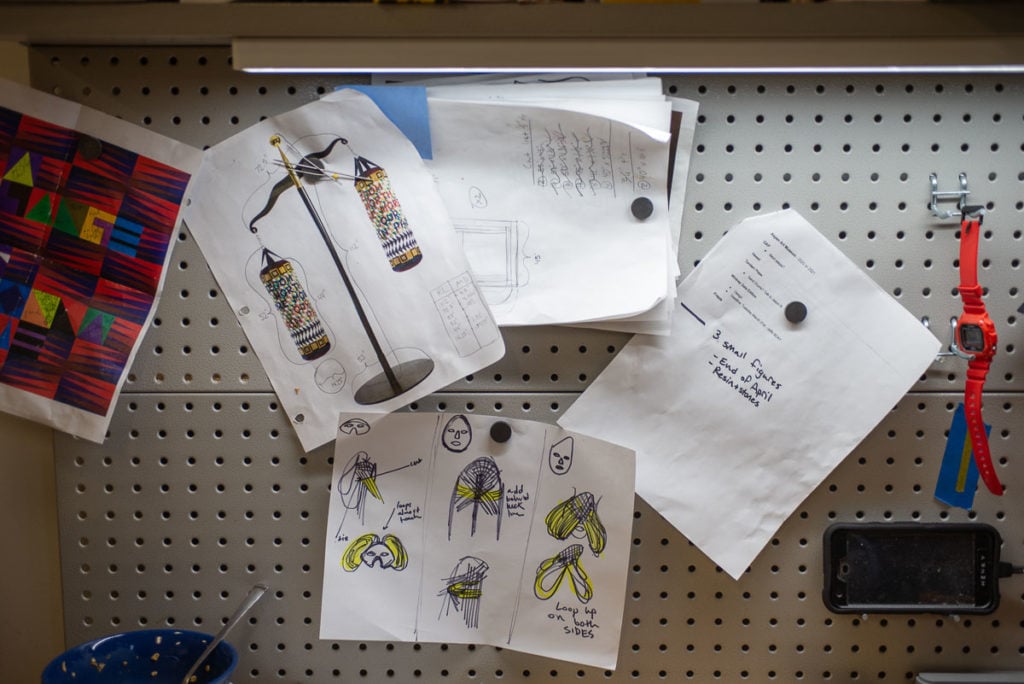
Details from Gibson’s studio. Photo:
Taylor Dafoe.
The post Ten Years Ago, Artist Jeffrey Gibson Almost Quit
the Art World. Here’s How He Found the Will to Keep Striving
appeared first on artnet News.
Read more https://news.artnet.com/art-world/jeffrey-gibson-interview-1814940
Further reading


Leave a comment