
Smithsonian Curators Have Been Planning a Show About the History of Disease for Months. They Say They’re Not Surprised by the Current Pandemic
The Smithsonian Institute’s National Museum of American History is
planning a timely new exhibition about the history of disease and
how it has shaped our nation—and curators had it in the works well
before the current pandemic.
“We thought we would had to do a great deal of groundwork to
help people understand,” Alexandra Lord, curator of the
museums’s division of medicine and science, told Artnet
News. “Now, when visitors walk into our exhibition and see
quarantine signs, they will have a greater understanding of what
quarantine means—not just the word, but the feeling of being cut
off.”
Although no one at the museum expected anything to happen on the
scale of the novel coronavirus, the curators were already designing
the exhibition keeping in mind that it should be forward looking
and address the ongoing effects of disease in the US today.
In planning the new longterm display,
arranged chronologically, curators expected that the last
section of the show would need to be continually updated. “We’re
not that surprised, because disease has always played a major role
in America history,” Lord said. “Pandemics have really shaped and
changed who we are as a nation.”
From the earliest European contact with the continent, colonists
brought diseases that ravaged the Native populations, who had no
immunity to the foreign pathogens. And during the American
Revolution, the British inoculated troops against smallpox, giving
them a critical advantage against the colonists, until George
Washington followed suit.
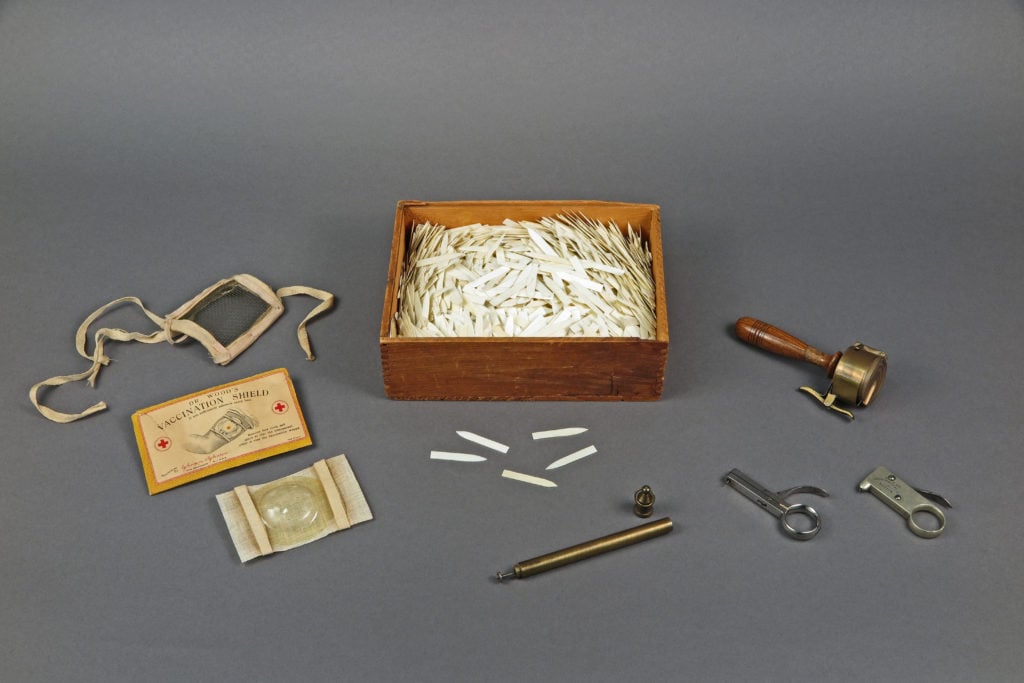
Vaccination objects from the medicine
collections. Photo courtesy of the Smithsonian’s National Museum of
American History.
The curators’ starting point is 1793, when the US was still a
new nation. When yellow fever swept through the capital of
Philadelphia, one in five people died. The wealthy fled in fear,
including many of the city’s doctors, leaving members of the Free
African Society to provide crucial medical care.
“For the people who lived through it, the epidemic was
incomprehensible—it seemed to come out of nowhere,” said Lord. “It
highlights a lot of things about American history and class
structures. African Americans played a crucial role at a time that
slavery was widespread and they were denied a voice. It sheds light
on a lot of different stories.”
The 1837 smallpox epidemic again hit hard Native Americans
in the Dakotas who had not yet been vaccinated by the government
because they lived near few white settlers. “As a result, the
smallpox just decimated the tribes,” said Lord. “That’s a story
that really illustrates the impact that disease had on different
communities in American history and also the ways in which the
federal government did not take an equal approach to providing
medicine and vaccination.”
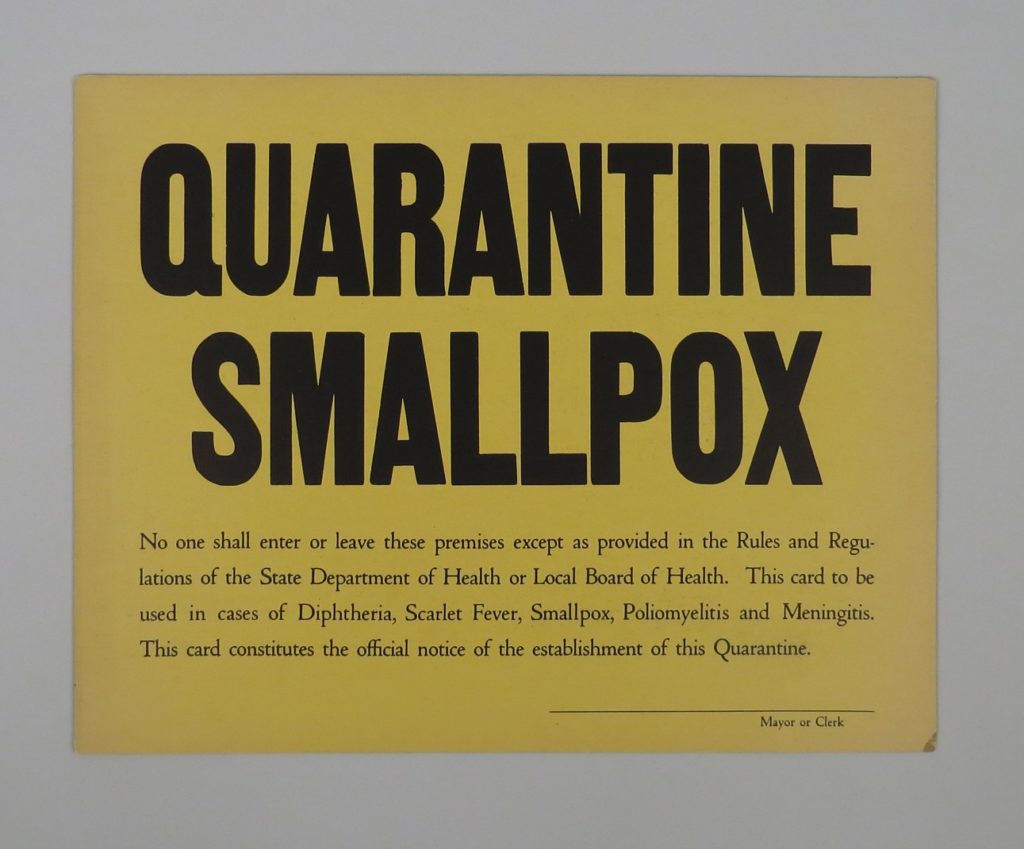
Photo courtesy the Smithsonian’s
National Museum of American History.
The third major disease outbreak featured is the cholera
pandemic that struck California shortly after the Gold Rush brought
a wave of settlers to the West Coast. “We always forget that when
humans move, diseases move,” said Lord. Like the coronavirus today,
the cholera pandemic of the 1850s “situates America—we’re not
immune to global forces.”
The show will highlight examples of success stories and of
near-miss disasters, such as the eradication of smallpox in
1980—the only disease ever fully eliminated—or the quick medical
response, in 1957, when a new strain of the flu threatened to
spread across the globe.
“Flu pandemics occur when there’s an antigenic shift in the
virus, and people who were exposed previously are no longer
immune,” Lord said. “But in 1957, Maurice Hillemann, an American
who had lost his parents in the 1918-19 Spanish flu, actually
developed a vaccine very early on, rushed it into production, and
really averted a major pandemic.”
The downside to defeating disease, however, is that serious
illnesses like mumps and rubella may no longer look like a threat
to later generations. “We will be talking about how many of these
diseases have come back with lax vaccination,” said Lord.
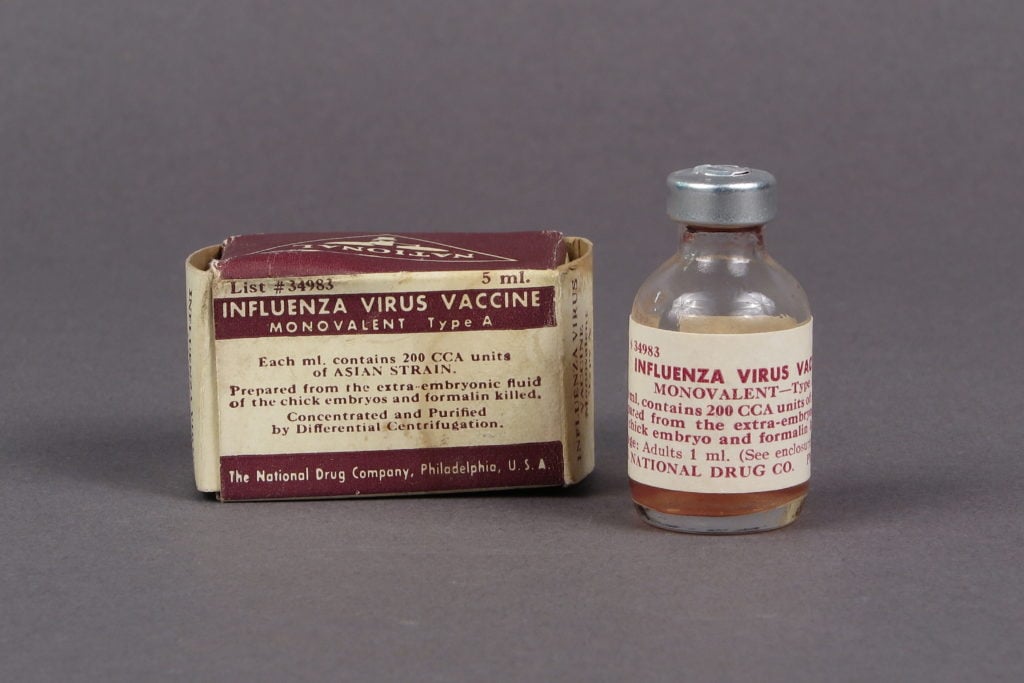
Biological, influenza vaccine,
Monovalent Type. Photo courtesy the Smithsonian’s National Museum
of American History.
“This is the curse of public health,” Lord said. “If public
health manages to wipe out polio or smallpox, we tend to forget
about it.”
Now, with coronavirus fresh in the public’s mind, the
exhibition will hopefully reach audiences who are more
receptive to learning about the ways in which disease has shaped
our nation—and will continue to do so.
Lord added: “We feel it’s a very important story that Americans
do not know.”
The post Smithsonian Curators Have Been Planning a Show
About the History of Disease for Months. They Say They’re Not
Surprised by the Current Pandemic appeared first on artnet
News.
Read more https://news.artnet.com/art-world/national-museum-of-american-history-epidemic-exhibition-1846068
Further reading


Leave a comment