
Protesters Are Taking Down Monuments Across Europe. So Why Is Germany Redoubling Its Commitment to Conservative Symbolism?
It glimmers against the Berlin skyline: an enormous golden cross
on a colossal domed building. And while crosses are not an unusual
sight in any European capital, this one sits atop the Humboldt
Forum, a major, €644 million ($711 million) new museum that
will house Berlin’s non-European and Asian collections—including
questionable objects culled during the colonial era—when it opens
in 2021.
With the toppling of monuments to colonialism and white
supremacy proliferating around the world in recent days, the gilded
Christian symbol, which went up at the end of May, feels more than
a bit out of touch with the current moment. Even Berlin
culture senator Klaus Lederer said the cross was “a clearly
religious sign” that runs counter to the museum’s mandate,
according to Deutsche Welle.
Nor is the cross the only Christian symbol on the dome. Around
the cupola, phrases lifted from the Bible dictate the dominance of
global Christianity: “There is no other salvation, there is no
other name given to men, but the name of Jesus… all of them that
are in heaven and on earth should bow down on their knees.”
Despite the strength of those words, the symbol, and the signals
sent by putting a non-European collection inside a reconstructed
Prussian palace, the museum maintains that the cross and the script
are open to interpretation. “Ambiguity is part of our DNA,” said
Hartmut Dorgerloh, the institution’s general director said in a recent
interview.
Yet a highly charged movement, existing for decades and spurred
into the streets following the death of George Floyd in May, has
reached Europe. Among actions taken to remove statues of ex-slave
traders or ill-gotten objects from the colonial era, institutions
are facing a renewed challenge over the legacies they celebrate.
The cross-topped gilded palace as a target of that discourse has
rendered itself unmistakable.
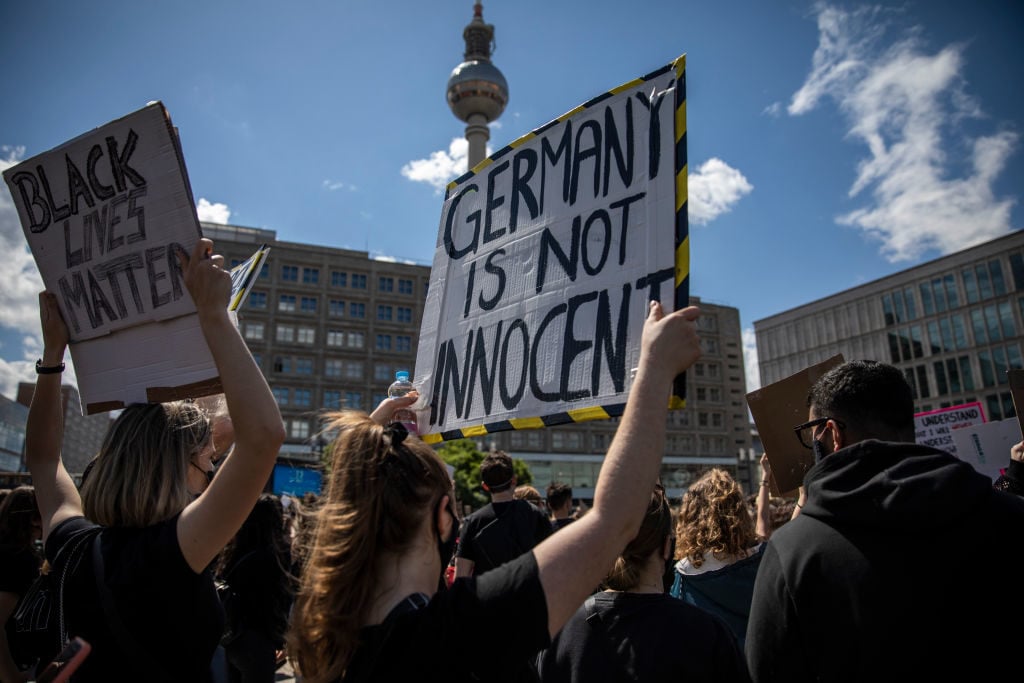
People protest against racism and police
brutality on June 6 in Alexanderplatz. Photo: Maja Hitij/Getty
Images.
Germany Lags Behind
In a statement, the Humboldt Forum Foundation’s board of
directors said that they “expressly distance themselves” from “any
claims to power, sole validity, or even domination that can be
derived” from the inscriptions and icons on the building, saying
that the symbols are simply “quotations from architectural
history.” Several articles, including dissenting ones, are
published on the museum’s website.
To some experts from the museum community and art world, the
answers and gestures at discourse from the Humboldt Forum do not
justify the cross’s reason for being there. It “sends problematic
signals to the world if Germany raises a symbol of White Christian
superiority” atop a museum of non-European art, says Mirjam
Brusius, a research fellow in colonial and global history at
the German Historical Institute in London.
She says it’s especially ironic that one recent Black Lives
Matter protest in Berlin drew 15,000 people to the streets just
steps away from the museum. The museum has released no press
statement on the matter.
“The contrast is stark,” she says. “Germany of all places can’t
afford to fall behind when it comes to debates concerning racism.
Denazification in the country has not worked in the ways many have
assumed, and antisemitism and racism never went away.”
Of course, it does not stand alone; there are other contested
colonial monuments around Germany. In Bad Lauterbach, there is a
statue of colonial general Hermann von Wissmann, who
torched villages and executed locals in what was then German
East-Africa during his colonial exploits during that late 19th
century.
There are the so-called Askari-Reliefs, which celebrate Paul von
Lettow-Vorbeck, a colonial war criminal who was nicknamed the “Lion
of Africa.” Due to protests over the past years, the monuments have
been closed off from the public.
And in Berlin, there are several sites that carry racist names,
such as the Mohrenstrasse train station, which is near
the Brandenburg Gate. In German, “mohr” is a derogatory term
for a black person. Other street names, which celebrate
imperial conquests, were motioned to be
changed in 2018.
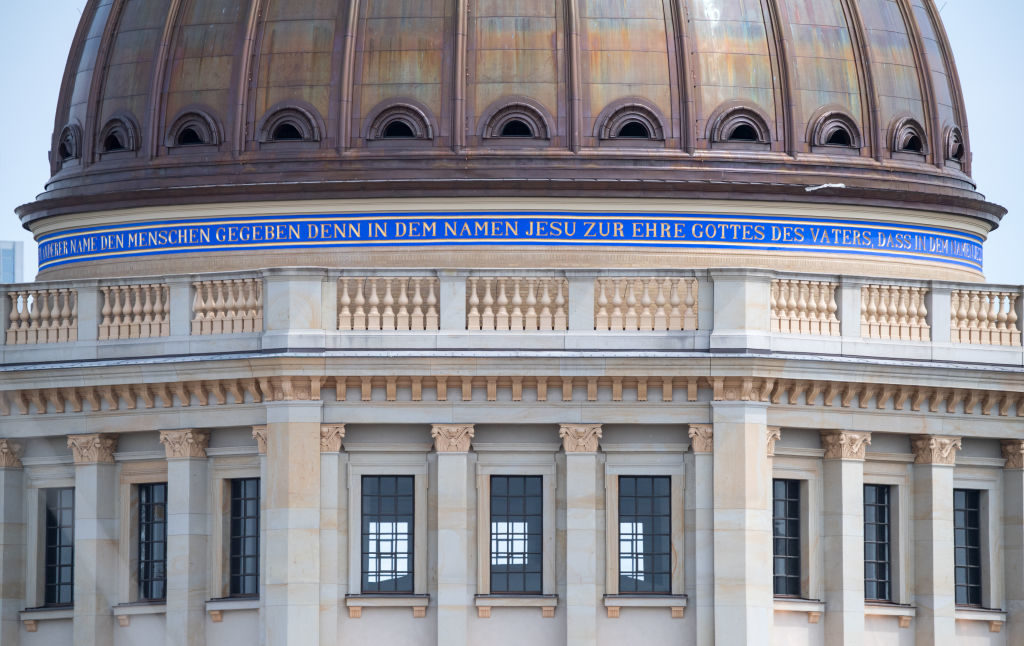
The inscription below the top of the
dome on the Humboldt Forum, which is a combination of two Bible
quotations. Photo: Bernd von Jutrczenka/dpa via Getty Images.
Another Dark History
Yet on many other fronts, as the UK, Belgium, and the US are
being forced to comprehensively revise their monuments to dark
histories, the German state is going in the other direction.
On Thursday, June 11, the German culture ministry posted on Twitter that
it would be promoting the restoration of 40 monuments throughout
the country. According to a spokesperson from the ministry, the
state intends to devote €30 million ($34 million) to the
project.
The culture ministry declined to comment on the monuments in
Britain and Belgium that celebrate those countries’ dark and
painful pasts, but promoted its new plan on Twitter
by stating: “Cultural
monuments are an essential part of our cultural heritage.”
But to some in the arts community, that sounds like willful
ignorance of a global movement to reassess statues and monuments in
public spaces. And while Germany has made important
reparations to survivors of the Holocaust, including the
restitution of artworks and objects, and the construction of
memorials, it has done far less to repair the damage of its late
19th-century and early 20th-century colonial
projects, including the genocide of the Herero and Namaqua
peoples in what is modern-day Namibia.
“The extreme violence in the colonial enterprise cannot be
forgotten,” said Cameroon-born and Berlin-based curator Bonaventure
Soh Bejeng Ndikung in a recent radio
program. Ndikung added that the cross being erected over a
museum of colonial-era collections is a display of “dominance” and
“supremacy.”
If the Humboldt Forum wants to lead the conversation, “it now
has to start with this cross and its role within as well as outside
Europe,” says Jürgen Zimmerer, a professor of global history
at the University of Hamburg. “Whereas all over Europe colonial
monuments are dismantled, Germany erects a new one in Berlin.”
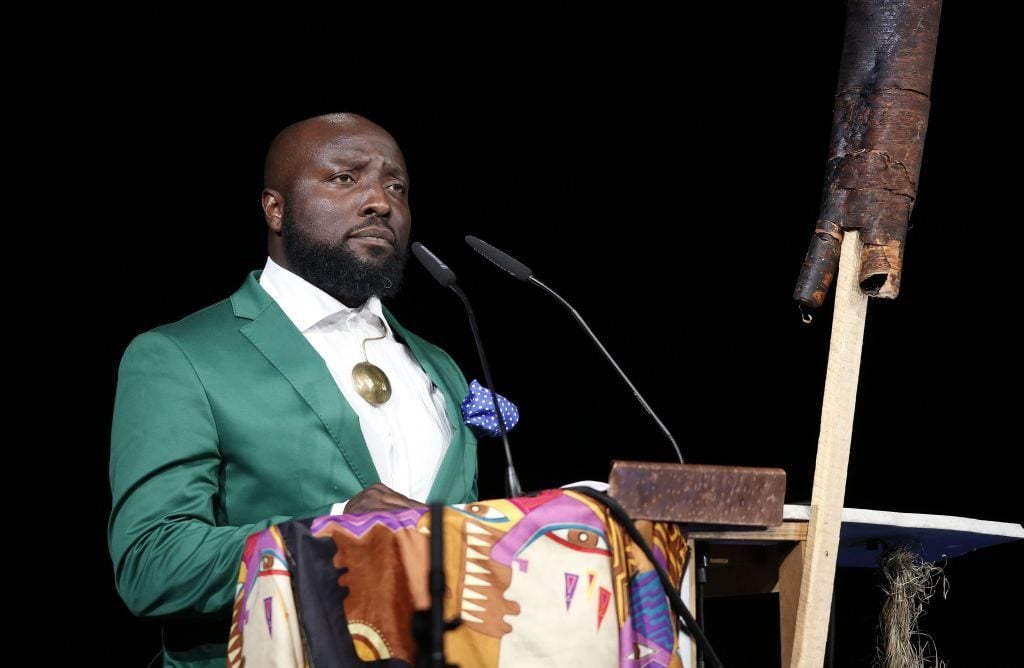
Bonaventure Soh Bejeng Ndikung. Photo
courtesy Rony Hartmann/AFP/Getty Images.
Certainly, the erection of the cross a few weeks ago, which is
designed by Franco Stella and is a replica of the one that once sat
atop the original Prussian Palace on which the Humboldt Forum is
modeled, is no surprise. Its planned installation was first
announced in 2017, and the institution published several essays
from officials and experts to explain its relevance.
But even an article published by the museum admits that the
announcement of its “dominating” presence flew under the radar for
years.
“Franco Stella’s winning design included the cupola and cross,
but at this point in time, most of the general public had not
really noticed this,” Laura Goldenmann, an art historian and
academic advisor at the Humboldt Forum Foundation, wrote last month
in the museum’s online magazine that floats debates on the subject
of the cross, called “What It All About?” (According
to Goldenmann, the cross was not included in a wooden model
presented in 2008.)
But no one can miss it now. On May 29, four days after the
police killing of George Floyd in Minneapolis, Berliners gathered
to watch the gilded sign of Christ be lifted onto the 17-ton cupola
of the reconstructed Prussian Palace.
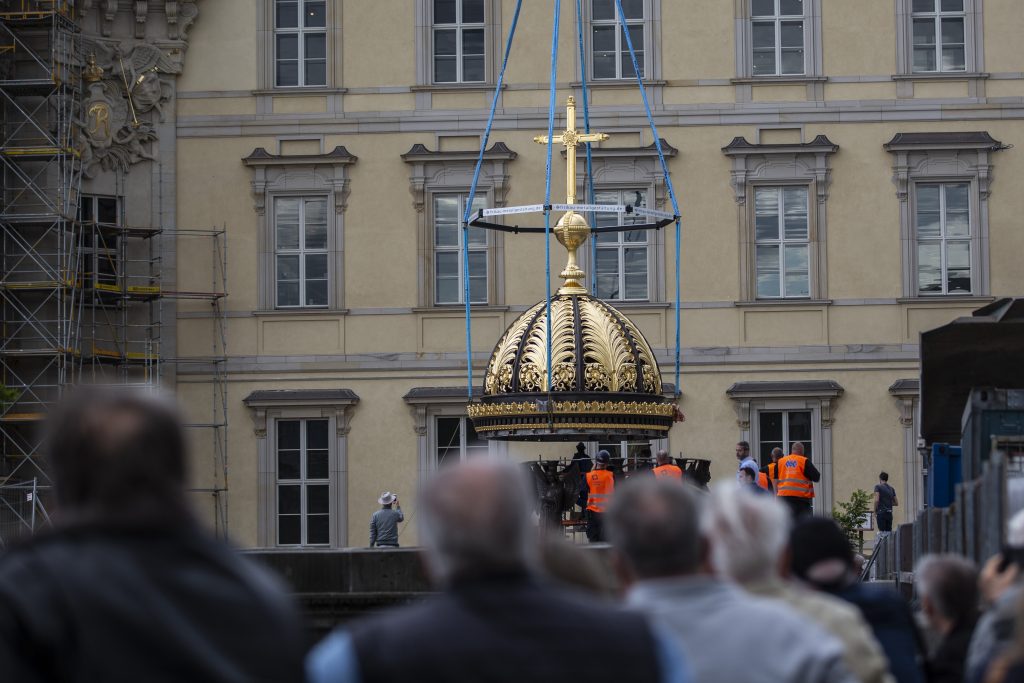
People watch as the cupola and cross
onto the Humboldt Forum in Berlin. Photo by Maja Hitij/Getty
Images.
I watched with a similar feeling of confusion in 2018 when a 52-foot-long
boat from Oceania was craned into the museum before the front
wall of the palace was built because it would not otherwise fit
through the door. At the time I called it “a gesture terminal
enough to feel macabre.” Despite debates, essays, press releases
occurring since then in on the subject of colonial legacies, with a
particularly strong eye cast on the Humboldt Forum, now a cross
hangs above the museum, and what is argued as being ambiguous is
nevertheless also very terminal. It’s not going anywhere.
But some things do change. The museum may intellectualize and
create a forum for ideas about its gestures and its very existence,
but the conversation and the air outside has fundamentally changed.
People are in the streets now, and the protestors are knocking on
doors.
The post Protesters Are Taking Down Monuments Across Europe.
So Why Is Germany Redoubling Its Commitment to Conservative
Symbolism? appeared first on artnet News.
Read more https://news.artnet.com/opinion/humboldt-forum-cross-issue-1884378
Further reading


Leave a comment