
Painter Ed Clark’s First Hauser & Wirth Show Radiates Effortless Beauty. But It’s the Product of Decades of Toughing It Out
It was late July when the news hit the internet: “Ed
Clark now represented by Hauser & Wirth.”
The Swiss super-gallery represents the top of the top, showing
the likes of Philip Guston, Zeng Fanzhi, and Rashid Johnson. Clark
is hardly an unknown quantity. He has had well-reviewed shows at
Tilton and Mnuchin galleries in
recent years (the latter amounting to something of a career
survey). But his first show at Hauser & Wirth certainly represents
a clear statement of faith that the contemporary interest in and
vitality of the 93-year-old painter’s work isn’t going away. Titled
simply “Ed Clark,” it features
fifteen paintings from 2000–2013.
In an email, Melanca Clark, the artist’s daughter, expressed the
excitement of the moment: “We’re so pleased to partner with Hauser
& Wirth on this absolutely beautiful exhibition of my father’s
recent paintings.”
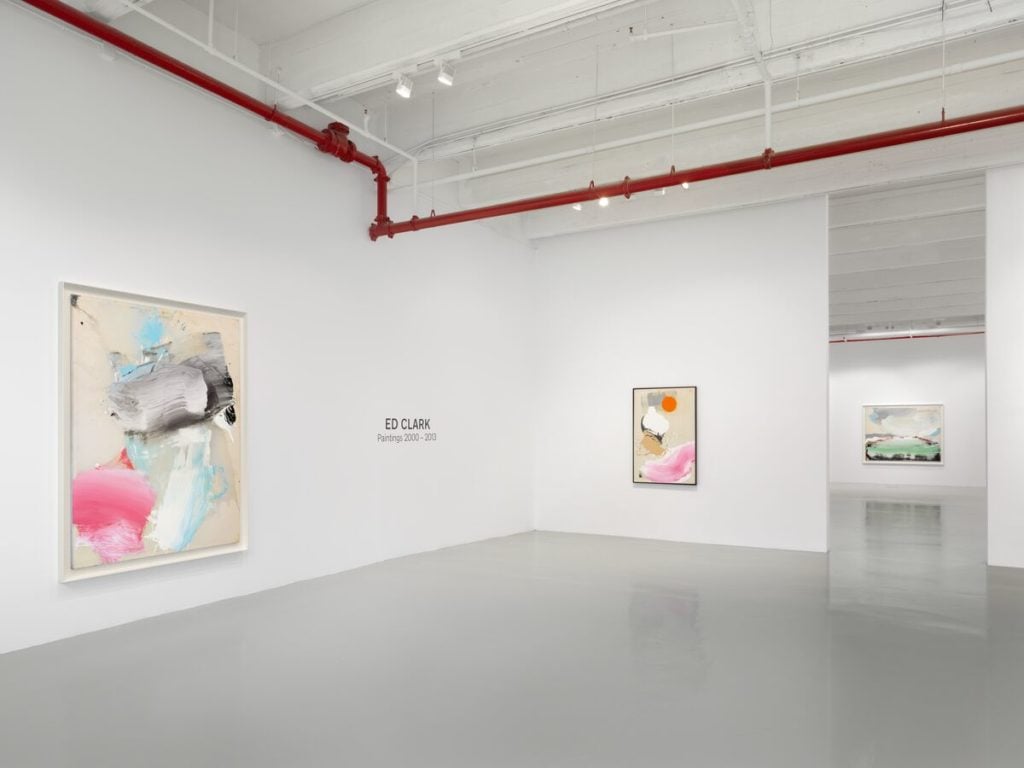
Installation view of “Ed Clark” at
Hauser & Wirth, New York. Photo by Daniel Bradica, courtesy of
Hauser & Wirth.
Clark wasn’t always considered blue chip—in fact, he wasn’t
until very recently. Back in 2007, you could have easily picked up
a mid-1980s push broom painting from a Swann Gallery auction for
less than $25,000. Even at that price, it went unsold. In May 2019
at a Phillips auction, the momentum had definitely shifted: a 2007
work that had been estimated to sell between $80,000–120,000 came
in at $337,500 once the hammer came down.
Race had something to do with that. For the majority of his long
career, very few collectors were making an effort to buy the works
of African American artists and white-dominated art institutions
didn’t provide opportunities for career advancing criticism. The
art world in Paris, however, didn’t care what color you were, and
for Clark, as for many African American artists in the immediate
aftermath of World War II, it offered space to explore. He lived
there in the 1950s, and has travelled frequently since, harvesting
influences in terms of tonal combinations and composition that he
adds into the mix of his art.
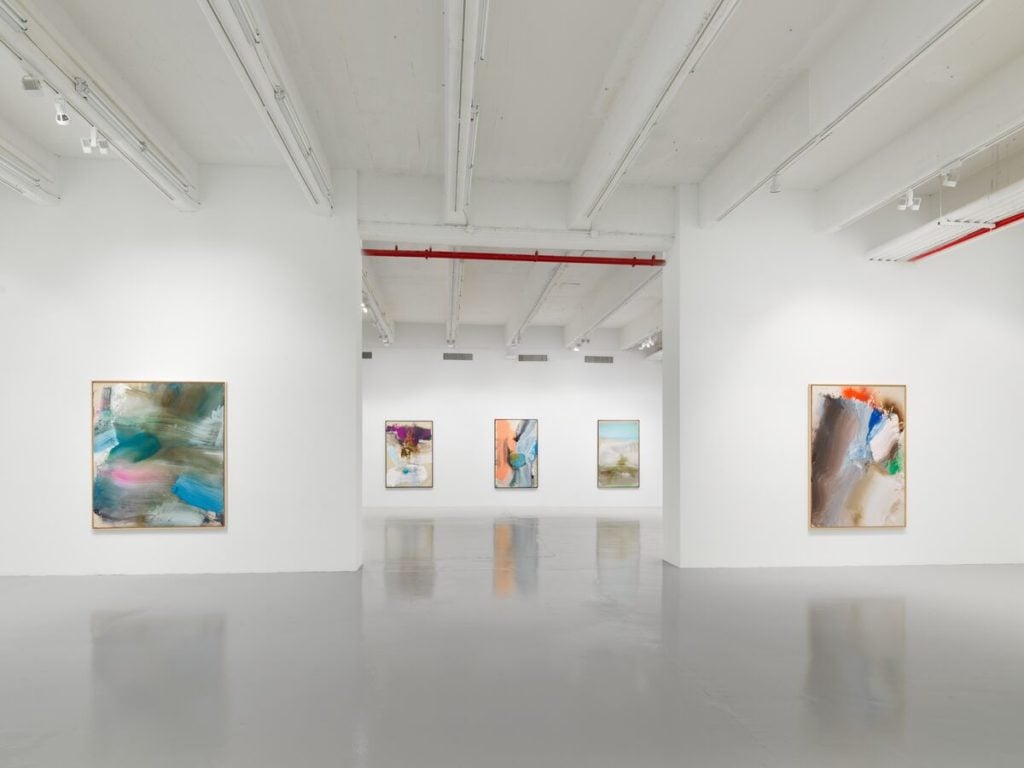
Installation view of “Ed Clark” at
Hauser & Wirth, New York. Photo by Daniel Bradica, courtesy of
Hauser & Wirth.
As a testament to Ed Clark’s longevity, his first show was way
back in 1955 at a YMCA in Chicago. While he’s known for his use of
the broom to create dynamism on the canvas, he has also been
credited as one of the first—if not the first—artist
to paint on a shaped canvas. Artists like Adger Cowans, Herbert
Gentry, Howardena Pindell, and Sam Gilliam all have paid homage to
the influence Clark has had on their work.
One can only imagine the tenacity needed to hang on for so long,
but you get a sense of how Clark’s obstinacy paired with an
unyielding belief in his own art has served him well. In the Hauser
& Wirth galleries, one abstract work, Untitled (2000), is
suggestive of a glowing sun hovering over a beachfront view.
Overall, this collection of art radiates a sense of contentment, at
this moment when his reputation has at last caught up to his
achievement.

Ed Clark, Untitled (2000).
Image: Charles Moore.
Historically, a lot of his support came from the African
American art community by default. Alaina Simone, a multi-faceted African American art world
professional, remembers first seeing Clark’s work in Detroit in the
late 1990s, introduced by the legendary Motor City gallerist George
N’Namdi. “Meeting Ed was great,” Simone told artnet News. “He had
travelled the world and he used a push broom to paint the
work—which was like a comment on his ability to think outside the
lines.”
Despite his long list of achievements, for many longtime Clark
fans it’s still exciting to see him get his due in a way rarely
achieved by living artists of color of his generation. The recent
mainstream success may, indeed, make it even more important to take
note of the networks that have nurtured the conditions, over long
years, for his new level of new renown. Others who have championed
him in their way over the past four decades include Peg Alston Fine
Arts, a historically important New
York private dealer who focused on advocating for black artists,
and the artist David Hammons, who is said to have one of the
largest collections of Clark works and has been an advocate behind the
scenes.
Private gallerist Alitash Kebede is another longtime Clark fan.
She has had a career spanning over three decades focused on
collecting and exhibiting black artists, and remembers learning of
Clark while visiting Peg Alston. Kebebe’s space, Alitash Kebede Fine Arts in Los Angeles,
first showed Ed Clark painting—way back in 1988.
“After a while, the truth comes out,” Kebede said to artnet News
on the occasion of the Hauser & Wirth show. “A painter as good as
Ed Clark eventually must be appreciated and respected.”
“Ed Clark” continues at Hauser & Wirth, 22nd Street, New
York, through October 26, 2019
The post Painter Ed Clark’s First Hauser & Wirth Show
Radiates Effortless Beauty. But It’s the Product of Decades of
Toughing It Out appeared first on artnet News.
Read more https://news.artnet.com/exhibitions/ed-clark-hauser-wirth-1670578
Further reading


Leave a comment