
On the Heels of a Sold-Out Solo Show, Painter Vaughn Spann Describes How to Navigate a Hot Art Market Without Getting Burned
Discussions about young artists on the rise frequently employ
the passive voice. He “was chosen” for a competitive residency or
solo exhibition; she “was accepted” to an elite art school. But the
trajectory of newly minted art star Vaughn Spann, who recently
opened a sold-out solo show at Almine Rech gallery in New York, is
no accident. Instead, it is the result of a series of deliberate
and canny choices on the part of the 27-year-old artist.
Less than two years after graduating with an MFA from the elite
Yale School of Art, Spann’s career has gone into overdrive. His
work—which alternates between lush portraiture and mixed-material
abstractions—has already been included in more than three dozen
group shows across the US, including a prominent position in the
inaugural display at the newly opened Rubell
Museum in Miami.
His latest exhibition—sold out within a week of the
opening—presents a dozen paintings priced around $20,000 to
$90,000, depending on size. Two years ago, similar works were
selling on average for under $20,000. Spann’s work has already
been collected by the likes of the Pérez Art Museum Miami, the High
Museum of Art in Atlanta, and corporate collections such as the UBS
Art and the Credit Suisse Corporate Collection.
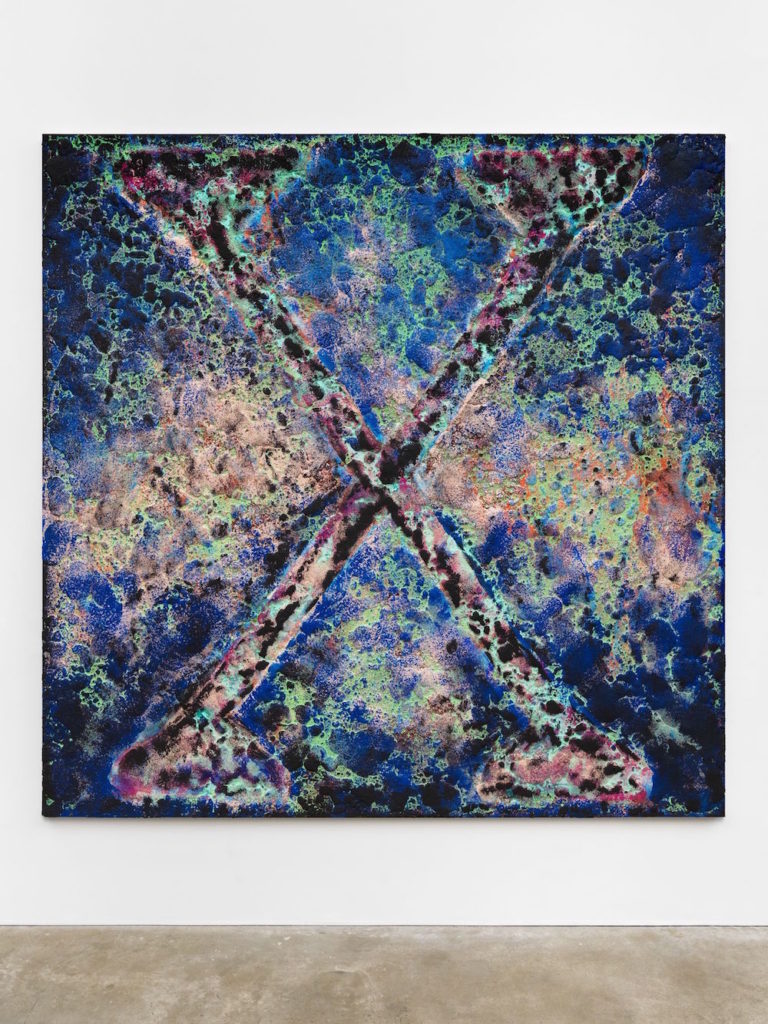
Vaughn Spann, Cosmic Symbiote (Marked
Man) (2019). Photo by Dan Bradica. Image courtesy of the artist
and Almine Rech, New York.
Growing up in Orange, New Jersey, Spann says he “didn’t have a
lot of [exposure to] art per se, though I definitely saw a lot of
murals and local art around the town.” That was enough to give him
the bug, and he found himself constantly drawing, whether it was
“portraits of people, sketches, landscapes—I always had a
free-running imagination regarding art.”
Nevertheless, just as governing
and running for election require different skill sets, making art
and navigating the art world are two different beasts. “When it
came down to being an artist, I didn’t know what that entailed in a
serious manner,” he tells Artnet News. “I only knew what that
entailed in a very lighthearted, naive manner.”
Hitting the Ground Running
That naivete didn’t last long, however. Spann was forced to
confront the reality of the commercial art world as a student at
Yale, where, unlike almost any other art school in the country (or,
in fact, the world), collectors and art dealers are constantly
circling to find new talent, particularly at a moment when the art
world is paying more attention to the work of black
artists than it has in the past.
“During grad school, you should be focusing on the potential
framework of your work or the art historical context,” Spann says.
“But we’re attending a school that has a lot of visibility, so we
can’t deny that. We can’t just sit under a rock. I feel like there
has to be a balance, where maybe there can be a course to talk
about some preparedness. People do come to the school or send
emails” looking to see artists’ studios, he says.
In the absence of formal instruction on how to navigate the nuts
and bolts of shaping a career, Spann constructed his own curriculum
with the help of other artists familiar with the spotlight.
It was artist Rashid Johnson, for example, who first brought
Spann to the attention of the mega-collectors Don and Mera Rubell,
while fellow Yale alumnus Titus Kaphar was, in Spann’s words, “the
ultimate mentor.” Kaphar used part of his MacArthur “genius” grant
to create a year-long residency program called “Next Haven,” which
Spann just completed. Such spaces can offer a space of creative
nurturing for students, especially black students, who
have navigated the
pressure-cooker of an elite art school. The support of
dedicated collectors, principally early supporter Bernard
Lumpkin, was also key, Spann says.
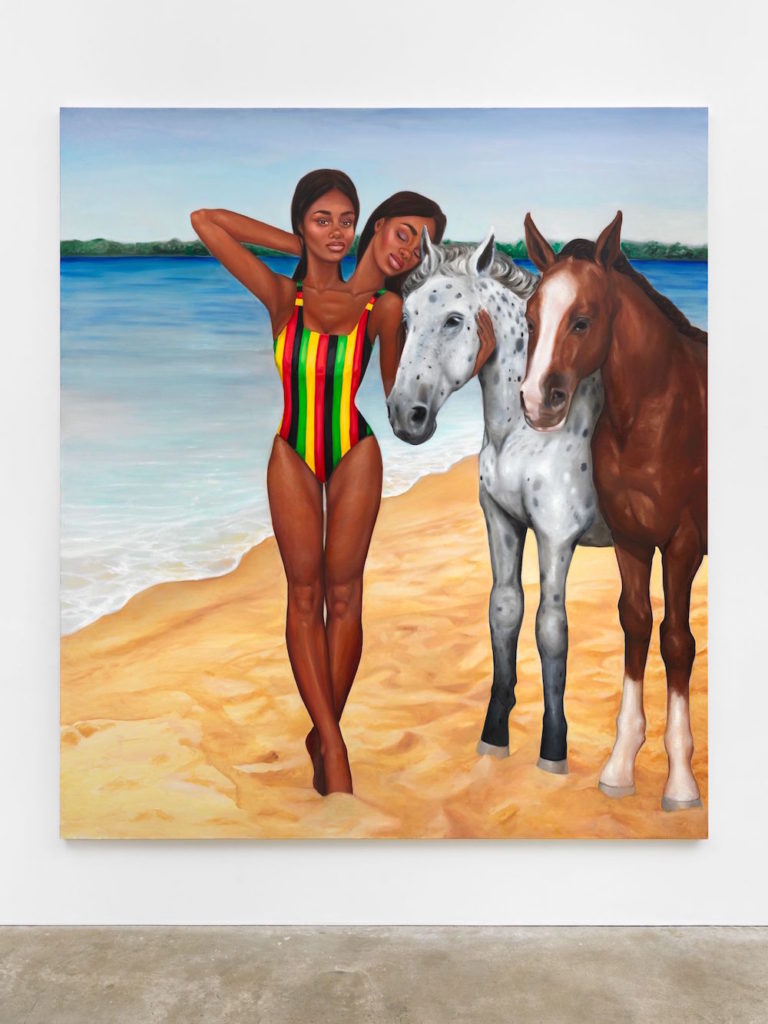
Vaughn Spann, Beachside (2019).
Photo by Dan Bradica. Image courtesy of the artist and Almine Rech,
New York.
“Yale could be a little bit of a polarizing program at first,”
the artist says. “To be clear, there are very different practices
and art-making going on. You gravitate toward the faculty that you
need to gravitate to. You have instances where your conversation
can be very productive versus not productive at all. It’s honestly
what you make of it.”
Both Johnson and Kaphar were critical in helping him avoid some
“rookie” mistakes, Spann says. “I
have people looking out for me to tell me things, like I should
know where my work is being placed and other things an emerging
artist might overlook,” he says. “Rashid and Titus have helped me
sharpen up.”
A Fluid Approach
Spann has also avoided a pitfall that lots of artists with early
success can fall into: the temptation to settle on one narrow,
signature style. The artist, who had initial exposure via group
shows at New York galleries Kravets Wehby and Fredericks &
Freiser, has remained committed to making both surreal figurative
scenes and abstractions, as well as works that float between the
two spheres.
The Almine Rech show, “The Heat Lets Us Know We’re
Alive” (January 15–February 22), includes 12 new paintings
that range from near-allegorical compositions depicting two-headed
figures and animals in brilliantly hued clothing alongside giant
recurring X’s and American flags.
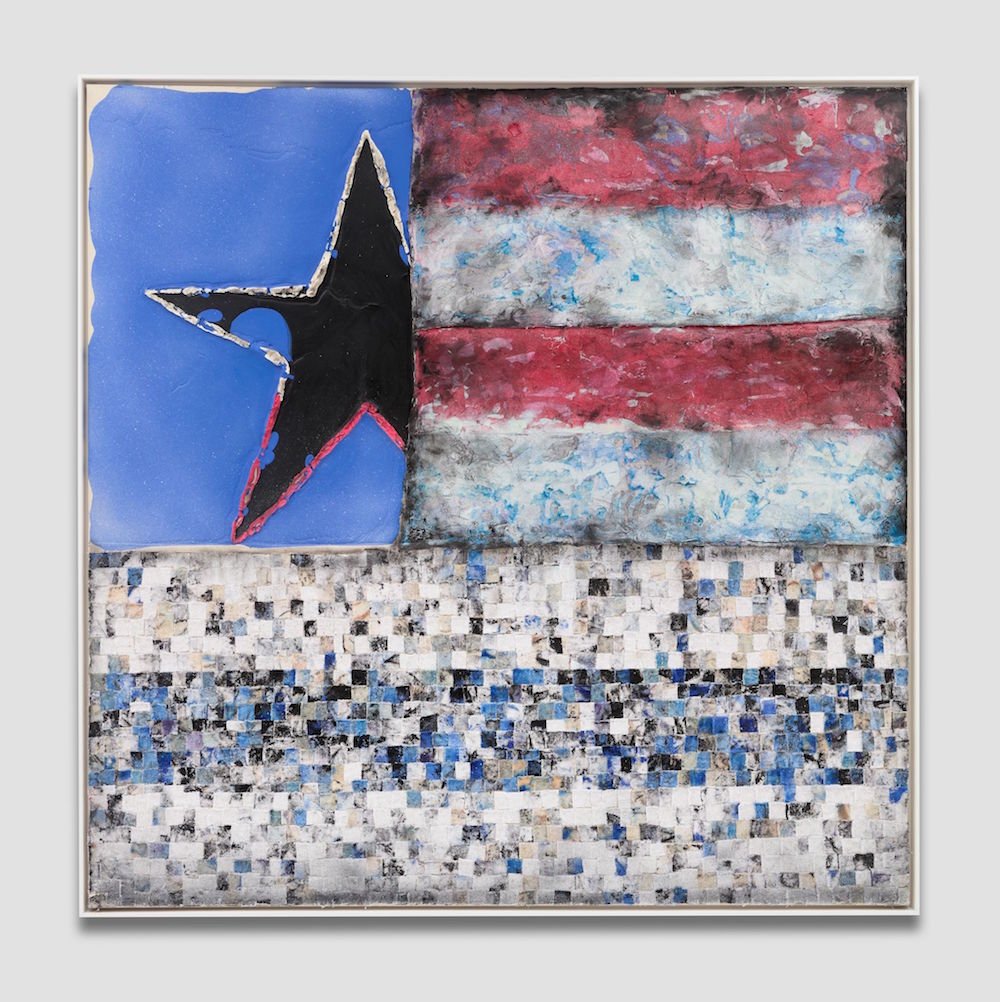
Vaughn Spann, Untitled (Flag)
(2019). Photo by Matt Kroening. Image courtesy of the artist and
Almine Rech, New York.
The work is “quite original, new, and fresh,” dealer Almine Rech
tells Artnet News. “He has many directions. That interested me a lot.
There are many open doors.” Rech first encountered Spann’s work
when the gallery included him in a summer 2018 group show in
London. “We wanted something figurative and very
contemporary,” she says.
Conversations and a studio visit with the artist in Newark, New
Jersey followed. When Rech asked Spann about the significance of
the X in many of his paintings, she says, he told her it was a
reference to his own personal experience with stop-and-frisk
measures by police over the years. “It’s not abstract, the X,” she
says. “In fact, it’s him.”
Rech, who represents the artist in Europe and the UK, also noted
keen interest for the work in Asia (she operates in Shanghai),
where the graphic and easily recognizable X and flag symbols have
resonated with audiences.
The Importance of Balance
Spann stressed the importance of balance when it comes to
everything from studying at Yale while raising two young children,
to vetting collectors, to deciding which galleries to show
with.
“My whole M.O. is that it’s always family first,” says Spann,
who has an eight-month-old and three-year-old daughter. “When I
started [at Yale], my daughter was a tot, so some days she would be
in the studio coloring as I try to get my work done and my wife was
in the area living near the studio. That balance was critical.”
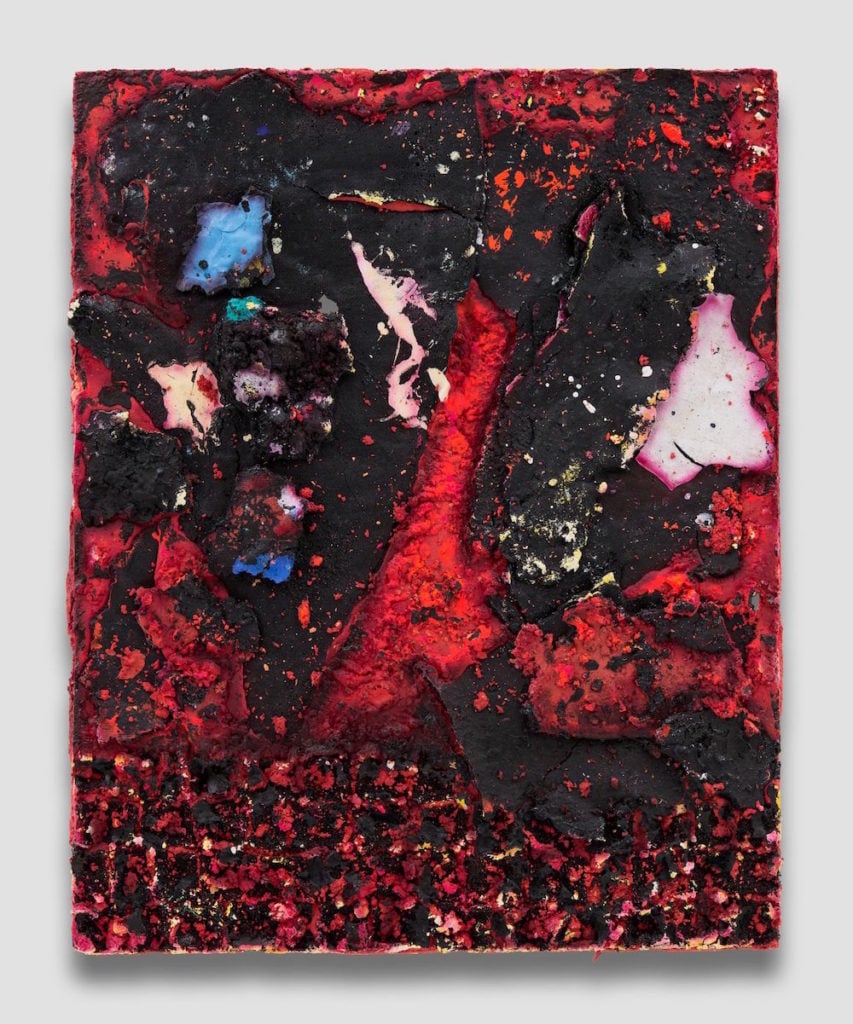
Vaughn Spann, Sweet Red (2019).
Photo by Matt Kroening. Image courtesy of the artist and Almine
Rech, New York.
This kind of equanimity has likely helped Spann make canny
choices, but it will be equally imperative for other artists coming
up after him. Spann says the practice of dealers and collectors
trying to court students at Yale seems to have only intensified
since he graduated. His advice? “It’s like a dance. You allow
certain people to come into your life, and to help you. At the same
time, you should also vet, and not allow that space to become one
where people are intruding on your time and studies.”
Spann says he often hears from stressed-out students seeking
guidance about which galleries to sign with. He tells them to stay
humble and take the long view.
“It’s so funny, because the same galleries come to these
programs over and over. I’m like, ‘To be honest, you shouldn’t even
feel special. Don’t even worry about this stuff. The best that you can do for yourself is to
wait on any of this… take a show or get
into a summer group
show, whatever it is. Be patient—because the vultures, as they say,
are out there.’”
The post On the Heels of a Sold-Out Solo Show, Painter
Vaughn Spann Describes How to Navigate a Hot Art Market Without
Getting Burned appeared first on artnet News.
Read more https://news.artnet.com/art-world/vaughn-spann-at-almine-rech-1760085
Further reading


Leave a comment