
Money Troubles Force MCH Group, Art Basel’s Parent Company, to Choose Its Fairs Over Its Event-Marketing Business
Limited investment resources and
a rocky path to restructuring are forcing major changes at Art
Basel’s parent company, the MCH Group. Long focused on both
producing its own trade fairs and marketing and supporting others’
live events, the Swiss firm has announced that financial realities
now require it to choose only a single core business going forward.
That business will be its own fairs—and to reinvest in this
segment, the MCH Group will explore everything from cost-cutting to
a full or partial sale of its robust Live Marketing Solutions
division.
The company made its decision
public late last month, shortly before releasing its financial
results for the first half of 2019. Although the board saw
opportunities for growth in each of its two core competencies, its
members concluded that the MCH Group was better positioned for
sustainable success with its trade fairs than its experiential
marketing efforts. At
the same time, they also recognized that a brighter future won’t
come cheap or easy, necessitating a strategic
reckoning.
“New ideas will be required,”
said MCH Group CEO Bernd Stadlwieser in a statement. “We must
therefore invest in innovations, digitization, and
internationalization.” The aim would be to “build communities that
go beyond the physical event.”
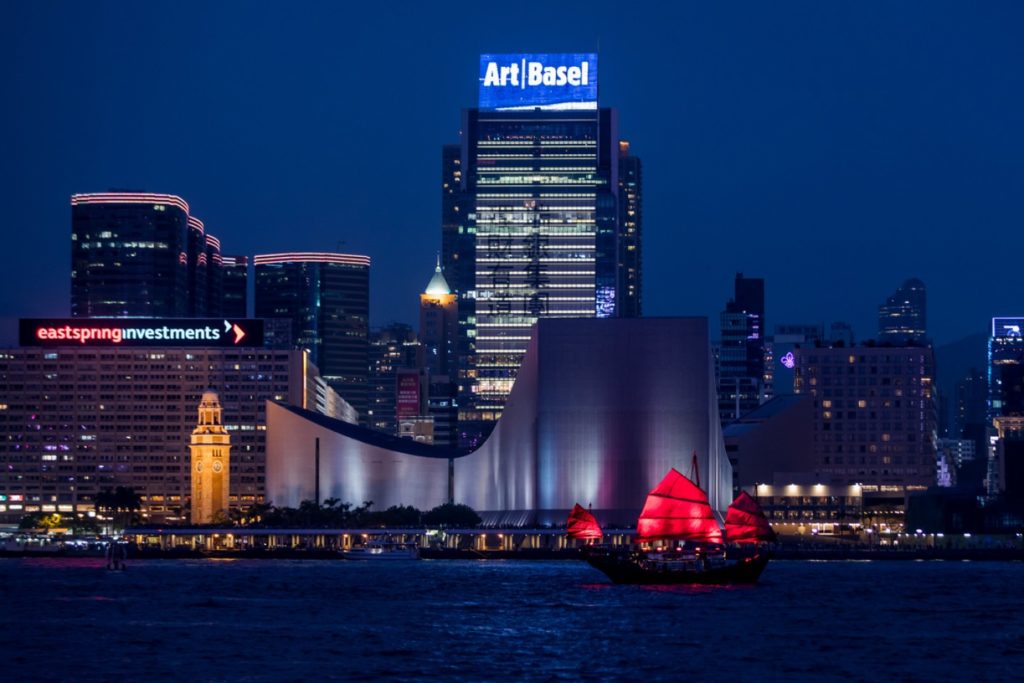
Art Basel Hong Kong. Courtesy Art
Basel.
The Path Forward
The need for reinvestment
potentially makes a sacrificial lamb of the company’s Live
Marketing Solutions division, whose services include everything
from consulting with clients on live-event strategy to building
stands and other display elements inside convention centers. The
department currently employs roughly 500 people worldwide and
accounted for just under 40 percent of MCH Group’s sales through
the first six months of 2019. (The Exhibitions division generated
about 56 percent.)
Reached by artnet News, MCH Group
spokesperson Christian Jecker stated that the company has not
published any projections concerning a possible sale price for the
experiential marketing wing. However, an article for BZ, a Swiss daily newspaper, reported Stadlwieser
anticipates that merely offloading MC2,
originally an American live-event marketing firm acquired by MCH
Group in 2017, could generate upwards of 100 million CHF ($100
million) to reinvest in its fairs.
Another crucial component of MCH
Group’s future will be the fate of its various physical venues.
While art-industry veterans are most familiar with Messe Basel, the
sprawling complex Art Basel occupies in the heart of its namesake
city, the MCH Group’s real-estate holdings are substantially
larger. The company controls over 182,000 square meters of
exhibition halls, theaters, and conference rooms in Basel and
Zürich combined.
The MCH Group has stated that it
will reassess the ownership and operational structure of these
venues “over the medium term.” Jecker would not elaborate on the
timeline other than to say that this element “is not the top
priority at the moment” and “has no direct influence on the
core-business strategy that has now been defined.”
But the company has made clear
that all options will be on the table when the time comes,
including selling to a private owner or soliciting greater public
investment. It is also seeking to entice more guest fairs to its
venues, with the goal of increasing its current 25 percent
occupancy to more than 35 percent.
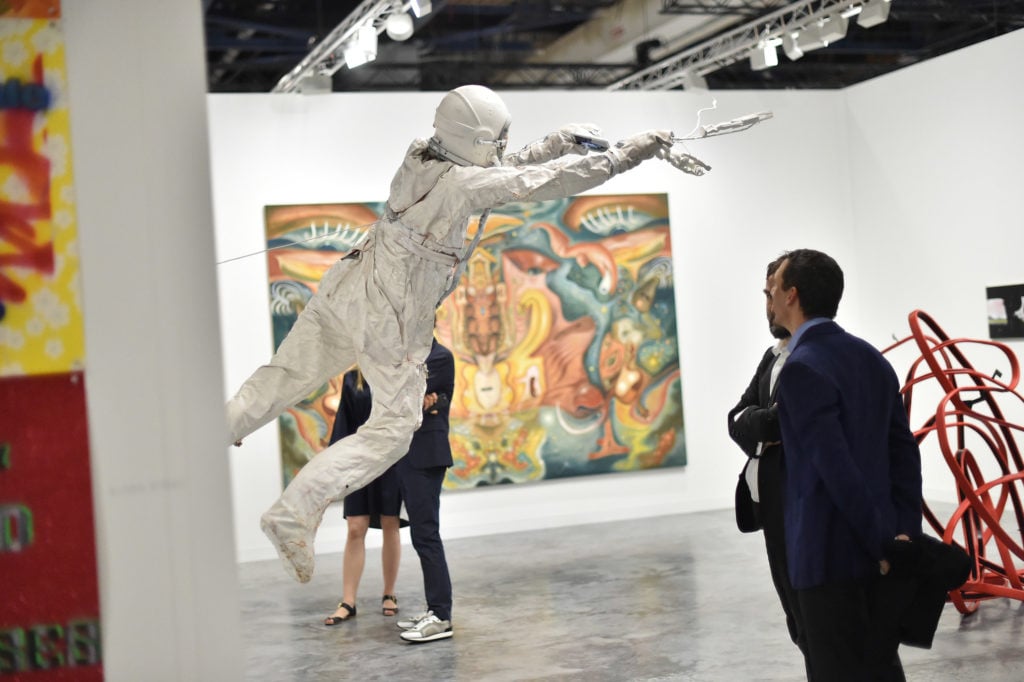
The atmosphere at Art Basel Miami Beach
2019. (Photo by Mike Coppola/Getty Images)
‘Showdown’ Over Art Basel?
The board’s plan has one vocal
opponent inside its shareholder ranks. Erhard Lee, whose
Zürich-based AMG fund holds a 10 percent stake in the MCH Group,
has blasted the new strategy as “stupid” in the Swiss press. He argues
that the company would do better by selling the trade-fair business
and doubling down on its Live Marketing Solutions arm. He has also
advocated for a full or partial sale of Art Basel via the
assumption that, just like a sought-after painting in a speculative
market, the brand could attract a price far above its on-paper
value.
When asked if selling Art Basel
was a serious consideration within the MCH Group, Jecker responded,
“No, not at all.”
Lee took to the Swiss press in
late September to call for a special audit of the board of
directors, suggesting that they have acted against shareholder
interests. He also threatened to call an Extraordinary General
Assembly to force a “showdown” over the company’s future.
However, Jecker said that the
company still had not received “any according request” from Lee or
AMG regarding these matters as of mid-afternoon Friday, roughly two
weeks after his comments appeared in BZ.
The prospect of selling Art Basel
seems especially curious given that the MCH Group identifies the
fair as a model for the type of expansion it hopes to implement
with its other events, particularly its Baselworld trade fair for
watches. “We already have a
strong community for Art Basel and we wish to extend this with
additional offerings,” said Stadlwieser. “For Baselworld, we are
intending to establish an extended industry community and are thus
considering further events abroad, which is a matter of concern for
many customers.”
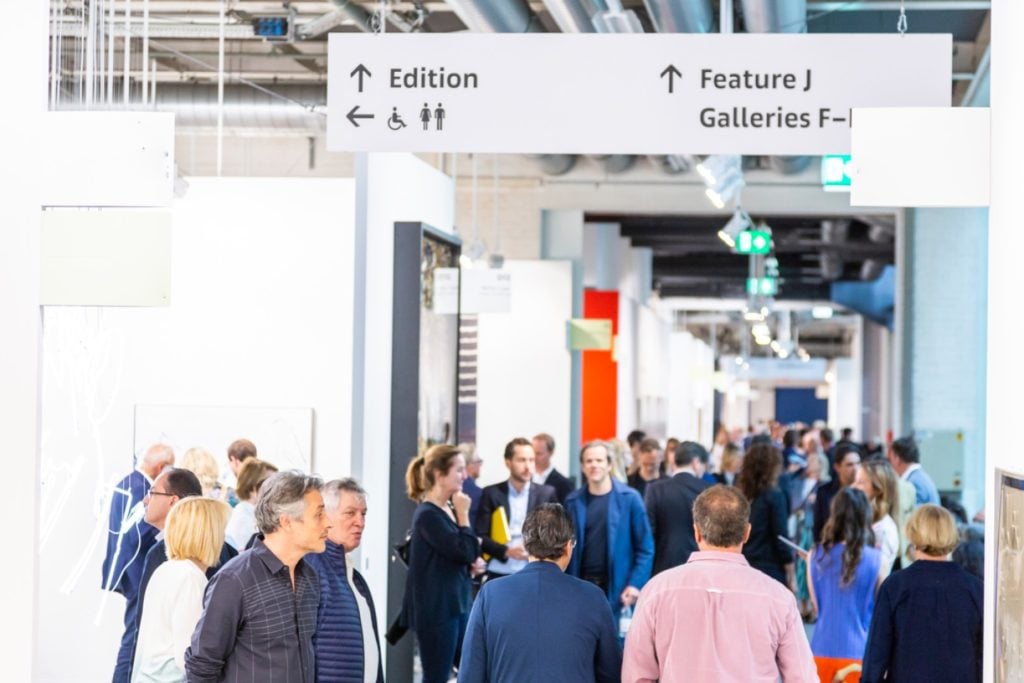
Art Basel 2018. Image © Art Basel.
Follow the Money
Art Basel also emerges (albeit
briefly) as an unmitigated bright spot in the MCH Group’s results
for the first half of 2019. Although the report breaks out no
specific figures for the fair, it states that the brand “further
strengthened its leading market position and economic stability in
this year’s editions of its Hong Kong and Swiss fairs.” Few of the
MCH Group’s other endeavors seemed to inspire much
praise.
Overall, the results
show continued turbulence.
Consolidated operating income (effectively, sales) declined nearly
24 percent versus the equivalent period in 2018, while operating
expenses dropped by only about 17 percent. That combination left
the MCH Group one million CHF in the red during 2019’s opening
half. Last year, the company netted CHF 21.5 million in profit over
the same span.
The group attributed the steep
drop to a variety of factors. Most notably, an exodus from
Baselworld continues to wreak havoc on both of its core businesses.
The fair saw half its exhibitors
vacate last year,
including Swatch, its largest client. MCH Group’s then-CEO René
Kamm resigned shortly after Swatch announced its departure. In the
results for the first half of 2019, MCH Group noted that “declines
in Baselworld” depressed sales in its fair business, creating
“follow-on effects” felt in reduced demand for its
exhibition-dependent services businesses, such as marketing and
stand construction.
Other losses flowed from the
restructuring plan initiated in the summer of 2018. The company
sold Winkler Livecom AG, a subsidiary of its Live Marketing
Solutions division, late last year. In May 2019, it also furthered
its planned retreat from regional art
fairs when it divested
its ownership stake in Art Düsseldorf. The MCH
Group trimmed its Swiss-based workforce by 50 employees, to a new
total of roughly 520.
Underwhelming performance by the
inaugural Grand Basel, billed by Architectural
Digest as “the Art
Basel of collectible cars,” convinced the MCH Group to “not make
any further investments in [the event] for the moment”—a signal
that the new fair gave little lift to the company’s
health.
Despite the report’s overtures
toward “initial positive effects of the restructuring efforts,”
results are poised to get worse before they get better. True, the
organization notes that cost savings and a slimmed-down trade-fair
portfolio, trimmed further by the early September 2019
sale of its shares
in the India Art Fair,
will result in lower expenses. But second-half results “will be
weaker than the first half,” and the company expects to take a loss
for the full year “of the same order of magnitude” as it did in
2018.
One silver lining: the results
state that the MCH Group should have no need to write down the
value of its exhibition halls again, meaning it may finally be on
the verge of a turnaround. Still, that turnaround will not
come soon enough for one of its public investors.
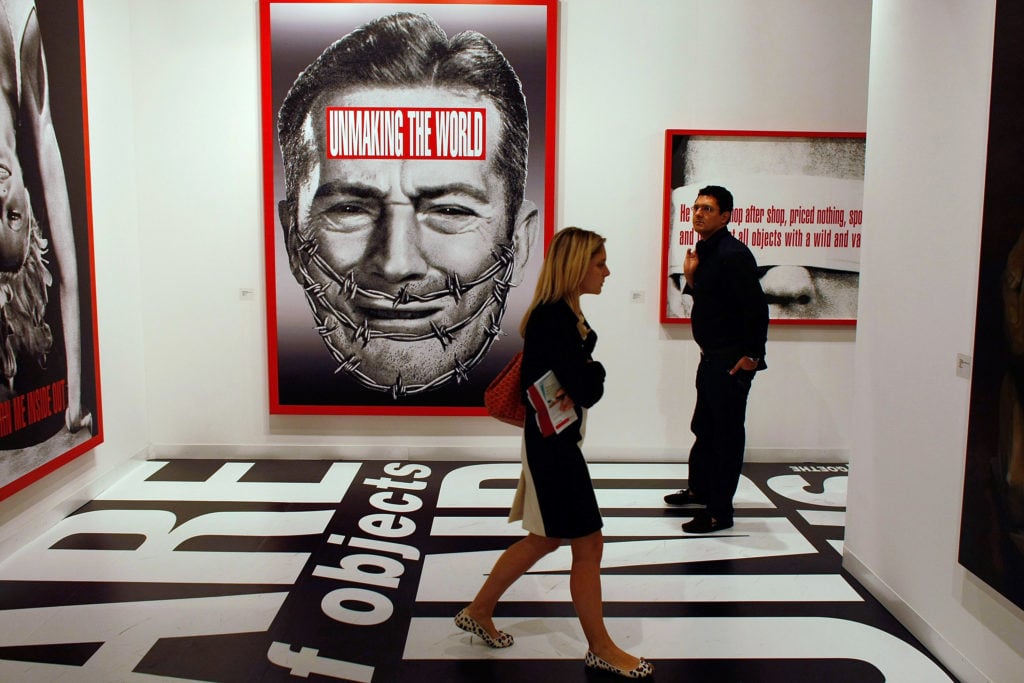
Visitors explore Mary Boone’s booth at
Art Basel Miami Beach. (Photo by Joe Raedle/Getty Images)
Getting Out While the Getting’s Good?
Swiss cantons—essentially
Switzerland’s equivalent to states or provinces—collectively own 49
percent of the MCH Group. But the canton of Basel-Landschaft is now
on the verge of selling its 7.8 percent stake in the
company.
Basel-Landschaft purchased its
shares all the way back in 1918, when an economic crisis compelled
officials to deem the MCH Group’s health vital to the public good.
This judgment meant the 7.8 percent stake was labeled as a
so-called administrative asset in the canton’s books, alongside the
likes of public-school buildings. But after 101 years, officials
reclassified the shares as a financial asset
this June, freeing them to sell the canton’s stake when the
opportunity arises.
When asked by artnet News, Jecker
of the MCH Group said the impending sale “has no direct impact on
the core-business strategy that has now been defined.”
According to
BZ, the canton of Basel-Stadt, the MCH Group’s
largest shareholder at 33 percent, has the right of first refusal
on Basel-Landschaft’s stake. Although the latter’s shares have a
nominal value of CHF 4.7 million, the Directorate of Economics and
Health recently estimated them to be worth about CHF 11
million.
Basel-Landschaft officials have
justified the decision on purely bureaucratic grounds. They reason
that current economic conditions relieve the canton and its
citizens of the duty to continue supporting the MCH
Group.
However, a look at the company’s
debts raises a more financially motivated possibility. The MCH
Group has received three government loans totaling CHF 85 million
in the past 10 years. The first of those loans, for CHF 30 million,
comes due in 10 interest-free tranches of CHF 3 million each
starting in June 2020—but only if the MCH Group has an equity ratio
of at least 30 percent.
The company’s financial struggles
place it light years away from that milestone. Despite improving on
the 11.4 percent equity ratio registered at the end of 2018, it
reached an equity ratio of just 12.3 percent in its results for the
first half of 2019. This figure makes it highly unlikely that
Basel-Landschaft will see repayment anytime
soon. If officials
believe they can generate roughly CHF 11 million in the immediate
future by selling the canton’s stake in the MCH Group, that
prospect may have more appeal than holding onto the shares for the
possibility that the government will be made whole at some
indeterminate point in the future.
The operative question for
Basel-Landschaft, then, is the same as the one facing all MCH Group
shareholders, public and private alike: How many more quarters of
losses are worth enduring to see if the restructuring and renewed
focus on traditional fairs pay off? No matter the answer, the one
thing we can count on is that more change is coming. To succeed,
the company will need better luck replicating the Art Basel model
than most of Art Basel’s competitors.
The post Money Troubles Force MCH Group, Art Basel’s Parent
Company, to Choose Its Fairs Over Its Event-Marketing Business
appeared first on artnet News.
Read more https://news.artnet.com/market/mch-group-live-marketing-1670869
Further reading


Leave a comment