
He Clicked, But Does He Think It Clicks? We Zoomed Along With a Collector to See What He Thinks of Frieze’s Online Art Fair
Everyone knows that an online
art fair can never fully replace the real thing. But no matter how
much analysis a journalist does from a distance, nothing could
reveal the strengths and shortcomings of the attempt more vividly
than a two-hour screen-sharing experience with a veteran collector
on opening day of the first-ever Frieze Viewing Room.
Fortunately, Chris Birchby was
game for the virtual ride-along. Now known as the San Diego-based
founder and CEO of COOLA LLC, a flourishing organic skincare empire
that contains the upscale COOLA and accessible Bare Republic
brands, Birchby entered the first online Frieze week hoping to
thoughtfully expand his collection of more than 100 works. His
journey to accomplishing this goal gave Artnet News a view of how
much—and how little—changes when a premier art fair is forced to
pivot to an online-only existence.
The good news for the art
market? For dedicated collectors, a virtual art fair can still
create the sense of competitive urgency that drives many
transactions at physical fairs, and UX (user experience) design
doesn’t have to be flawless to chisel away any remaining obstacle
to transacting remotely.
The less good news? Speedy
communication with clients needs to be considered a much higher
priority by fairs and exhibitors alike if the format ever hopes to
hit escape velocity at scale. And the current virtual
infrastructure offers only a shadow of the sense of spontaneous
discovery that keeps open-minded buyers roaming the aisles at live
fairs.
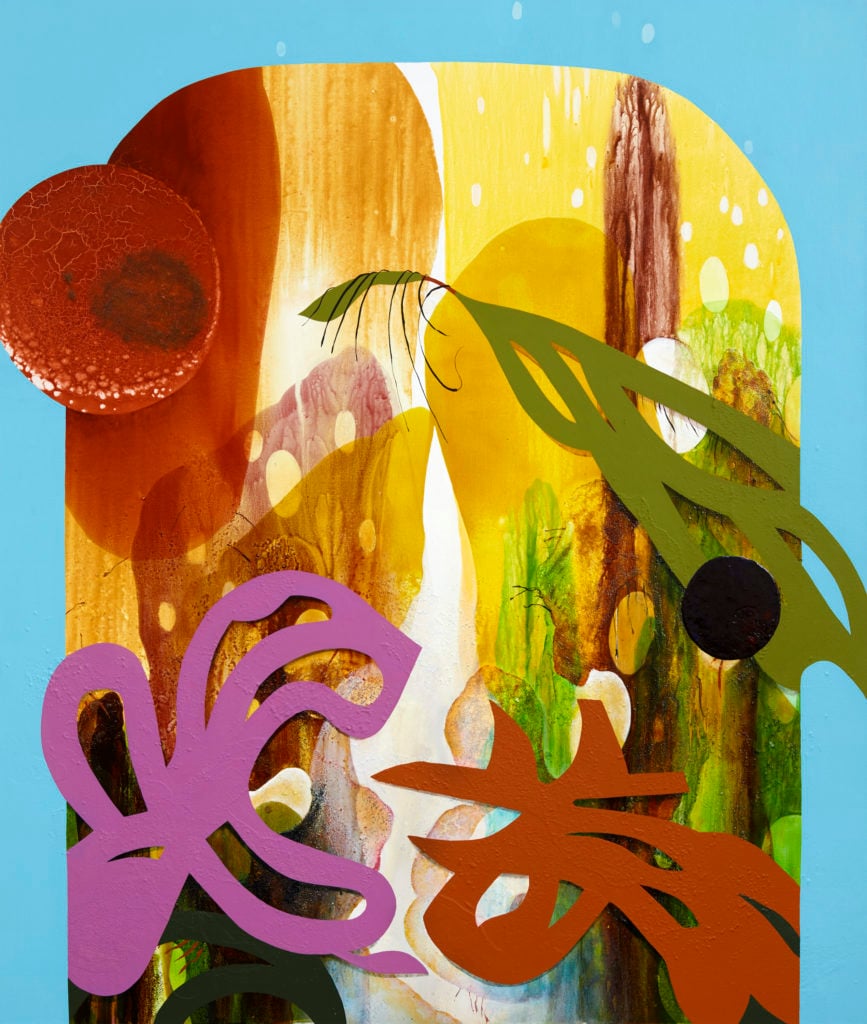
Carrie Moyer, Neapolitan
Projection, 2019. Courtesy of the artist and DC Moore Gallery,
New York.
Early Engagement
Although Birchby didn’t know
exactly what to expect from a top-tier virtual
fair—he’d skipped the online
sales platform rolled out to replace Art Basel Hong Kong in
March—he did know exactly how he wanted to approach the event. He’d
assembled a budget and targeted a handful of artists in the lead-up
to the fair based on PDF previews, but he also held out hope for
serendipitous additions, especially by emerging young
painters—though he stressed that tactic was absolutely not about
any financial motivation.
“I’m not out here to pick
stocks,” explains Birchby, wearing a Bare Republic t-shirt in his
home office. “I want to support the artist while they’re trying to
break into the art world and make a career. There’s a mission-based
quality [to my collecting] that I enjoy.”
Birchby understands the young
artist’s struggle firsthand. After earning an MFA from ArtCenter
College of Design in Pasadena in 2001, he funded years of striving
as a painter in downtown Los Angeles largely by excelling at online
poker. (A fragment of one of his own canvases is visible behind his
task chair in the Zoom window.) And while his painting practice
eventually took a backseat to more classical entrepreneurship, his
past experience in the studio and his deep knowledge of the
medium’s history continue to guide his collecting today.
Birchby proves as much with his
first acquisition from a Frieze exhibitor—a deal that confirms pre-selling has very much
survived the fair sector’s transition to
online-only. In a call with
Artnet News three days before the viewing room opened to VIPs, he’d
signaled a strong interest in the new Carrie Moyer paintings that
would be shown by DC Moore Gallery because the artist had been
“very influential” to him in his own painting career. Shortly after
reconnecting on preview day, he announces that he already reached
out to the gallery and acquired Neapolitan Projection, a lush canvas melding hard-edged abstraction
with streaks and imprints recalling coral lifeforms, priced at
$65,000.
After logging into the viewing
room, Birchby clicks into DC Moore’s digital booth to scroll
through and admire Moyer’s works again. “I’ve been looking for the
right [piece] of hers to live with for a while,” Birchby says.
When Neapolitan
Projection arrives, he
plans on installing it in his home near works by Katharina Grosse,
Bernard Frize, and Joanne Greenbaum to “tell a nice story of
non-representational painting.”
From DC Moore, Birchby clicks
over to Various Small Fires, the innovative Los
Angeles and Seoul-based gallery he knows well. Here, too, he’s finalized two
acquisitions prior to VIP preview day: Joshua Nathanson’s
Fight or
Flight, a quietly
hallucinatory oil-on-canvas that floats between figuration,
landscape, and abstraction, priced at $24,000; and a small
photorealist painting by Calida Rawles depicting a young girl in a
white dress eerily suspended underwater, priced at
$15,000.
His pride in his new purchases
is palpable through the software. But with the pre-existing deals
now covered, it’s time to venture into the digital
unknown.
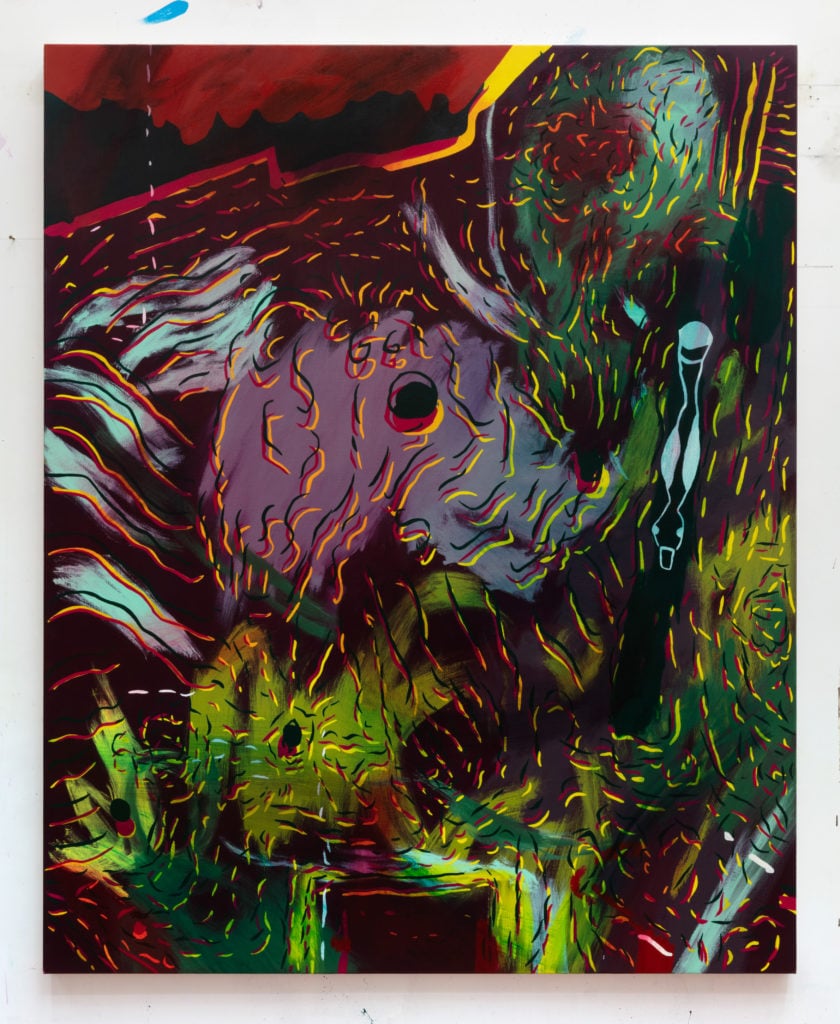
Joshua Nathanson, FIGHT OR
FLIGHT, 2020. Courtesy of Various Small Fires, Los Angeles and
Seoul.
Two Steps Forward, One Step Back
Birchby returns to the Frieze
Viewing Room’s main galleries page and scans through the exhibitors
somewhat at random, as much to get a feel for the online
architecture as to see what other works might interest him. A few
days earlier, he’d wondered how robust the user experience would
be. He’d even mused about the future potential for a game-ified
virtual-reality art fair where collectors would have to outpace
each others’ avatars to secure first dibs on prized
works.
Now that he’s merely
free-scrolling through an alphabetized grid of galleries, though,
his brow furrows. “I don’t
really see how this is any different from browsing a normal
website….”
However, he brightens a bit upon
encountering a vibrantly colored text painting by Jeffrey Gibson.
Since this is the first time he’s fully clicked through to a single
work—he only reviewed his
early acquisitions within the grid view of available pieces on each
gallery’s individual page—it’s the first time he’s seen the “to-scale”
view in Frieze’s online interface. Here, the piece appears on a
white wall with an empty modernist chair in frame as a size
reference.
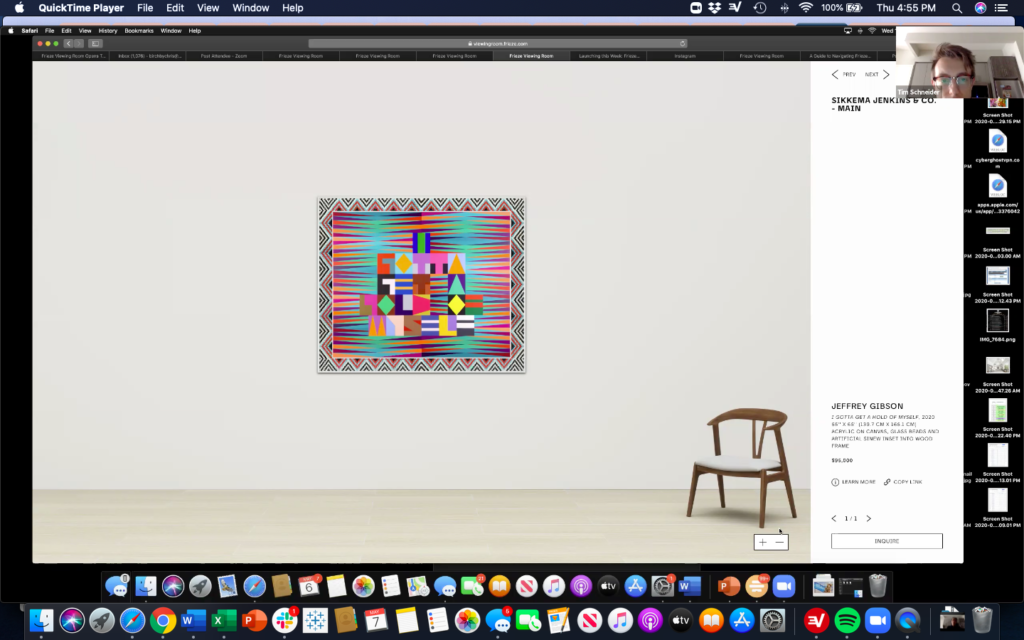
The shared screen experience of the
Frieze Viewing Room, featuring a scale view of a Jeffrey Gibson
painting at Sikkema Jenkins & Co. Courtesy of Chris Birchby.
“Oh, beautiful that it comes up
like that.” He zooms in on the piece using the site’s controls.
“They just Photoshopped that all in [on the
wall]—you can see how even
it is on the edges there,” he says, a line meant as an appreciation
of the execution, not a criticism. Here, at least, is something he
can’t get in a PDF.
Birchby also commends Frieze and
the exhibitors willing to openly display pricing and availability
for the works on view, noting that dealers are “usually a closed
book on that front” at live fairs. But a bit of confusion bubbles
up when he tests out the fair’s search function. After filtering
out all works except those in the price bracket between $20,000 and
$50,000, he notices some paintings that carry no listed price at
all, as well as a few others that merely reiterate the price range
he’s selected in the menu.
“Just $20,000 to $50,000? That’s
a big range,” he says. With a grin, Birchby uses a comparison to
explain why he sees price ranges as self-defeating to sellers in
any context. “In California real estate, if a house is listed at $1
million to $1.25 million, you just say, ‘It’s a million-dollar
house.’” Good luck trying to get a buyer to go
higher.
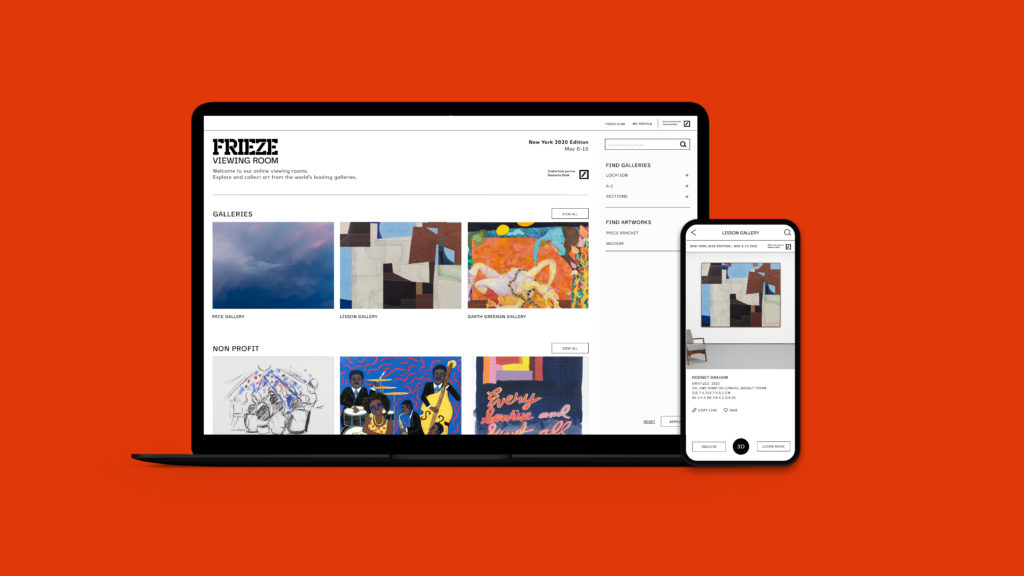
Courtesy of Frieze.
Real Life Asserts Itself
Although Birchby states that
he’s not looking to buy more beyond his three pre-fair
acquisitions, he continues exploring what Frieze has to offer,
including works at PPOW and the fair’s nonprofit sections
benefiting public-health causes. He has a bit of flexibility thanks
to a savvy recent business move.
While COOLA and Bare Republic’s
shared foundation is organic sun-protection
products—a category poised
to decline due to the global collapse in travel and outdoor
activity in the social-distancing era—the “new normal” compelled him and his team to
whip up Bare Hands, a quick-drying hand sanitizer made with natural
ingredients, in a small fraction of their normal
product-development timeline. Sales of the new item have been
strong enough that Birchby has even been hiring new staff instead
of having to cut back during the crisis.
Despite a mission to keep
browsing, though, Birchby’s energy is starting to wane after an
hour of click-and-scroll. “I don’t know if my patience is here to
spend as much time as I would at the real fair,” he admits. “I can
hear my kids in the other room, and I know I have work to do.” It
is, after all, the middle of a Wednesday.
Most likely, he says, he’ll
“come back and click around at night with three or four other
[browser] windows going, so
it’s not total focus.” This
is a natural, and perhaps insurmountable, hurdle for a live event
that has suddenly had to transform into an e-commerce platform
beamed into home offices everywhere.
Another such hurdle emerges when
Birchby grins and looks away from his screen toward the tiny voices
rising in volume over the Zoom connection. “Oh, the kids found
me!”
What ensues is the toughest
negotiation Birchby encounters during his time in the Frieze
Viewing Room: with his diaper-clad son, Wilder, bouncing on his
lap, his not-quite four-year-old daughter, Bellemy, tries to
convince her dad to give up on the art fair so she can watch
My Little
Pony.
Delighted but not deterred,
Birchby instead tries to interest Bellemy (who, it turns out, has
used markers to apply Ziggy Stardust-like streaks of bold color
across her eyes) in the onscreen grid of works by emerging
painters. “Which of
these is your favorite?” he asks.
“None of them!” Bellemy
exclaims, gesturing at Birchby’s second monitor.
“My Little
Pony!”
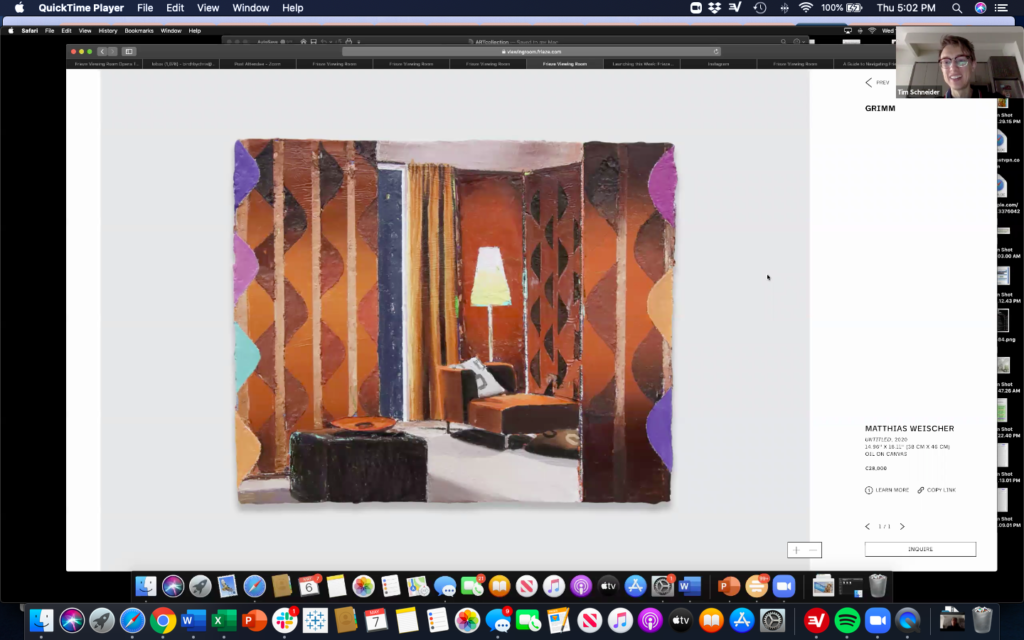
The shared screen experience of the
Frieze Viewing Room, featuring work by Matthias Weischer at GRIMM.
Courtesy of Chris Birchby.
Winding Down
Although AJ, Birchby’s wife,
soon retrieves the kids—and
stops to admire a small, texture-heavy painting of a retro home
interior by Matthias Weischer at GRIMM—it’s clear the collector is
nearing the saturation point. He browses for a while longer,
including using the site’s
messaging capabilities to inquire about young figurative painters
Sedrick Chisom and Trey Abdella with Matthew Brown and T293
Gallery, respectively. (All of Abdella’s works are already marked
as sold or reserved by then, but the Chisom canvas appears to still
be available.)
However, responses aren’t
forthcoming from either gallery. Birchby laments the absence of a
real-time chat function like you now find on nearly every
e-commerce or customer-service website outside the art market. The
problem isn’t just the inconvenience; it’s also the way it turns
the social, dynamic aspect of meeting a dealer inside a booth or
gallery into an impersonal, closed-ended query. In this setting,
you’re unlikely to be led from your interest in one work to your
interest in something completely different through the magic of
live conversation.
“This is the stage at a real
fair where I’d be looking for a sandwich or a cocktail,” Birchby
says with a laugh just after passing the two-hour mark. He’s ready
to sign off, but he’s satisfied. After having seen so much other
work, he says there’s nothing he would have wanted more than the
three pieces he acquired before the viewing room
opened.
In a later email exchange,
however, Birchby confirms that he did in fact return later on in
the preview. While he was disappointed that he still hadn’t
received a reply from either Matthew Brown or T293 by noon Eastern
Time Thursday (the former did eventually write back with apologies
that the Chisom had already found a buyer), he had discovered a
delicate but humorous painting of the grim reaper beckoning to a
disobedient dog by Sanam Khatibi at Rodolphe Janssen overnight.
After the gallery responded to his inquiry, he was delighted to
quickly finalize the acquisition, proving that small discoveries
aren’t completely off the table even when fairs are forced to go
digital—and even when Death himself, however whimsically rendered,
is directly involved.
The post He Clicked, But Does He Think It Clicks? We Zoomed
Along With a Collector to See What He Thinks of Frieze’s Online Art
Fair appeared first on artnet News.
Read more https://news.artnet.com/market/frieze-viewing-rooms-chris-birchby-1854924
Further reading


Leave a comment