
Ever Wonder How Art Gets on TV? Here’s How Some Major Masterpieces Got Cameos on Six Streamable Shows
Are there more rich people on TV
nowadays or is the depiction of their lifestyle just getting more
accurate? During recent at-home streaming marathons, we couldn’t
help but notice a generous helping of art on some of our favorite
shows—and not just Picasso knock-offs, but works that appear to be
the real thing. A Basquiat here, a Matisse there.
How did they get there? It turns
out their presence is the result of extended negotiation—and often,
painstaking reproduction.
“Yes, they’re ‘real’ artworks
you’re seeing—we license the images to many shows. Replicas of the
works are created to very specific detail,” explained
Katarina Feder, vice president and
director of business development of the visual arts copyright
organization Artists Rights Society. In order to keep fraudulent
works from appearing on the market or making their way around the
web, the organization requires the production to destroy the
reproductions or return them once filming is over.
Only in rare instances do the real works appear on
screen. “Most of the
time, I like to make official reproductions as we will need them
for an extended length of time, but I do use originals sometimes
for short shots,” explained celebrated set designer Fanny Pereire,
who has worked on shows from Billions to the recent hit
Mrs. America. “Often, sculptures are borrowed as they are
harder to reproduce, but with the progress of 3D printing it will
become easier.”
Check out six art-filled shows currently streaming and get ready
to play “Where’s Warhol?” next time you fire up the cue.
Billions
(Showtime)
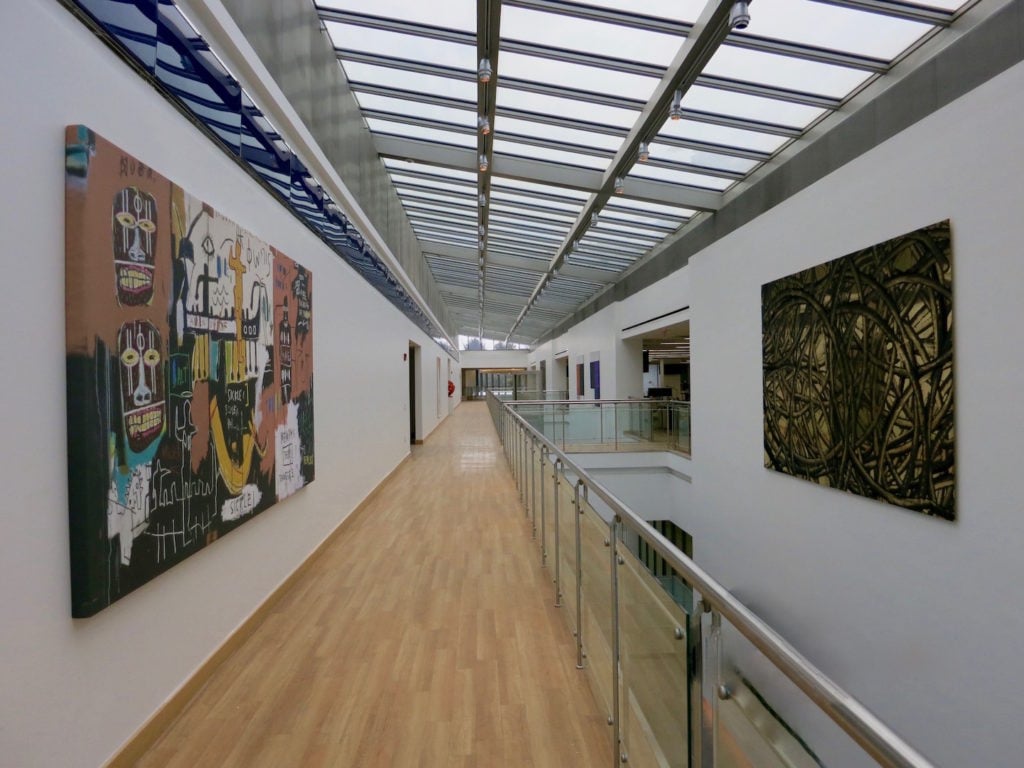
Basquiat’s nearly
12-foot-long Nile in the hallways of Axe Capital.
What It’s About: This
dizzyingly fast-paced show chronicles the ongoing battle between a
tenacious US Attorney (played by Paul Giamatti) and a hotshot hedge-fund tycoon,
Bobby “Axe” Axelrod (played by
Damian Lewis).
Real-Life Creative Spark: The central plot
is loosely based
on former US Attorney for Southern New York Preet Bharara’s
dogged investigative pursuit of SAC Capital and Point72 founder Steve Cohen. In
real life, Cohen is an avid art collector who owns major works by
Picasso, Andy Warhol, Jasper Johns, and Jeff Koons—so it’s
unsurprising that “Axe” has an eye for art as
well.
Art Appearances: The
cameos start in the very first episode as we’re introduced
to Axe Capital’s headquarters, whose walls are
lined with massive, bold artworks that attest to the founder’s own
brash persona. Through the seasons, works by Jean-Michel Basquiat,
Pat Steir, Frank Stella, and Yves Klein come across the screen.
Producers say the choice of artworks is anything but arbitrary.
When the mood turns from bullish to bleak in the second season, the
art takes on a more subdued tone, too. “My reference for the second
season was World War II bunkers, feeling like he is shut down
emotionally, so we went more with photography… things that are more
industrial and cold,” Michael Shaw, the
show’s production designer, told Artnet News in 2017.
Keep an Eye Out For: A
large Robert Motherwell “Elegy” painting that adorns Axelrod’s
Manhattan penthouse.
Succession
(HBO)
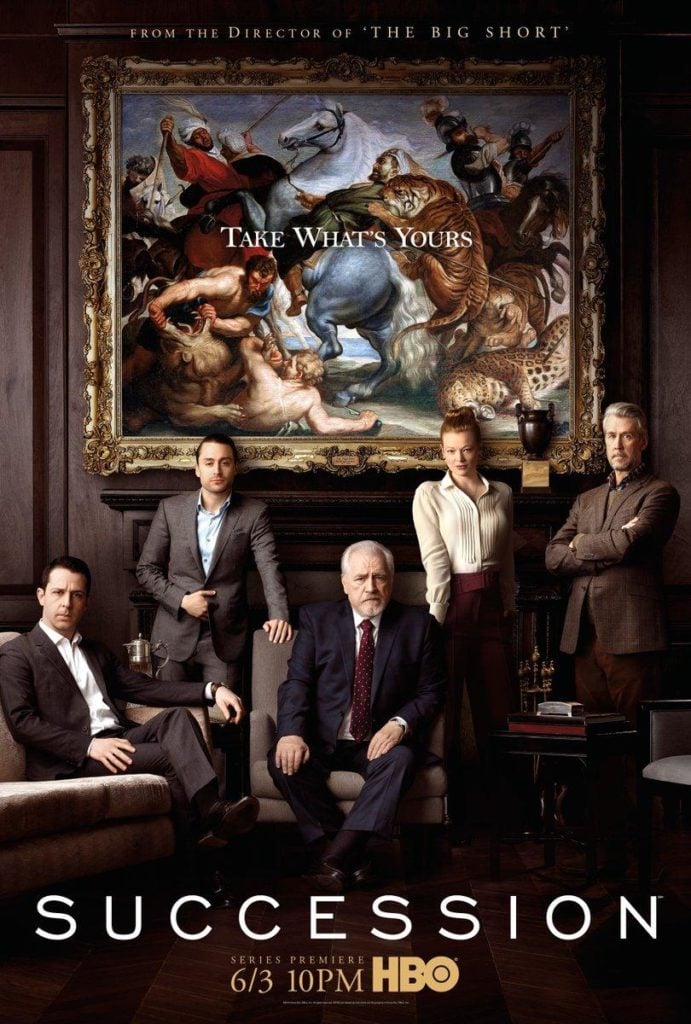
Peter
Paul Rubens’ The Tiger Hunt serves as the background
for the Season 1 promotional image for Succession.
What It’s About: An addictively watchable show about the Roy family,
a ruthless Murdoch-style media dynasty who spend their days
sabotaging one another on the Upper East Side. The unlikable family
has cultural ambitions and often tries to parlay their wealth into
all manner of stunts. Never forget when Kendall (Jeremy Strong),
the bumbling likely heir to the media empire, takes a meeting with
a fine-art start-up to hype the democratization of art while
wearing a pair of freshly purchased Lanvin
sneakers.
Art Appearances: The
first season’s publicity photos picture patriarch Logan Roy, tycoon
of Waystar Royco, and his four duplicitous children in front of
Peter Paul Rubens’s The Tiger Hunt (1615–17). (The
painting never materialized in the show itself.) The publicity shot
for season 2 followed up on the trend with William-Adolphe
Bouguereau’s Dante and Virgil (1850), borrowed from the
collection of the Musee D’Orsay.
Keep an Eye Out For: An Isamu Noguchi Cube in
Season 1, Episode 7.
Little Fires
Everywhere (Hulu)

One of Cindy Sherman’s Untitled Film
Stills appears in a scene in the Hulu series “Little Fires
Everywhere.”
What It’s
About: Worlds collide in picturesque Shaker Heights, Ohio,
when a single-mother artist Mia Warren (played by Kerry Washington)
and her daughter move to town and upend the cookie-cutter life of
the Richardson family, led by matriarch Elena
Richardson (played by Reese Witherspoon).
Art Appearances: Art
underpins much of Mia’s complex persona and backstory. One of her
photographs hanging in her apartment draws lots of attention from
the Richardsons for it’s enigmatic, slightly menacing nature. We
don’t want to give anything away, but photography plays an
increasingly pivotal role as the story comes to a head. One plot
point involves Sotheby’s, a New York Times article,
and a conversation between Mia and her gallerist in which the
latter tenderly reminds the artist that a buyer has the right to
publicize a purchase.
Keep an Eye Out For: One of Cindy Sherman’s iconic “Film Stills,”
which is projected as a slide in a flashback to Mia’s art-school
days, when her professor Pauline encourages her students to
discover what is “repulsive, terrifying, and uncanny” about
themselves.
Mrs. America
(Hulu)
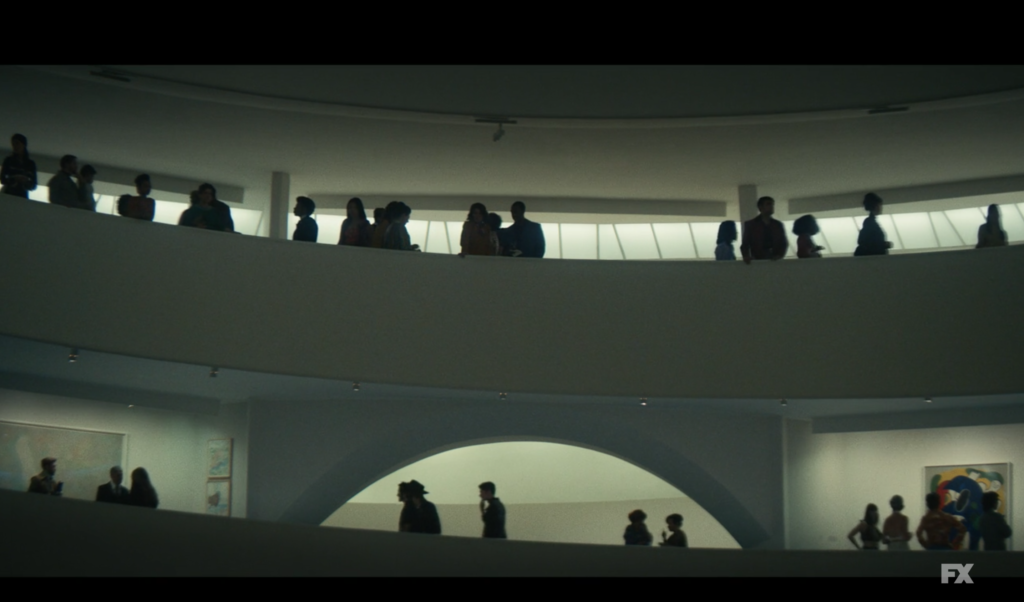
Ms. Magazine at the Guggenheim.
Courtesy of Mrs. America
What It’s
About: This riveting miniseries focuses on the
stories of the women behind the movement to pass the Equal Rights
Amendment and stars Cate Blanchett as the delightfully dangerous
Phyllis Schlafly—the woman who led a conservative backlash against
the feminist movement.
Art Party: Watch out for Gloria Steinem’s trip to an
opening at the Guggenheim Museum for the launch party of
Ms. magazine.
Behind the Scenes:
The filmmakers were allotted just three hours to shoot the sequence
at the Guggenheim and rushed to replace the contemporary signs with
period graphics and artworks. “Shooting inside the Guggenheim, with
its own art collection, was a surreal treat,” Pereire told
Artnet News. “The task was to get clearance from all the artworks
created before 1972 which is when the scene takes place.” Her team
also created Guggenheim period posters with Mondrian artworks from
the collection, which they posted on site to conceal other
anachronisms.
Keep an Eye Out For: Those
with a keen eye for Guggenheim exhibition history will notice that
Lawrence Weiner’s wall drawing To the Sea/ From the Sea/
Bordering the Sea/ At the Sea/On the Sea, from the
museum’s 2019 “Artistic License” show, is visible. But rest
assured, it’s chronologically plausible: the 1970 work predates the
launch of the magazine (even if it might not have been in the
museum at the time).
Genius: Picasso
(Hulu)
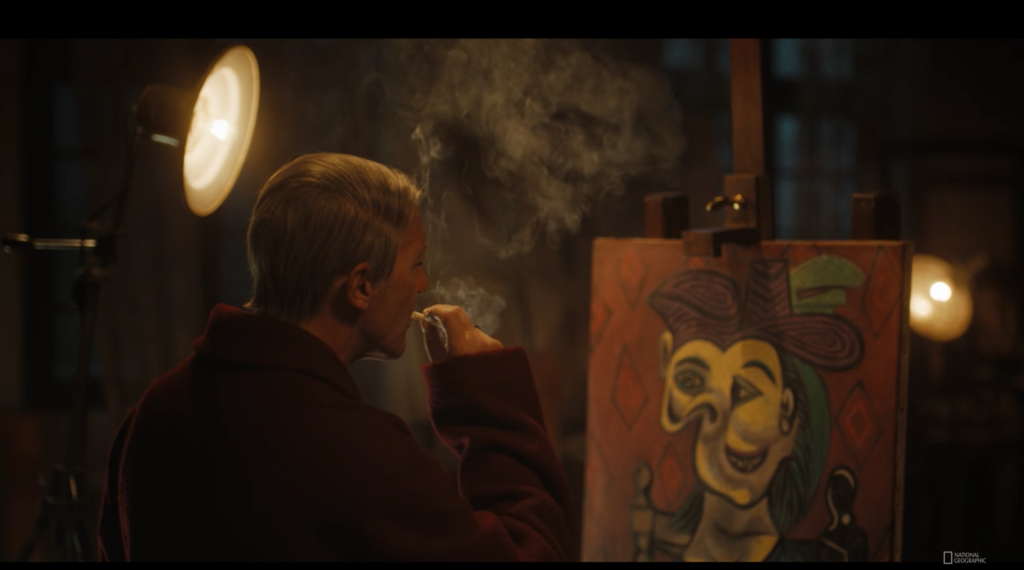
Pablo Picasso’s Femme Assise Robe
Bleue (1939) on the set of Genius. Courtesy of
National Geographic.
What It’s
About: The second season of
Genius focuses on the life of that temperamental 5’ 3”
Spaniard, Pablo Picasso. With the leading man played by Antonio
Banderas, the show traces the tribulations and triumphs of the
artist, from a young man discovering his talents to his
later-in-life worldwide celebrity.
Art Plotline: You’re right to assume
you’ll see a lot of Picasso’s own works (one episode is devoted to
the creation of Guernica). But there are a lot of other
artists’ works to marvel at, too—including the colorful creations
of Picasso’s close friend Henri Matisse and the dreamily surreal
works of Henri Rousseau.
Keep an Eye Out For: The pivotal scene when Picasso
finds inspiration in the African masks at the Musée d’Ethnographie
du Trocadéro in Paris and creates Les Demoiselles
d’Avignon, as well as his first encounter with the
paintings of Matisse, which he calls “all wrong” and yet
“magnificent.”
Leading Ladies: Dora, Olga, Marie-Thérèse,
Francoise—all the women of the philandering artist’s life take the
stage, and often steal the show in this campy miniseries.
I Am The Night
(Hulu)
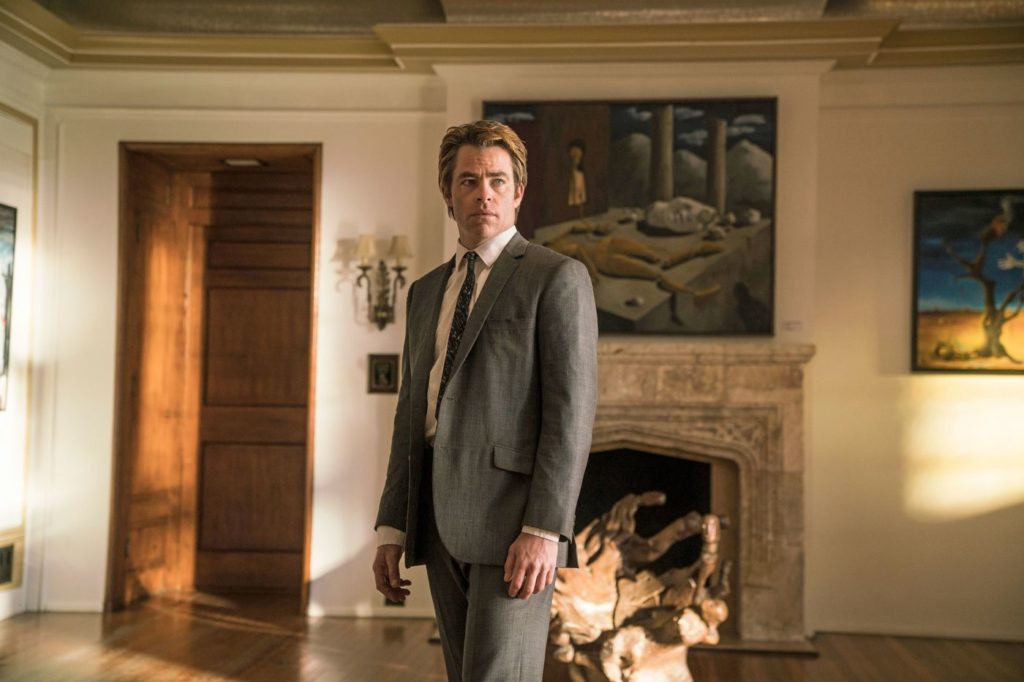
Journalist Jay Singletary has a
horrifying realization while looking at some Surrealist
Masterpieces. Courtesy of TNT.
What It’s
About: The
six-episode miniseries is based on the real-life
story of Fauna Hodel
(India Eisley), a young girl who was given up by her birth mother
and sets out to retrace her past. In the process, she winds up
following the trail of the infamous Black Dahlia slaying of an aspiring actress in
1947 Los Angeles.
Macabre
Masterpiece: Dr. George Hodel, a gynecologist with a
twisted mind, finds morbid inspirations in the work of the
Surrealists… need we say more? (Disturbingly, the real George Hodel
was friendly with Man Ray in the 1940s.)
The Art of
Enlightenment: Journalist Jay Singletary (Chris
Pine) has an “aha!” moment
about the case while wandering through a museum.
Keep an Eye Out For: German Surrealist Max
Ernst’s painting Celebes (1921), which appears
hanging in the museum’s gallery. (In real life, it’s owned by the
Tate.)
The post Ever Wonder How Art Gets on TV? Here’s How Some
Major Masterpieces Got Cameos on Six Streamable Shows appeared
first on artnet News.
Further reading


Leave a comment