
Christie’s Quietly Pulls Greek and Roman Antiquities From an Online Auction After Evidence Suggests They May Have Been Looted
Christie’s has pulled four Greek and Roman antiquities from an
online auction after new evidence arose suggesting they may have
been looted.
The four lots—a Roman marble hare, a bronze Roman eagle, and two
Attic vases—were quietly withdrawn from the
antiquities sale, which ends
tomorrow, following “new information by the appropriate authorities
from archives currently still unavailable to our researchers,” a
Christie’s spokesperson told the Guardian.
Christie’s did not respond to requests for comment.
Archaeologist Christos Tsirogiannis, who has a history of
outing looted
antiquities that come up for
sale as well as in private and museum collections,
revealed the artifacts’ illicit origins.
“Unprovenanced, looted, and stolen antiquities are continuously
on offer by the market, because the market refuses to send images
of the objects they intend to sell to the relevant authorities and
check these objects with them, before the auction houses and the
dealers even compile their sale catalogues,” Tsirogiannis, an
associate professor at the Institute of Advanced Studies at the
University of Aarhus in Denmark, told Artnet News in an email.
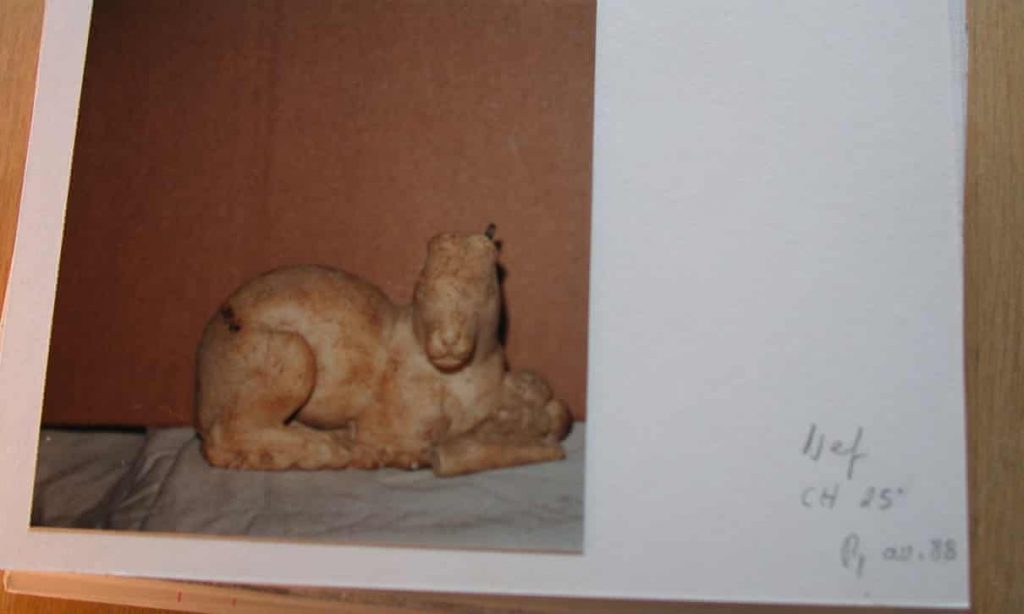
This photograph of a Roman marble hare
sculpture from the archives of Italian antiquities dealer
Gianfranco Becchina, convicted of selling looted art, matches a
work that was set to be sold at an upcoming Christie’s auction.
Photo courtesy of Becchina archive.
To stop these sales from going through, Tsirogiannis began
compiling his own database of looted antiquities in the early
2000s, gaining access to Greek and Italian records on antiquities
trafficking, including photographs and other evidence collected
during police raids. He’s tracked down an estimated 1,100
antiquities over the past 15 years.
In this instance, Tsirogiannis was able to trace the four
artifacts on offer at Christie’s to Gianfranco Becchina, an
Italian antiquities dealer convicted in Greece for selling looted
art.
The hare sculpture (dated to the circa second or third century),
which carried an estimate of $20,000 to $30,000, was a match for a
photograph from Becchina’s inventory. The dealer’s records noted
that he bought the artwork for 13,000 Italian lire in 1987, from a
man called Tullio, along with other looted antiquities.
The older of the two vases (circa 540–530 BC), featuring black
figures, matched a Polaroid of a vase that Raffaele Monticelli, who
served four years in prison for trafficking illicit antiquities,
supplied to Becchina. The vase with the red figures (430–420 BC)
and the eagle sculpture (circa second or third century) also were a
match to photographs of artifacts in the Becchina archive.
The post Christie’s Quietly Pulls Greek and Roman
Antiquities From an Online Auction After Evidence Suggests They May
Have Been Looted appeared first on artnet News.
Read more https://news.artnet.com/market/christies-pulls-looted-antiquities-auction-1886958
Further reading


Leave a comment