
Can I Break My Art Gallery’s Lease Because of Coronavirus? + Other Questions About How Force Majeure Works, Answered by Lawyers
As art lawyers in the age of
COVID, we have received a lot of novel questions from our clients
and others. The one question that has plagued lawyers like
us the most concerns the widely known but often ill-considered
legal principle of “force majeure” and its application to our
current crisis. In an effort to
cure some common misconceptions, we thought it might be useful to
treat our readers to some actual (and a few entirely made up)
questions we have recently received on this very topical
topic.
What is “force majeure” anyway?
It’s a legal principle that
states that a party may suspend or excuse performance under a
contract when extraordinary and unforeseen circumstances beyond its
control—typically Acts of God such as fire, natural disasters, or
severe weather conditions—make it actually or virtually impossible
to complete. Other force majeure events we have seen in
auction-house contracts include acts of war, terrorism, or civil
insurrection.
Does COVID-19 make the list?
It depends. Force majeure is a
contractual term, so if it is not specifically provided for in an
agreement, a party can’t rely on it to avoid a legal obligation.
That said, if your contract contains “catch-all” language
stating that the list of force
majeure events in your agreement is not exhaustive,
the coronavirus should qualify.
However, if your force majeure clause refers vaguely only to
“natural disasters” or “Acts of
God,” the prognosis is less
clear. Even with a well drafted contract, a force majeure clause
won’t help you if your compliance is merely economically difficult
rather than truly impossible or impracticable. This very issue is
certain to be one of the most actively litigated issues since Noah
built his boat.
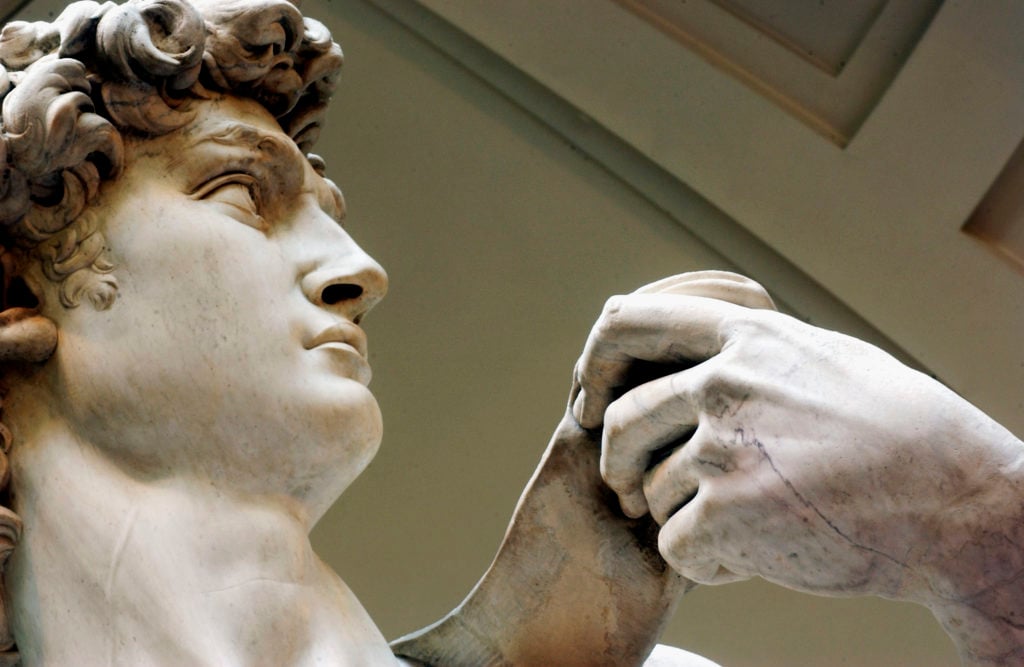
Michelangelo’s masterpiece David at the
Galleria dell’Accademia in Florence. Photo by Franco Origlia/Getty
Images.
Are there any interesting applications of force majeure in
art history?
Great question! Our intrepid
researcher Thomas Elliott dug up an early force majeure contingency
in Michelangelo’s contract with the heirs of Pope Pius III to
create 15 marble statues for the cathedral in Siena. The artist’s
savvy lawyer (we presume) inserted a clause stating that the
delivery period for the statues would be suspended in the event of
“hindrances” such as the artist’s falling ill or the outbreak of
war that prevented delivery of marble from Carrara. It seems that
the clause was actually invoked when war broke out between Florence
and Pisa, thereby preventing Florentine engineers—who were busy
helping the military—from redirecting the Arno to allow the marble
to be delivered to Siena in a timely fashion.
If this principle has been around for hundreds of years, it
must be codified in US laws, right?
Wrong. Unlike in countries such as France,
one cannot make a claim under force
majeure in the United States if the parties to a contract haven’t
specifically provided for it. Typically, US courts construe force
majeure clauses narrowly and won’t “read in” this type of provision
when it is not included in the contract.
That makes no sense today. Because of the pandemic, I can’t
fulfill many of our gallery’s contractual obligations, including
the delivery of an expensive painting to a buyer. The warehouse
where the painting is housed is closed by government order.
Fortunately for you,
the Uniform Commercial Code
(“UCC”), which governs commercial transactions in New York and all
other states, specifically addresses this type of situation. The
UCC provides that a seller’s “delay in delivery or non-delivery in
whole or in part” could be excused if its agreed performance “has
been made impracticable by the occurrence of a contingency the
non-occurrence of which was a basic assumption on which the
contract was made or by compliance in good faith with any
applicable foreign or domestic governmental regulation or order
whether or not it later proves to be invalid.” (In other words, you
don’t need to fulfill your obligations if they became impossible
based on external factors nobody could have seen coming.) Since
this UCC provision would apply even if you had no force majeure
clause in the agreement with your buyer, it may save you
here.
As for other possible cure-alls,
even without a force majeure clause in your sale agreement, you
could try relying on the legal doctrines of “impossibility” and
“frustration of purpose.” In New York, compliance with a contract
may be excused when it becomes impossible to do so (in the old law
school example, when the cow you are buying dies before the sale is
completed), or when a change
in circumstances makes performance virtually worthless to the other
party, thereby frustrating that party’s purpose in making the
contract (to take the famous English example, you rent a balcony to
view the King’s coronation but the coronation is
cancelled).
Although New York courts apply
“impossibility” and
“frustration of purpose” narrowly, in our experience “frustration of purpose” can
be particularly useful because it does not require that a contract
be literally impossible to perform.
Got it. My Chelsea gallery lease does contain a force majeure
clause. Can I break the lease due to the coronavirus
crisis?
It depends on what the lease
says, but generally these clauses are drafted in favor of landlords
only, and don’t permit
tenants to terminate the lease even in the event of a force majeure
scenario. And note that New
York courts typically only excuse performance based on force
majeure events that are unforeseeable at the time a lease or other
contract was signed, so if you rented your space after the pandemic
hit New York City, your defense on that basis is probably dead in
the water. An interesting
legal question is when, exactly, the impact of coronavirus could
have been reasonably foreseeable here. Was it when Wuhan, China
first shut down, or was it at some later date? The timing of
foreseeability here is another issue certain to keep litigators
happily employed for years to come. And it is important to
note that in some
jurisdictions, a party trying to rely on a force majeure provision
may also have to show that it actually attempted to perform its
obligations, and that it gave adequate notice of non-performance to
the other side as strictly required by the terms of the
agreement.
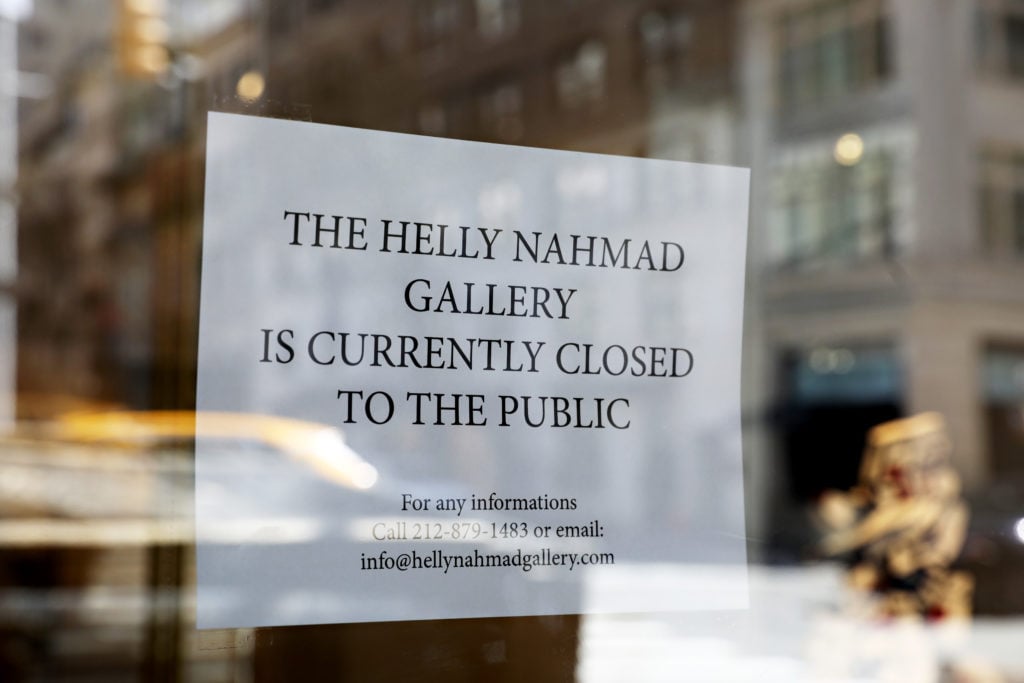
A sign is seen in the window of Helly
Nahmad Gallery on Madison Avenue on March 13, 2020 in New York
City. Photo by Cindy Ord/Getty Images.
If I break the gallery lease anyway, isn’t the landlord
obligated to re-rent the space to someone else and off-set my rent
against the new tenant’s payments?
Unfortunately, that is not the
law in New York for commercial leases. For a gallery lease like
yours, the landlord has no obligation to cut his losses (in legal
parlance, “mitigate damages”), and can theoretically sit back, do
nothing, and require you to pay rent and perform your other
obligations under the lease through the end of the term, even if he
or she has managed to rent the space to someone
else.
I’m broke, so good luck collecting anything from me now. Does
the same principle for commercial leases hold true for my apartment
lease?
The law in New York governing
residential leases is entirely different, and unlike with your
commercial lease, the landlord for your apartment must try to
mitigate damages if you default—but that may not be so easy during
this lockdown. Luckily for you, New York has enacted a temporary
moratorium on both residential and commercial evictions, so at
least for the time being, you can’t be thrown out of either your
home or gallery space even if you don’t pay your rent.
My Jersey City gallery paid a deposit to a local art fair
which was just cancelled, and the fair organizer is ducking my
calls. Can he keep the deposit?
That would be ill-advised on his
part. The 2006 New Jersey Appellate Court case
Facto v. Pantagis
involved an analogous situation in
which plaintiffs
Leo and Elizabeth Facto
sued Pantagis Renaissance, a New Jersey banquet hall, for the costs of
renting a wedding reception space and hiring a photographer,
videographer, and band. A power outage occurred 45 minutes after
the reception began and made hosting the function impossible. The
court held that the
defendant did not need to perform under the contract because the
outage was an “unusual extraordinary unexpected circumstance”
covered by the contract’s force majeure clause, and also
determined that
Pantagis’s inability to perform relieved the Falcos of any
obligation to pay the agreed-upon price except for the value of the services that were
received before the power outage. We believe there would be a similar result if
this case were litigated in New York today.
What’s the bottom line here? Will a force majeure clause in a
contract help me in light of the current pandemic?
Unless the clause is tightly
worded, a force majeure provision is no panacea, but certainly
provides the basis for a good legal argument. And as cases in this
area hit the courts, the application of force majeure to the
coronavirus crisis will become much clearer. In these
difficult times, that could be just what the doctor
ordered.
Charles and Thomas Danziger are partners in the New York firm
Danziger, Danziger & Muro, LLP, specializing in art law. Go to
danziger.com for more information. The
authors thank Thomas Elliott for his research assistance. Some
facts have been altered for reasons of client confidentiality.
Nothing in this article is intended to provide specific legal
advice.
The post Can I Break My Art Gallery’s Lease Because of
Coronavirus? + Other Questions About How Force Majeure Works,
Answered by Lawyers appeared first on artnet News.
Read more https://news.artnet.com/art-world/danziger-force-majeure-1846080
Further reading


Leave a comment