
At London’s 1–54 Fair, Curator Azu Nwagbogu Lays Out the Pitfalls of the New Wave of Interest in African Contemporary Art
In the courtyard of London’s neoclassical Somerset House, artist
Kiluanji Kia Henda and curator Azu Nwagbogu are standing together
ruminating on Henda’s large black iron sculpture. The work casts a
thin shadow along the cobblestoned courtyard of the muscular Royal
palace. “It looks better in the Angolan desert,” Henda points out.
Nwagbogu nods his head in careful agreement.
The whole point of this ghostly piece of architecture by Henda,
called The Fortress, is to draw attention to how
ephemeral the human constructions that it silhouettes really are.
The artist, though represented by Goodman Gallery, which is a
regular at Frieze London, is nevertheless happy about the work’s
central presence at the 1–54 Contemporary African Art Fair.
The event is rapidly emerging as a star contender in London’s
bustling art fair calendar, setting itself apart from the rest by
dedicating itself to presentations of African art. The fair’s
presence this year within Somerset House’s old imperial building
reads as a deliberate disruption of the aesthetics of
English-ness.

The Fortress by Kiluanji Kia
Henda on view in the courtyard of Somerset House during 1.54
African art fair. Courtesy the artist and Goodman Gallery.
Starting at the Right Place
Nigerian curator Azubuike Nwagbogu and Henda seem to have known
each other for a while—but then again Nwagbogu, who has agreed
to share his expertise with me at this fair, seems to know every
second or third person here. As we find a spot for a quiet coffee
before plunging into the display of 46 international galleries
presenting here, I start by confessing my lack of real knowledge of
African art.
“Well, you saying that means that you are, in fact, starting at
the right place,” says Nwagbogu. “You cannot be outside of the
African art scene and pretend to be an expert.” The curator is
himself undeniably a razor sharp authority on the continent, an
active member of the art scene for most of professional his life in
multiple countries.
Until a month ago, he was acting chief curator of one of
Africa’s top museums, the Zeitz Mocaa in Capetown (he passed the
reigns to curator Koyo Kouoh). Now once more an independent
curator, Nwagbogu is busy. He has a Lagos-based nonprofit, the
African Artists’ Foundation (AAF),
which supports emerging talent on the continent, and he is
planning LagosPhoto, the annual photo
festival which he founded and which opens on October 27.
"background:#FFF; border:0; border-radius:3px; box-shadow:0 0 1px 0 rgba(0,0,0,0.5),0 1px 10px 0 rgba(0,0,0,0.15); margin: 1px; max-width:500px; min-width:326px; padding:0; width:99.375%; width:-webkit-calc(100% - 2px); width:calc(100% - 2px);">
View this post on Instagram
Nwagbogu’s enthusiasm for African artists visibly bubbles over.
Nevertheless, he expresses caution regarding the grouping of an
entire continent’s artistic production together—a point that
notably seems to call into question the very premise of the 1-54
fair.
“I’m interested in other angles,” he admits. “I want to limit
the blind spots, and I want to normalize the existence and the
representation of African art, which you cannot do if you continue
to isolate it. African art continues to attenuate itself because we
still own this narrative of othering ourselves. I am interested in image-makers who load their
work with poetry and feeling—that is what I want to find
today.”
With that aim in mind, we
put down our coffee cups and head in.
By Africa, for Africa?
The first stop is Accra-based
Gallery 1957, where one of
Nwagbogu’s favorite artists, the Côte d’Ivoire photographer Joana
Choumali, is presenting works. By the time we get to the space,
which is chock-a-block with collectors, more than half of her small
works, which are embroidered photomontages that range between
£5,000 and £7,000, are either sold or on reserve. Choumali is
currently shortlisted for the
eighth edition of France’s Prix Pictet prize for international
photography.
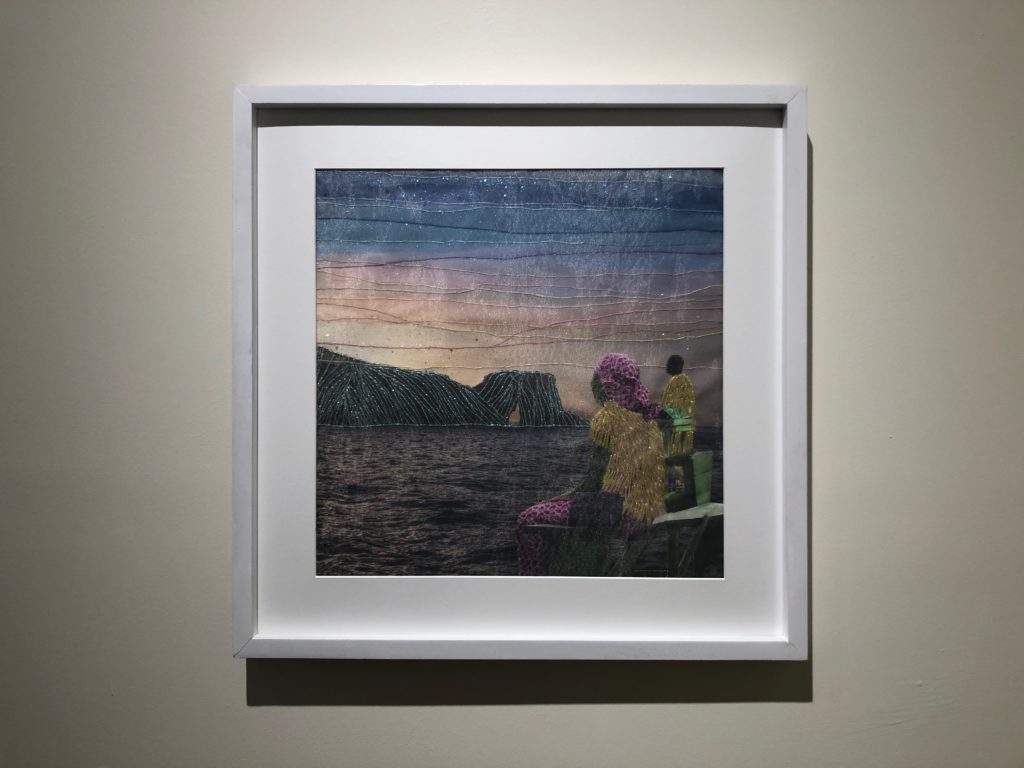
Joana Choumali’s work at Gallery 1957 at
1-54 African art fair, a photomontage that is embroidered and
overlaid with six pieces of translucent gauze. It was sold by 11
a.m. on preview day. Photo: Kate Brown
“I’m really excited about artists who are interested in
image-making, like Joana,” says Nwagbogu. “It’s more than time to move past this
dated idea of post-photography. Where we are today is so much for
advanced.”
On another wall at Gallery 1957, British-Ghanaian artist
Godfried Donkor, who has never been exhibited before in the UK,
presents tall works on blown-up pages from the Financial
Times stock page listings, on which he has overlaid figures in
oil and ink. Again, these works oscillate somewhere between the
painterly and the photographic. Both sold for around £8,000 to
a private US collection.
As we continue to explore fair, Nwagbogu takes note of where the
various exhibitors are based. “When I come to 1-54 art
fair,” he explains, “my interest is really in galleries that
have roots in Africa—galleries that are invested in the ecosystem
of the local African art scene beyond the commercial and event
economies.”
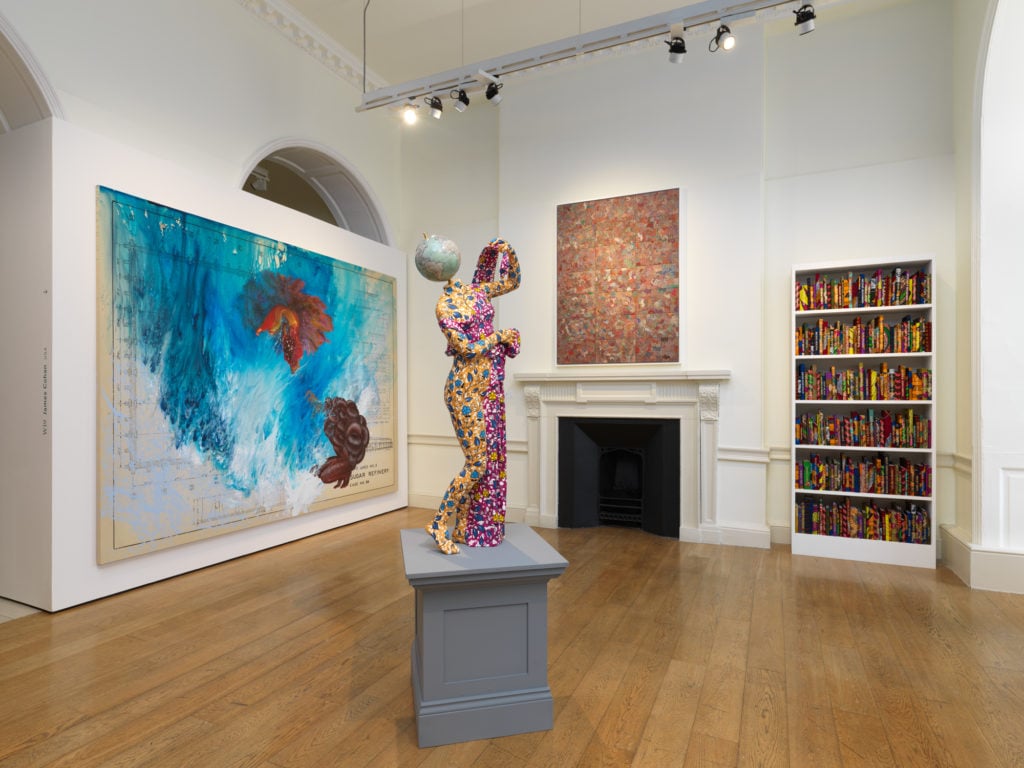
View of James Cohan gallery’s
presentation at 1-54 art fair. Photo: James Cohan Gallery.
At this year’s edition, over half of the galleries are from the
global north (Europe, the UK, and the US), including spaces
like New York’s James Cohan, which had an impressive display
that paired two sculptures by Yinka Shonibare CBE with several wall
works by Ethiopian artist Elias Sime. (Jane Cohan told artnet News
that the “exceptional” quality of discussions with curators and
collectors is a major drawing point, not to mention the intimate
scale of the Somerset House, which “leads to deeper connections in
the artwork.”)
Just 18 galleries, or 38 percent, have bases in Africa. Six of
these are South Africa-based dealers, with the rest amounting to a
thin peppering of spaces from other nations including Egypt,
Morocco, and Nigeria.
Towards New Modes of Representation
Nwagbogu points out that his concern over whether African art is
represented by insiders or outsiders is not necessarily reducible
to questions of race or national origin.
He brings up Viviane Sassen. The Dutch photographer spent
her childhood in Kenya and has made renowned portraits of black
subjects. “Being African is not about your race or color,” Nwagbogu
says. “It is about your sensibility, your influences.”
In general though, Nwagbogu hopes that the scene will
continue to move beyond what he describes as limiting “tropes” in
contemporary African art. In particular, he notes the “explosion”
of work focusing on the beautiful black body at art fairs.
“The history of art eliminated the black body and it almost
feels like now there is a deliberate effort by black artists to
say, ‘we exist, we are beautiful, we are here,’” he says. “But now
you see a lot of it—maybe too much of it. By reclaiming the black
body, which has been objectified for the longest time and excluded,
you become that cliché. I am more interested in what happens beyond
that.”
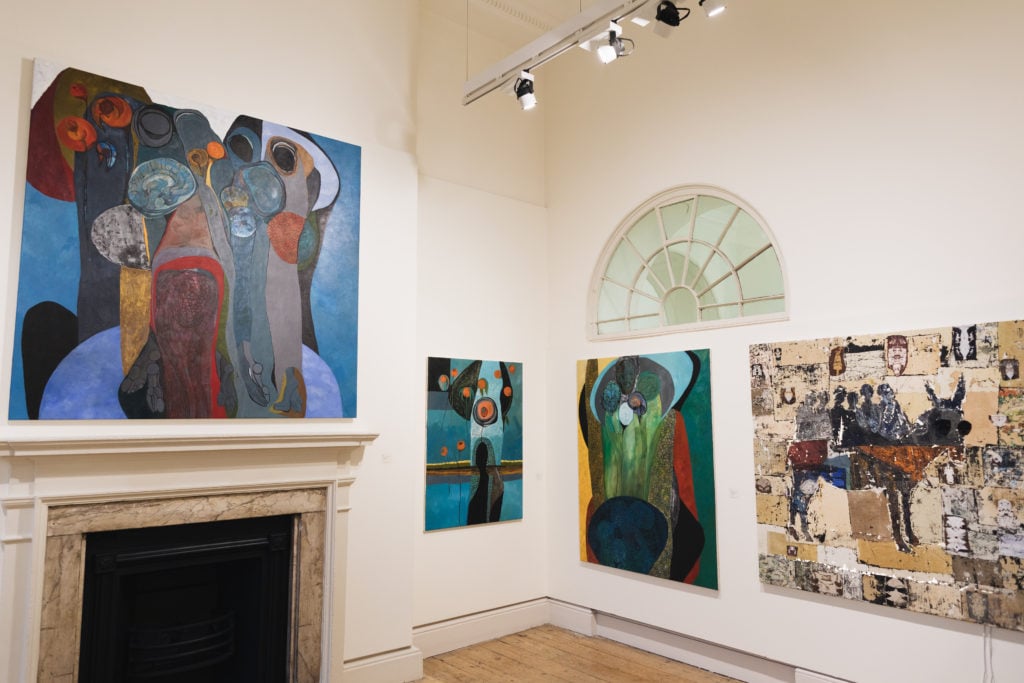
View of Addis Fine Art’s presentation of
Merikokeb Berhanu. © KatrinaSorrentino.
We stop in at Addis Fine Art. There, Nwagbogu expresses his
excitement as he discovers Ethiopian painter Merikokeb Berhanu,
whom he says fits into this idea of moving “beyond.” He points to
her poetic balance between figuration and abstraction, and how
natural and anatomical elements seem to flow into one another. For
such stunning works, the prices seem more than fair, lingering just
under €10,000.
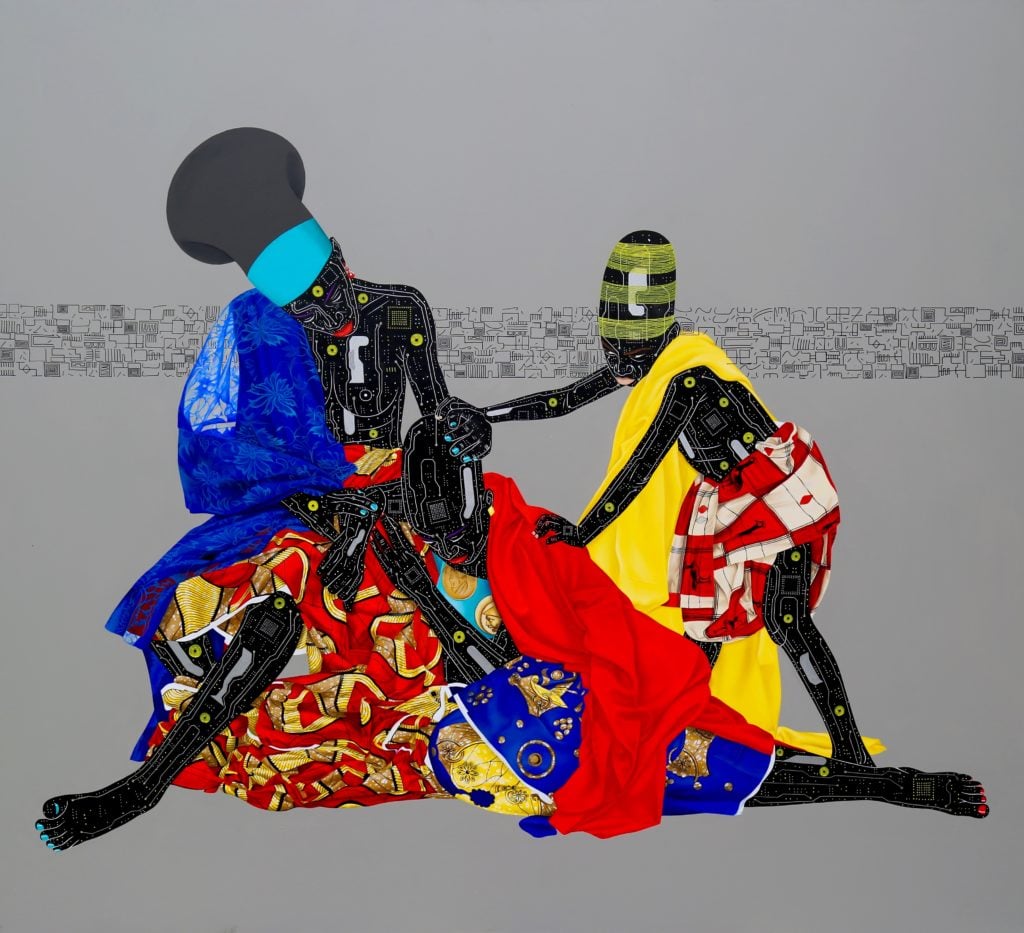
Oubliez le passé et vous perdez les
deux yeux by Eddy Kamuanga Ilunga on view at October
Gallery.
At October gallery, Nwagbogu highlights the promising young
Congolese painter Eddy Kamuanga Ilunga, whom he says is a prime
example of the Kinshasa painting scene’s penchant for
hyperrealism.
But he has a criticism, or at least a concern. “Again though, we
are seeing blackness represented as an object,” he says as we cast
our eyes over Ilunga’s subjects, which have cellphone chip
patterns painted on their skin.
Embracing Complexity
One example of an artist Nwabogu thinks usefully complicates
some of the “tropes” is Johannesburg artist Mary Sibande. The
fast-rising star in conceptual photography and sculpture has an
incredible work on view at South Africa’s SMAC Gallery, part
performance, part sculptural installation, part photo.
The image eludes easy reading—which is exactly what Nwagbogu
finds important about it.
It shows Sibande crouched below a window wearing a traditional
dress of a domestic worker, a persona she continually represents in
her artwork, called “Sophie.” Her face is obscured by alien-like
fabric tentacles. Behind her, she is again depicted in a stained
glassed window. (Called Turn, turn, turn,
turn (2019), the work sold for between £8,000 and £12,000
by the end of preview day on Wednesday.)
“Everyone knew a Sophie,” a representative from SMAC explains.
“Sophie is an avatar that embodies the mothers and grandmothers who
were domestic workers for white families during Apartheid.”
However, when the artist started to find that Sophie’s popularity
in the art world signified that she was becoming “an appeaser of
guilt,” the artist changed course. She tried to complicate the
narrative.
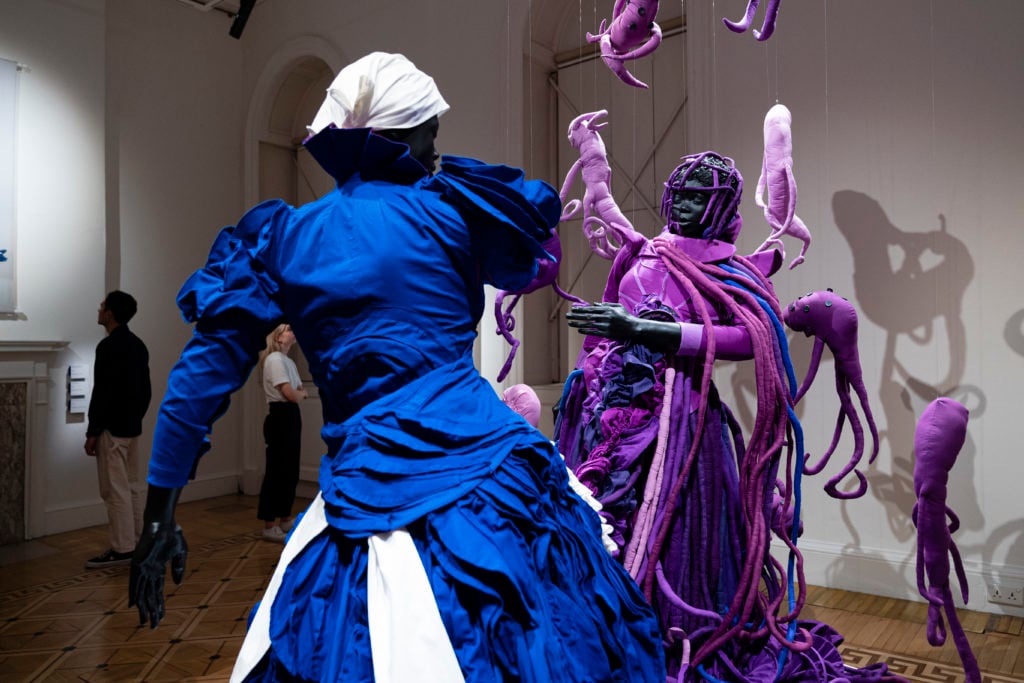
A work on view from Mary Sibande’s solo
exhibition “I Came Apart at the Seams” currently on view at
Somerset House. Photo: Kate Brown
Just around the corner from their SMAC’s presentation at
Somerset House is a multi-room exhibition by Sibande, presented in
partnership with the fair as part of the venue’s Charles Russell
Speechlys Terrace Rooms Series (it is on view until January 5,
2020).
Titled “I Came Apart at the
Seams,” the exhibition is filled with new, progressive versions
of Sophie. The largest work, on loan from the MAC/VAL museum
outside of Paris, is a sculpture of Sophie that is scaled to
Sibande’s body. Sophie seems to be dancing as masses of purple
tentacles emanate out of her and creep up the wall. It is a
must-see.
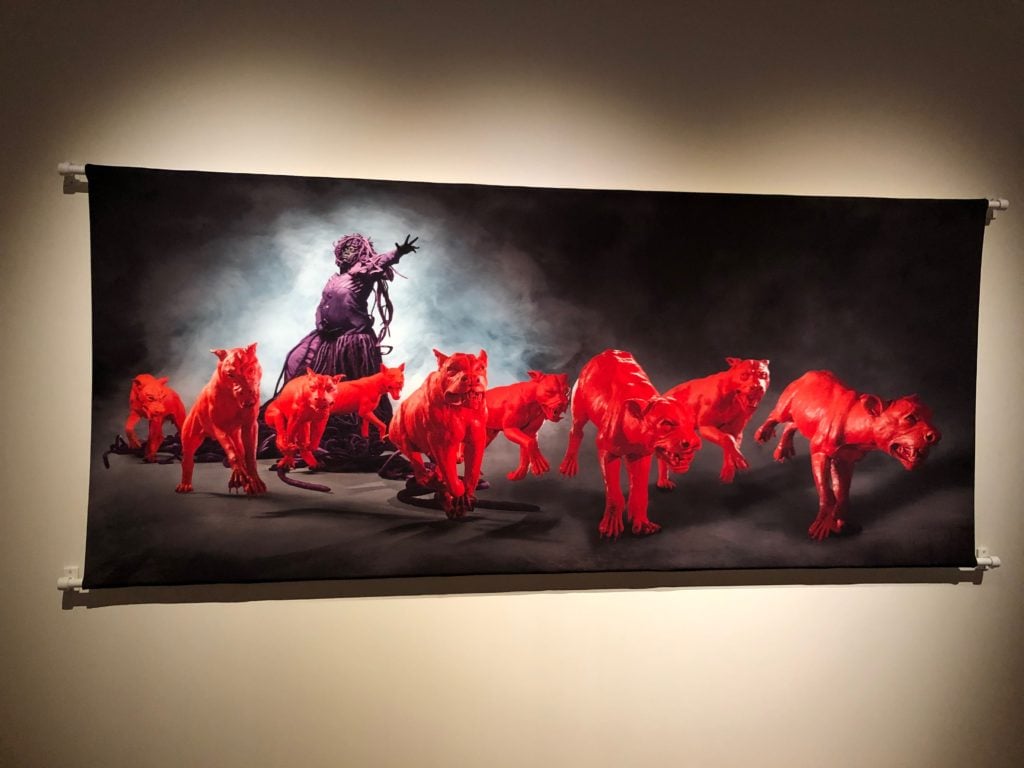
A Reversed Retrogress, Scene 1,
2013 by Mary Sibande © Anne Tetzlaff, Mary Sibande.
“Mary has developed a fascinating way of embracing material
culture to create empowered identity that is not about the
presentation of an image but about the creation of a voice,”
says Nwagbogu. “OK, so we are here, we exist, we know that
now—but what are we doing with that agency, what are we saying with
our presence? This is the question we should be concerning
ourselves with.”
The post At London’s 1–54 Fair, Curator Azu Nwagbogu Lays Out the
Pitfalls of the New Wave of Interest in African Contemporary
Art appeared first on artnet News.
Read more https://news.artnet.com/market/1-54-london-1668568
Further reading


Leave a comment