
Archaeologists Have Uncovered an Ancient Egyptian Funeral Parlor—Revealing That Mummy Embalmers Were Also Savvy Businesspeople
The ancient Egyptians, known for their elaborate mummies, took a
lot of care in preparing for the afterlife. Now, for the first
time, archaeologists have discovered that they had a bustling
funeral industry, too. As it turns out, priest-embalmers were also
savvy businesspeople whose tactics presaged the modern funeral
industry.
A burial workshop unearthed in 2018 in Saqqara, a necropolis (or
city of the dead) 20 miles south of Cairo, offered Egyptologists
the first major opportunity to document a site where mummies were
made. Archeologists behind early excavations likely overlooked such
sites in their eagerness to uncover richly decorated royal
tombs.
But as it turns out, the Egyptian funeral parlor wasn’t just
preparing the pharaohs for the afterlife. They offered a whole
range of services, from ornate golden funerary masks to cheaper
plaster ones embellished with gold foil. The canopic jars, which
stored the organs of the dead, could be made from alabaster or
cheaper painted clay.
“The evidence we uncovered shows the embalmers had very good
business sense,” says Ramadan Hussein, an Egyptologist at the
University of Tübingen in Germany, told National
Geographic. “They were very smart about providing
alternatives.”
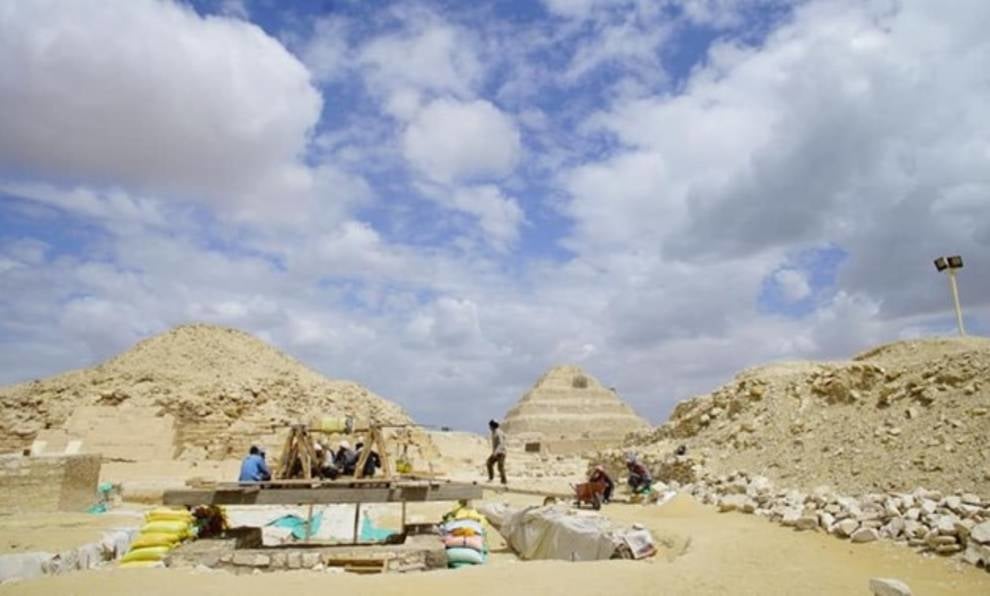
Archaeologists examine a mummy at the
Mummification Workshop in Saqqara. Photo courtesy of of the Egypt
Tourism & Antiquities Ministry.
The ancient funeral parlor was located beneath a burial shaft
that had last been investigated in the late 1800s—archaeologists
had to remove 42 tons of debris to access the chamber, found just
three feet below where the earlier excavations had ceased.
Hussein soon realized that what they had found wasn’t a tomb,
but the site where bodies were prepared for burial. There was an
air shaft that would have provided crucial ventilation, bowls
containing traces of the oils and resins used in mummification, and
a table-like slab perfect for laying out bodies.
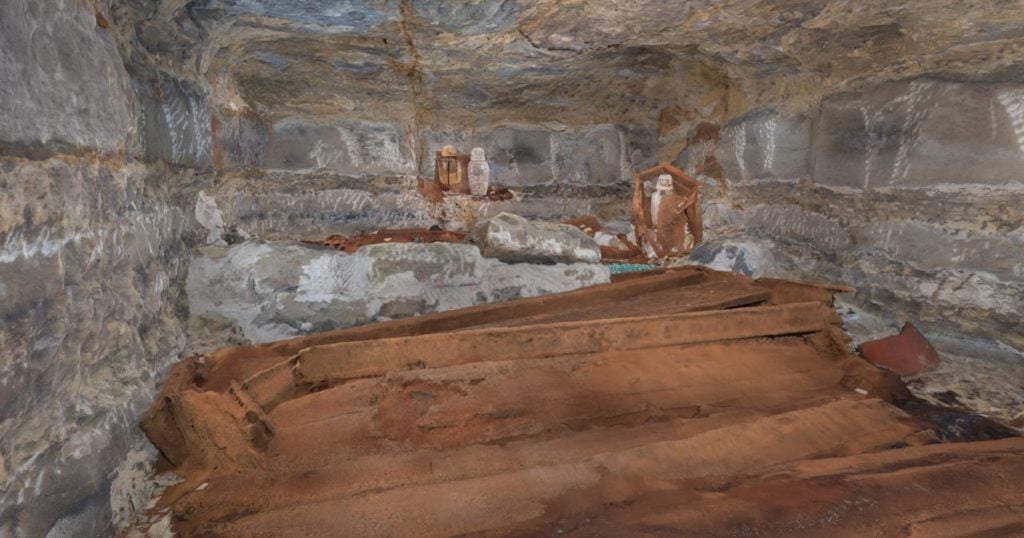
The newly discovered burial chamber at
the mummification workshop in Saqqara with four wooden coffins.
Photo courtesy of Egypt Ministry of Tourism and Antiquities.
The excavation of the funeral parlor also uncovered six nearby
tombs, home to some 50 mummies that illustrate how the business
offered its services to different clientele.
The wealthy, buried the deepest—the closest to the
underworld—bought such expensive trappings as a limestone
sarcophagus and a silver face mask with gold gilding, only the
third of its kind ever discovered. The working class on the tomb’s
upper tiers, on the other hand, settled for simple wooden
coffins.
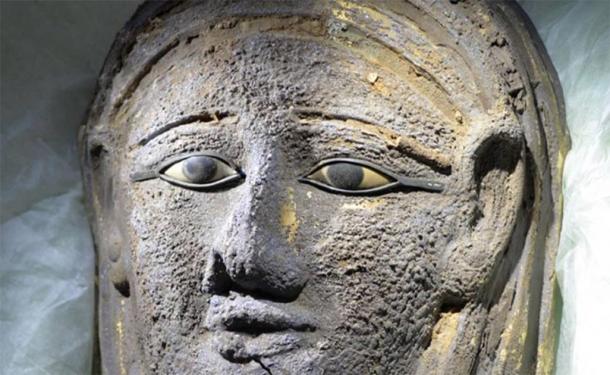
The rare silver face mask gilded with
gold. Photo courtesy of the University of Tübingen, Ramadan
Hussein.
The afterlife was hugely important to the ancient Egyptians, and
the ritualized mummification process that ensured one’s safe
journey to the underworld took a full 70 days. Embalmers carefully
packed the internal organs into four canopic jars, then dried the
body out with salt, anointed it with oil, and wrapped it in linen.
The finished mummy would be laid to rest in a fully provisioned
tomb, according to the family’s means.
Loved ones would pay embalmers regular fees for the upkeep of
the dead, according to papyrus documents found in Saqqara over 100
years ago. The discovery of an actual Egyptian funeral parlor
offers the first physical evidence of this practice.
“Mummification was a business transaction between an individual
and an embalmer in which the embalmer was a specialist, a priest,
and a businessman,” Hussein told See News.
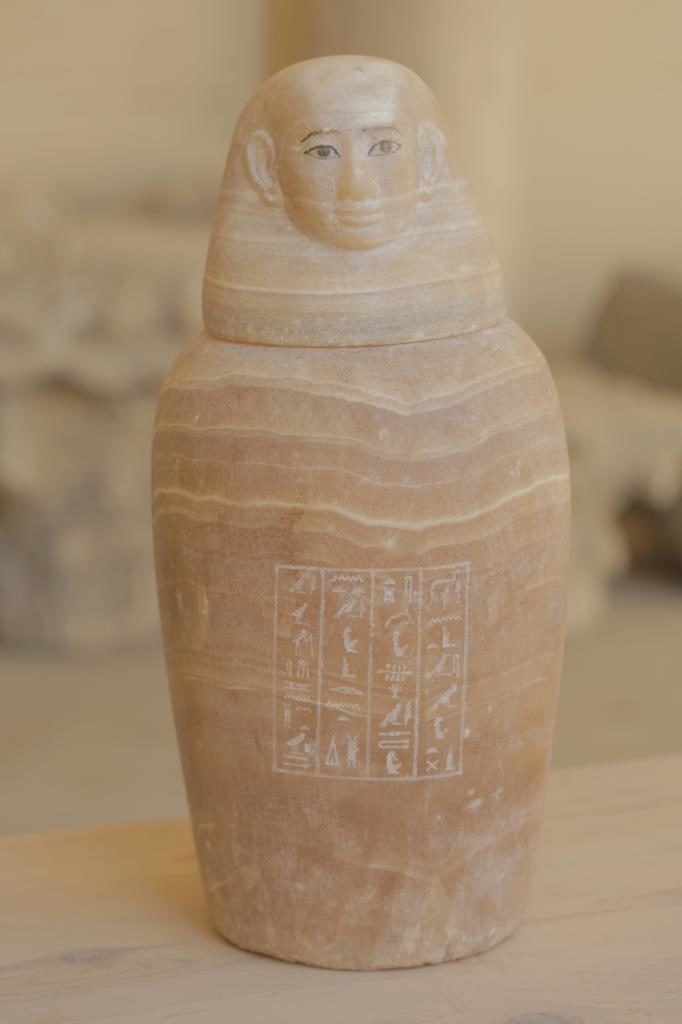
One of two extra mystery canopic jars
containing an unidentified organ, buried with the coffin of a woman
named Didibastet. Photo courtesy of the Egypt Ministry of Tourism
and Antiquities.
Among the important discoveries at the site was the coffin of a
woman named Didibastet, who was buried with six canopic jars, two
more than tradition dictates, reports Al-Ahram
Weekly. All of the jars contain human tissue, a CT scan
revealed, suggesting that this was a special form of mummification
that preserved additional organs beyond the lungs, stomach,
intestines, and liver. The team’s radiologist is now studying the
jars to identify the extra organs.
A new four-part National Geographic series, Kingdom of
the Mummies, will share the findings of Hussein and his team
starting next Tuesday. “For the first time,” he said
to Nat Geo, “we can talk about the archaeology of
embalming.”
The post Archaeologists Have Uncovered an Ancient Egyptian
Funeral Parlor—Revealing That Mummy Embalmers Were Also Savvy
Businesspeople appeared first on artnet News.
Further reading


Leave a comment