
A Vast Bauhaus Museum Opens in the German City Where the Famous Art School Came of Age
The Bauhaus arrived in Dessau with a
bang. The world’s most influential art school may have been born in
Weimar, but it came of age when it moved in 1925 to what was then
Germany’s “silicon valley.” A new Bauhaus museum in Dessau tells
the story of how the socially-engaged school of architecture and
design flourished briefly until growing pressure from the Nazis
forced it to leave for Berlin.
When in 1938 New York’s Museum of
Modern Art canonized the school’s astonishing achievements, the
former Bauhaus professor Josef Albers argued with its founder
Walter Gropius that the revolutionary learning at the heart of the
school should be highlighted in the survey show. Albers finally gets his say at the new Bauhaus
Museum Dessau, the second of three new museums to open in the
Bauhaus centenary year.
Hailing the museum as a “wonderful thing,”
German chancellor Angela Merkel said at the opening ceremony on
Sunday that for her the Bauhaus was a beacon in a “multitude of
tastelessness we were surrounded by in the German Democratic
Republic.”
Thirty
years after the fall of the Berlin Wall, this still holds true. The
newly erected building puts to shame many of the post-unification
buildings in the former East German city’s tacky commercial
center.
Claudia Perren, the director of the Bauhaus
Dessau Foundation, said that the new museum was created not only as
a “venue for the presentation of our internationally renowned
collection, but also a new cultural venue for the City of
Dessau-Roßlau, and the State of Sachsen-Anhalt.” It aims to
celebrate the legacy of the Bauhaus, and stay true to its spirit of
openness to new ideas.
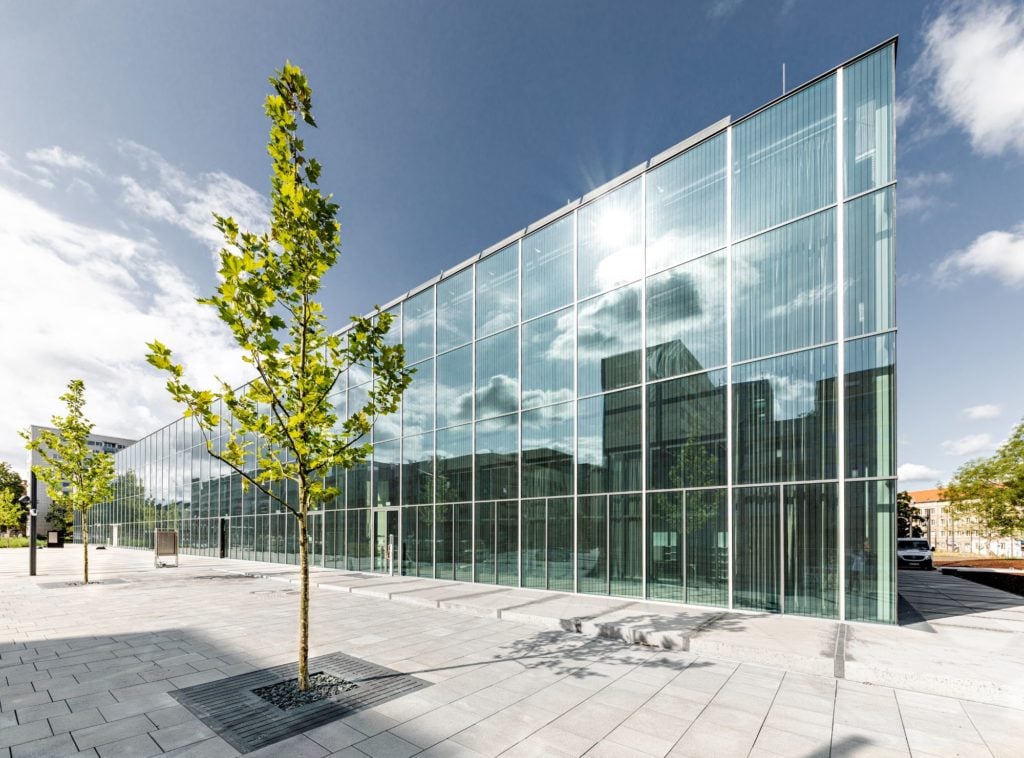
The new Bauhaus Museum Dessau. Copyright
Stiftung Bauhaus Dessau.
Big Is
Beautiful?
The
competition-winning design of the vast Bauhaus Museum Dessau is a
far cry from Gropius’s landmark Bauhaus Building, or the Masters’
Houses a mile away. The young Spanish practice addenda
architects’s building resembles a not-quite-welcoming bar
overlooking the city park in the small East German town, which has
been wrecked by the post-wall exodus of industry and many of its
younger generation.
Built
in less than three years, on a budget of €28 million ($31 million),
the museum building is a 393-foot-long glass block overlooking a
city park. Inside visitors find a large, open foyer. Beyond is a
concrete “black box” that sits atop a steel-work
construction.
The
massive building—has nearly 5,000 square feet of exhibition
space in total—stands in stark contrast to the airiness of the
original Bauhaus Building designed by Gropius. The inaugural
exhibition is a comprehensive and sometimes surprising survey of
the products designed by Bauhaus teachers and students in the
school’s Dessau heyday. Called “Versuchsstätte Bauhaus,” the show
features more than 1,000 objects drawn from a 49,000-strong
collection, which is second only to Berlin’s.
The
exhibition opens with a replica of László Moholy-Nagy’s light
installation, Licht-Raum-Modulator (1922-1930), and a
set of costumes from Oskar Schlemmer’s Triadic Ballet, reflecting the Bauhaus founders’ fascination
with movement and transformation. The exhibition includes the story
of how the rise of National Socialism forced the Bauhaus school to
leave Dessau for Berlin within seven years, and led to its eventual
closure in 1933 after Hitler seized power.
But
this obligatory reference remains the only political context in the
exhibition, which opens in a city where the right-wing Alternative
für Deutschland party has become the second strongest political
force. Instead, the politically neutral exhibition chooses to add
one more milestone to the traditional narrative of the Bauhaus
founders’ as visionary modernists.
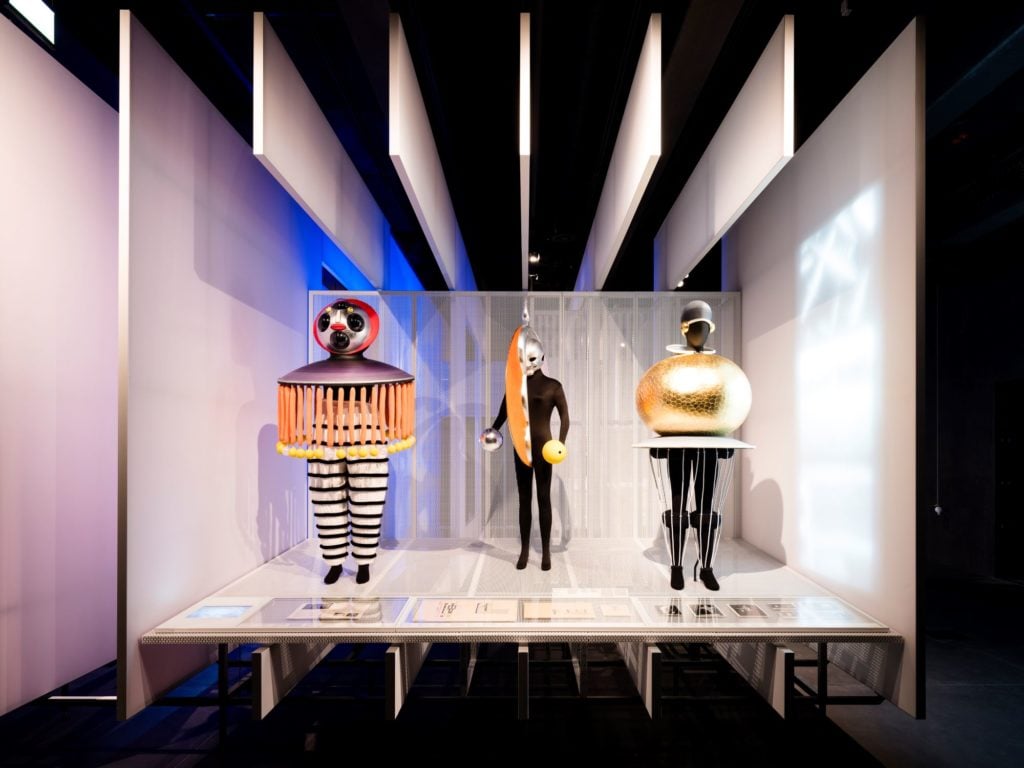
Oskar Schlemmer display, Bauhaus Museum
Dessau. Copyright Stiftung Bauhaus Dessau.
Female Bauhaus
The
Dessau period is honored with a showcase of the school’s most
iconic pieces, including Marcel Breuer’s Wassily Chair,
and furniture from Mies van der Rohe’s 1929 Barcelona Pavilion.
They highlight the school’s shift towards industrial design and
architecture. Next to the classics, there are detailed
teacher-student pairings. such as Wassily Kandinsky and
Grete Reichardt. These displays illustrate the methods of teaching,
the mutual influences and the interactions between the different
artistic disciplines within the Bauhaus. Finally, the exhibition
look Bauhaus’s influence across in the world, its rediscovery in
the German Democratic Republic, and the foundation of the
Dessau collection in 1976.
While
many of the insights into the school’s life and the processes
behind the iconic designs are refreshing, the first exhibition of
the Bauhaus Museum Dessau fails to grapple with the complexity and
contradictions of the school’s history. It overlooks how at the
male-dominated institution many female students were sent to the
Weaving Workshop. While one of the most successful of the
workshops, it played second fiddle to architecture and industrial
design. Inexplicably, Lilly Reich is not even credited alongside
Mies van der Rohe for her contribution to the Barcelona
Pavilion.
For
the museum’s opening, the ample foyer space is filled with
installations by contemporary artists Lucy Raven and Rita McBride.
The museum has the space and the collection to present a more
nuanced exploration of the Bauhaus movement in the future. It
would also benefit from putting its achievements in a
contemporary context as Germany grapples with the consequences of
an unequal reunification between East and West, and rising
right-wing populism. The second of three museums to open during the
Bauhaus centenary celebrations after the one at its birthplace
Weimar, and head of Berlin, the Bauhaus Museum Dessau could be a
fortress against the rising reactionary forces that the school
faced a hundred years ago, if rightly programmed.
The post A Vast Bauhaus Museum Opens in the German City Where the
Famous Art School Came of Age appeared first on artnet
News.
Further reading


Leave a comment