
A Self-Taught Thai Artist Has Won the 2020 BP Portrait Award—Which, for the First Time in Two Decades, BP Is No Longer Judging
Self-taught artist Jiab Prachakul has been
named the winner of the 2020 BP Portrait Award at
London’s National Portrait Gallery—a decision that,
for the first time since 1997, the oil giant had no part in.
The Thailand-born artist’s piece, Night
Talk, is a moody depiction of two chic friends in a
Berlin bar. It bested 1,981 entries from 69 countries, including
runner-up Sergey Svetlakov and
third-place winner Michael Youds, who
works as a gallery attendant at the National Galleries of
Scotland. In addition to receiving the £35,000 ($43,555)
prize, Prachakul—who took up painting after seeing a David
Hockney show at the National Portrait Gallery—will paint a new
£7,000 ($8,700) commission for the museum.
But perhaps more notable than the winner was the process by
which she was chosen. The NPG contends that the decision to
remove Des Violaris, BP’s head of art, culture, and sport,
from the jury was not influenced by ongoing pushback against the
sponsorship. Two members of the award’s six-person panel
change each year. “The gallery and BP jointly agreed not to have a
sponsor representative on the judging panel this year,” the museum
told the Guardian.
But Culture Unstained, which has been advocating for the NPG to
cut ties with the oil
giant, contends that the move is “no coincidence.” The
reshuffle comes after former Turner Prize winners
and a-listers such as Anish Kapoor, Sarah Lucas, and Christian
Marclay penned an open
letter encouraging the museum to sever the relationship
and another group, BP or Not To BP?, protested
the 2019 exhibition. (At the award ceremony, demonstrators blocked
the entrance to the galleries, forcing VIP guests to climb over a
wall to get inside the museum.)
For artist Gary Hume, one of the award’s 2019 judges, the
removal of BP from the jury is a step in the right direction, but
is not nearly enough. “The NPG should have bitten the bullet and
used the opportunity of the prize going digital and the gallery
closing for three years to cut its ties with BP, following the lead
of other cultural institutions,” he said in a statement issued by
Culture Unstained. “The board need to realize that they are now
seriously out of step, and damaging the NPG’s reputation by
maintaining a partnership with one of the world’s worst polluters
in the midst of a climate crisis.”
Other British cultural institutions have bowed to public
pressure in the recent years and stopped accepting money from oil
companies. London’s Tate museum ended a 26-year sponsorship
agreement with the company in 2017 following a
string of high-profile
protests. The Royal Shakespeare Company followed suit this
past October, cutting short its contract with BP. Days later, the
National Theatre ended its partnership with oil giant Shell, and
the Southbank Centre announced in March that it would not renew
Shell’s corporate membership.
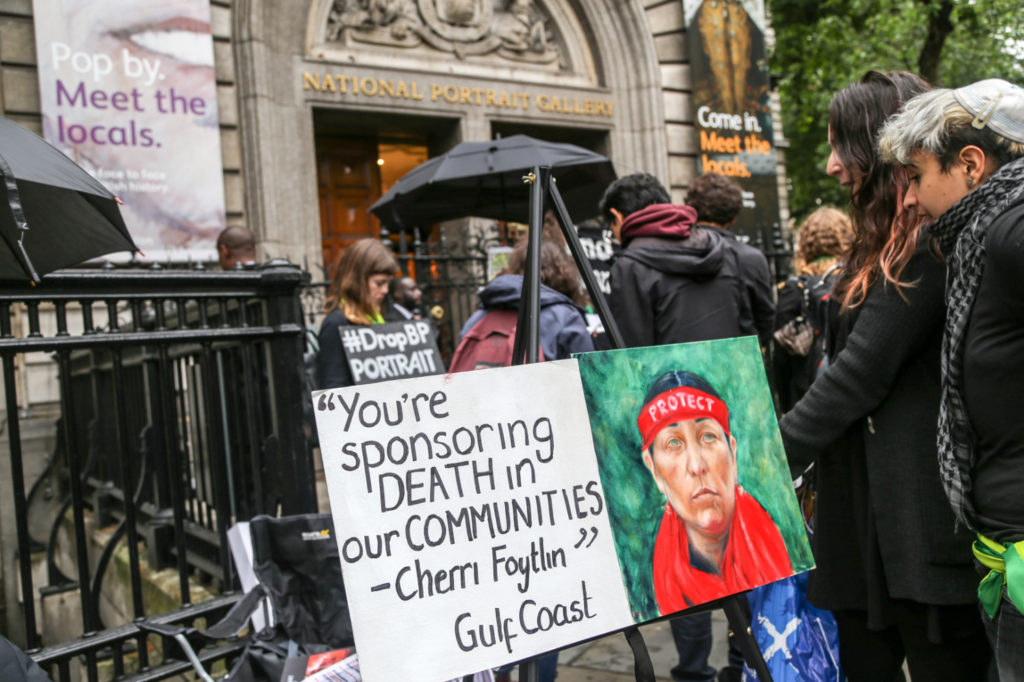
Zora Owen painted a portrait of Cherri
Foytlin, Indigenous journalist and advocate against BP’s
catastrophic Deepwater Horizon disaster in 2010, outside the
National Portrait Gallery in London protesting the 2019 BP Portrait
Award ceremony. Photo by Diana More, courtesy of BP or Not BP?.
In November, the National Galleries of Scotland withdrew from
the tour of the BP Portrait Award exhibition, as long as BP
remained the prize’s sponsor. “We recognize that we have a
responsibility to do all we can to address the climate emergency,”
said the museum in a statement. “For
many people, the association of this competition with BP is seen as
being at odds with that aim.” (It remains to be seen if the British
Museum will renews its contract with BP, which set to expire 2022,
after a number of protests.)
The winner of this year’s BP Portrait Award has not weighed in
on the controversy. “I’m totally dazzled!” wrote Prachakul on
Instagram. “Thank you from my
heart.”
The judges praised her work, calling it “an evocative portrait
of a fleeting moment in time, giving us a glimpse into someone
else’s life that is “beautiful, mysterious, and alive.”
Due to the ongoing closure of the museum in response to the
global pandemic, the 48 paintings in this year’s exhibition are on
view in an online exhibition.
The post A Self-Taught Thai Artist Has Won the 2020 BP
Portrait Award—Which, for the First Time in Two Decades, BP Is No
Longer Judging appeared first on artnet News.
Read more https://news.artnet.com/art-world/jiab-prachakul-wins-bp-portrait-award-1852980
Further reading


Leave a comment