
A Philosopher Explains How the Playboy Mansion is a Cautionary Image for the COVID Era + Two More Weekend Reads
Earlier this year, before the COVID-19 crisis changed
everything, I had been trying to start a
project of looking through the art web each week and picking out a
few articles that were worth taking note of. The last few months
have massively disrupted all kinds of routines, but I want to
return to this small project. Now more than ever, writers are
reexamining how art manifests in the world, and it’s worth keeping
an eye on how those conversations are playing out.
Here are a few things that caught on the last week of April.
“Learning From the
Virus” by Paul B. Preciado, Artforum
Paul B. Preciado, the philosopher well known in art
circles as advisor to the recent Documenta,
among other things, not so long ago reported movingly on his own experience with
COVID-19 for Artforum. For the new issue of the magazine,
Preciado returns with some lessons—albeit less from the experience
of the virus itself than from philosophy.
Historically, rhetorics of containing mass infection, Preciado
argues, tend to get caught up with ideology about what groups or
people are desirable and undesirable, and to ratify existing social
pathologies of their own. “Tell me how your community constructs
its political sovereignty and I will tell you what forms your
plagues will take and how you will confront them.”
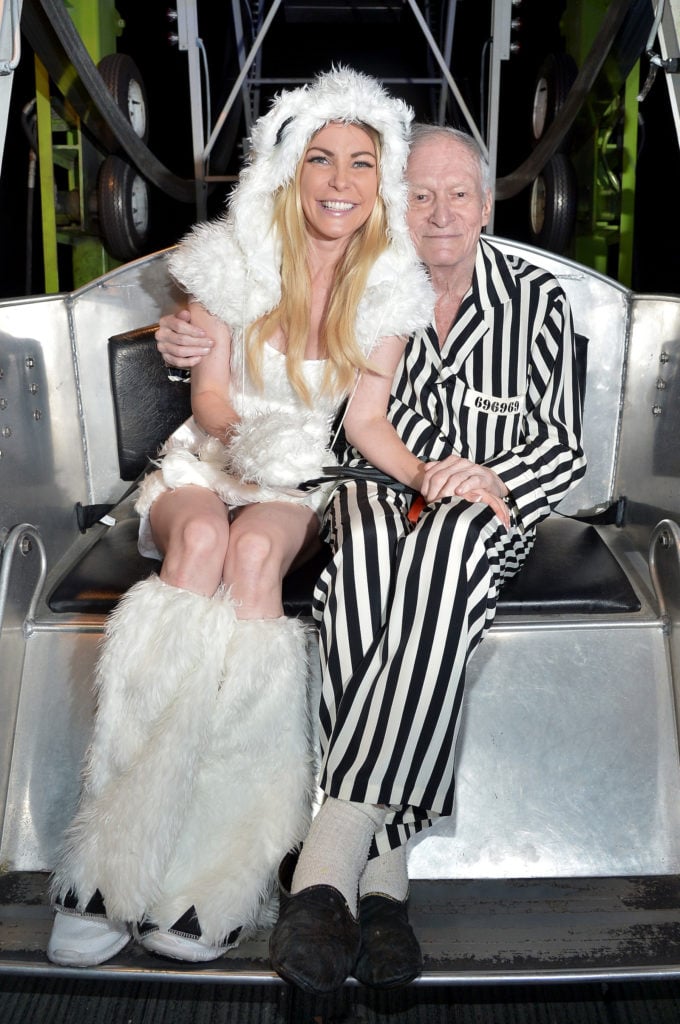
Hugh Hefner attends the annual Halloween
Party, hosted by Playboy and Hugh Hefner, at the Playboy Mansion on
October 24, 2015 in Los Angeles, California.
Most notably, the philosopher reflects on the experience of
compulsory “social distancing,” and how these accelerate types of
social control that were already insinuating themselves into the
life of affluent First World subjects. Drawing on past theorizing
(in the
book Pornotopia), he uses the bedroom in
Hugh Hefner’s Playboy Mansion as a symbol of a lifestyle that has
been long sold as a fantasy, collapsing bedroom, entertainment, and
work into one seamless space—“a prison,” as Tom Wolfe wrote of
Hefner’s work-from-bed routine, that was “as soft as an artichoke
heart.”
Sunnier commentators might frame the technological tools that
have allowed some parts of the white collar and media economy to
keep ticking over as life-savers, maybe even prefiguring a less
alienated form of office life. Those with jobs that can be done
remotely get to be their own version of Hugh Hefner’s “horizontal
worker” now, working in their pajamas and being fed an endless
stream of entertainment (adult and otherwise) to keep them
becalmed.
Preciado, however, wants to caution that the new virtual-work
mainstream also fits more into a narrative of the increasing
collapse of all aspects of life into one continuous, commodified,
hyper-surveilled performance. The expedient new arrangements are
likely to lead to new and insidious forms of control if not
approached critically. (And obviously, as he points out as well,
the sunnier narrative ignores all the “vertical workers” who can’t
work from bed.)
“Governments are calling for confinement and telecommuting,”
Preciado writes. “We know they are calling for de-collectivization
and telecontrol.”
This is a big essay that ultimately makes a passionate case
against isolation and for new forms of solidarity. I do have a
question about how Preciado frames the COVID crisis. The keystone
philosophical reference is Michel Foucault. As in Foucault, it’s
not exactly clear where power is located in Preciado’s essay, with
“regimes” of discourse just seeming to permeate everything
omnipresently. The argumentation tends to proceed by the mechanism
of homology—something like this: the rhetoric of trying to keep
diseases out of the body is like the rhetoric of keeping immigrants
out of a country; therefore the two are governed by the same
discourse.
I’d put more stress on who amplifies what ideologies
and whose interests they serve. Anti-immigrant regimes,
for instance, have not risen just because of a general Western
philosophical pathology that has constructed the ideal subject as
“an immunized body, radically separated, that owed nothing to the
community.” Very powerful political and corporate interests have
long found it convenient to amplify xenophobic ideas to deflect
from their own predations and create scapegoats for the grinding
disparities an unfair economic system produces. A ready-to-hand
example: Donald Trump is clearly hell bent on turning COVID-19 into
“the Chinese virus” as a way to mask his own malign incompetence
and to hold onto power.
Preciado arrives at advocating “a new sharing with other beings
on the planet.” But he also says, towards the end, “[l]et us use
the time and strength of confinement to study the tradition of
struggle and resistance among racial and sexual minority cultures
that have helped us survive until now.” Surely those traditions of
struggle emphasize targeting specific levers of power as much as
the importance of new ideas. ACT-UP, just as an example, was very
concrete about locating power in the Reagan administration, the Koch administration,
the FDA, the Catholic Church.
“Flatten the Cube:
Post-Internet Art’s Lessons for the Pandemic and What Comes
After” by Artie Vierkant, Art in America
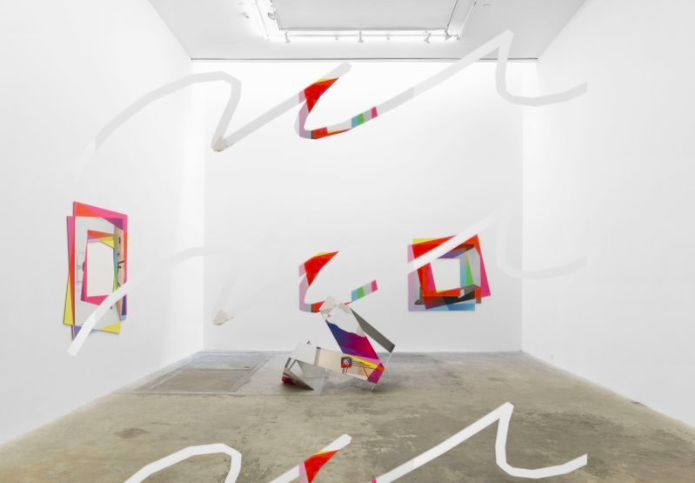
Artie Vierkant, Image Objects
Installation View (2015). Image courtesy Perrotin.
In “The Image-Object
Post-Internet,” written a decade ago, Vierkant wrote one of the
closest things that came to count as a manifesto of recent years.
“Post-internet art”—that is, art that blurs the lines between
online life and in-gallery experience, or comments on that
condition—is sort of relegated to sidenote status now, but it was a
major force in art in the first half of the 2010s. With old
structures of the art world now wobbling beneath the weigh of
lockdown and reliance on digital tools becoming even more
pervasive, Vierkant returns to make the case that the
“post-internet” trend’s underlying impulses were connected to the
fallout from the 2008 Great Recession, as a questioning of the
way art was presented in the “traditional” white cube and an
attempt to find an available working alternative.
“It seems fitting that the twin collapse of finance and real
estate coincided with a way of making art that reconsidered the
dematerialization of the object and made a joke of the white cube,”
he writes. An interesting argument, and thought-provoking when it
comes to thinking of what may be emerging again now (though one to
think about with all of Preciado’s cautions in the back of your
mind.)
“Diné COVID PSA,” Art
Journal
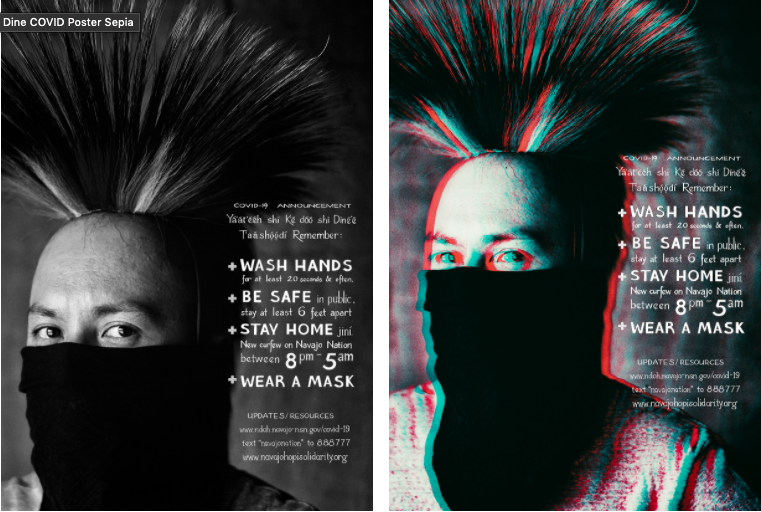
“Diné COVID PSA” by Chip Thomas.
Chip Thomas is an artist,
activist, and physician who has been working on the Navajo nation
since 1987. Collaborating grass dancer Ryan Pinto as a model, he’s
created this graphic, which Art Journal brings to my
attention. It’s being offered both as a practical resource and a
way to focus minds on just how badly the Navajo Nation has been hit, with the
third highest rate of
infection in the country after New York and New Jersey, given
its criminally under-resourced medical system.
The poster’s link takes you to a site, where anyone can donate to Diné and
Hopi families who are dealing with the pandemic.
The post A Philosopher Explains How the Playboy Mansion is a
Cautionary Image for the COVID Era + Two More Weekend Reads
appeared first on artnet News.
Further reading


Leave a comment