
A High-Tech Museum Show in San Francisco Will Tackle Algorithmic Bias and the Low-Wage AI Economy—Just a Stone’s Throw From Silicon Valley
Artificial technology: Is it a tool with limitless potential for
progress or a terrifying dystopian future waiting to happen?
Artists including Trevor Paglen, Hito Steyerl, and Pierre Huyghe
will consider the implications of AI and humankind’s relationships
with intelligent machines in a show next year at the de Young Museum in San Francisco.
“Technology is changing our world, with artificial intelligence
both a new frontier of possibility but also a development fraught
with anxiety,” Thomas P. Campbell, director and CEO of the Fine
Arts Museums of San Francisco, said in statement. The museum,
just a stone’s throw from Silicon Valley, “the ground zero of
emerging technology,” is an ideal venue to engage artists in this
increasingly important conversation, he added.
The exhibition takes its title—”Uncanny Valley: Being Human in
the Age of AI”—from the term coined in 1970 by Japanese engineer
Masahiro Mori to describe the sense of unease we feel when machines
or robots too closely resemble human beings in appearance. But
whereas in this past this phenomenon has been most commonly
encountered in computer-animated movie characters—like
2004’s The Polar Express—new technologies such as
machine learning have allowed artificial intelligence to mimic
human behavior in increasingly convincing fashion.
“As our lives are increasingly organized and shaped by
algorithms that track, collect, evaluate, and monetize our data,
the uncanny valley has grown to encompass the invisible mechanisms
of behavioral engineering and automation,” said exhibition
organizer Claudia Schmuckli in a statement.
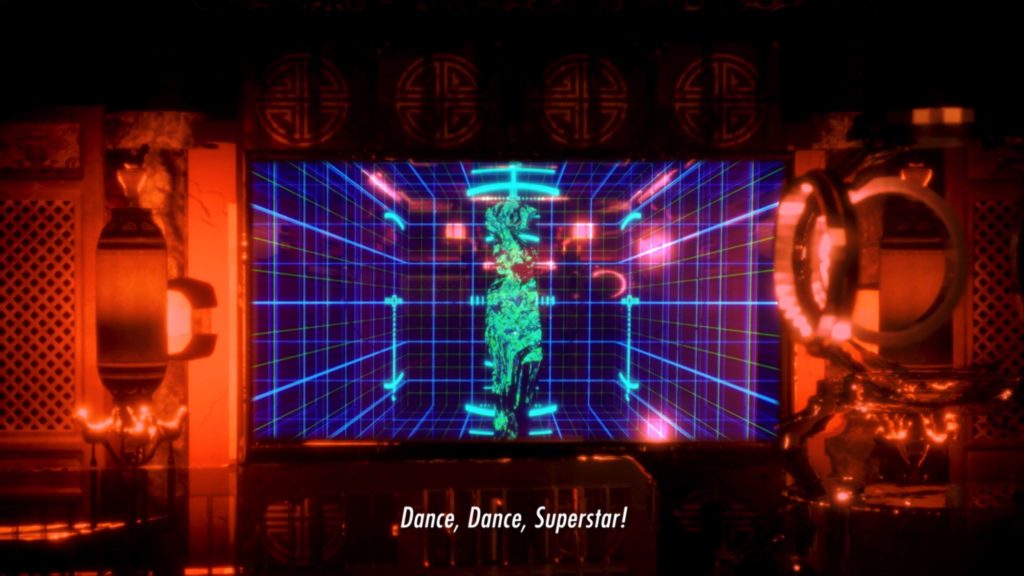
Lawrence Lek, AIDOL (2019),
video still. Image ©Lawrence Lek, courtesy Sadie Coles HQ,
London/the Fine Arts Museums of San Francisco.
In fact, the invisible mechanisms that power artificial
intelligence often involve underpaid human labor, such as
people being paid pennies to answer questions on Amazon Mechanical
Turk, which will train computer programs.
Artist Agnieszka Kurant critiques the growing use of these
online laborers in her sculpture A.A.I. (artificial artificial
intelligence). An installation of colorful sand termite
mounds, embellished with gold, glitter, and crystals, makes visible
the plight of these workers, who are paid sub-minimum wages. The
work raises the question of how the rise of artificial intelligence
will continue to shape the global economy.
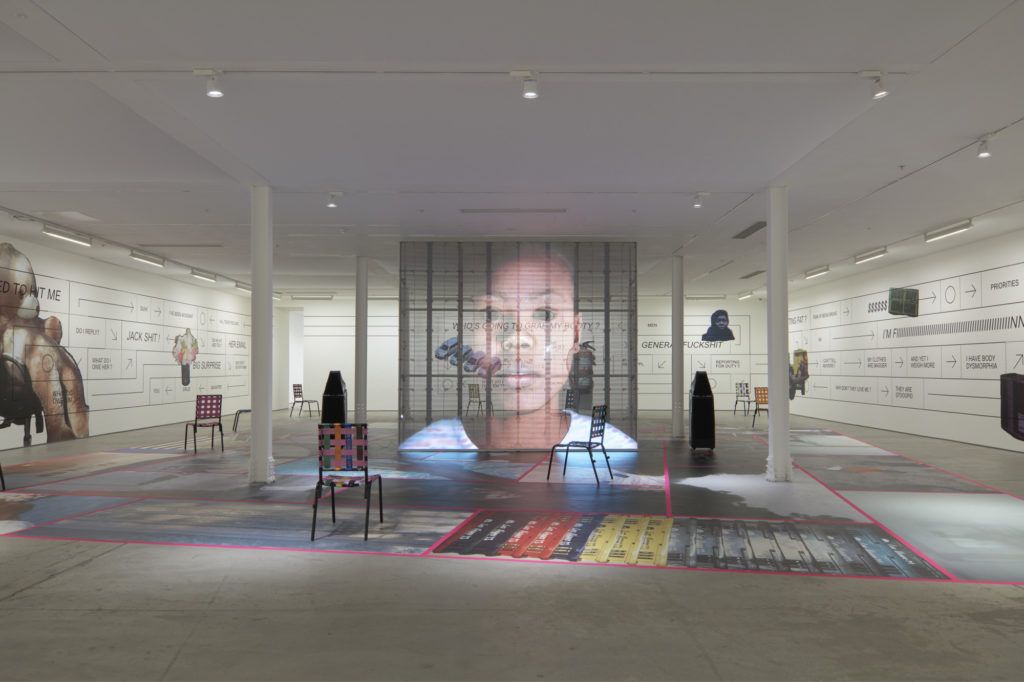
Martine Syms, installation view
of Mythiccbeing at Sadie Coles HQ, London. Photo
by Robert Glowacki, courtesy of Sadie Coles HQ, London, and the
Fine Arts Museums of San Francisco.
And as these workers train artificial intelligence, they pass
along their own implicit biases, perpetuating stereotypes. The show
will include Trevor Paglen and AI researcher Kate Crawford’s
ImageNet, a visual data
training set that went viral after labeling photographs of people
with racist slurs. As a counterpoint, the museum also
offers Martine Syms’s Mythiccbeing, an avatar of
the artist that responds to queries much like Siri or Alexa, but by
pointing out instances of racial inequality and social
injustice.
The artists, Schmuckli added, are “paying close
attention to the imminent and nuanced realities of AI’s
possibilities and pitfalls.”
See the full list of participating artists below.
Zach Blas, b. 1981, Point Pleasant, West Virginia. Lives in
London.
Ian Cheng, b. 1984, Los Angeles. Lives in New York.
Simon Denny, b. 1982, Auckland. Lives in Berlin.
Stephanie Dinkins. Lives in Brooklyn.
Forensic Architecture, founded 2010, London.
Lynn Hershman Leeson, b. 1941, Cleveland. Lives in San
Francisco.
Pierre Huyghe, b. 1962, Paris. Lives in New York.
Christopher Kulendran Thomas, b. 1979, London. Lives in London and
Berlin.
Agnieszka Kurant, b. 1978, Lodz, Poland. Lives in New York
City.
Lawrence Lek, b. 1982, Frankfurt. Lives in London.
Trevor Paglen, b. 1974, Camp Springs, Maryland. Lives in
Berlin.
Hito Steyerl, b. 1966, Munich. Lives in Berlin.
Martine Syms, b. 1988, Los Angeles. Lives in Los Angeles.
“Uncanny Valley: Being Human in the Age of AI” will be on
view at the Fine Arts Museums of San Francisco’s de Young
museum, 50 Hagiwara Tea Garden Drive, San Francisco, California,
February 22–October 25, 2020
The post A High-Tech Museum Show in San Francisco Will
Tackle Algorithmic Bias and the Low-Wage AI Economy—Just a Stone’s
Throw From Silicon Valley appeared first on artnet
News.
Read more https://news.artnet.com/exhibitions/uncanny-valley-de-young-museum-1662343
Further reading


Leave a comment