
‘A Brick-and-Click Approach Is the Way Forward’: Berlin Dealers Report Lively In-Person Sales at the Art Basel Booths They Built in Their Galleries
While dealers around the world were wringing their hands
yesterday, wondering if Art Basel’s Online Viewing Room would
deliver with all its tweaks and toggles since its first tech-addled edition
for Hong Kong in March, art dealers in Berlin were hosting
analogue versions of their Basel booths at their physical
galleries.
The event, Basel by Berlin, was planned in less than two weeks
after a few dealers test-ran the idea this past
spring in Berlin, where many lockdown restrictions have
been lifted. “It brings back a little of the Eros we are missing,”
says Daniel Wichelshaus from Société. The 32 participants are even
hosting an “exhibitor dinner” tonight as an homage to the
festivities they’d normally be enjoying any other year.
How does one install an art fair booth in a gallery? The brief
was open to wide interpretation. Dealers were careful not to erode
the church-and-state division between a fair stand and a gallery
exhibition, placing cues, like tiny fair tables or wall labels,
around their spaces.
At Galerie König, Johann König hosted a jam-packed salon-style
show, with labels listing prices and acquiring red dots through the
day as smiling staff cruised around the corridors with fair badges
dangling from their necks. König had called up collectors and
dealers all over Germany and asked them if they were interested in
selling something—they were, and so his space was dedicated to
secondary-market works.
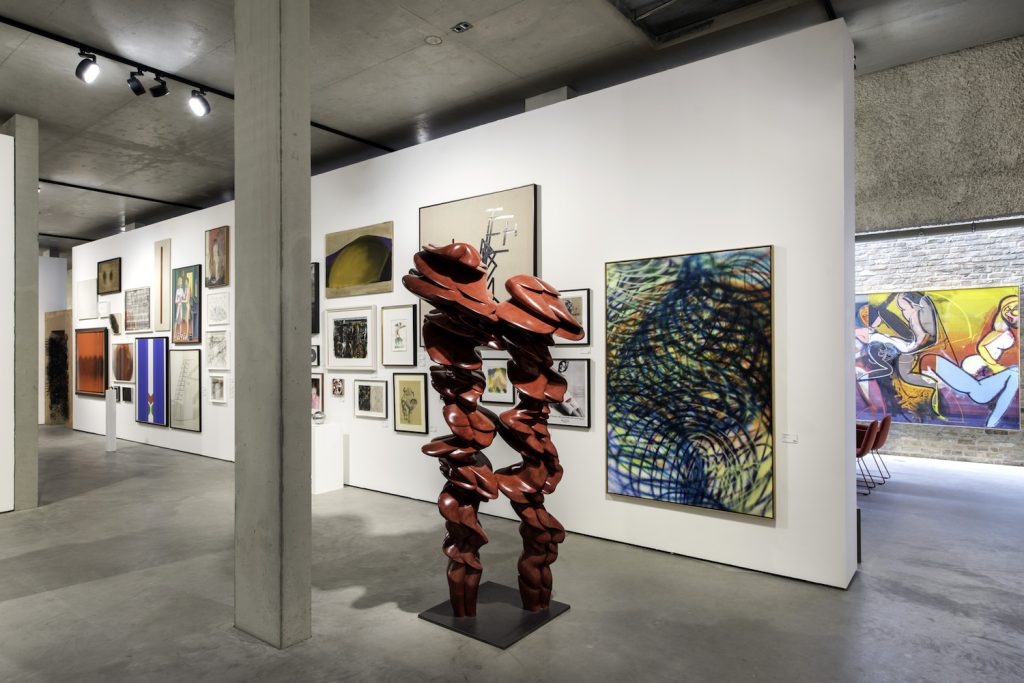
Galerie König’s art fair. Courtesy of
the KÖNIG GALERIE Berlin, London, Tokyo. Photo: Trevor Lloyd.
“I think this is a good alternative to auction houses,” he tells
Artnet News, sitting in front of a large Daniel Richter painting.
“It doesn’t risk getting bought in and if the work doesn’t sell,
it’s still market fresh.”
He checks his phone intermittently to keep an eye on the VIP
access to the Basel Online Viewing Rooms. But he seems more excited
about what is happening within his gallery walls.
“A good day at Art Basel is the day where you can’t take a bite
of your sandwich! That’s what it has been like here,” he says.
Carlier | gebauer presented a replica of their booth concept,
although some works were absent due to shipping complications. “We
wanted to make the Online Viewing Room experience more tangible,”
says Marie-Blanche Carlier, who co-organized the event with
galleries Mehdi Chouakri and ChertLüdde. “This is fun, it’s real,
and it’s reactive.”
The event has Art Basel global director Marc Spiegler’s
blessing. Dealers report that he was very supportive of the
initiative. In an opinion piece in the Financial
Times this week, Spiegler offered public
praise: “Perhaps most interesting is the clicks-and-mortar
approach many galleries are concurrently planning,” he wrote,
citing the analogue event in Berlin… [C]ollectors can actually see
the works “hanging” on the Art Basel platform.”
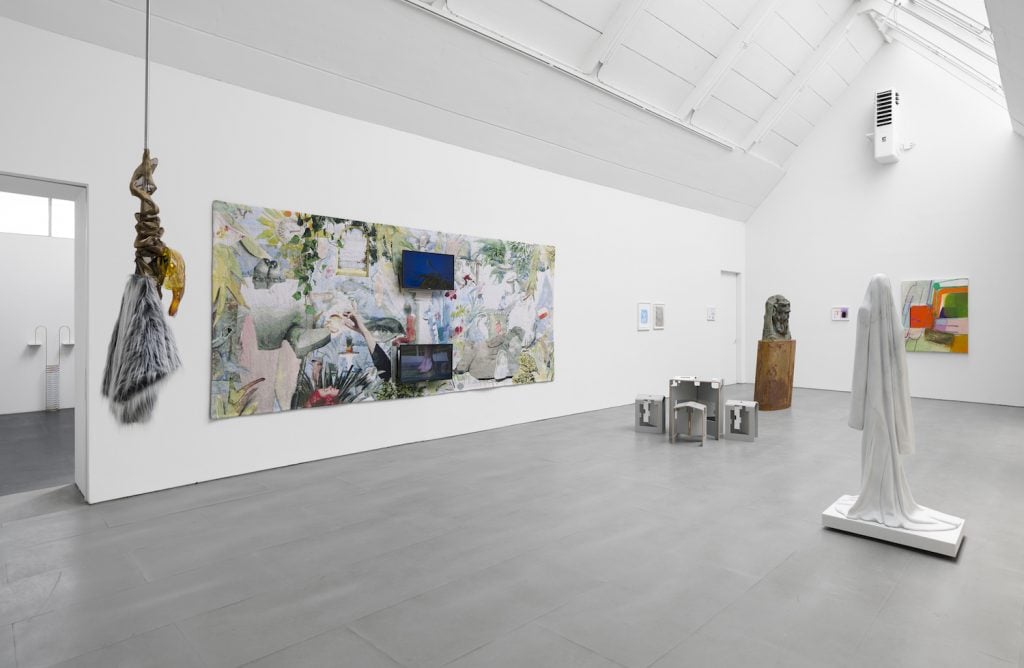
Installation view of carlier | gebauer’s
Art Basel booth. Courtesy carlier | gebauer. Photo: Trevor
Goode.
The blending of physical art with digital tools—call it
brick-and-click or click-and-mortar—is probably the future going
forward, say many dealers. Carlier praises viewing rooms for their
ability to “handle” works that physical booths may not have been
able to, while being able to walk collectors through their gallery
on FaceTime helps its ability to connect collectors to works. In
fact, the ability to call in collectors and show them works over
the phone seemed like the main reason for the event.
Collectors were around, mostly from Berlin and a peppering from
elsewhere. Dealers reported that enthusiastic clients were indeed
venturing in from the neighboring cities of Hannover, Hamburg,
Munich, and in some cases, from Belgium, London, and Switzerland
(one collector was stopped at the Swiss-German border due to
heightened migration restrictions, but received a letter from a
gallerist that allowed him to pass through.)
“We can react immediately to collector feedback while providing
them closeups with works and showing them details of the pieces,”
she says. The gallery, choosing to make it fair-like with a small
set of tables and chairs with business cards and a price list,
showed a mix of works by Laure Prouvost, Amy Sillmann, and Thomas
Schütte, among others. The latter two artists’ works were already
sold when I stopped in around noon yesterday. A vibrant painting by
Sillman sold for €550,000 ($561,000) and Schütte went for €380,000
($426,000).
Face-to-face, with masks off, few gallerists said they were
enthralled by the online viewing rooms. Toward the end of the day,
one dealer shrugged as he said, yes, there were inquiries
but they were from all the “same contacts.” Another said the bulk
of the emails coming in were from Art Basel. The muted reply was
echoed by many dealers who said emails trickled in, but business on
the virtual “floor” was still a far cry from being as lucrative as
in-person booths in Basel.
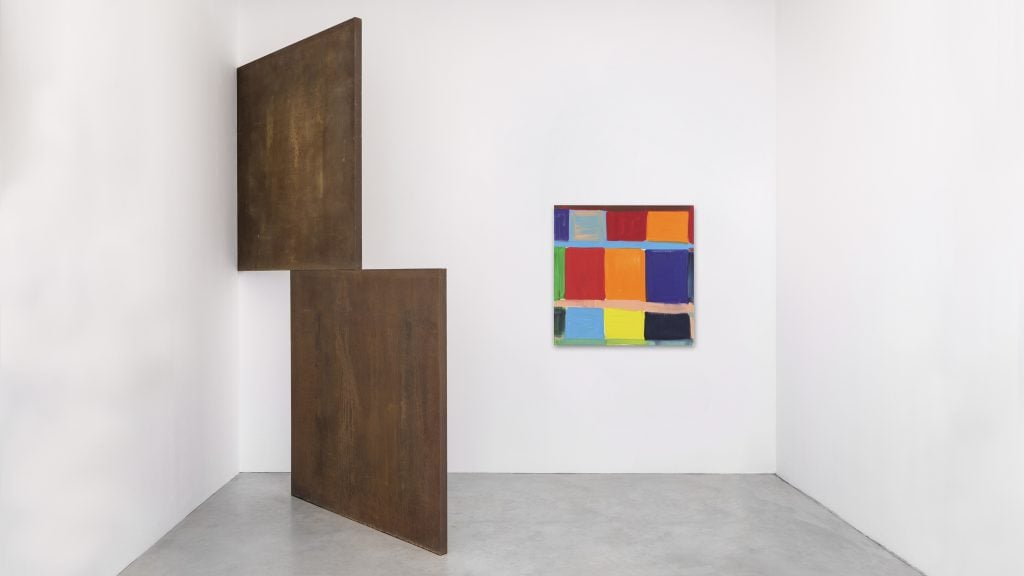
Richard Serra’s Step Up
(1988) and Stanley Whitney’s Stay Song 67 (2019).
Galerie Nordenhake, Berlin, Germany
Dealer Claes Nordenhake was roaming around his Berlin location
as the gallery was finishing installing the monumental
piece Step Up (1988) by Richard Serra, which will
open on June 26 alongside other works from his Art Basel booth.
Exceptional pieces by Imi Knoebel and Stanley Whitney were
already in place as the gallery’s booth concept, “Orthodox
Abstraction (and of course there was poetry),” was just going live
online.
“I was rather skeptical in the beginning, thinking that only
flat works by very well-known artists would function in this
format,” he tells me the following day. “But there is something
with the excellence of Art Basel that makes it work on
different levels. There is of course a big difference from seeing a
two-dimensional photo of a Richard Serra sculpture such as ours and
experiencing it in an enclosed space in the gallery. The balance
act of two tons of steel is a very physical experience.”
Judy Lybke from Eigen + Art was happy with the results of both
the brick-and-mortar presentation and the online viewing platform.
He had already test-piloted the latter, having rolled out his booth
rolled in the gallery during Art Basel Hong Kong’s Online Viewing
Room Though he says it is a loss for young artists. “New positions
are key to have clients encounter in person. You may walk into my
booth to see a work by Carsten Nicolai, and, bam, you see an
emerging talent you did not know before,” he tells me. “It is a
loss for young artists to miss this opportunity to
really be at Basel.” Given that, he was pleased to
sell two pieces by emerging artists Titus Schade and Kristina
Schuldt, as well as works by Carsten Nicolai, Neo Rauch, and
Tim Eitel.
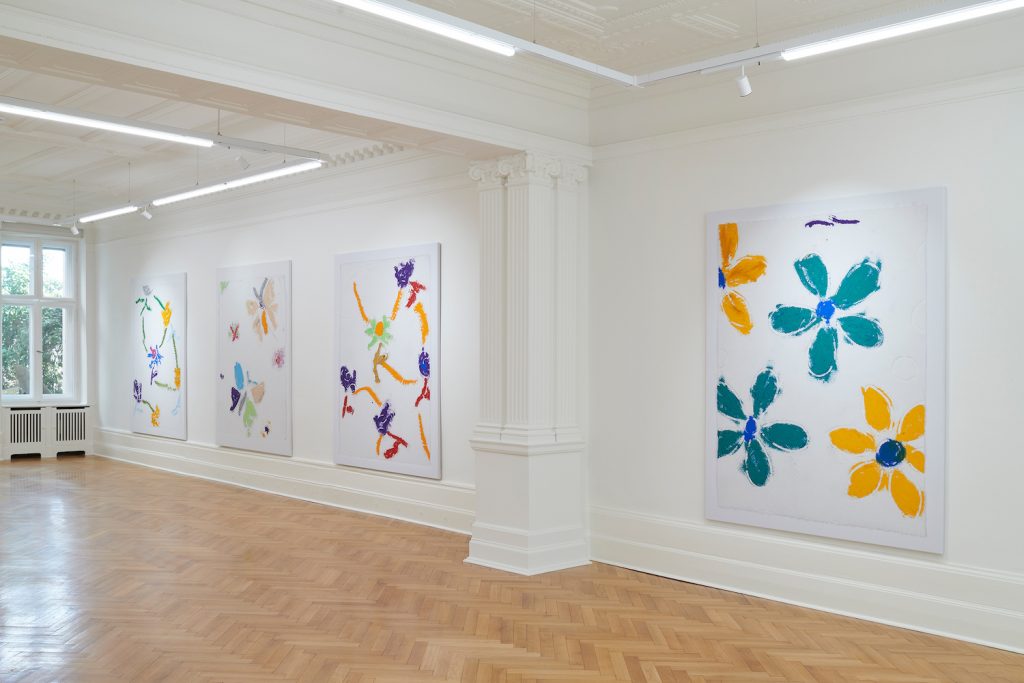
Kaspar Müller’s Mandala
(2020). Courtesy: Société and the artist. © Société
Across town, Daniel Wichelhaus of gallery Société has just
unveiled a sparkling new gallery space in a historic building in
West Berlin, a stone’s throw from Prada and Gucci, and galleries
like Daniel Buchholz. While he is on the participant list for Basel
by Berlin, he opted to not put a fair booth in his brand-new space
but to show a dozen or so new works by Kaspar Müller, which the
artist made during lockdown after being inspired by his
six-year-old daughter’s doodles on a single ply of toilet paper
(they range from €15,000 to €20,000). Given the recent shortage of
toilet paper that plagued Germany during the early days of
lockdown, these pieces are coyly political.
“We are participating in everything, but we cannot replace the
physical experience of Art Basel,” he says.
Asked about hosting fairs in galleries, and why he didn’t do it,
he said he just changed his mind: “We blur lines all the time. I
don’t believe in the dogmatic concepts of fairs or exhibitions. It
either works, or it doesn’t.”
His soft launch on Tuesday is a testament to the art world’s
desire to come together. The event spilled out onto the street at
the usual evening opening hours, despite the fact that there was no
slotted opening.
Wichelhaus says it is a time for reflection on what needs to
stay and what can go. One wonders how fairs will emerge from this,
but no one seems to doubt that they will not be around. “We are all
trying right now different modes and there are interesting
considerations of how to generate content, yes, but we all know we
are not quite there yet,” he says. “But I know that change never
happens slowly. Interesting things will come out of this.”
The post ‘A Brick-and-Click Approach Is the Way Forward’:
Berlin Dealers Report Lively In-Person Sales at the Art Basel
Booths They Built in Their Galleries appeared first on artnet
News.
Read more https://news.artnet.com/market/basel-by-berlin-2020-1888082
Further reading


Leave a comment