
Art Industry News: A Scholar Has Discovered a Trove of Important Russian Avant-Garde Art in a Tiny Museum’s Basement + Other Stories
Art Industry News is a daily digest of the most
consequential developments coming out of the art world and art
market. Here’s what you need to know on this Monday, May
4.
NEED-TO-READ
BP Won’t Judge This Year’s Portrait Contest –
For the first time in more than two
decades, BP will no longer be represented on the panel of judges
that determines the winner of the prestigious £35,000 ($43,400) BP
Portrait Award. A spokesperson for the museum said the decision was
decided jointly with BP and was unrelated to recent high-profile
campaigns and ongoing advocacy
pushing for the institution to sever ties with the oil giant. The
winner of the award will be announced on Tuesday. (Guardian)
New App Seeks to Bring Street Art Across America –
Graffiti artists are returning to
the streets (six feet apart, of course) under the auspices of a new
technology company, Beautify, that seeks to facilitate mural
painting on rundown city walls. Since many businesses have closed
up shop amid COVID-19, some, like the kitchenware store Sur La
Table in LA, are using the app to commission street artists to make
murals on their boarded-up windows. The company is working with
corporate brands to sponsor new public art at $10,000 apiece, with
the goal of producing 1,000 murals by 1,000 artists in 100 cities
as neighborhoods across the US begin to reopen. (New York
Times)
Russian Avant-Garde Treasures Found in Museum Basement
– The art historian Andrey Sarabyanov has made
what he calls an “astounding” discovery: dozens of works by leading
avant-garde artists including Wassily Kandinsky, Alexander
Rodchenko, and Varvara Stepanova languishing in the basement of an
obscure history museum in Russia’s Kirov
region. Sarabyanov—who learned about the hidden works, many of
which were entirely unknown to historians, from a local
official—believes they were abandoned after being included in an
early Soviet traveling exhibition in 1921. “It is a very
important discovery which will not only bring new works to light
but will also tell the fascinating story of the traveling
exhibitions in Russia in the first years after the October
Revolution,” says historian Natalia Murray. (The Art
Newspaper)
Where Are the Images of COVID Deaths? – Harvard art history professor Sarah Lewis pens
an op-ed exploring why we have seen so few images of the
coronavirus crisis (other than the oft-reproduced spiky
depiction of the virus itself). Due to privacy laws,
professional images from inside medical zones remain rare, leaving
us with pie charts and images of politicians behind lecterns
instead of visual representations of the human toll. But without
photographs that communicate the scale of the calamity, she argues,
the virus will be harder to combat. “Images force us to contend
with the unspeakable,” she writes. (New York
Times)
ART MARKET
Gallerist Helga de Alvear Donates to COVID Research –
The Madrid gallerist has donated
$1.1 million to support research to find a vaccine for the novel
coronavirus. Her gift will fund the work of the National Center for
Biotechnology in Madrid and help provide protective equipment for
its scientists. Spain’s death toll from the virus currently stands
at just under 25,000. (Artforum)
This Artist Is Driving
Africa’s Market Boom – The market’s renewed interest
in the Nigerian painter Ben Enwonwu is having a ripple effect on
the demand for younger contemporary artists in Africa. Sotheby’s
first online-only modern and contemporary African art sale in March
saw a 46 percent increase in bids compared to a year ago. Now, more
works by Enwonwu are coming out of the woodwork. One was
recently uncovered thanks to an
unwitting owner’s Google search. (Quartz)
COMINGS & GOINGS
Uffizi Cuts Capacity Ahead of Reopening
– The Italian museum that
houses The Birth of
Venus plans to reopen in
mid-May—but with precautions. Its director, Eike Schmidt, estimated
that only half the normal number of guests—450 people—would be
admitted at one time. Since the institution has lost around €10
million in revenue since it closed in March, some building projects
that had been in the works will likely be put on hold.
(TAN)
Iran’s Art Galleries Prepare to Reopen – After a two-month shutdown, art galleries in
Iran were permitted to reopen on April 20. Although some remain
closed, a handful have registered with the health ministry to
welcome visitors again, providing they adhere to strict limitations
on the number permitted to enter at one time. The country’s labor
ministry is working to estimate the amount of economic damage that
small businesses, including arts galleries, suffered as a result of
the closures. (Tehran
Times)
Russia’s Art World Returns—But Looks Different – As
Russia begins to reopen after more than a month and a half on
lockdown, its art institutions are surveying the damage. The
director of the Hermitage, Mikhail Piotrovsky, estimates that half
the museum’s annual budget has been lost. Many institutions are
planning to limit visitor numbers to help preserve public heath,
which means they will continue to lose income even after they
reopen. Russia’s culture minister, Olga Lyubimova, said in an
official statement that the government would cover the losses of
state museums like the Hermitage, but private museums and the
commercial art sector will not receive support. (Les Journal des Arts)
FOR ART’S SAKE
Antony Gormley Sculpture Stirs Controversy – Not everyone is thrilled with Antony Gormley’s
proposal for a sculpture commemorating code-breaker Alan Turing at
the University of Cambridge, where he once taught. The heritage
body Historic England has criticized the 12-foot-tall abstract
sculpture, which it says could interfere with the “architectural,
landscape, and aesthetic significance of the college.”
(The Art
Newspaper)
Royal Academy Is Losing $1.2 Million Each Month –
The artist-run museum, unlike many
of its London peers, does not receive government funding. Without
relied-upon income from tickets, it is losing around $1.2 million
each month—and facing one of the biggest financial challenges in
its history. Still, the museum plans to forge ahead with its high-profile Marina
Abramović exhibition, originally due to open this fall. With a
thorough schedule reshuffle as a result of the shutdown, the show
will now be pushed to 2021. (ARTnews)
A Small New Jersey
Museum Offers Art Classes to Essential Workers – The
Hunterdon Art Museum in Clinton, New Jersey, is offering free
virtual art classes for essential workers and their children.
Classes include painting and drawing, poetry, art journaling,
comics, manga, anime, and clay. (NJ.com)
Art Institute’s Lion
Face Mask Is Immediately Stolen –
Not just what this says about our commitment to wearing masks: just
a day after face coverings were installed on the pair of lions
outside the Art Institute of Chicago in an effort to encourage
mask-wearing, one lion was left without protection. A museum guard
saw two men climb the lion and remove the face covering around 11
p.m. on Thursday, April 30. (Hyperallergic)
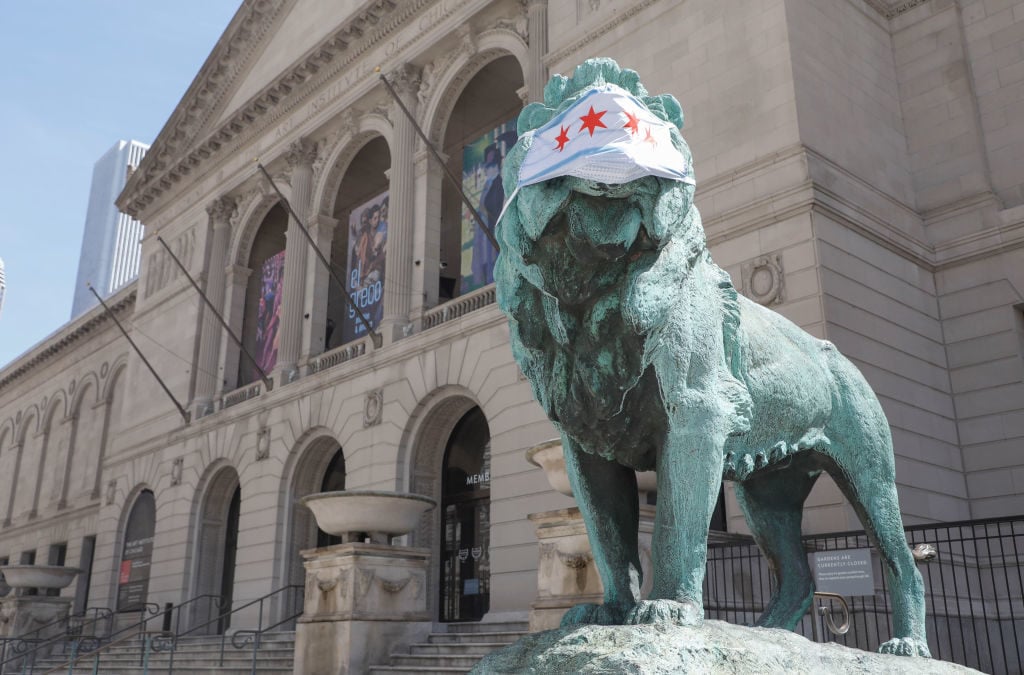
The lion statue with a mask in front of
the Art Institute of Chicago in Chicago, Illinois. Photo: Joel
Lerner/Xinhua via Getty) (Xinhua/ via Getty Images.
The post Art Industry News: A Scholar Has Discovered a Trove
of Important Russian Avant-Garde Art in a Tiny Museum’s Basement +
Other Stories appeared first on artnet News.
Read more https://news.artnet.com/art-world/art-industry-news-may-4-stories-1851522
Further reading


Leave a comment