
Massimiliano Gioni on What He Learned From Germano Celant, the Troublemaking Curator With a Maniacally Precise Mind
For as long as I can remember, I have been shocked by the fact
that Germano Celant wrote the Arte Povera manifesto in 1967, when
he was 27.
At the same age, I had moved to New York as the editor of
Flash Art, the very magazine where Germano published his
“Notes for a Guerrilla War.” His apartment in New York was on 12th
Street and 4th Avenue, a few blocks west from where Francesco
Bonami used to live and a couple blocks north of where Maurizio
Cattelan—still unable, either financially or psychologically, to
afford his own place—shared an apartment with a roommate.
I was living on 18th street as a guest of RoseLee Goldberg, who
saved my life by letting me live with her and her family because my
monthly salary from the magazine was $500. She and Germano went way
back, and had collaborated on a small but fabled book and
exhibition in London in the 1970s.
By the time I got to New York at the end of 1999, Germano was
already a kind of living legend: for his role in the Arte Povera
movement; his shows at the Guggenheim and the Palazzo Grassi, where
he had been one of the last disciples of Pontus Hultén; his
collaborations with Ingrid Sischy for Artforum and
Interview; his radical exhibition, “Ambiente/Arte,” for
the 1976 Venice Biennale, which he also directed in full in 1997,
and had less than six months to organize; and the hundreds of
books, catalogues, and exhibitions he put together for virtually
every museum in the world, from the Pompidou to the Art Gallery of
Ontario.
He was revered and feared and sometimes bad-mouthed for his
presumed greed and authoritative style, and in certain Italian
circles, he was believed to have controlled the art system for
decades. In 2000, he curated the controversial Giorgio Armani
exhibition at the Guggenheim, which had been paid for by the
designer; 15 years later, he caused somewhat of a scandal by
curating the exhibition “Art & Foods” for the Expo in Milan for a
fee of €750,000 euros. Whether you liked it or not, one had to give
him credit for making the curatorial game bigger than anyone before
him.
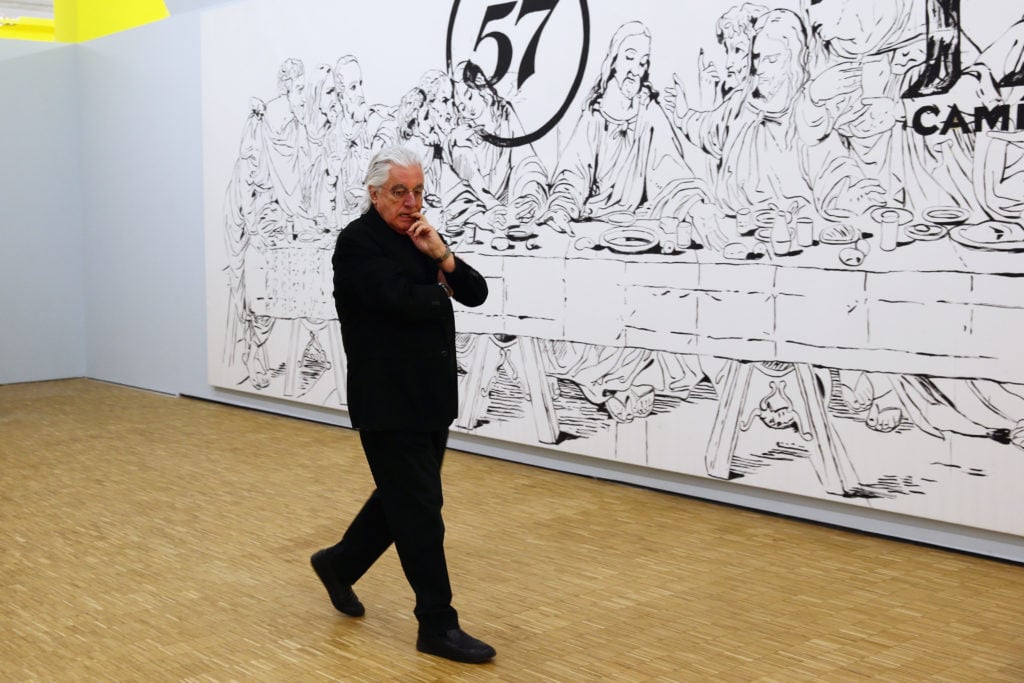
Germano Celant before Andy Warhol’s
The Last Supper (Camel-57) at the “Arts & Foods”
exhibition, which Celant organized for the 2015 Milan Expo. Photo
by Vittorio Zunino Celotto/Getty Images.
All this is to say that when I moved to New York, Germano was
for me literally a landmark: his house was a place that I would
point out to friends and visitors from Italy, his career a series
of milestones I would keep an eye on to understand how I was
doing.
And yet, even as established as he was, some of his best work
was still to come in the form of a series of group shows in Venice
and Milan at the Fondazione Prada, which he had been directing
since 1995: “The Small Utopia: Ars Multiplicata” (2012); “Art or
Sound” (2014); “Post Zang Tumb Tuuum” (2018); and his somewhat
contentious remake of Harald Szeemann’s “When Attitudes Become
Form” (2013).
Famous were his rifts with younger curators. But for some
reason, with me, he always proved to be the kindest and most
generous colleague—if not a big brother or an uncle, at least a
benign godfather. After he received the Agnes Gund Curatorial Award
from Independent Curators International for his reinterpretation of
“When Attitudes Become Form,” I remember teasing him for finally
winning a prize for a show he had copied from someone else.
To his credit, he was not incapable of very negatively reviewing
an exhibition after having complimented you in person. I took that
as a form of honesty, even though I am sure sometimes it was a kind
of strategy. But he knew how much I had admired his Arte Povera
book, and how it had literally changed my life when I had
encountered it at age 16. I had secretly hoped that a book of mine
could have the same effect, if not on him, then at least on some
young teenager somewhere.
He was a man of great appetites. Once, during a tour of his
house, which doubled as a laboratory, he proudly pointed to Bruce
Nauman’s drawing for his historic
sculpture, From Hand to Mouth, saying
that it was the only artwork he had ever paid for. He had acquired
it from legendary gallerist and agitator Seth Siegelaub, I believe
for a few hundred dollars, and it sat among many other great gifts
and trades from dozens of artists. (Another sweet memory of that
visit was seeing his then 10-year-old son, Argento, jumping and
playing among the artworks which he proudly proclaimed as his own.
Those who had known Germano for years used to say that after he met
his wife, Paris, with whom he had Argento, he became warmer and
kinder.)
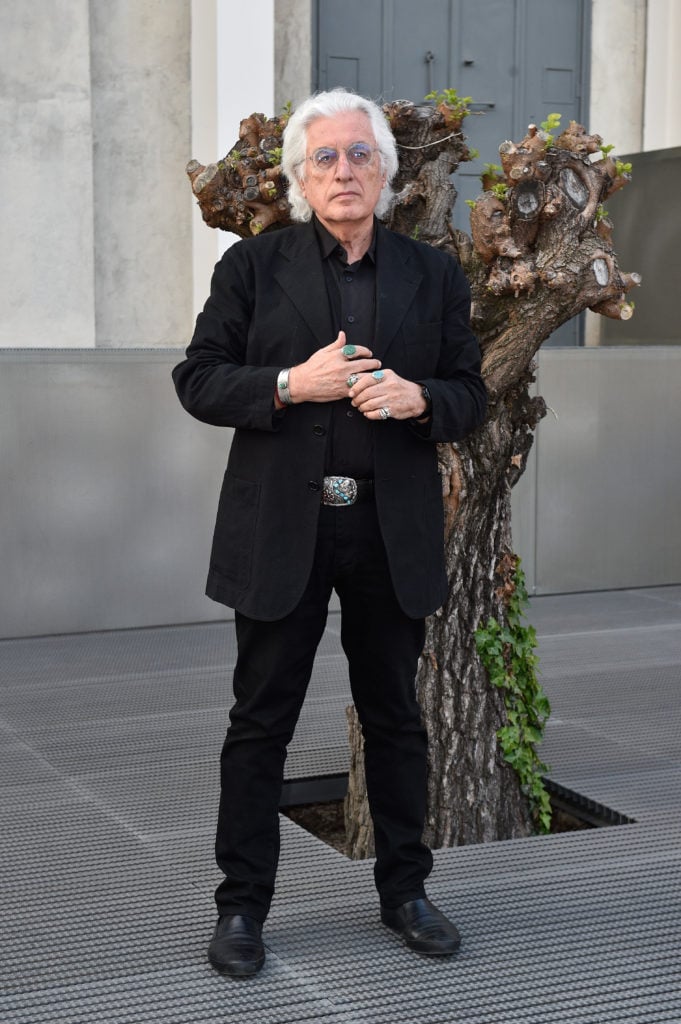
Despite Germano Celant’s punk rock
appearance, he took an organized and precise mind. Photo by Pietro
D’Aprano/Getty Images for Prada.
In spite of his punk rock appearance—leather vests, jade rings,
cowboy belts—Germano always had the slightly maniacal precision of
an accountant. After all, at age 30 in 1970, he organized an entire
exhibition for the Galleria Civica in Turin about Conceptual art
drawn from his own meticulously organized archive. He owned
thousands of books, distributed between his home and countless
storage spaces, all dutifully catalogued. At last count, he claimed
to have 80,000 volumes, including magazines. Until just a few years
ago, he even still kept some of them in his mother’s house in
Genoa.
A tour of his house was never complete before a visit to the
room packed with the many books he had authored. I had been trying
to collect many of his historical publications, and one of them—the
catalogue for “Ambiente/Arte”—I had been trying to obtain for some
time. It was one of the hardest of his books to find, and I once
even offered 10 of my own catalogues to him in exchange for one of
his old copies of the publication, but he still didn’t capitulate.
I eventually bought it online years later.
During one of these visits to his home, in the company of Paul
McCarthy, the artist told Germano that he had loved the Arte Povera
book so much, that when he was young and broke and couldn’t afford
to buy his own copy, he shared one with a friend: they literally
cut it in half and held on to their own parts, which they exchanged
periodically.
Germano’s presumed archirival in the Italian art system, Achille
Bonito Oliva, used to tease Germano by saying that his initials
stood for General Catalogues, as to indicate his ability to release
an impressive number of catalogues raisonnés every year. And it was
impressive: in just over one year, between 2019 and the first
months of 2020, Germano had published monographs on Richard
Artschwager, Marco Bagnoli, Kaws, Jannis Kounellis, Mimmo Rotella,
Franco Toselli, Emilio Vedova, Doug Wheeler, Michele Zaza, and
probably many others.
And yet, for all his professionalism and efficiency, when a few
years ago I interviewed him about his relationship with Alighiero
Boetti and the birth of Arte Povera, he proudly said that the
mythical origin of the movement owed perhaps less to Maoist student
revolts or to Jerzy Grotowski (the Polish theater director from
whom Celant borrowed the notion of a “poor” art), than to the
consumption of large quantities of recreational drugs in artists’
studios.
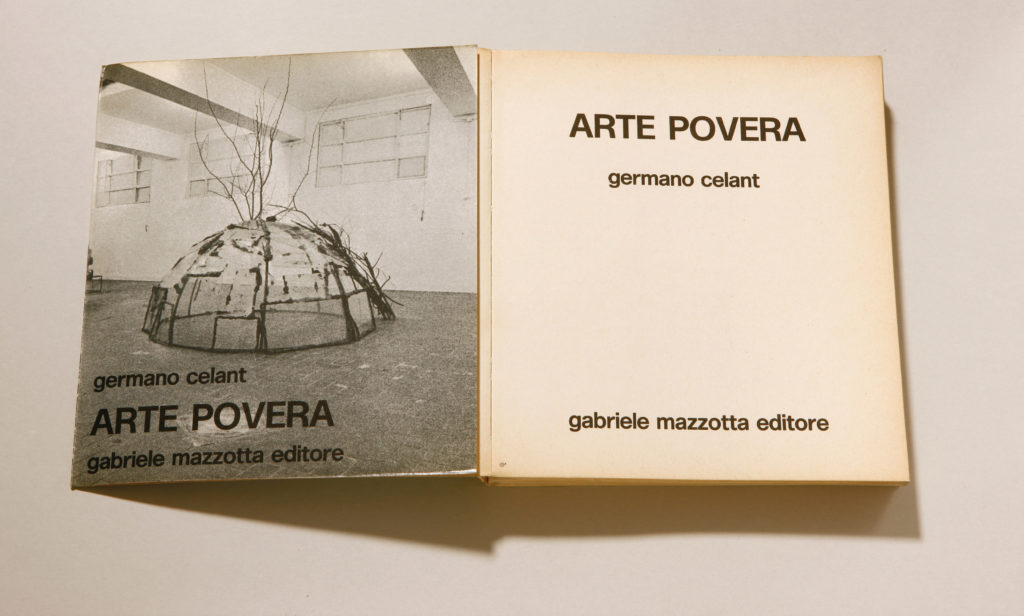
A copy of Germano Celant’s Arte
Povera, one of the countless publications he authored over the
course of his career. Photo by Fabrizio Carraro/Electa/Mondadori
Portfolio via Getty Images.
At the time, Germano was still a 25-year-old kid, and a pupil of
art historian Eugenio Battisti, whose most famous book,
L’Antirinascimento (the anti-Renaissance) displayed a
contrarian attitude that would have rubbed off on the young Celant.
Anyway, whatever they were smoking, it clearly served them well. I
still remember one of the pages in the beautifully and starkly
designed Arte Povera book that had an entry by Michelangelo
Pistoletto that read: “Dear Germano, the word ‘povera’ is ok. You
rich, me poor, it’s not ok. You poor, me rich, it’s not ok.” This
was the climate of idealism and rebellion that fed their
dreams.
And Germano’s relationships with his old friends did not
dissolve. In 2013, as I was sitting with Marisa Merz in her
house (she was 87 years old at the time), her phone buzzed with a
message: it was Germano wishing her a happy new year. That stayed
with me as an image of continued friendship, support, and respect,
and as a reflection of a relationship between artist and curator
that had lasted for more than half a century. That intimacy proved
to me—if it was at all necessary—that Germano was a great friend of
artists.
As his early days prove, despite Celant’s precision and accuracy
in his accountings, he was allergic to bureaucracy. He would say
proudly that when he was working as a curator at the Guggenheim, he
never had an office: he only had a chair. He still belonged to a
generation for whom museums had to be reinvented and transformed.
He was still a troublemaker, even though he had recently described
himself to me as a tinsmith.
Starting, I believe, in 2006, I would periodically receive an
email from Germano or from one of his collaborators at the Studio
Celant asking for the catalogue of one of my recently opened shows.
I think I still have the email in which he asked me for the book
for my show, “After Nature,” about which he had read a review in
the New Yorker. Every time he asked for a catalogue, I
knew I was doing something right, or at least good enough to
capture his attention. The last time I saw him in New York, at the
Armory Show at the beginning of this past March, he said he was
coming to see my Peter Saul and Jordan Casteel exhibitions at the
New Museum. And that meant more to me than he probably knew.
The post Massimiliano Gioni on What He Learned From Germano
Celant, the Troublemaking Curator With a Maniacally Precise
Mind appeared first on artnet News.
Read more https://news.artnet.com/art-world/massimiliano-gioni-germano-celant-1849257
Further reading


Leave a comment