
This Is the Toughest Challenge My Business Has Ever Faced. But Here’s Why Small Galleries Like Mine Will Come Out Alive
We Poles are optimistic
fatalists.
My gallery, Postmasters, opened in New York on a murky
Saturday night on December 13, 1984—the anniversary of the
post-Solidarity imposition of martial law in Poland, no less. In
the gallery’s 35 years, my partner Tamás Banovich and I
have weathered many storms and upheavals. We moved four times
as gentrification pushed us back and forth across the city (from
the East Village to Soho to Chelsea and, in 2013, to Tribeca).
We survived the savings and loans crisis of the late ‘80s; 9/11;
the Great Recession; Hurricane Sandy; and various smaller setbacks
along the way. The global pandemic and subsequent economic collapse
are, by far, the toughest challenges we’ve
faced.
But I have hope for galleries
like ours. In fact, I see a path forward from our current,
painfully deficient online existence to one in which IRL
galleries—and, specifically, small-to-midsize galleries—become
vital again.
There will be a revolution. Art
fairs will be dead for a long long time, maybe forever.
Gallery culture will be redefined. Survival will be based on
innovation, adaptation, flexibility… and smallness. At the moment,
oversized, shiny vessels control the spotlight. They have the
resources and the PR apparatus. But in the end, it is
little sailing boats that can best navigate choppy
waters.
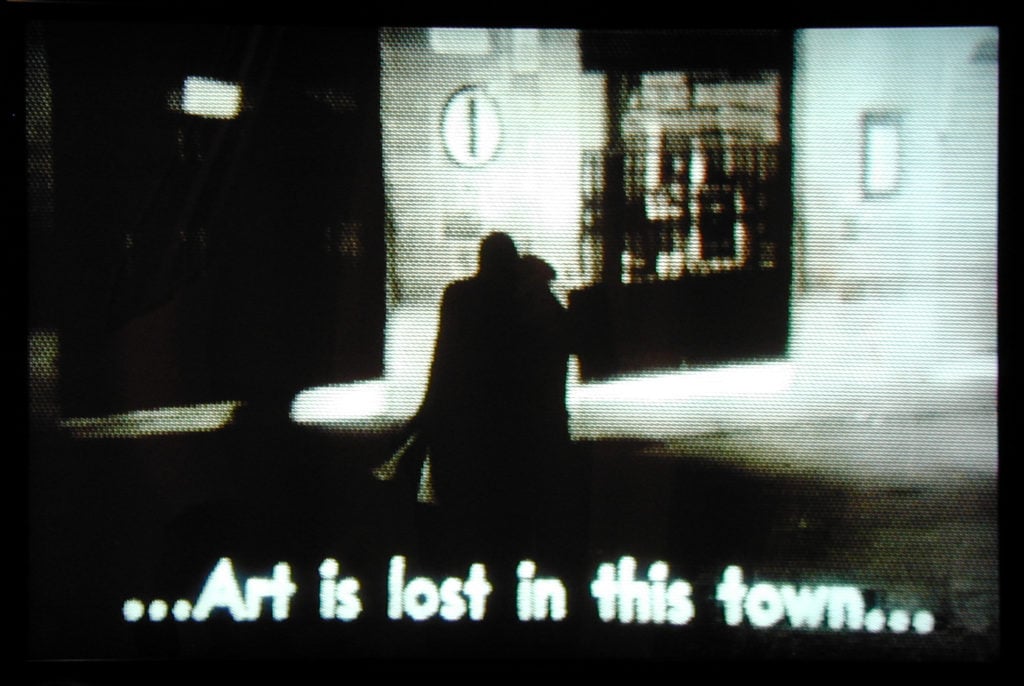
Wolfgang Staehle, Art Is Lost in This
Town (1989). Photo courtesy of Postmasters Gallery.
Let me explain.
The art ecosystem as we know it
has not been a healthy, diverse place for a long time. Even before
COVID-19, we had
a bloated, predatorial, and over-industrialized art
complex, rife with speculative collecting, surreal pricing, and
risk-averse dealers with ears bigger than their eyes and brains
trained to prize profit above all.
As the collector
Alain Servais has tracked with his Twitter hashtag #GroworGo since 2012, there has been a
systematic erosion of the lower levels of the art ecosystem, with
many of the most vital, progressive galleries unable to stay in the
race. This dynamic of destructive consolidation has been seen in
other fields, too, but perhaps no more than in the contemporary art
market.
The current virus may well
be the equivalent of the asteroid that killed the dinosaurs.
Because sometimes, the system has to be destroyed in order to be
liberated—and to make room for evolution.
The Opposite of “Size Matters”
The health and vitality of art
is exclusively dependent on the bottom of the food chain. It relies
first and foremost on the artists, who reflect on the world and the
time we live in, and secondarily, on institutions,
organizations, and galleries that have the passion and foresight to
support them.
Tamás and I came to the US
by choice as adults, and became Americans. But we never developed
that acutely American “entrepreneurial gene,” instead searching for
challenging and relevant art that the market has not yet swallowed
whole. We look for new forms of creative expression that do
not yet have the benefit—or the burden—of years, decades, or
centuries of history behind them. We never wanted to
anticipate where the market was headed. Rather, we aspired to
challenge the market and, perhaps, to teach it. We like selling
things and have, over the years, sold some rather impossible art,
like websites by Rafaël Rozendaal and art literally stolen from
others by Eva and Franco Mattes.

The author in a mask. Photo courtesy of
Magda Sawon.
It has been a hard road that has
been made possible by having a lean but muscular operation. We are
a big small gallery or small big gallery (I forget which). Our core
team is three people in New York and one in Rome. And I believe
this type of efficient model is best equipped to emerge
post-pandemic.
Here is the opposite side of the
“size matters” argument:
Tamás used to sail competitively
when growing up in Hungary. He sailed Finn dinghy, the smallest
Olympic-class boat with a huge sail-to-hull ratio. One-man boats,
Finns are beautiful: refined, deceptively simple, and extremely
sensitive to wind and waves. Both sailor and boat must constantly
adjust to changing conditions on the water. They are unforgiving
and capsize easily, but can also recover fast. When compared to,
say, cruise ships, the gas-guzzling floating entertainment centers
with an obscene crew-to-passenger ratio, guess which vessel can
maneuver and adapt better?
Back to the
galleries.
Only the Small Survive
Better people have
written beautifully
about the need for art
to be seen in real spaces to deliver a full spectrum of
contemplative experience. But not all of these spaces will recover
equally.
Galleries—which are by
definition local, low-density environments—will be allowed to open
their doors first. And people starving for non-virtual encounters
will come. As theaters and other performing-art spaces have to
reconsider their very structures to serve audiences safely,
galleries will be able to reopen without too much change. (This is
already happening in Shanghai, Berlin, and Vienna.)
Museums will follow. The
logistics of re-opening them are far more complex, but manageable
(as excellently laid
out by András
Szántó).
By requiring restrictions on
travel and crowds, this pandemic has devastated the event
industry. No sports games, no concerts, no Oktoberfest,
and… no art fairs. As a
result of the one-stop-shopping vacuum, collectors will
inevitably visit galleries more. Of course, in an economy
where most galleries have generated almost half their revenue from
art fairs, there will be attrition as a vast segment of buy-to-sell
collectors disappears.
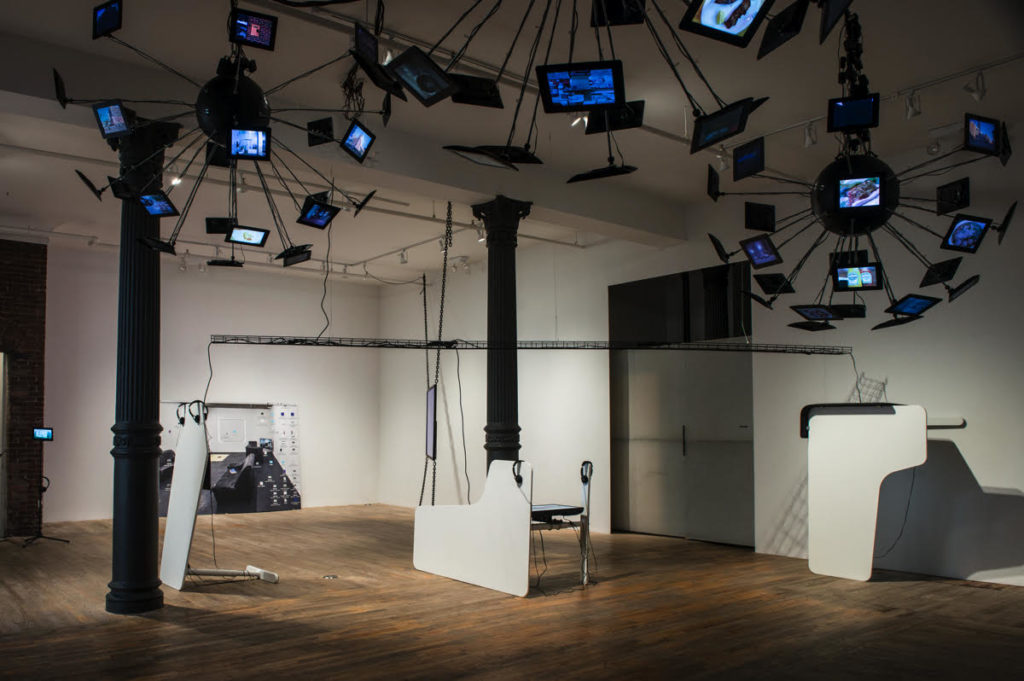
Installation view of “saved by the web”
(May/June 2017) at Postmasters, a three person show of Eva and
Franco Mattes, Hasan Elahi and Lin Ke. Image courtesy of
Postmasters Gallery.
But I prefer to bet on the
curiosity, vision, and connoisseurship of the collectors who stay
in the game, and the new ones that will come along. The new
paradigm—which will force people to engage intimately with art in a
gallery setting—will favor them and the galleries that serve them.
Artnet News columnist Tim Schneider has posed the
theory that true
collectors will return in force because they simply can’t help
it. To keep the naval metaphors going, I am on
board with this. True collectors are junkies in search
of cultural value rather than a liquid asset. They
will always look for new voices, not just the branded and easily
consumable ones.
Perhaps, in the “new normal,”
collectors will become more connected to their local scenes,
Perhaps a shared experience of the world collapsing violently
around us will favor content, which is good news for art that
requires attention and the galleries that support it.
Even before we return to our physical galleries, the
online migration of the past few months has shone a light on net
and screen-based art (the only art, by the way, that is
actually meant
to be viewed online) and the (small
and midsize) galleries like ours that have supported it. An
incredible trove of historic and new material is out there, ready
to take the spotlight, and ready to be collected—no shipping
involved. We have championed media art (beginning with now
historic “Can You Digit?” show in 1996) and used online platforms
for documentation, dissemination, and sales for many years, which
puts us at an advantage among galleries that have focused only on
brick and mortar until now.
What’s Next
Just like in the world at large,
the virus has exposed the gaps in wealth, connections, and access
that already existed in the art market. We need more
radical initiatives to save our industry, and to save
art. Except for the newly announced and
promising Platform LA and
David Zwirner’s generous gestures (hosting
selected young
galleries online and,
before the pandemic, hosting the displaced
Volta), there is minimal
cross-pollination in the gallery ecosystem. Top just takes from the
bottom. Gives nothing.
Collaboration takes place among
peers only, with small galleries banding together
to share resources (Condo, NADA) and mega-galleries banding
together to optimize business (see: Pagavella’s
management of the Marron Collection).
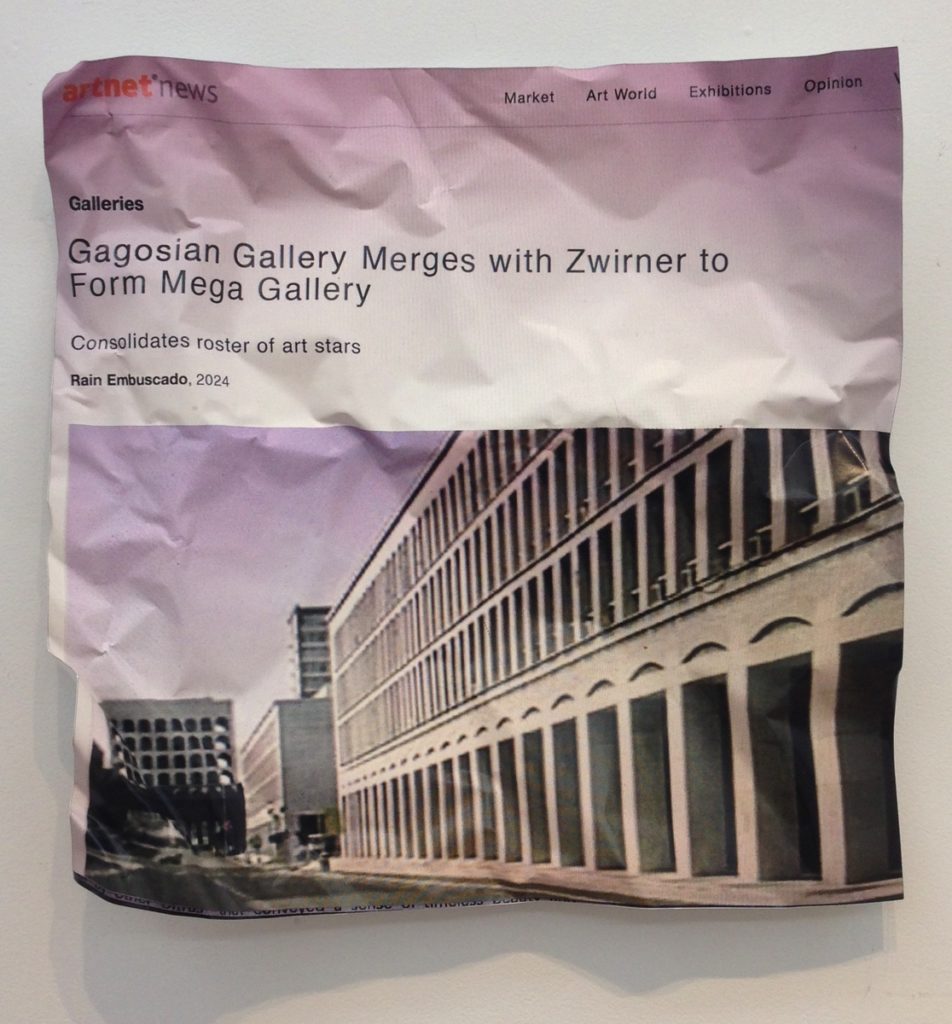
William Powhida’s Didactics (Gagosian
and Zwirner) (2017). Courtesy of the artist and Postmasters
Gallery.
But revolutions and change never
come from the top. What we need is new, progressive ideas for
both galleries and artists working separately and together rather
than trying to plug the hole in a sinking ship.
William Powhida, an artist we represent, recently came up
with “Store-to-Own,” a novel way to
distribute his work and
get it out of storage. He offered select artworks to people to live
with for free; they could purchase it at an increasing discount
over the years or sell it and share the profit. It proved very
successful. This kind of initiative offers no direct benefit to
galleries—but it opens up a system that is in dire need of
reinvention.
In the famous words of the
infamous Donald Rumsfeld, “You go to the war with the army you
have.” The post-Covid art world will be physically
local and virtually global as the regional scenes (a domain of
smaller galleries) gain relevance while “long-distance” art
business continues and grows online.
Art is needed, and art will
rise. To paraphrase Dylan: “Come gather Finn Dinghies
wherever you roam…”
All this may be naive and
delusional. Along with many others, I may not be here in a few
months, bankrupted and unable to continue. But this is the
time. You know the David vs Goliath story. And you know
how it ends. Take care, everybody.
Magda Sawon is the co-founder
of Postmasters Gallery.
The post This Is the Toughest Challenge My Business Has Ever
Faced. But Here’s Why Small Galleries Like Mine Will Come Out
Alive appeared first on artnet News.
Read more https://news.artnet.com/opinion/magda-sawon-postmasters-op-ed-1845471
Further reading


Leave a comment