
Forensic Architecture Will Use an ICA Exhibition to Present New Evidence About the Police Killing That Triggered the 2011 London Riots
The Turner Prize-nominated
collective Forensic Architecture will present new evidence about
the 2011 police killing of Mark Duggan in London in an exhibition
at the city’s Institute of Contemporary Arts in the
fall.
After investigating the
controversial shooting, which triggered the 2011 London riots, the interdisciplinary research
agency has concluded that Duggan could not have been holding a gun
when he was shot. Their investigation undermines the official
accounts of events given by police, and sheds light on alternate
possibilities—including one that police may have planted the
firearm after Duggan was killed.
Forensic Architecture’s work
will be shown in an exhibition at the ICA curated by the activist
community group Tottenham Rights, which focuses on community
responses to police violence in London. Initially slated for May,
the exhibition will now be presented in the fall, with exact dates
yet to be announced.
“Our investigation demonstrates
that independent civil society groups, empowered by new media
technologies, are capable of holding the police and their oversight
bodies to account,” Forensic Architecture’s director, Eyal Weizman,
said in a statement.
“Events in the US and elsewhere
show that this is more necessary than ever. As our work on police
violence around the world has shown us, long histories of systemic
and structural racism all too often become visible in the
split-second actions of police officers, and in the subsequent
efforts by the institutions around those officers to explain and
justify their actions.”
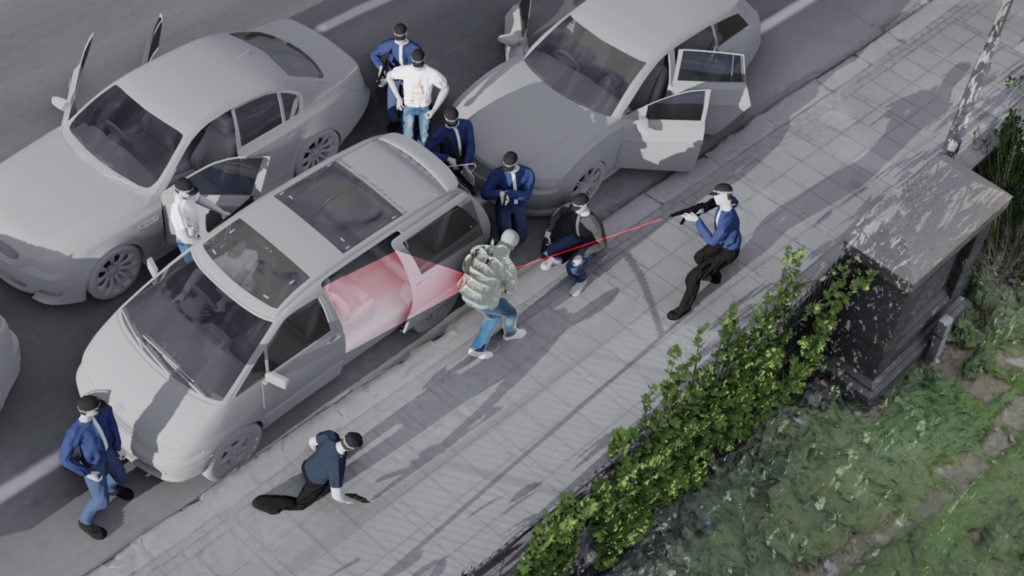
One-and-a-half seconds: According to
FA’s analysis, between Mark Duggan exiting the minicab, and
receiving the second, fatal shot, no more than 1.5 seconds had
elapsed. Image courtesy Forensic Architecture.
The 29-year-old Duggan was
fatally shot in Tottenham, North London, on August 4, 2011, while
allegedly traveling with a gun in a shoebox on the seat next to him
in a cab. Metropolitan Police pulled the car over, and an officer
said he saw a gun in Duggan’s hand when he shot him. No DNA or
other evidence links Duggan to the gun, which was later found more
than 22 feet away from the scene.
Many questioned this official
narrative, and more than 3,000 people were arrested in the civil
unrest that followed the killing. Duggan’s name has also been a
rallying cry during the Black Lives Matter protests in the UK
following the police killing of George Floyd in the US.
Lawyers for the family of Duggan
commissioned Forensic Architecture to investigate the incident in
2018, the same year the collective was
shortlisted for the Turner Prize.
The group produced a detailed
spatial analysis of the moment Duggan was shot after reviewing
videos and images, witness testimony, hand-drawn plans, and expert
reports.
The new evidence undermines the
conclusions of two official investigations by the coroner’s office
and the Independent Police Complaints Commission in 2014 and 2015,
and reopens speculation about whether police officers on scene
could have moved the gun to where it was found.
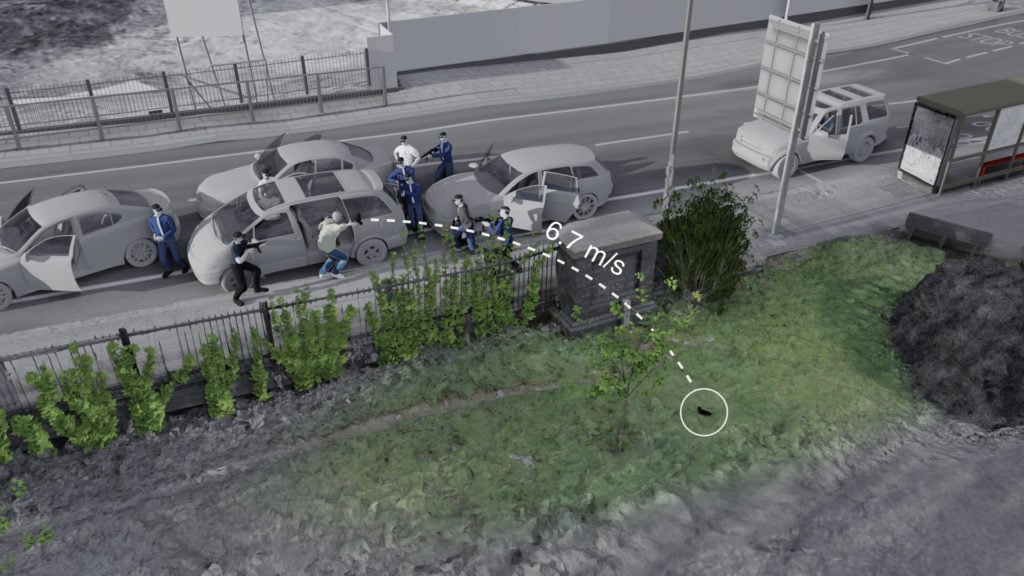
The required throw: New biomechanics
evidence, published for the first time with FA’s investigation,
claims that Duggan would have had to throw the gun at a velocity of
6.7m/s, to reach the location at which it was found. This would
require a large, sweeping motion with his right arm. Image courtesy
Forensic Architecture.
The evidence, as well as a
virtual reality reconstruction of the scene of the killing from
multiple perspectives, will be shown in the ICA. Stafford Scott, a
Tottenham Rights activist and co-curator of the exhibition, said
that the investigation, which was first presented to the local
community, was an “opportunity to see what justice looks like when
the state is not in control of the process.”
Forensic Architecture’s analysis
helped the family get a financial settlement in an out-of-court
civil claim against the Metropolitan police in September 2019.
Marcia Willis-Stewart, a lawyer for the Duggan family, says that
the work shows how emerging technologies can be used to “unpick the
State’s chosen narratives” and prevent miscarriages of
justice. The conclusions have been presented to the
Independent Office of Police Conduct in the hope that it will
reopen the investigation.
The ICA’s director, Stefan
Kalmár, said in a statement that since beginning work with Forensic
Architecture, “a confluence of connected crises—first the pandemic,
then the subsequent economic fallout, and now the global response
to the lynching of George Floyd—have exposed the endemic, indeed
systematic, inequality in contemporary Britain, giving this
exhibition, and the work of Tottenham Rights and Forensic
Architecture, more urgency than ever.”
See a video presenting Forensic Architecture’s investigation
below.
The post Forensic Architecture Will Use an ICA Exhibition to
Present New Evidence About the Police Killing That Triggered the
2011 London Riots appeared first on artnet News.
Read more https://news.artnet.com/exhibitions/forensic-architecture-mark-duggan-ica-london-1886013
Further reading


Leave a comment