
Frieze New York’s Online Edition Launches With Seven-Figure Sales to VIPs as Art Dealers Hustle to Get a Handle on Virtual Fairs
There may be no better reflection of the current art-world
moment than a virtual art-fair booth that is comprised of photos
taken at a gallerist’s home, viewed from a collector’s couch. That
was the dynamic for Axel Vervoordt Gallery at the first online version of Frieze
New York, which opened to VIPs on Wednesday. (Yes, even
online, fairs have VIP days; this one required two-factor
authentication to gain admission.)
In lieu of the serpentine tent on Randall’s Island, Vervoordt
and more than 200 other dealers set up virtual shop in Frieze’s
online viewing rooms. (The fair officially launches to the public
on May 8 and runs through May 15.) Vervoordt presented works by
Dansaekhwa artist Chung Chang-Sup installed in Vlaeykensgang,
Antwerp, where gallery director Boris Vervoordt lives. Two works,
priced between $45,000 and $220,000, sold by the end of the first
day.
“It actually feels good we didn’t send several crates flying
across an ocean and instead have the opportunity to enjoy these
works in our home,” Vervoordt said. “These times require
innovative ideas and moments of reflection. Somehow, the slower
pace creates a better understanding.”
Dealers have had little choice but to embrace the format.
Seemingly overnight, a business that had been high-touch and
extremely cosmopolitan became simultaneously entirely digital and
quite a bit more homespun than it used to be. At this
fair, photographs of works on offer were sometimes taken in
artists’ homes (complete with paint-spattered floors) and dealers
posted their cell phone numbers on their gallery pages. For the
mega-galleries and a selection of smaller dealers (though, to be
sure, not all of them), the approach paid off: sales were happening
at a steady clip.
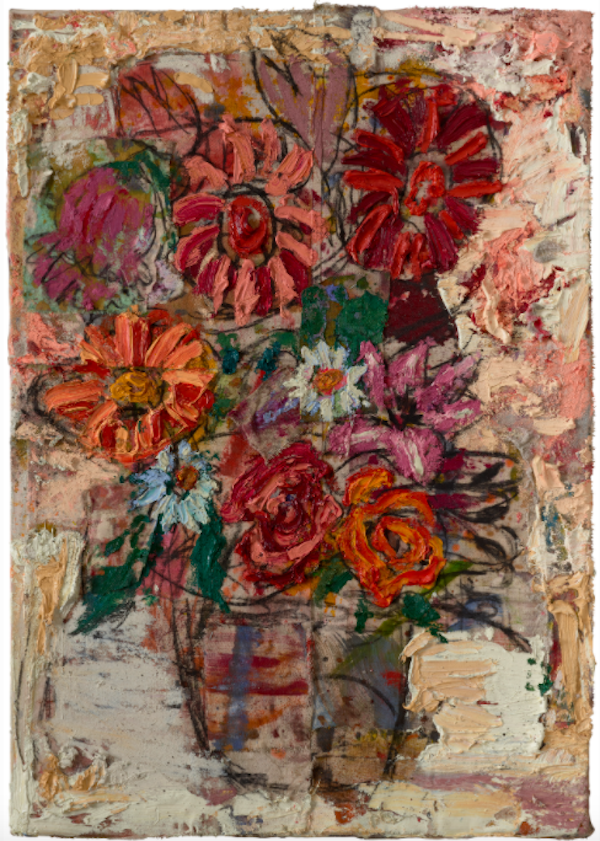
Daniel Crews-Chubb, Flowers V
(2020). Image courtesy the artist and Timothy Taylor gallery.
During the first hour of the VIP preview, for example, Timothy
Taylor sold five of six paintings from its solo presentation of
British artist Daniel Crews-Chubb for prices ranging
from $15,000 to $35,000 to a mix of American and European
collectors. But as at most fairs, some of these early transactions
were cemented in advance, offering a somewhat airbrushed view of
buying activity out of the gate.
Embracing the Form
Like many dealers, Hauser & Wirth opted not to try to recreate
the traditional fair experience but rather adapt its offerings to
the viewing room format. With artists everywhere on lockdown and,
in many cases, cut off from access to their studios, the gallery
invited artists to create new work that reflects their current
situation of quarantine and isolation.
“It’s very important to be as specific as possible, to bring
today’s mood into our presentation, and really lean in,” gallery
partner Marc Payot told Artnet News. “Obviously the photography
can’t be great because you can’t have professional photos of the
work. The [online] presentation is far from perfect and not refined
in the sense it would normally be.” But at the same time, he noted,
the more casual nature of the photos “really reflects the
moment.”
For a gallery like Hauser, which represents many artists that
already have lengthy waiting lists and widely recognized styles,
such an approach is a relatively easy sell. By the end of the
first day, the gallery reported 16 sales, including George Condo’s
Distanced Figures 3 sold for $2 million; Rashid Johnson’s
Broken Men sold for $245,000; a drawing by Paul McCarthy
priced at $495,000; a mixed-media work by Lorna Simpson for
$350,000, and paintings by Rita Ackermann and Henry Taylor for
$275,000 and $225,000, respectively.
The gallery also sold works by new additions to its roster,
including a glazed stoneware sculpture by Simone Leigh for
$110,000; an untitled 2019 work on paper by Avery Singer for
$150,000; and two new Nicolas Party watercolors for $60,000
each.
Payot noted that a new group of younger viewers has cropped up
with the online art fair, a platform he deems more “democratic”
than the physical fair, which boasts pricey admission tickets.
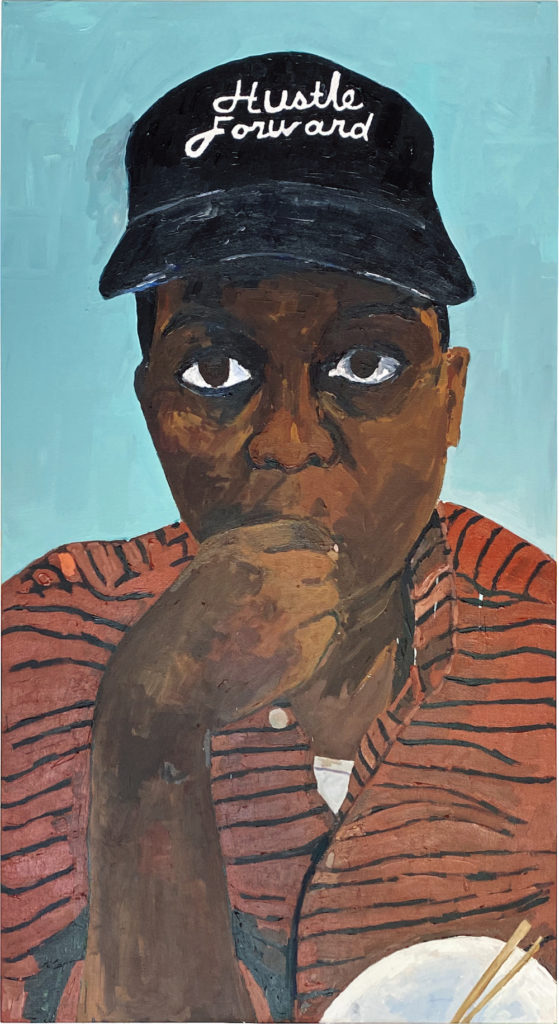
Henry Taylor, Man I’m So Full of
Doubt, But I Must Hustle Forward, As My Daughter Jade Would Say
(2020). Image courtesy the artist and Hauser & Wirth.
Piano Nobile, in the Spotlight
section, reported early sales of three works by Leon Kossoff,
including a painting for $1.8 million, which is just above the
auction record of £1.39 million set at Christie’s London in
November 2018. Meanwhile, a work on paper sold for
$65,000.
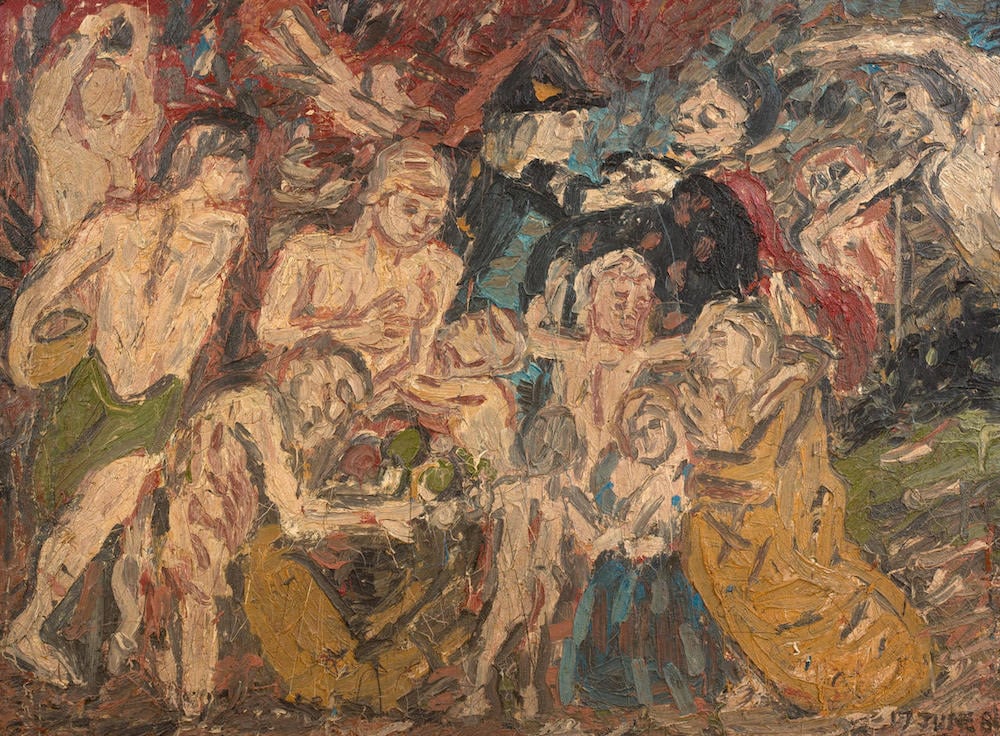
Leon Kossoff Study from ‘Minerva
Protects Pax from Mars’ by Rubens (1981). Image courtesy Piano
Nobile
“For a long time, Kossoff has been
overshadowed in the market place by the other School of London
painters, particularly Frank Auerbach with whom he is most
frequently compared by the critics. But the
market is now beginning to understand his real worth,” said founder
Dr. Robert Travers,
A Friendly Format
To be clear, this is not boom times—many, if not most, dealers
had no works labeled “sold” by the end of the first VIP day, and
sold-out or nearly sold-out booths were the exception, not the
rule. More common were booths with one or two works off the market.
But as Frieze’s global director Victoria Siddall said in a press
conference over Zoom, this event is “about getting everyone through
this time” and making sure businesses come out the other side as
healthy as possible.
To that end, Frieze refunded galleries 100
percent of their booth fees for the New York fair and provided
access to the viewing room for free. As Vervoordt noted, the
platform itself—which had been in the works long before the
lockdown era began and was initially developed as a complement to
the IRL fair—”has a stylish, to-the-point interface and when
exploring the fair, you sense that Frieze is a community.”
The site also allows users to search by various categories
including artist gender (there were four works by women for every
five by men, and a total of 31 works by artists who identify as
transgender or non-binary) and artistic medium (painting,
unsurprisingly, was by far the most common medium, with 1,636
examples, while the sound/audio category was represented by a grand
total of one work).
Most helpfully, the site also allows users to search by price
bracket. This element is not without its frustrations, however: a
search for items under $10,000 yielded nearly 1,500 works with no
way to further break down results, and several six-figure works
inexplicably turned up in this grouping.

Katharina Grosse, Untitled
(2019). Image courtesy the artist and Gagosian.
Still, dealers who found success seemed to find it at a variety
of price points, challenging conventional wisdom about what sells
online (which, up until now, has largely been regarded as
lower-priced items under $100,000). Ortuzar Projects of Tribeca
sold a painting by Dororty Iannone for $150,000 and three
paintings by David Robilliard for $45,000 each.
David Zwirner gallery also reported major first-day sales
including Suzan Frecon’s untitled composition in four
colors (2020) for $400,000; two gouaches on paper by Raymond
Pettibon for a combined $90,000; and Wolfgang
Tillmans’s Lighter (passage) I-IV (2019) for
$220,000.
Meanwhile, Gagosian unveiled new spray-paint-blasted works by
Katharina Grosse, which found an eager audience. By the end of the
day, eight of the works—which gallery director Deborah McLeod
described as “bite-size and easy to acquire”—sold at prices ranging
from €40,000 to €145,000 ($43,000 to $157,000).
At the other end of the price gamut, the gallery is also hosting
a single-artist viewing room on its own platform, complete with
bells and whistles like bespoke videos and market research. The
presentation dedicated to Cecily Brown’s massive Figures in a
Landscape (2001), priced at $5.5 million, went live on May 4.
“You have quite a breadth and two ends of the spectrum—easy pricing
on the primary works coming out of Grosse’s studio and, at the
other end, you have a masterpiece with all the attendant
research,” McLeod said.

Loie Hollowell Expanding Figure
(2019). Image courtesy the artist and Pace Gallery.
Pace, another mega-gallery with swift sales, sold 13
works from its “Perspectives” presentation spotlighting
artists from its contemporary program at a range of price points.
These included a 2019 painting by sought-after painter Loie
Hollowell priced at $250,000; Nigel Cooke’s 2020 painting
Oceans, part of a new series he made while in isolation in
the UK over the past two months, for $250,000; a recent nine-part
Mylar work by Adam Pendleton for $135,000; and three photographs by
Nina Katchadourian from her “Sorted Books” series for $3,800
each.
The post Frieze New York’s Online Edition Launches With
Seven-Figure Sales to VIPs as Art Dealers Hustle to Get a Handle on
Virtual Fairs appeared first on artnet News.
Read more https://news.artnet.com/market/the-virtual-frieze-fair-vip-day-had-startling-results-1854624
Further reading


Leave a comment