
Sotheby’s Is Reopening Salesrooms—and Aggressively Cutting Costs—in a Race to Repay Almost $120 Million in Debt This Year
When French-Israeli telecom magnate Patrick Drahi took Sotheby’s private last
year, many industry observers said his purchase marked the end
of an era in art-market transparency. That’s because, as the only
major publicly traded auction house, Sotheby’s was required to make
detailed quarterly reports about the state of its business, when
its peers were not.
But Sotheby’s release of a detailed annual report, published
last week and first reported by Art Market Monitor,
offers a new window into its finances—and, at first glance, it
paints a precarious picture. The report signed off on by accounting
firm Deloitte, and made public due to the company’s ongoing debt
obligations, noted that because much of the company’s business came
to a standstill in March, when looking to the next 12 months
Sotheby’s was “unable to predict or quantify with certainty the
effect on our liquidity, our ability to meet our obligations when
they become due and maintain compliance with its financial
covenants required by” more recent debt taken on after the merger
last year.
Drahi’s deal to buy Sotheby’s, valued at $3.7 billion, involved
a large amount of debt. To date, the company’s outstanding debt
stands at $467 million (plus interest), according to the latest
documents. It has to pay more than one quarter of that—$119
million—in interest and principle this year, and around $84
million for each of the next four years. That debt burden, coupled
with an extended period when Sotheby’s isn’t generating the kind of
revenue it would in a non-pandemic year, resulted in the release of
Deloitte’s “emphasis of a matter” related to Sotheby’s own focus on
the business as a “going concern.”
“In normal times, seeing this in an audit would be considered a
a big red flag,” art advisor Todd Levin said. But, of course, these
aren’t normal times, and the audit later notes that
Sotheby’s “capital requirements include the liquidity
necessary to support our recurring business needs and capital
required for the pursuit of technology and other initiatives, as
well as growth opportunities.”
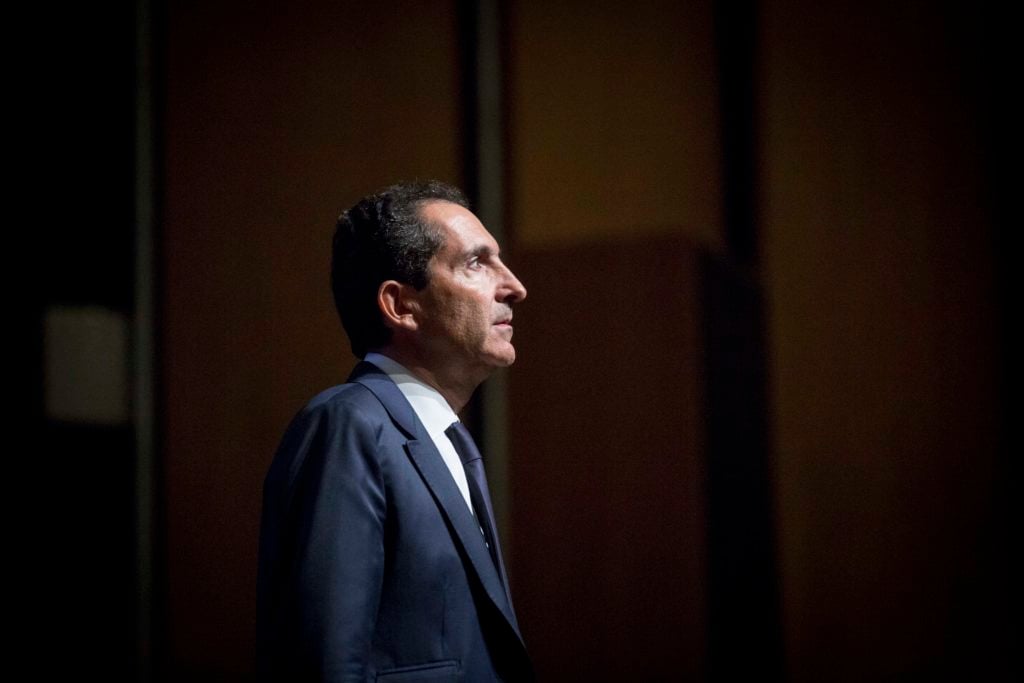
Patrick Drahi, Sotheby’s new owner, in
2016. (Photo by Christophe Morin/IP3/Getty Images)
Notably, some of Sotheby’s debt obligations will be fulfilled
thanks to cutbacks taken as a result of COVID-19, which the
auditors said would result in “significant cost savings in excess
of $100 million when compared to the prior year.” Those include
salary cuts of between 20 and 30 percent, furloughs of around 200
staffers, deferred spending on in-person sales and employee
bonuses, and a reduction in capital spending. (Sotheby’s noted it
will still need to pay between $13 million and $14 million in
severance in the first quarter of 2020, likely related to the departure of a number
of top staffers at the end of last year.)
“There are two issues facing Sotheby’s, one is their actual
financial condition, the other is the perception in the marketplace
based on the financials filed with Deloitte,” said attorney and art
law specialist Thomas Danziger, who frequently works with the house
on behalf of his clients. “I believe that
Sotheby’s can solve its financial issues if it wants, but the
longer that there is no reaction or response publicly from the
company, the harder its going to be to fight the perception that
there is an issue. It’s important that Mr. Drahi come out sooner
rather than later in support of the company and in support of his
staff, to put to rest the fears in the market and that he’s
invested to make sure the company succeeds.”
Perhaps not coincidentally, the evening after the report was
made public, Sotheby’s CEO Charles Stewart sent a lengthy email to
clients that appeared designed to allay jitters created by the
report without acknowledging its existence. Stewart said that
“teams are beginning to return to work in a number of
Sotheby’s offices in Europe and Asia, and we are actively preparing
for the reopening of our galleries in New York and London.” He said
the house had made nearly $70 million from 37 online sales since
March and reiterated plans to hold its marquee spring sales at the
end of June in New York, pending the lifting of certain
restrictions. “In a world of self-isolation, we are seeing
increased collector engagement and focus on their areas of
passion,” Stewart added.
Sotheby’s confirmed that “the Company absolutely has
Mr. Drahi’s financial support if it is needed.” Further,
amid the broader pandemic, a representative points out that
Sotheby’s situation is not unique as far as the uncertainty facing
the art world: “No one else in the art market, or any industry for
that matter, can predict when and how the world will recover from
Covid-19.”
As one financial expert pointed out to Artnet News, the company
has already made severe cost cutbacks and executed some savvy
financial moves—like paying down a mortgage and spinning the real
estate off to a separate trust—that demonstrate Drahi’s commitment
to the business. But it needs to be made clear that any continued
moves—such as restructuring debt if the need arises—are a
continuation of these plans, the person said. If not communicated
properly and transparently observers will continue to interpret
them as “desperate moves.”
The post Sotheby’s Is Reopening Salesrooms—and Aggressively
Cutting Costs—in a Race to Repay Almost $120 Million in Debt This
Year appeared first on artnet News.
Read more https://news.artnet.com/market/auditor-report-on-sothebys-debt-1853403
Further reading


Leave a comment