
New New Deal: Towards a New Era of Social Imagination
I recently came across a collective document called “The Grey Briefings,” written by the Special
Circumstances Intelligence Unit, a global group of 90 futurists,
writers, designers, technologists, and policy makers. The question
they ask is this: “What would happen to Europe and North America if
COVID-19 lasted a year or more?” Using software from MIT, they
uncover three scenarios, all of which mean saying goodbye to the
world as we know it.
All three begin with massive unemployment. Scenario One is the
Pyramid Scenario, where governments enact policies that benefit the
rich, which will result in exacerbated inequality, poverty, and
violence. Scenario Two is the Leviathan Scenario, where governments
expand their powers and use them to deliver social goals and
collective benefits. The third is The Village Scenario, where
ineffective and unsustainable state responses lead to fragmentation
and fragile local DIY solutions and support.
According to the briefing, the scenario that pays off in the end
is the Leviathan Scenario, where everyone makes sacrifices and is
mobilized to develop local solutions, creating bottom-up
experimentation with government support. There is a focus on public
goods and social welfare, transforming the economy and creating a
more resilient and sustainable foundation. This will lead to
post-crisis recovery and result in a New New Deal.
Based on the Works Project Administration introduced in America
in 1935, such projects would focus on new public networks, digital
services, widely accessible next-generation health-care systems,
and climate-resilient energy, transport, and housing projects.
Governments would act as both guides and delivery partners.
The briefing ends with some pertinent questions. What might a
Post-COVID-19 Renaissance look like? Could a long-term COVID crisis
provide stimulation for a new era of social imagination? How can we
imagine a more healthy, satisfying, and fair world in light of the
challenges posed by this “Great Transition”?
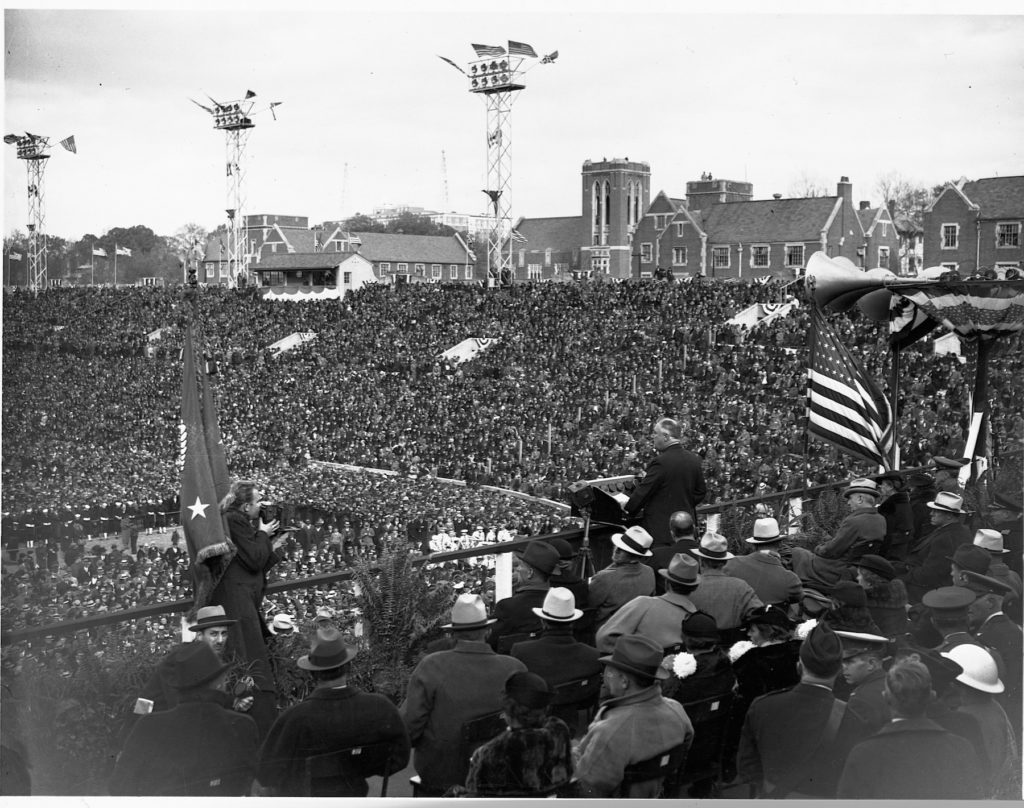
President Franklin Delano Roosevelt
addresses crowds at Grant Field and defends the New Deal. Photo by
Bettmann/Contributor via Getty Images.
In terms of culture, the challenge, according to the briefing,
will be in navigating a delicate balance between honoring people’s
concerns about change and encouraging them to experiment and be
open to new ideas. As president Franklin D. Roosevelt, author of
the New Deal, wrote in 1932: “The
country needs, and—unless I mistake its temper—the country demands
bold, persistent experimentation. It is common sense to take a
method and try it: if it fails, admit it frankly and try another.
But above all, try something.”
The future is often invented from fragments of the past. In the
late 1990s, I was friendly with Helen Levitt (1913–2009), the
extraordinary street photographer, filmmaker, and friend of Walker
Evans. Levitt told me that Evans told her at length
that during the Great Depression he participated
alongside Dorothea Lange, Gordon Parks, and many other
American photographers in the Farm Security Administration (FSA)
photography program, which was organized as part of the New Deal in
1937 by Roy Stryker and produced 250,000 images of rural
poverty.
Levitt told me that should there one day be a major global
crisis that would shake society to its roots (such as the one we
are living through now), we should revisit the legacy of
Roosevelt’s New Deal and what it did with and for culture.
Remembering her words, I found my notes recording what she had told
me: how to put in place democratic and decentralized government art
patronage, and how to connect the artist and the social
environment. Levitt also made me aware that these projects of
large-scale governmental support of artists had a predecessor in
1926, when the Mexican government paid artists to decorate public
buildings with murals.

Jackson Pollock, Going West
(1934-35). Image via Wikiart.
In the US, government support for art started in 1933 as a
direct result of the Great Depression, which began in 1929 and led
to mass unemployment. As cultural historian Robert C. Vitz points
out, “the magnitude of the crisis forced artists to explore ways of
combatting their traditional isolation and eventually through
artist organization and with the help of several government art
programs they found a new sense of community and a new role in
American Society.” Vitz describes how Morris Graves wandered
through the West selling paintings on the roadside, how Jackson
Pollock travelled across the country hitching rides and jumping
freight trains, how Arshile Gorky called the Depression years “the
bleakest, most spirit-crushing” period of his life, and spoke of
the “futility of such paralyzing poverty for the artist.” He also
tells us how Marsden Hartley wrote that “the uncertainty adds no
whit whatever to the peace of mind that is necessary for decent
work.”
Artists lost most of their previous private philanthropic
support, and the many cooperative events and markets (such as the
Society of independent Artists’s art market held at the Grand
Central Palace in NYC in 1931) did not provide the necessary
income. One initiative was put forward by the American Society of
Painters Sculptors and Gravers, who in 1935 suggested that museums
should pay rental fees to the living artists whose work they
exhibited. Only a few museums, like the Whitney Museum of Art and
the San Francisco Museum complied, so this failed to raise the
necessary income. It became increasingly obvious that only a
large-scale governmental initiative could bring solutions.
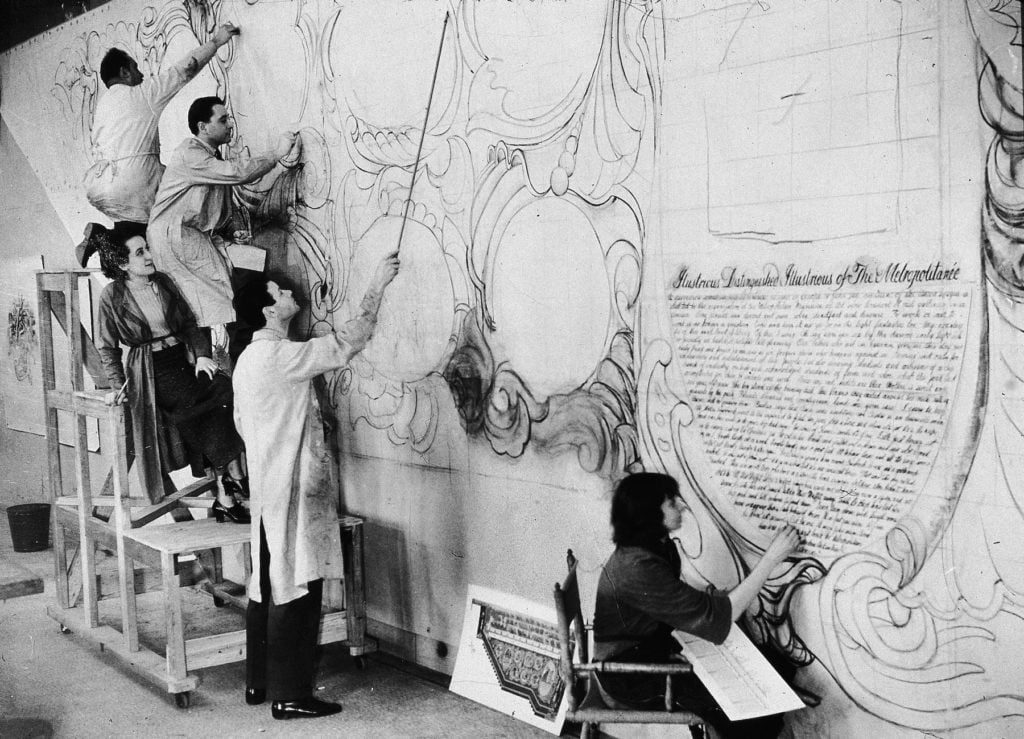
American artist Allen Saalburg directs
WPA artists at work in a temporary studio at the American Museum of
Natural History on murals commissioned for the Arsenal Building in
Central Park, New York, New York, 1935. Photo by New York Times
Co./Getty Images.
As art historian Erica Beckh writes, a momentous meeting took place in
the home of Edward Bruce in Washington, DC on December 8, 1933.
Bruce was an artist, lawyer, businessman, publisher, and collector.
His generalist mind and pragmatic spirit were instrumental in
creating a scheme to help artists. He gathered many museum
directors from all over the country to convene at the one-day long
meeting, which was also attended by Eleanor Roosevelt and chaired
by Roosevelt’s uncle Frederic A. Delano. Here, the first Federal
art program, the Public Works of Art Project (PWAP) was defined,
with the aim of providing work for American artists through
commissions, for example sculpture and mural decorations for
federal buildings. Beckh summarizes:
Administered by the Procurement Division of the Treasury
Department with funds allotted from the Federal Emergency Relief
Administration, the PWAP was a part of the Federal relief program.
It was directed by a central staff in Washington, assisted by
sixteen regional volunteer committees, composed of art museum
personnel and the like. The broad aims of the program were (1) to
establish democratic methods of government art patronage, (2) to
decentralize artistic activity throughout the entire nation, (3) to
encourage the emergence of young, unknown talent, (4) to increase
the general public appreciation of the arts, and (5) to promote a
closer interrelation of the artist with his social environment.
The PWAP came to an end in 1934 and was replaced by two
independent programs. The first, again under the directorship of
Bruce, was called the Section of Painting and Sculpture (which
later become the Section of Fine Art) and was a permanent agency,
no longer part of the Treasury’s relief fund. It commissioned
professional artists to decorate federal buildings and was
organized through open, anonymous competition. The idea was to
create more interest in the arts within society.
As the artist/muralist George Biddle wrote in 1940, “This employment of over 600
artists in almost 800 American cities has not cost the taxpayer one
additional cent of money. It has been financed through the
earmarked use of a Congressionally-voted building allocation.”
Biddle also noted that the “policy of selecting by open
competitions coupled with the decentralization (inherent in the
fact that the building program itself is located almost entirely in
small towns) is in my mind the greatest contribution and the
healthiest influence of the section.”
The second project, under the directorship of Holger Cahill, was
called the Federal Art Project (FAP). Intended to bridge fine art,
public art, popular art, craft, industrial arts, and folk arts, it
was part of the Work Progress Administration (WPA, renamed the Work
Projects Administration in 1939), a New Deal agency that employed
millions of job-seekers to carry out public works such as the
construction of public edifices, roads, and other large-scale
works. One of the main problems with the Section of Fine Art was
that often artists were paid in several installments, and each step
needed to be approved, which often led to a lack of risk-taking and
to compromise in the result of the murals. Under the FAP, however,
every participating artist received a salary, which required less
supervision.
In Cahill’s own words, “It is the function of our time to
organize great democratic and participatory cultural programs for
restoring the relation between artist and public. The shock needed
to set the program going was the Great Depression, which made it
clear that unless the organized community stepped in, the arts
would enter a dark from which they might not recover for
generations.”
The FAP encompassed
—Fine Arts: murals, sculpture, easel painting, graphic art. The
murals had the biggest outreach, or in the words of muralist George
Biddle, “Whenever mural art had reached its fullest expression,
there had also been a universal religion—that is, a common social
faith or purpose which the artist had shared with all classes of
society.”
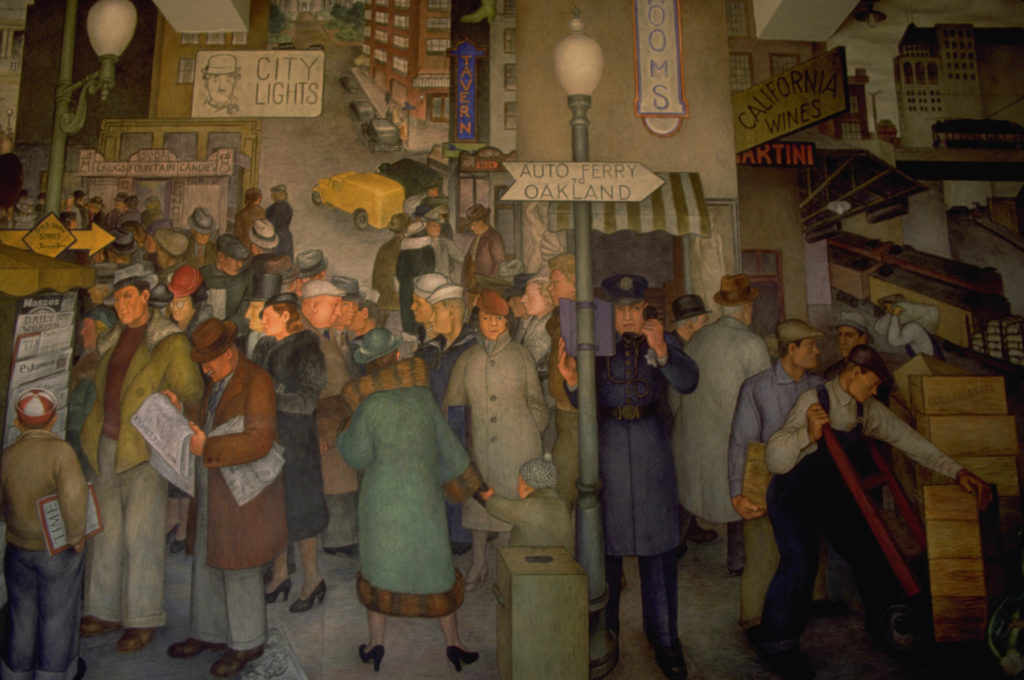
Detail of City Life mural at
San Francisco’s Coit Tower by Victor Arnautoff. Photo by © Robert
Holmes/CORBIS/Corbis via Getty Images.
—Practical Art: posters, photography, arts and craft, dioramas,
stage sets. This included the Index of American Design, an
encyclopedic survey of decorative arts and folk arts in the US in
the 19th century. That project is composed of more than 18,000
plates depicting American crafts and textiles.
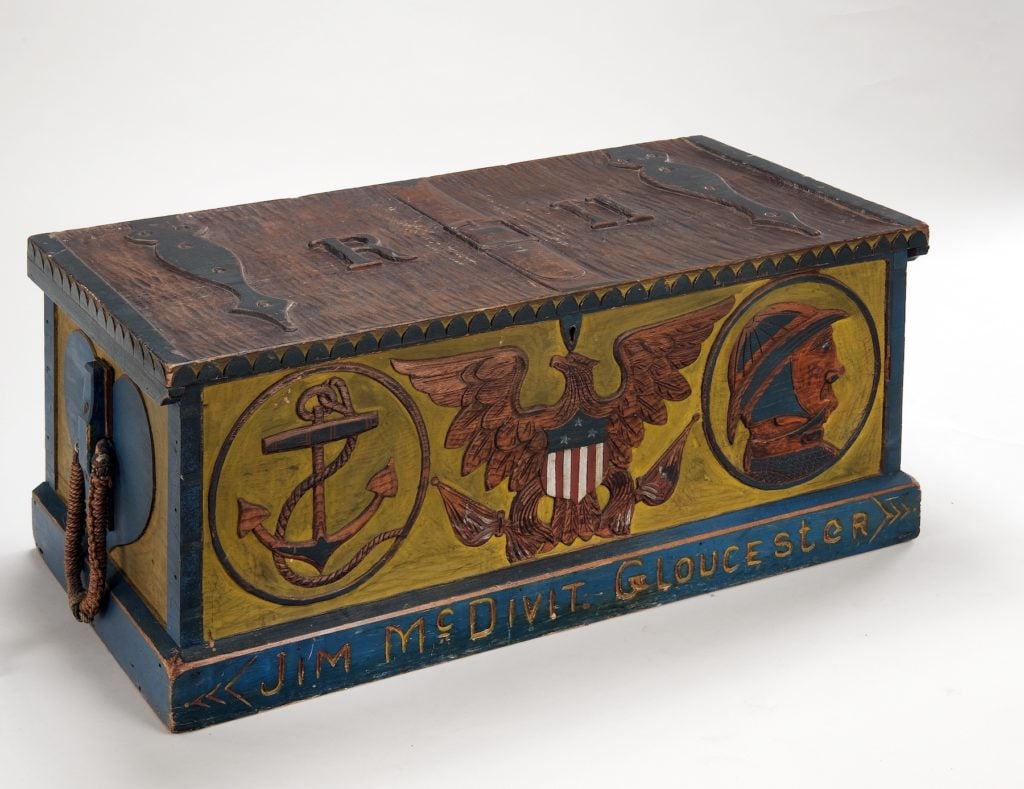
American Sea Chest (circa 1840), a
painted and carved storage box, an item illustrated in the Index of
American Design. Photo by Sepia Times/Universal Images Group via
Getty Images.
—Educational Services: galleries and art centers, art teaching,
research and information. Of particular importance was the creation
of more than 100 community centers, as it brought generations
together and made art accessible to many more people.

Poster for Harlem Community Art Center.
Image via Wikimedia Commons.
As George J. Mavigliano wrote:
Community art centers helped break down the strange notion that
art could only be appreciated by a limited group of people. Growing
numbers of people began to see the value of art as a recreational
pastime which formed a link between the professional artist and the
layman, broadening the scope of art in the community. Both of these
programs were to serve as a means of introducing art into many
American communities hitherto barren of art and art interest.
Mavigliano reminds us of Cahill’s speech at philosopher John
Dewey’s eightieth birthday, where he emphasized the value
Dewey gave to seeing art in daily life and to connecting art and
society. He believed that art should not be looked upon as a mere
frill to standard education, but something to be experienced
through participation.
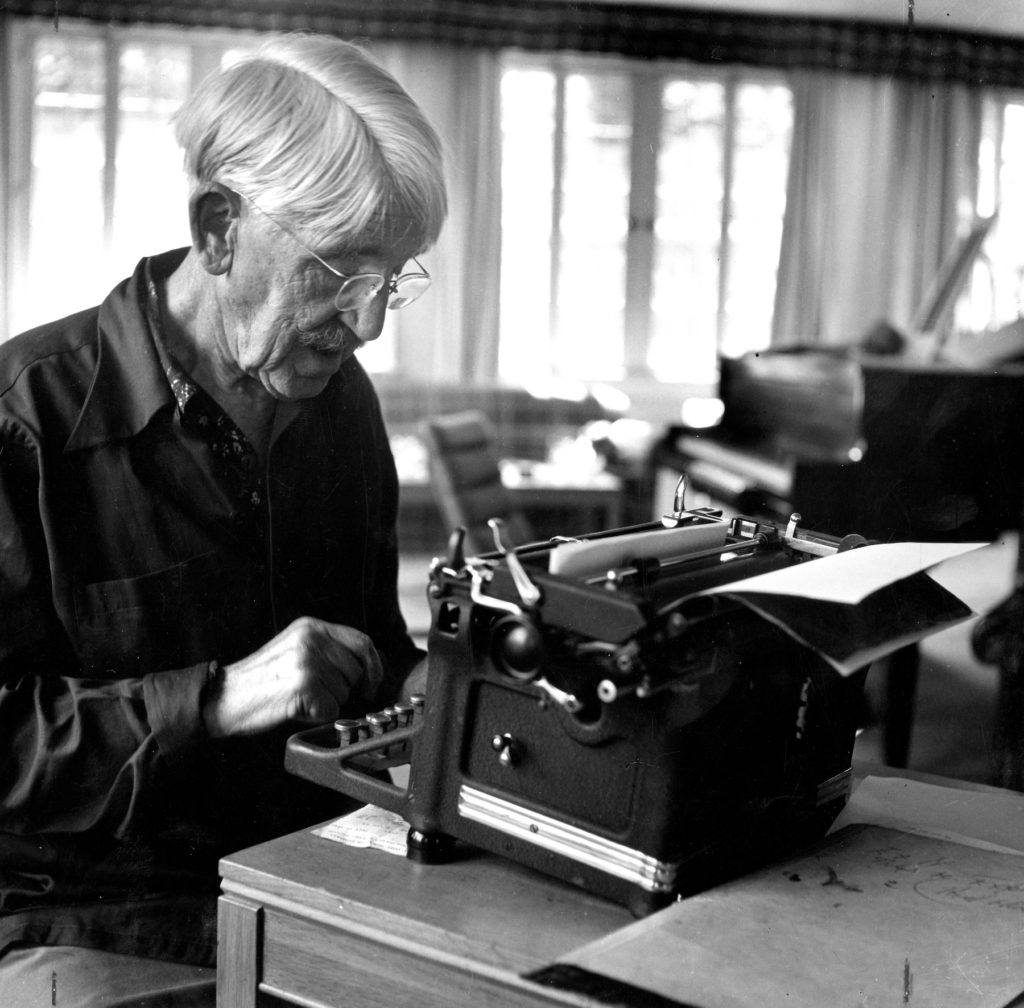
American philosopher, psychologist, and
educational reformer John Dewey sitting at a typewriter, 1946.
Photo by JHU Sheridan Libraries/Gado/Getty Images.
Cahill wrote that his inspiration from his teacher Dewey came
from “the fact that philosophic ideas have a way of getting
translated into programs of action… the thought of the philosopher
makes its way into the homely experience every day.” He was
inspired by Dewey’s book, Art as
Experience (1934), which reads like a manifesto for
the democratization of art and was one of the major inspirations
for my own “Do It” exhibition project. Art
as Experience describes how “the growth of capitalism has
been a powerful influence in the development of the museum as the
proper home for works of art, and in the promotion of the idea that
they are apart from the common life.” Dewey wanted to recreate a
continuity between the refined and intensified forms of experience
that he attributed to the work of art and the everyday events that
form our experience.
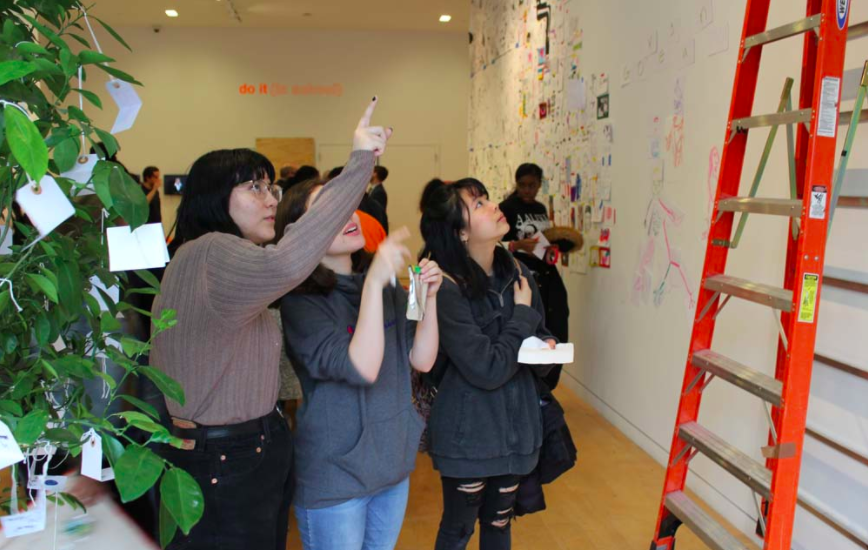
Installation view of “do it” at the
Hunter College’s East Harlem Gallery, 2019. Courtesy of Seamus
Gallagher and ICI.
As Jillian Russo notes, “For Dewey,
philosophy required practical application, testing, and active
participants to enact reform.” This is exactly what Cahill did
at the FAP, which became a large, concrete practical laboratory
where he applied and disseminated Dewey’s ideas.
After Pearl Harbor and the US entry into World War II, the
conservative-minded Congress became increasingly opposed to
government art projects. It had been an amazingly productive five
years of art patronage, resulting in thousands of public artworks.
Millions of people attended arts and craft classes in the 107
community centers, which were open to everyone. The anonymous
competitions, both regional and national, also created a sense of
community. Exhibitions were held that were seen by millions, with
many people in regional places where there were no museums
experiencing original works of art for first time.
The program’s many initiatives allowed young artists the
possibility to work in an otherwise destitute environment, and
triggered an explosion of creative talent in the following decades.
Stuart Davis, Marsden Hartley, Arshile Gorky, Philip Guston,
William de Kooning, Lee Krasner (who said that the WPA saved her
life), Jacob Lawrence, Norman Lewis, Alice Neel, Ad Reinhart, and
Mark Rothko all benefited from the scheme at a crucial early moment
in their careers despite abysmal conditions.
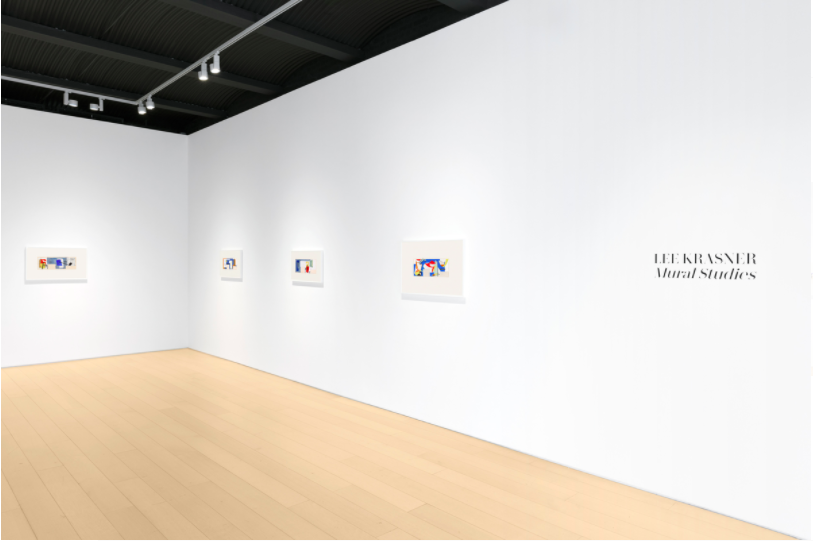
Installation view of “Lee Krasner: Mural
Studies” at Kasmin Gallery in 2018, a show of studies for an
unrealized WPA mural. Photo by Diego Flores, courtesy Kasmin
Gallery.
Today, at this moment of extreme crisis in the world, a deeply
worrying and precarious time for artists and for everybody, an art
stimulus project similar in scale to the WPA is urgently needed.
The idea is highly relevant for the current moment, both in terms
of supporting the economy and of helping and caring for artists. In
this time, it’s particularly important that (as Helen Lewitt told
me in the conversation which triggered this text) art institutions
think about how they can go beyond their walls and reach everyone.
It is our collective role as public institutions to support artists
and culture at this time. When art institutions make their
platforms available to artists, many of the dire problems of the
world can be explored with honesty and hope. If there was ever a
time that the world needed artists, it is now. In the aftermath of
the virus, when the world is rebuilding itself, the cities have to
step up. The regions have to step up. Countries have to step up.
Governments have to help lay out this infrastructure for
change.
Thinking about a New New Deal and how the FDR government arts
program could be a toolbox for today, it is interesting to visit
Jeremy Rifkin’s book The Green New Deal (2019).
Here, Rifkin proposes an urgent plan to confront climate change,
transform the economy and create a green post-fossil-fuel culture.
Similar to the New Deal mobilization and large-scale federal
program during the Great Depression, which found support across all
political parties and enabled the infrastructure to go into the
Second Industrial Revolution, the Green New Deal will generate all
electricity from renewable sources, and create jobs and promote
research in the new green economy.
It is important to state that this is a very different time from
the 1930s and, as Rifkin notes, this is not a replication of FDR’s
New Deal. It is rather a Green New Deal for the 21st century
centered around locally harvested renewable energies and managed by
regional infrastructures that connect across borders like wifi. In
the 21st century, every state, city, and country around the world
can be relatively self-sufficient in its green power generation and
resilience. The Industrial Revolution infrastructure works most
effectively and efficiently when it is laterally scaled and
connects a multitude of small players. The Green New Deal asks for
such laterally scaled cooperatives, all building to a smart green
Third Industrial Revolution, working at near-zero marginal costs
with a near-zero carbon footprint.
This is end of Part 1 of a 2-part essay. I will be writing a
second chapter on the Green New Deal and the arts which will speak
about the Serpentine’s “Back to Earth” project.
The post New New Deal: Towards a New Era of Social
Imagination appeared first on artnet News.
Read more https://news.artnet.com/opinion/new-deal-arts-hans-ulrich-obrist-1851828
Further reading


Leave a comment