
The ‘Girl With the Pearl Earring’ Originally Had Eyelashes, Researchers Discover in a Series of New Revelations About Vermeer’s Masterpiece
After two years of study, the
Mauritshuis museum in The Hague has
revealed surprising new findings about Girl With the Pearl
Earring, the Dutch Golden Age masterpiece by Johannes Vermeer.
Researchers have discovered that
the artist did, in fact, paint the girl with eyelashes, which have
since faded from view. The canvas’s dark background, meanwhile,
originally depicted a green curtain.
The museum released the findings of its “The Girl in the
Spotlight” research project, begun in 2018, during an online
presentation yesterday. (The institution is currently closed as
part of the public-health lockdowns.)
“No, we didn’t find out who this young lady was or if she ever
really existed,” museum director Martine Gosselink said in
a video statement. “But we did get a little
closer to her.”
The museum used new technological advances that have been
developed since the last time the painting underwent study, in
1994, such un-invasive imaging and scanning techniques, digital
microscopy, and paint sample analysis. The research took place
on-site in the museum galleries, inside a glass room built for the
occasion.
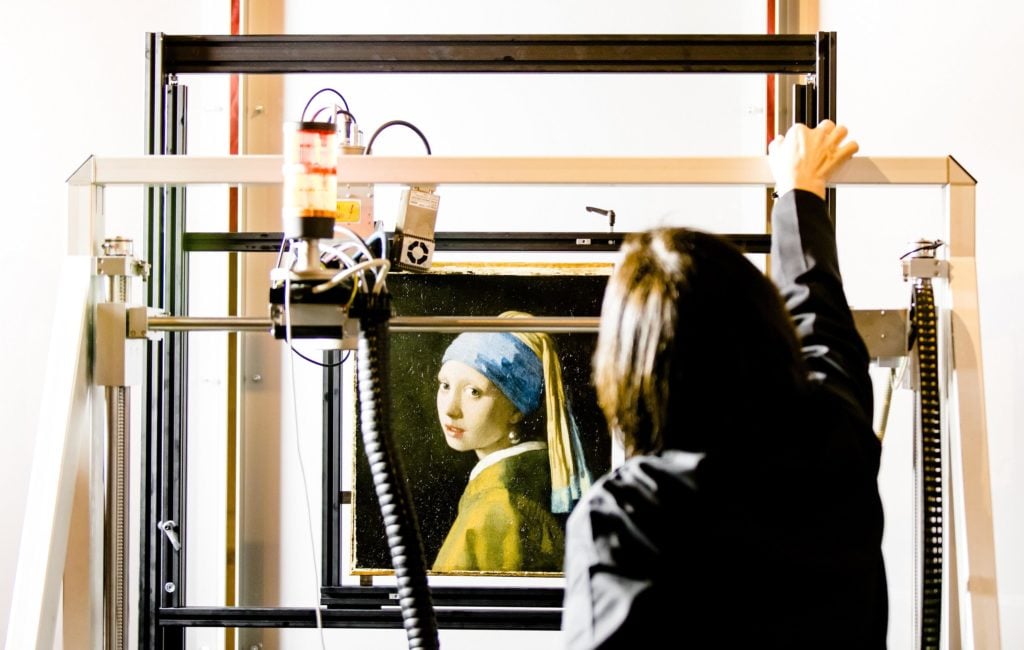
A researcher at the Mauritshuis gallery
in The Hague places Vermeer’s Girl with a Pearl Earring
inside a scanner. Photo by Bart Maat/ANP/AFP via Getty Images.
Thanks to macro-X-ray fluorescence scanning and microscopic
examination, the researchers were able to prove that Vermeer
painted tiny hairs around both eyes, and that there were once
folded drapery details behind her. Previously, the lack of
eyelashes, and the shapeless void of the background was thought to
indicate that Vermeer was painting an idealized face, rather than a
real person.
The discovery of these hidden details, no longer visible to the
human eye, “put the girl in a defined space and brings us a lot
closer to her,” said Vandivere.
The researchers were also able to identify the sources of the
pigments used in the oil painting. There was white lead from
the Peak District in northern England, ultramarine blue from lapis
lazuli in modern-day Afghanistan, cochineal red made from bugs in
Mexico and South America. Thanks to a thriving trade in global
goods, Vermeer was likely able to purchase these far-flung
materials in his hometown of Delft.
“It’s surprising how much high-quality ultramarine Vermeer used
in the girl’s headscarf,” Vandivere said. “This blue pigment was
more valuable than gold in the 17th century.”
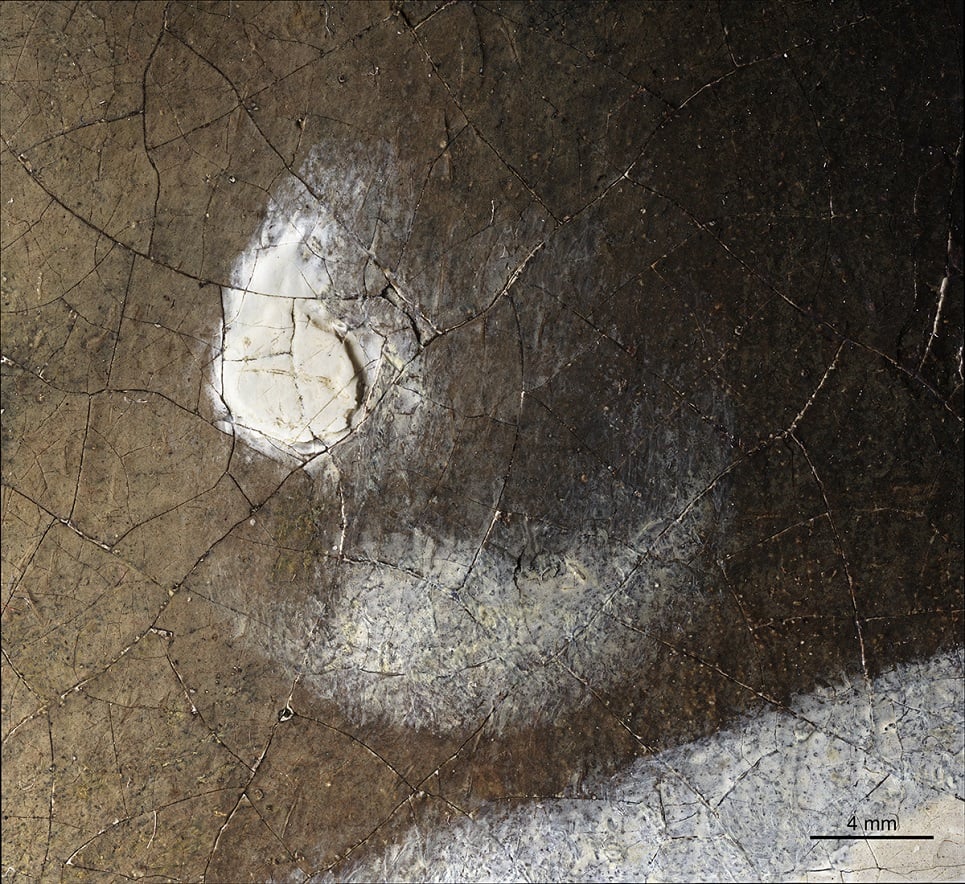
The pearl in Vermeer’s Girl with a
Pearl Earring at 140-times magnification. Photo by Hirox
Europe, Jyfel.
When the museum last investigated the painting, it found that
a second highlight on the
pearl wasn’t painted by Vermeer, but was actually a flake of
paint that had fallen and reattached itself to the canvas. This
time around, they’ve made note of the way he rendered the earring,
adding just a few dabs of pigment atop the background to create the
illusion of the jewel.
“It has no contour and also no hook to hang it from the girl’s
ear,” said Mauritshuis conservator Abbie Vandivere.
The entire painting can now be closely examined online, zooming in to
magnify each detail up to 140 times.
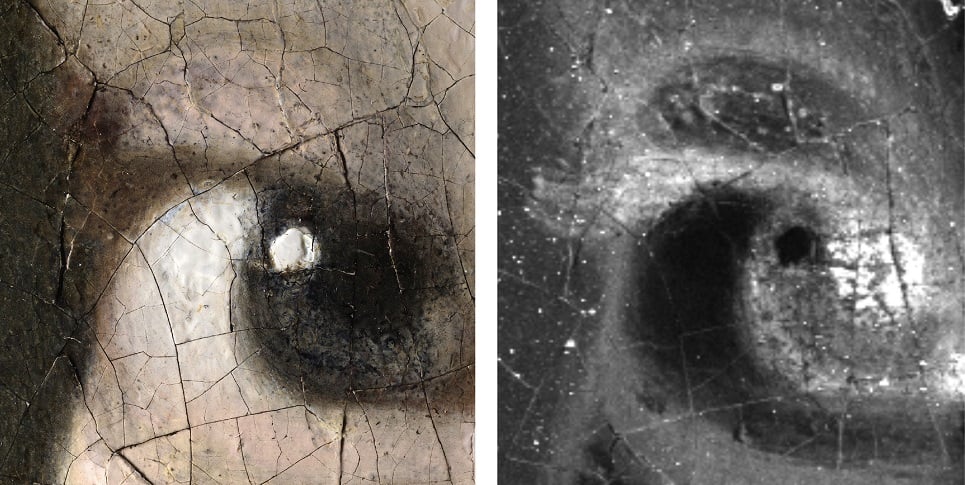
Left: 3-D digital microphotograph of the
Girl’s right eye. Image courtesy of Hirox Europe, Jyfel. Right: The
macro-X-ray fluorescence map for iron shows that Vermeer painted
eyelashes using a brown paint. Image courtesy of Annelies van Loon,
Mauritshuis/Rijksmuseum.
Investigating the canvas also revealed the order in which it was
painted. Vermeer first used black lines to outline the
composition, before painting the girl’s face, jacket, and collar.
The blue headscarf and pearl earring were the final elements added
to the canvas, save for the artist’s signature.
“The fact that she is still a mystery keeps people coming back
and keeps her exciting and fresh,” said Vandivere. “It is good that
some mysteries remain and everyone can speculate about her. It
allows people their own personal interpretation of the girl.
Everyone feels their own connection with the way she meets your
eyes.”
The post The ‘Girl With the Pearl Earring’ Originally Had
Eyelashes, Researchers Discover in a Series of New Revelations
About Vermeer’s Masterpiece appeared first on artnet
News.
Read more https://news.artnet.com/art-world/girl-with-the-pearl-earring-eyelashes-1847367
Further reading


Leave a comment