
A German Cathedral Plans to Display Its Shrine to Saint Corona, Who It Says Is the Patron Saint of Epidemics
One of Europe’s oldest
cathedrals is getting a lot of attention for unearthing a group of
relics tied to the
little-known Saint Corona, who church representatives in Germany
say is the patron saint of epidemics.
But at least one scholar is challenging that claim.
Workers at Aachen Cathedral were already restoring the reliquary
well before the outbreak of the virus after the cathedral’s
treasurer dug it out from storage more than a year ago in
preparation for an exhibition on goldsmithery slated for the
summer.
The ninth-century cathedral in
Aachen, Germany, now says it will put the ornate shrine and relics
on public view after
the coronavirus pandemic has subsided.
But while some devotees may have
already begun to pray to Corona for salvation, one theological
expert is questioning the saint’s historical link to infectious
diseases.
FACT CHECK: There is a St. Corona (d.170)
but (1) she is not the patron saint of infectious diseases (look to
St Edmund for that) (2) her name is from the vision she had of a
crown & there are reasons to think she was invented (3) her
remains are in Anzu, N.Italy #coronavirus pic.twitter.com/bwRpeDGLwb— Candida Moss (@candidamoss) March 20, 2020
Candida Moss, a professor of
theology at the University of Birmingham, tweeted that Saint
Edmund, not Corona, is the patron saint of infectious diseases, and
that Corona actually gets her name from her visions of crowns.
(Corona is Latin for garland or crown.)
What’s more, Moss even says there is reason to believe that
Saint Corona was invented altogether, and that if she did exist,
her relics are in Northern Italy, not Germany.
“The veneration of saints is a very regional affair,” Moss tells
Artnet News. “The way that Saint Edmund became the patron saint of
plague victims—roughly 700 years after his death—was that residents
in Toulouse, the city that housed his relics, prayed to him for
healing during an outbreak of plague.”
“I think what we are seeing now is a substantial elevation in
Corona’s profile,” she added. “The most cynical reading is that
[church representatives in Germany] are being opportunistic, but
it’s important to remember that this is exactly how saints have
always become attached to particular professions or groups. Local
events provoke a focused attention on a particular saint which,
leads to that saint’s association with a particular group of
people.”
The cathedral’s head of
treasury, Birgitta Falk, did not respond to requests for comment by
press time.
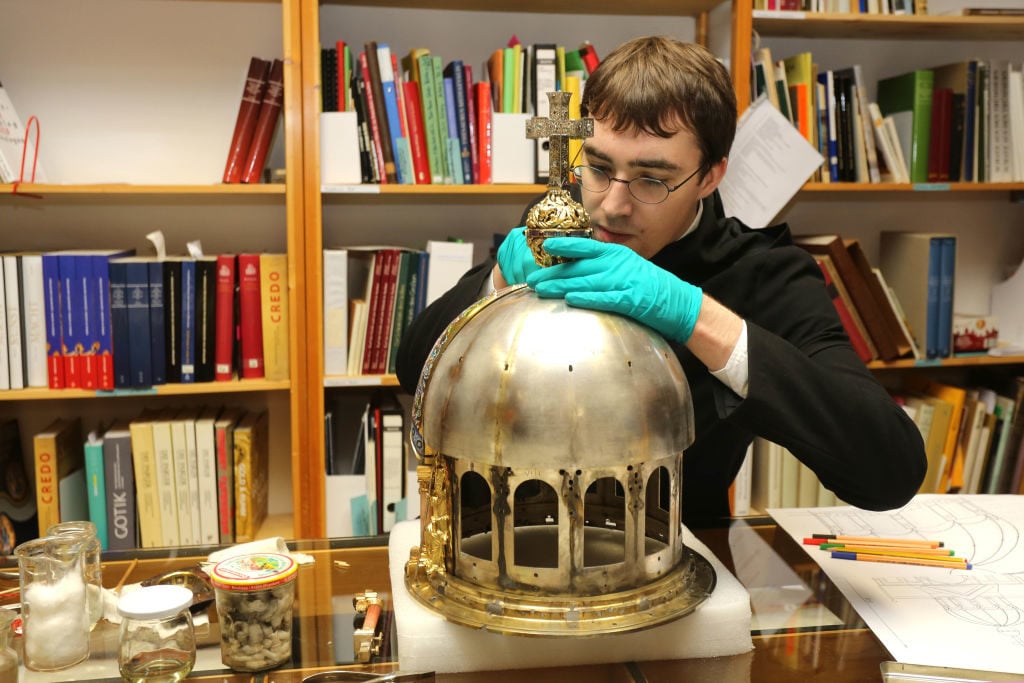
Luke Jonathan Koeppe, a student of
restoration and conservation science, cleans and preserves the
shrine of St. Corona. Photo by Ralf Roeger/picture alliance via
Getty Images.
Saint Corona is said to have been born either in 161 or 287, and although not much is
known about her life, she is thought to have been martyred by the
Romans, possibly in Syria, at the age of 16.
According to Reuters, emperor Otto III brought the relics to
the cathedral in Germany in 997. They were kept in a tomb until the
early 20th century, when they were moved to a 220-pound shrine made
by the prominent Aachen goldsmith Bernhard Witte.
The church says the shrine was
in storage for 25 years before Falk brought it out to be
restored.
“Around 45 employees worked on
this very detailed piece for almost a year,” Falk says in a
description on the cathedral’s website. “The workshop almost went
bankrupt in view of the effort and the costs.”
The detailed reliquary is in the
shape of a Byzantine church with a cruciform structure, the end of
which forms an ornamented 12-part dome.
But regardless of whether Corona
can protect people against the virus, Falk told Reuters that she
stands as a symbol of faith.
“Like many other saints,” she
said, “Saint Corona may be a source of hope in these difficult
times.”
The post A German Cathedral Plans to Display Its Shrine to
Saint Corona, Who It Says Is the Patron Saint of Epidemics
appeared first on artnet News.
Read more https://news.artnet.com/art-world/aachen-cathedral-saint-corona-1817631
Further reading


Leave a comment