
The Gray Market: Why History Equipped the Mega-Dealers to Win the $450 Million Marron Estate (and Other Insights)
Every Monday morning, Artnet News brings you The Gray Market. The column decodes
important stories from the previous week—and offers unparalleled
insight into the inner workings of the art industry in the
process.
In this edition, leaping from the week’s biggest story back in
time…
PRIVATE PARTY
On Wednesday, news broke that the powerhouse collection of
late financier and former Museum of Modern Art board president
Donald Marron would not, in fact, supercharge this year’s auctions
as expected. Instead, a gallery-sector triumvirate of Pace,
Gagosian, and Acquavella will team up to sell Marron’s roughly 300
works, which collectively carry an estimated value in the
neighborhood of $450 million, entirely on the private market. But
while the collaboration is newsworthy and novel in certain ways,
we’re fooling ourselves if we treat it as an unprecedented paradigm
shift in the trade.
Granted, I’m more jaded than most when it comes to…
well, practically everything, I guess, but
especially the disintegrating boundary between major
auction houses and major galleries. The theme was a pillar of the
book I wrote in 2017, the cover story I wrote for the Artnet Intelligence Report last fall, and an
undoubtedly annoying number of one-off pieces I’ve put out before,
between, and after those milestones.
That doesn’t mean I wasn’t still surprised when I heard Marron’s
widow, Catherine, and his other executors chose to bypass the Big
Three auction houses for three big galleries. It just means that I
got over the initial jolt pretty quickly, and that the finer points
seemed downright intuitive once they emerged.
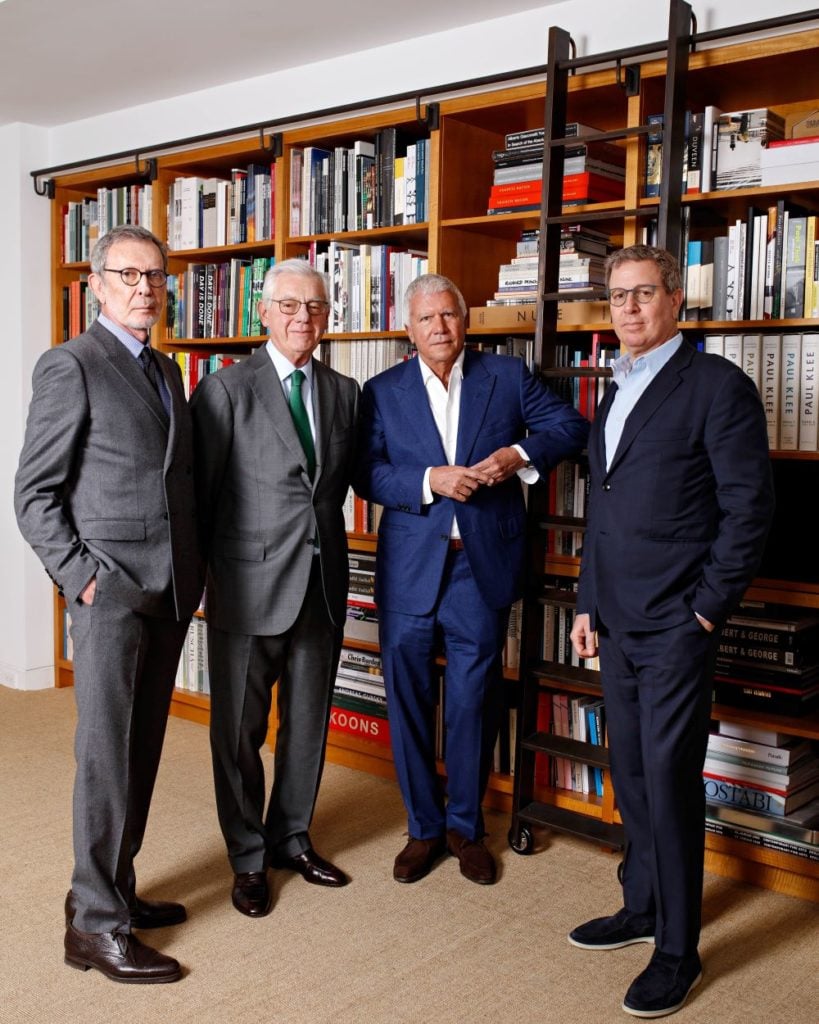
From left to right: Arne Glimcher, Bill
Acquavella, Larry Gagosian, and Marc Glimcher ©Axel Depuex.
A few of those finer points are worth mentioning here for
context’s sake. From April 24 to May 16, Pace and Gagosian will
present a joint exhibition in their Chelsea spaces of highlights
from Marron’s collection, such as Pablo Picasso’s Woman With
Beret and Collar (1937) and Mark Rothko’s Number 22
(Reds) (1957), supplemented by select works loaned from
institutions.
According to Marc Glimcher, the primary architect of the
alliance, not every work in Marron’s collection will be for sale.
(Personally, I don’t buy this notion for a second, but
that’s the party line.) Eleanor Acquavella also verified that the
troika sealed the deal in part by paying Marron’s estate an
up-front financial guarantee of an undisclosed amount. (The Wall Street Journal reported that
Sotheby’s, Christie’s, and Phillips had offered guarantees in the
range of $300 million, so it’s safe to consider that figure a
reasonable target.)
Last but not least, the galleries will work with premier
publisher Phaidon to produce a lush book on the collection, not a
crass auction-style “catalogue” with prices, as Glimcher emphasized
to my colleague Eileen Kinsella. Similarly, he told the
WSJ that asking prices will only be publicized for works
in the exhibition that are still unsold upon its opening. Because
most, if not all, of the pieces are expected to find buyers in
advance, most, if not all, of the prices will be known strictly to
the galleries, the estate, and the necessary financial
intermediaries.
All told, the plan has all the high-end elements and
private-sale obfuscations I’d expect from a co-production by
Pagavella. (Yes, I just Brangelina’d Pace, Gagosian, and
Acquavella. Hit me with a steel chair.) But the most remarkable
aspect here isn’t necessarily that these cogs all came together.
It’s that they came together in part because some of the galleries
involved had connected several of them decades earlier.
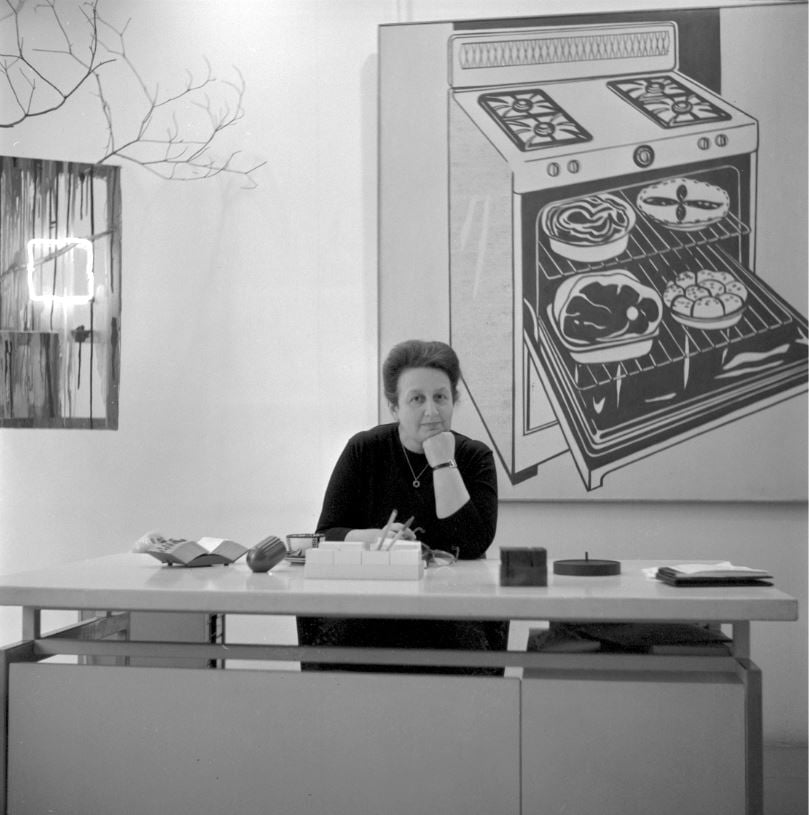
Ileanna Sonnabend at her gallery in
Paris in 1965. Image courtesy of the Sonnabend Collection
Foundation. ©SOCAN (2019).
BLAST(S) FROM THE PAST
In her Wall Street Journal story on the Marron
alliance, Kelly Crow briefly raises the most recent precedent: the
2008 private sale of artworks worth hundreds of millions of dollars
owned by the late, great dealer Ileana Sonnabend. Larry Gagosian
was a key part of that pact, too. And it’s worth sussing out how it
compares to the Pagavella team-up to get a sense of what has (and
hasn’t) changed over the years.
Antonio Homem, one of Sonnabend’s two heirs, told Carol Vogel of
the New York Times in April 2008 that the
estate had agreed to sell “two blocks of works” with a staggering
combined estimated value of $600 million (about $720 million today,
if you adjust for inflation). That’s well over the $450 million
estimate for Marron’s holdings.
The first “block” of Sonnabend works, totaling roughly $400
million (and including Jeff Koons’s later-to-be-record-smashing
Rabbit), was acquired by GPS Partners—the dealer trio
of Franck Giraud, Lionel Pissarro, and Philippe Ségalot. Although
Vogel reported the transaction came “on behalf of several clients,”
art-market opinion has since solidified around the notion that
most, or all, of the works were part of a historic spending spree by the Qatar Museums
Authority, which both Giraud and Ségalot worked with closely
for years.
The second “block” of works, comprising the remaining $200
million and consisting entirely of Andy Warhols, went to Gagosian.
He was simply said to be “representing several American and Russian
collectors in the deal,” which could mean literally anything.
What we can say for sure, though, is that Sonnabend’s collection
was nowhere near cleaned out even after these two mass sales.
Several more works mounted the auction block at Christie’s in 2015
via the estate of her daughter, Nina Castelli Sundell. The
Sonnabend Collection Foundation (now run by Homem) also just staged
an exhibition of more than 100 pieces at Canadian
institution Remai Modern last fall.

From left: Arne Glimcher (Gary
Gershoff/WireImage) and Marc Glimcher (Kris Graves, courtesy Pace
Gallery).
Another antecedent to the Marron deal also warrants
resurrection. In 1995, PaceWildenstein shocked the art market by
winning the rights to sell the collection of late TV producer Mark Goodson—a trove of
roughly 50 Modern masterpieces by the likes of Picasso, Francis
Bacon, and Wassily Kandinsky. The face of the deal? Marc Glimcher’s
dad, Arne Glimcher.
At the time, the elder Glimcher projected the Goodson holdings
to be worth more than $40 million (about $68 million today). While
the size of both the collection and the valuation pales in
comparison to Marron’s, other aspects of the Goodson pact loudly
echo elements of Pagavella’s new arrangement.
Most notably, PaceWildenstein mounted a dedicated exhibition
simply titled “The Mark Goodson Collection,” from October 27
through November 25, 1995, at its New York headquarters on 57th
Street. Goodson had acquired many of his works from Glimcher in
life—just as Marron built his collection largely through Pace,
Gagosian, and Acquavella—making it similarly organic for the same
dealer(s) to handle them in death. There was also speculation that
PaceWildenstein had offered Goodson’s executors a financial
guarantee. But Glimcher refused to discuss the matter with Vogel of
the Times, who noted that “art experts close to
PaceWildenstein [said] that the estate was not interested in such
financing deals.”
Glimcher did shed light on his gallery’s sales pitch to
Goodson’s estate… and it largely matches the one his son, Gagosian,
and the Acquavellas used to secure the Marron consignment 25 years
later. Unsold works would not be “burned” by failing in public, and
pieces could be sold more judiciously over time instead of being
lumped into one high-stakes evening auction. He also argued that
PaceWildenstein could exhibit and tour Goodson’s works across its
network of permanent spaces—then spanning New York, Los Angeles,
and London—even more effectively than the auction houses. Although
the Pagavella alliance hasn’t mentioned this point to the press
regarding the Marron estate, I’d be surprised if it didn’t come up
during negotiations.
The more things change, the more they stay the same, right?
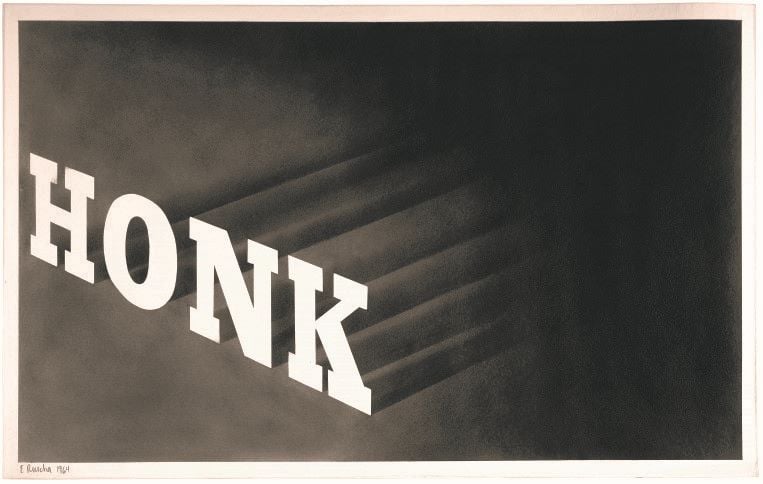
Ed Ruscha, Honk (1964) ©Ed
Ruscha. Courtesy the Donald B. Marron Family Collection, Acquavella
Galleries, Gagosian, and Pace Gallery.
BACK TO THE FUTURE
Overall, then, Pace, Gagosian, and Acquavella’s arrangement with
the Marron estate looks less like an art-market sea change and more
like a natural progression from these two past landmarks. The
Marron collection’s scope and value at least approach what we saw
in the Sonnabend private sale, and the decision to hold a gallery
exhibition of the works mirrors what PaceWildenstein did with the
Goodson estate. And while it was never stated that GPS Partners and
Gagosian struck an official alliance regarding the Sonnabend works,
the idea that these high-powered dealers didn’t coordinate closely
(and likely argue hard) to divvy up the inventory seems about as
dubious to me as ordering shellfish at a midwestern truck stop.
The financial guarantee made to the Marron estate lands in a
gray area between the two private-estate-sale precedents. Even if
we take Carol Vogel’s sources at their word that PaceWildenstein
didn’t provide a set sum for the Goodson collection, you could
argue that the Sonnabend private sale effectively worked as a
guarantee since it was carried out as two massive up-front
transactions that the dealers then had to carry forward into
individual deals, each one vulnerable to second thoughts or bad
behavior on the buyer’s side. (Remember: it’s not a deal until the
check clears.)
In this sense, it could be said that the only true novelties of
the Marron deal are the collaboration of three different
mega-dealers instead of two… and the production of a great book on
the collection. I’m not saying those aren’t consequential, or that
the estate’s choice to go private doesn’t wallop the Big Three
auction houses with the force of an anvil dropping onto a trio of
unsuspecting cartoon cats. I’m just saying that, when you consider
that a quarter century has passed since PaceWildenstein’s agreement
with the Goodson estate, it doesn’t exactly feel like a quantum
leap in art-market innovation.
Let’s also keep in mind that even the public auction market now
functions much more like the gallery market than ever. As Allan Schwartzman has pointed out, the real
competition now tends to happen in private before the
public sales, when buyers with swollen pockets jockey for the right
to guarantee major works in the first place—a scenario that
explains why upper-echelon lots often spur much less bidding in the
room than they used to. So why not skip the gavel and go straight
to the galleries, especially if they can now hand you just as rich
a guarantee as Christie’s or Sotheby’s?
I don’t know if that was part of the Marron executors’ calculus
when they accepted Pagavella’s collaborative offer. But I do think
it makes a lot of sense for both sides of the deal. All the more
reason we shouldn’t be floored when another major estate goes the
private-dealer route in the years ahead. Proof of concept has
already been in plain sight since the ‘90s—and as more money and
power gravitates to the apex of the gallery sector, the pitch is
only going to become more persuasive.
That’s it for this week. ‘Til next time, remember: Silicon
Valley will tell you the best way to predict the future is to
invent it… but being a geek about the past is a pretty decent
strategy, too.
The post The Gray Market: Why History Equipped the
Mega-Dealers to Win the $450 Million Marron Estate (and Other
Insights) appeared first on artnet News.
Read more https://news.artnet.com/opinion/marron-estate-gray-market-1784106
Further reading


Leave a comment