
Taipei Was Asia’s Biggest Market Hub 30 Years Ago. Can a Coterie of Art-World Insiders Return It to Its Former Glory?
The sophomore edition of Taipei
Dangdai, the closely watched
Taiwanese contemporary art fair, faced an uphill battle. Its
dates overlapped with those of S.E.A. Focus in Singapore, another fair with a
Southeast Asian focus. Since last August, China has also
suspended individual tourists from 47 Chinese cities from
travelling to Taiwan, limiting the number of mainland Chinese
collectors who could attend. To make matters even more difficult,
the recent Taal volcano eruption disrupted flights from Manila,
making it difficult for collectors from the Philippines to
travel.
So it is especially surprising
that against these odds, Taipei Dangdai drew a reported 40,000
visitors during its second edition, which came to an end on January
19. The event drew such international collectors as Richard Chang,
Dominique and Sylvain Levy, Shane Ackroyd, Daisuke Miyatsu, and
Miwa Taguchi as well as art-world figures like curator Fumio Nanjo
and artist Takashi Murakami.
The event—and the special effort
made to draw international collectors and galleries alongside local
ones—was a reflection of the ambition of Taiwan’s artistic
community. Some artists, gallerists, and curators on the island of
23 million people believe that there is no better time for Taiwan
to put itself on the world stage as a hub for creative expression
and art commerce.
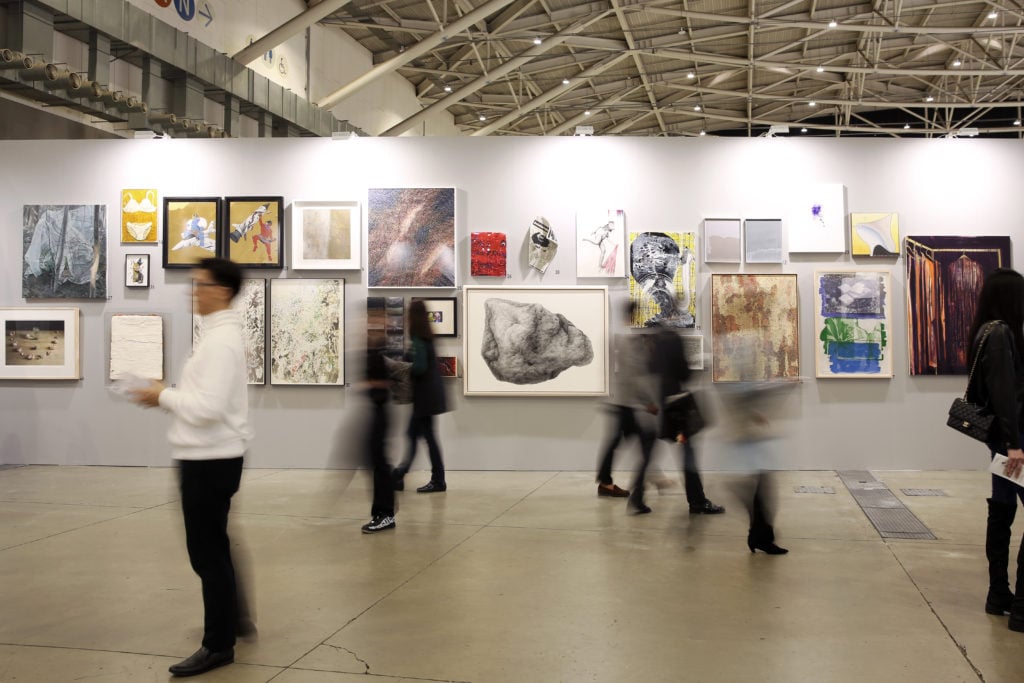
Installation view of Taipei Dangdai,
2020. Courtesy of Taipei Dangdei.
Taiwan is one of several Asian
nations looking to fill the breach as Hong Kong endures ongoing
political turmoil and enters an economic recession amid the ongoing
trade war between China and the United States. The nation is also
experiencing a spike in optimism following the recent landslide
re-election of president (and culture industry booster) Tsai
Ing-wen.
But whether this dream can be
fully realized remains an open question. Despite a successful
edition of Taipei Dangdai, which positions itself as a fair that
brings the international art world to the island, some members of
the artistic community wonder if Taiwan has what it takes to earn
its place as a global art hub.
In the Aisles of Taipei Dangdai
In the aisles of the fair,
business was being done, particularly in the five- to six-figure
price range.
Hauser & Wirth sold a number of
works to local and regional foundations, including Rashid
Johnson’s Untitled Escape
Collage for $475,000 and
a Jenny Holzer painting for $350,000. Lehmann Maupin sold a work by
Lari Pittman for $225,000 and one by Tony Oursler for $150,000 to
Asian collectors. David Zwirner sold multiple works by Luc Tuymans,
including one for $1.5 million, the biggest sale publicly reported
at the fair. Works by some Taiwanese artists also found buyers:
Sean Kelly and Galerie du Monde sold out all the works they brought
by Wu Chi-Tsung on the first day.
Some galleries said sales were
slow at the beginning of the fair but that collectors returned on
the last day to close deals. A2Z Gallery reported finishing strong
with late-in-the-game sales of works by Chinese artist Ma Desheng
and Serbian painter Vladimir Velickovic priced between €30,000 and
€40,000 ($33,000–44,100).
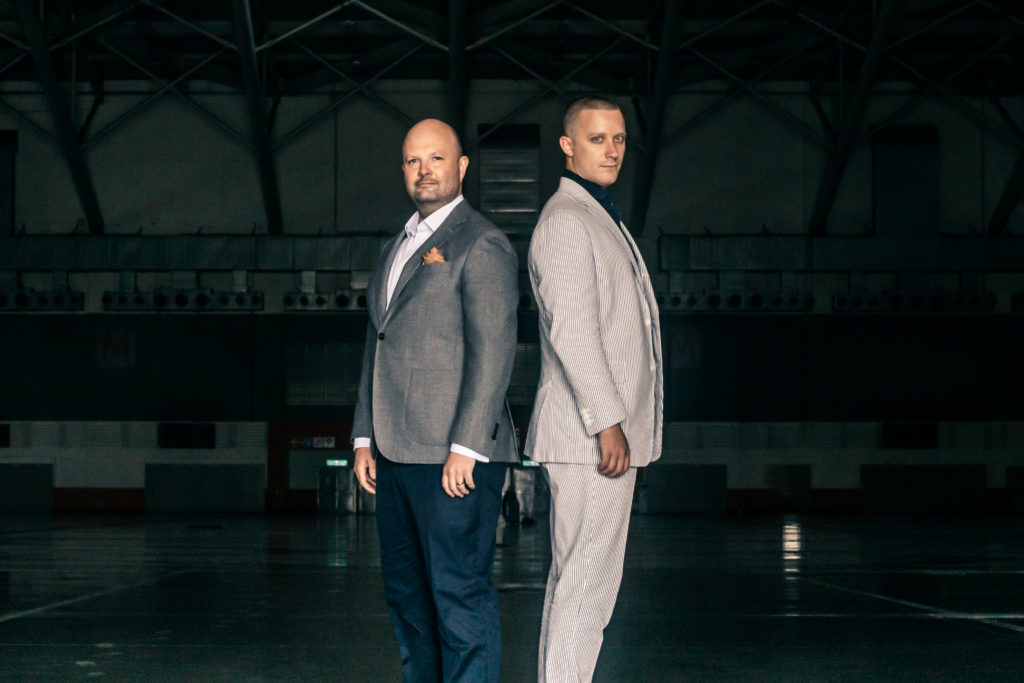
Magnus Renfrew and Robin Peckham,
Courtesy of Taipei Dangdai. Photo: Sean Wang.
Taipei Dangdai’s co-director
Magnus Renfrew, who a decade ago launched ArtHK, the fair that
would go on to become Art Basel Hong Kong, believes Taipei Dangdai
has the same potential to transform the local art scene—something
people in Taiwan seem to have immediately understood and gotten
behind, he adds.
But while coordinating with
local art institutions will help the fair maintain its regional
identity and draw in members of the global art world, he says more
must be done for Taiwan to emerge as an increasingly attractive
commercial center.
“I’m always asked what can be
done to create a viable art market,” Renfrew said. And looking to
Hong Kong as precedent, “I’d always say, cut the tax.” While the
tax situation in Taiwan is not onerous, Renfrew explained, it is
“complicated for people to understand their obligation. We have
accountancy firms advising international gallerists and our
official shipper has been very helpful. But in the end, no tax
wins.”
Make Taiwan a Great Art Market Again?
This would not be the first time
Taiwan has emerged as a regional art-market center. Taiwan was a
key hub for the region’s art trade until the late 1990s, when the
focus shifted to Hong Kong and mainland
China. “Taiwan got
slightly forgotten,” said the gallerist Sean Kelly, who runs a
project space in Taipei. “Taiwan has had serious, international
collectors for many generations. And now with what’s happening in
Hong Kong and China, Taiwan has an interesting opportunity. But is
Taiwan going to embrace that?”
Kelly said reducing tax and
offering more economic incentives that encourage the free movement
of art will be crucial as more businesses explore opportunities
outside of Hong Kong and mainland China. And since Japan and South
Korea remain relatively self-contained and hard to break into,
Taiwan and Singapore have emerged as leading alternatives. Taiwan’s
freedom and democracy puts it in a good position, he
added.
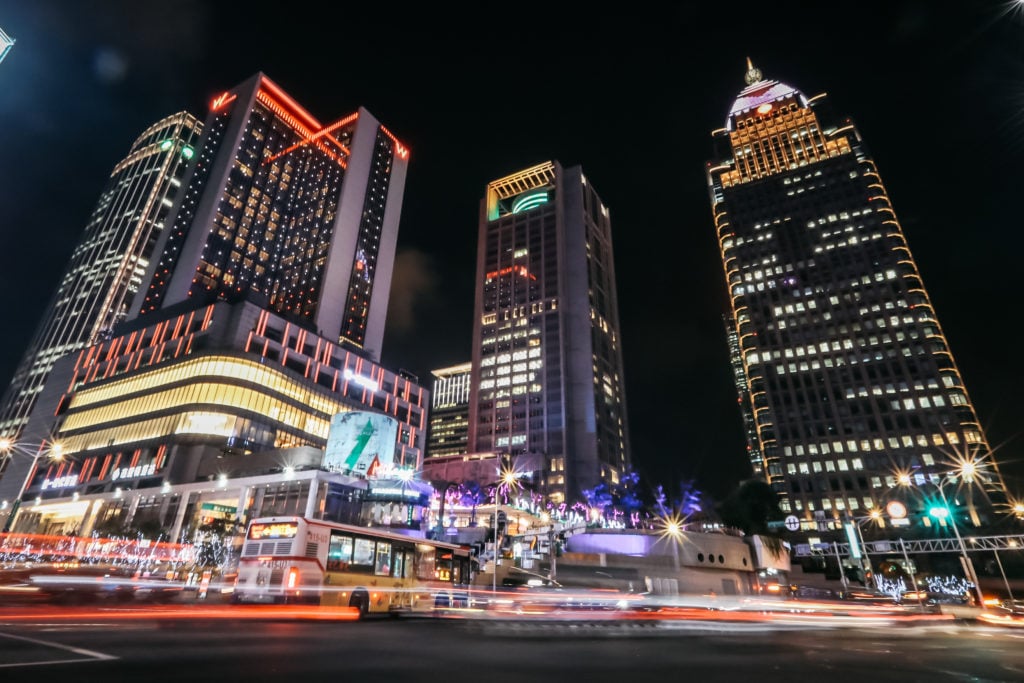
The city of Taipei. Courtesy of Taipei
Dangdei.
Now, some government officials
and art-market figures are hoping to capitalize on that
opportunity. At a Legislative Yuan public hearing last October,
Taiwanese billionaire and mega-collector Pierre Chen lamented that
the state had fallen behind due to its taxation of art. He
supported a legislative proposal to offer special terms for the taxation of art
and antiquities—an initiative that drew criticism from those who said the change
would only favor the rich and violate the fairness of the existing
system.
In November, the Ministry of
Culture reached an agreement with the Ministry of Finance to
essentially meet the art boosters halfway. They agreed to waive the
sales tax on artworks on public display even if they
are sold after a given
show ends—providing that a letter of intent is sent to authorities while the work is still on
view.
The art industry, however, is
still not satisfied. Jack Chen, director of the Taiwanese gallery
182ARTSPACE, said that the current taxes—which include a five
percent sales tax as well as other duties—add up to a hefty
percentage of an artwork’s total price.
“We now have this opportunity,
but it’s up to the government on whether to seize the chance to
make Taiwan a more competitive art market,” Chen
said.
More Than Just Money
While boosting the art market is
important to the business side of the art ecosystem, it is not the
only element that will create an enduring and vital scene. Some
members of Taiwan’s art community are more concerned with finding
ways to connect with the global art world beyond commerce. They
believe that arts and culture are key to building bridges—much more
effective than ordinary diplomacy, which Taiwan has been struggling
with under continuous and increasing pressure from
China.
“Taiwan is not officially a
country and we do not have diplomatic relations with most places,”
said Yuki Pan, a former director of MOCA Taipei. “But do we need
diplomatic relations? I feel that connections among people are much
more effective.”
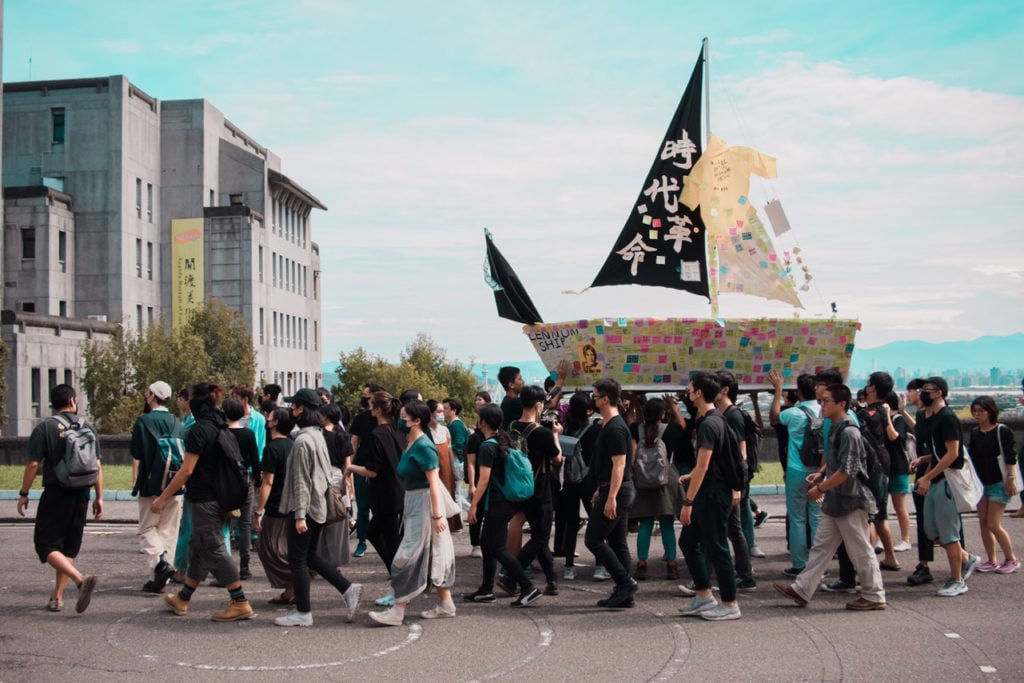
TNUA Concern Group for HK
Anti-Extradition Bill, Lennon Ship (2019) at Co/Inspiration
in Catastrophes. Courtesy of Museum of Contemporary Art,
Taipei.
When Pan was the director of
Taipei’s contemporary art museum, it staged the first-ever
contemporary art show on LGBTQ issues at a government-backed museum
in Asia. Two years later, in 2019, Taiwan became the first in the
region to recognize same-sex marriage.
MOCA Taipei’s current
exhibition, “Co/Inspiration in Catastrophes,” which Pan
co-curated with Huang
Chien-Hung, follows a similar path. The exhibition, which presents
work by 16 artists including Chinese dissident Ai Weiwei and
Pakavulay, a Taiwan art studio focusing on the stories of
indigenous tribes on the island, reflects on the impact of
catastrophes on humanity.
“In the past, I thought
international diplomacy was just about diplomatic relations. But
now, I feel that it is about how we relate to each other living in
an ecology,” Huang said. “We are living in the age of catastrophes,
be it economic, political, or natural. They come for us, and we
want to talk to artists who connect disasters with
us.”
Looking to the Future
Taiwan, which became a
self-governed region as Kuomintang fled mainland China after being
defeated by the Communists during the civil war in 1949, has long
been isolated on the global stage. But pressure from the People’s
Republic of China on Taiwan has been increasing since Tsai, who
represents the pro-independence Democratic Progressive Party, was
first elected president four years ago.
Seven countries have already
severed ties with Taiwan, leaving just 15 nations that have formal
diplomatic relations with the island. Taiwan is constantly shunned
from international organizations (despite its technological and
medical advancement, for example, it is still barred from the WHO
amid the spreading of the deadly Wuhan coronavirus).
But individual cultural
initiatives have the potential to get around these complex
international obstacles. Huang, for example, recently led an
exchange program to Mexico, which does not have a formal diplomatic
relationship with Taiwan.
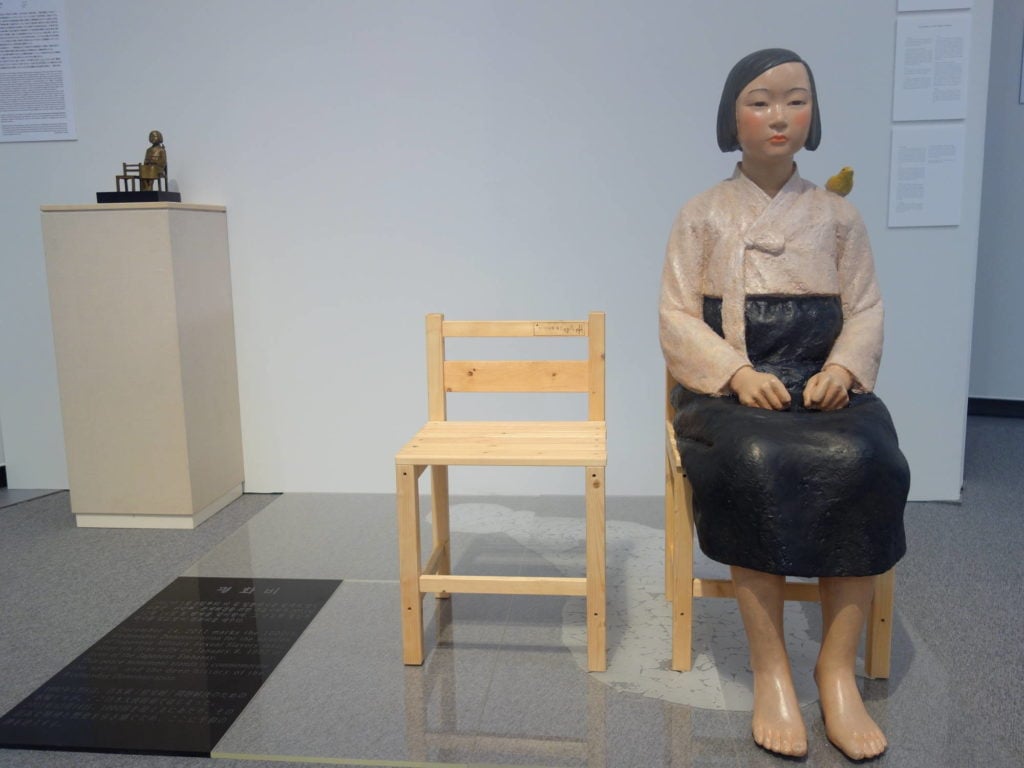
Kim Seo-kyung and Kim Eun-sung,
Statue of a Girl of Peace (2011). Courtesy of the
artists.
Li-Chen Loh, MOCA Taipei’s new
director, aims to continue this tradition of openness and exchange.
For her first major project, she plans to bring the controversial
work depicting sexually enslaved “comfort women” during World War
II by South Korean artists Kim Seo-kyung and Kim Eun-sung that was
abruptly censored at the
2019 Aichi Triennale.
The show, scheduled to run from
April 18 to June 7, will restage the original 2019 Japanese
exhibition and include additional works that chronicle the dark
history of Taiwan under martial law from 1949 to 1987.
Loh revealed that after the
initial news of the exhibition came out, she received negative
comments from those who worried it might offend Japan. But she is
not backing down.
“The exhibition is in fact also
a reflection of the current circumstances of Taiwan and our
history,” she said. “Art is not to offer a solution, but to ask the
right questions that will offer a critical perspective to look into
these issues. As a contemporary institution, we must speak up for
issues like freedom, human rights and justice.”
The post Taipei Was Asia’s Biggest Market Hub 30 Years Ago.
Can a Coterie of Art-World Insiders Return It to Its Former
Glory? appeared first on artnet News.
Read more https://news.artnet.com/market/taipei-dangdai-taiwan-art-market-1762140
Further reading


Leave a comment