
The Yayoi Kusama Craze Is Coming to Europe With a Splashy—But Nuanced—Three-Venue Retrospective
If you’re a European museum-goer, be prepared to stand in some
long lines, because next year, three major European institutions
are planning to present a sweeping retrospective dedicated to the
Japanese artist Yayoi Kusama.
The traveling show launches in September 2020 at the Gropius Bau in Berlin,
where it will occupy 3,000 square meters (32,000 square feet) of
space before it heads to the Museum Ludwig in Cologne in April 2021
and the Fondation Beyeler in Basel that October.
The currently untitled exhibition is being curated by Stephanie
Rosenthal, the director of the Gropius Bau; Yilmaz Dziewior, the
director of the Museum Ludwig; and Beatrix Ruf, a guest curator for
the Fondation Beyeler. The show is being put together in close
collaboration with the artist and her studio. Beatrix Ruf
tells Artnet News that the studio is working to complete a new work
specifically for each institution, and that the shows will examine
“the history of the European perception of Kusama’s work.”
Perhaps surprisingly, it will be the first-ever major exhibition
in either Germany or Switzerland dedicated to Kusama, who has
rapidly become one of the most sought-after artists in the world,
for both the public (with cellphones at the ready) and for the
market (Kusama is the auction world’s highest-grossing female
artist, with sales totalling $552.9 million, according to a
recent study by Artnet
News).
But has the world reached peak Kusama while missing the core
themes of her work? Some say the recent hype underestimates the
complexity of her practice, which explores topics of mental health,
feminism, obsession, and self-reflection.
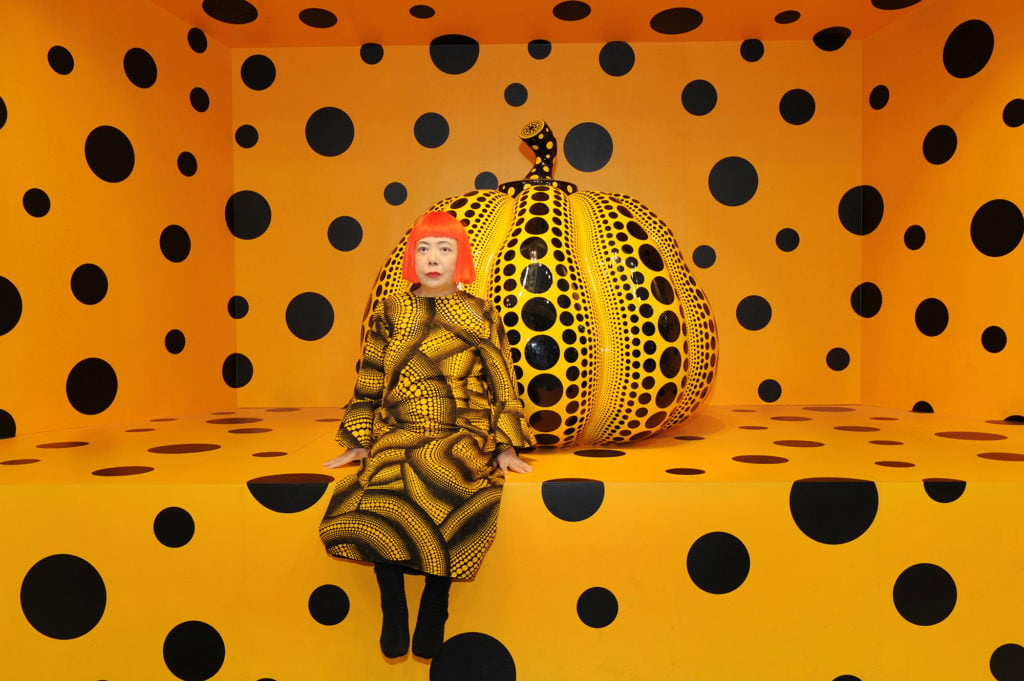
Kusama with PUMPKIN (2010).
Courtesy Ota Fine Arts, David Zwirner, and Victoria Miro © Yayoi
Kusama.
A New Way to See Kusama
Rosenthal tells Artnet News the aim of the trio of shows is “to
illustrate the revolutionary character and development” of Kusama’s
prolific practice “with new perspectives on the artist’s activities
and exhibition history.”
The exhibition will return to the beginning of the artist’s
career in the mid-1960s, a time when her work was more strongly
received by the European public than it was in the US (where she
was living) or in her home country of Japan. “Her work was
enthusiastically received by public audiences [here in Germany and
Europe] and therefore laid new academic ground,” says Rosenthal.
Other prominent—though perhaps less sprawling—shows in Central
Europe in the past decades have been the 2003 “Yayoi Kusama: Work
from 1949 to 2003” at the Kunstverein Braunschweig and “Yayoi
Kusama: Dots Obsession – Dots Transfromed into Love” at Haus der
Kunst in Munich in 2007.
Ludwig’s director, Yilmaz Dziewior, tells Artnet News that the
aim of the show is to “recreate the density” of some of those early
installations while contextualizing Kusama’s work in the “social
and political atmosphere” of the present. The show coincides with
the Museum Ludwig’s mission to broaden its presentations to include
20th- and 21st-century perspectives from Africa, Latin America, and
Asia.
News of the European retrospective comes as a major solo
exhibition opens at David Zwirner in New York, for which the
gallery is anticipating a staggering 100,000 visitors. That show,
“Everyday I Pray For Love,” opens on Saturday, November 9, and will
include new paintings from her ongoing series, “My Eternal Soul,”
as well as plush monochromatic sculptures. Of course, there will be
a must-have Infinity Room as well (there are, to date, already 18
versions globally). And—no surprise here—the German and Swiss
exhibitions will feature an Infinity Room as well.
Despite the certain level of frenzy the blockbusters are sure to
bring, the three organizers maintain that the goal is to present
less readily considered perspectives on Kusama’s practice, by way
of focusing a good portion of the presentation on early works.
There will be examples from every artistic period from the last 70
years: in addition to paintings and sculptures, the exhibition will
feature collages, watercolours, ceramics and her avant-garde
fashion, some from as early as 1940. There will be other immersive
installation rooms from the 1960s as well.
Rosenthal says the curatorial research has delved into seven
previous solo shows dedicated to the artist, perhaps in hopes of
cracking open a more nuanced way into the 90-year-old artist’s
inner creative world: “This comprehensive exhibition will
contribute new and vital aspects to the understanding of the
complex oeuvre of Kusama,” she says.
The post The Yayoi Kusama Craze Is Coming to Europe With a
Splashy—But Nuanced—Three-Venue Retrospective appeared first on
artnet News.
Read more https://news.artnet.com/exhibitions/yayoi-kusama-european-retrospective-1697466
Further reading


Leave a comment