
Artist Meriem Bennani’s Latest Work Is All About Imagining a Future in Which We Are Able to Cope With Our Disjointed Reality
Meriem Bennani’s video installation, Party on the
Caps, now on view at CLEARING gallery in Bushwick, evokes
a genre that I don’t know quite how to describe. “Dystopian art
mockumentary” gets close, but not all the way there. It’s
confounding and unsettling and funny, and also pretty great.
Bennani (b. 1988) hails originally from Rabat, Morocco, but
studied at Cooper Union in New York. She’s known, among other
things, for her zany Instagram art; for her recent solo show at MoMA PS1 (featuring a
multi-channel Moroccan travelogue told from the point of view of an
animated fly); and for gawky sculptural video installations
featuring interviews with Moroccan teenagers that were featured as
part of the Whitney Biennial. (She was one of the artists who
threatened to pull her work as part of the successful campaign to
remove teargas magnate Warren Kanders from the museum board.)
Party on the Caps, too, features oddball sculptural
elements, including bleachers clad in fake albino crocodile skin,
irregularly sized glowing cylindrical seats, and a wonky
multi-screen set-up that fragments and sometimes warps the
projected action. This scenography amplifies the atmosphere of the
onscreen action, which depicts a world of familiar but perplexingly
mutated human relations.
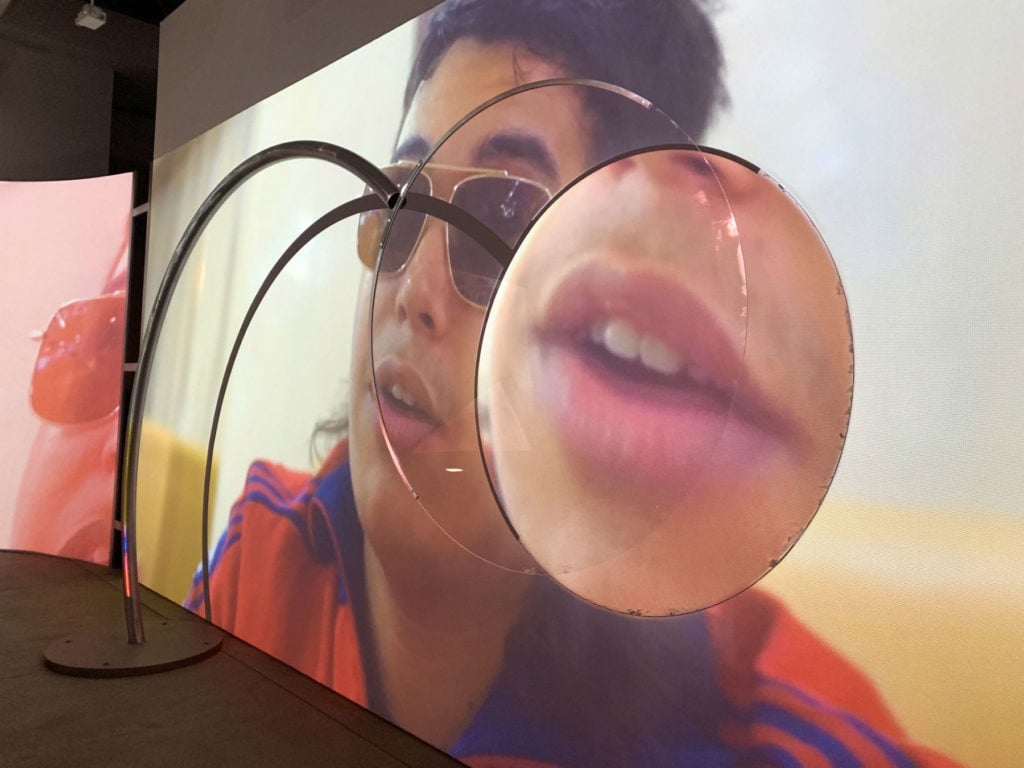
Installation view of Meriem Bennani,
Party on the Caps (2019). Image: Ben Davis.
As for what the onscreen action of this half-hour film actually
consists of, that is hard to express exactly—despite the fact that
the film effectively plays in two parts, the first of which is a
prologue that actually features a voiceover that just lays out the
rules of the world in the movie. It’s just that those rules and
that world seem to have their own internal logic that takes some
decoding.
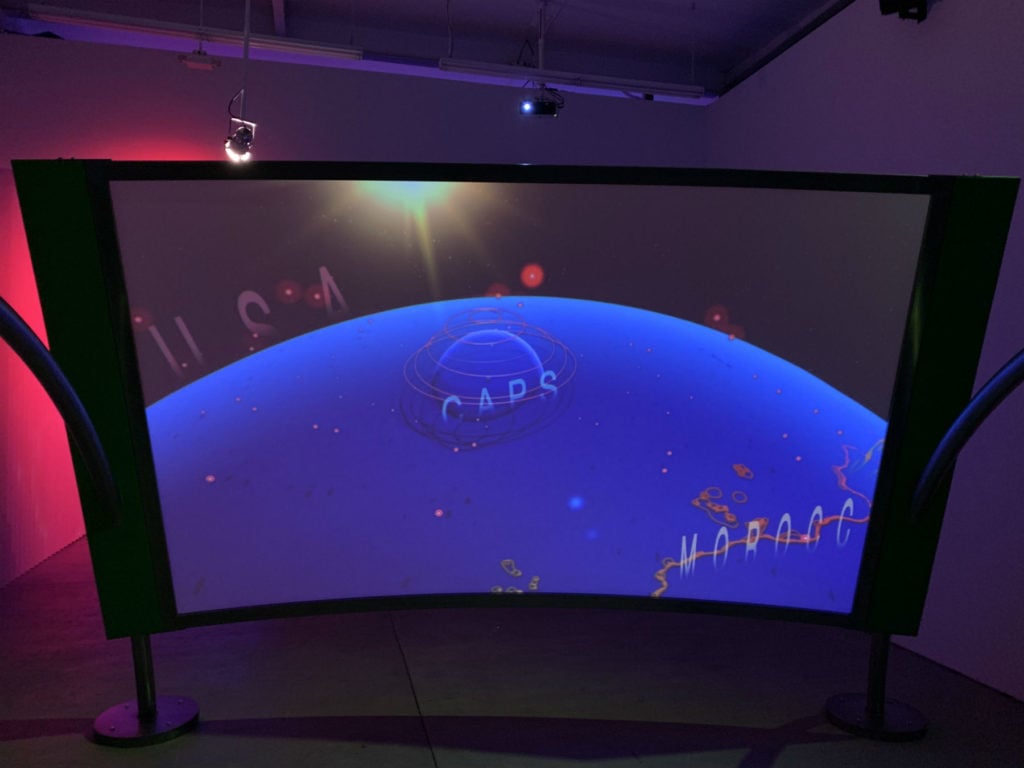
From the prologue to Meriem Bennani’s
Party on the Caps (2019). Image: Ben Davis.
Party on the Caps is set mainly in a Moroccan
neighborhood of an island in the Atlantic called the Caps that has
been set up as a prison for unwanted immigrants in a future where
teleportation has become the travel norm. People deposited in the
island’s shantytown are immigrants who have been intercepted
mid-teleport by American “troopers,” who appear in the film as
circling drones—bright, ominous, watchful spots hovering in the
distant sky. Some residents of the Caps suffer strange disorders
(“plastic face syndrome”) as a consequence of being molecularly
intercepted and reassembled.
“We don’t take anything for granted here—not even bodies!” the
narrator says in the intro, over the comic image of two shoes
walking by themselves.
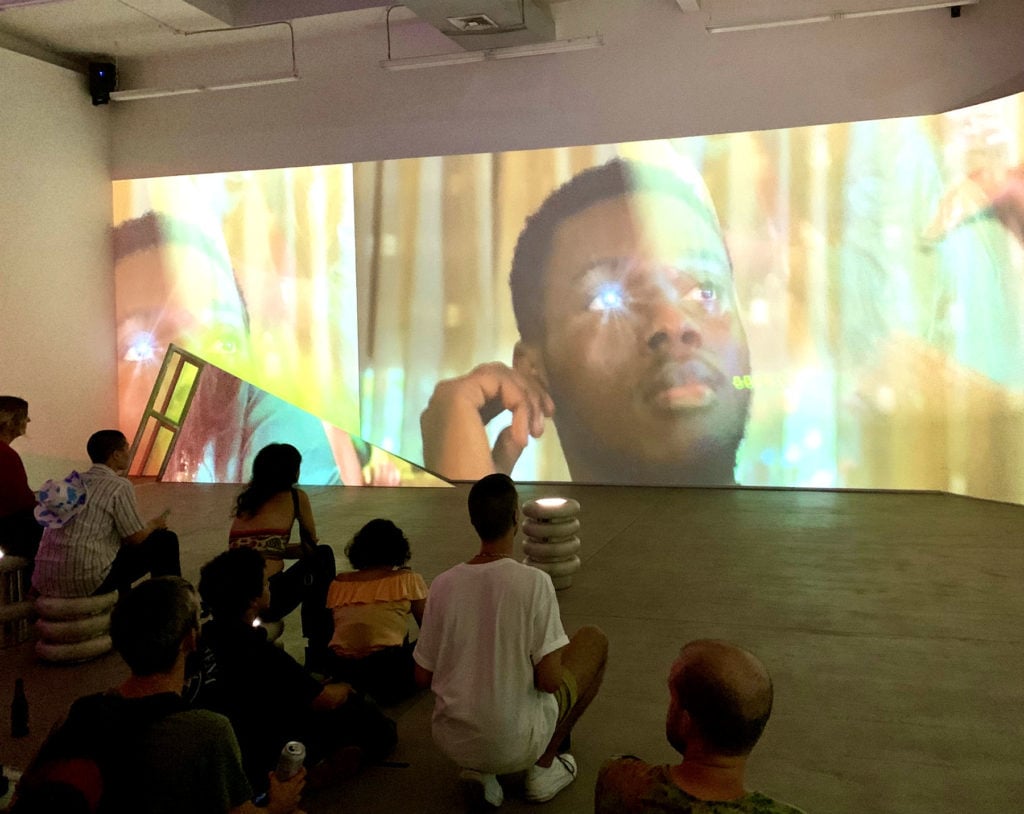
Installation view of Meriem Bennani,
Party on the Caps (2019). Image: Ben Davis.
But life goes on beneath the prison island’s dome. Residents
have access to holographic technology that allows them to send
messages, transfer money, and amuse themselves in various ways. Oh,
and the island is full of crocodiles, and the crocodile is
apparently the symbol of the Caps, recurring in different forms
everywhere—including as a clunky, animated humanoid crocodile who
intermittently serves as our narrator.
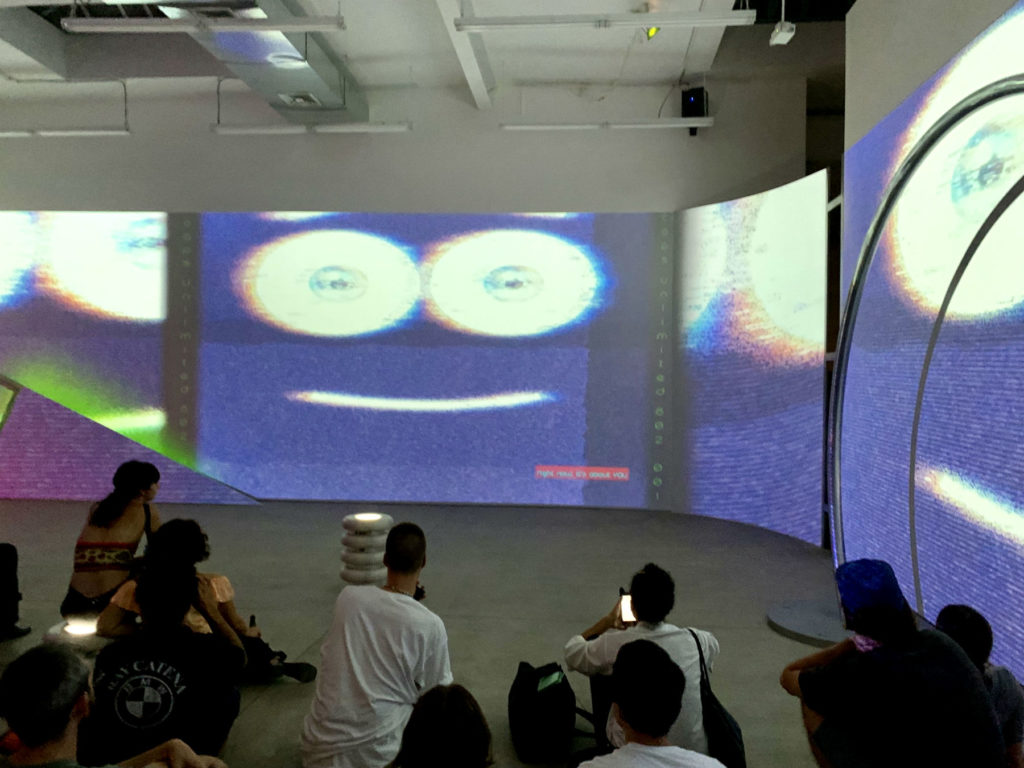
Installation view of Meriem Bennani,
Party on the Caps (2019). Image: Ben Davis.
To call what you see in Party on the Caps a “story”
would be too strong. The core of events is the titular party,
featuring dancing, drumming, and an MC rapping gleefully about life
on the island. At different points, there is pseudo-documentary
footage with people musing about life in Caps society. There is an
extended interlude with a large sinister animated cartoon face that
fills the screen and grins out of the darkness, representing, it
seems, a kind of AI smuggler, promising Caps residents that they
can be beamed into a new life in Florida for the right price (“I
have gorgeous bodies in America waiting for a second run”). There
are also snippets that suggest alternate-universe commercials and
TV shows full of crocodile symbolism.
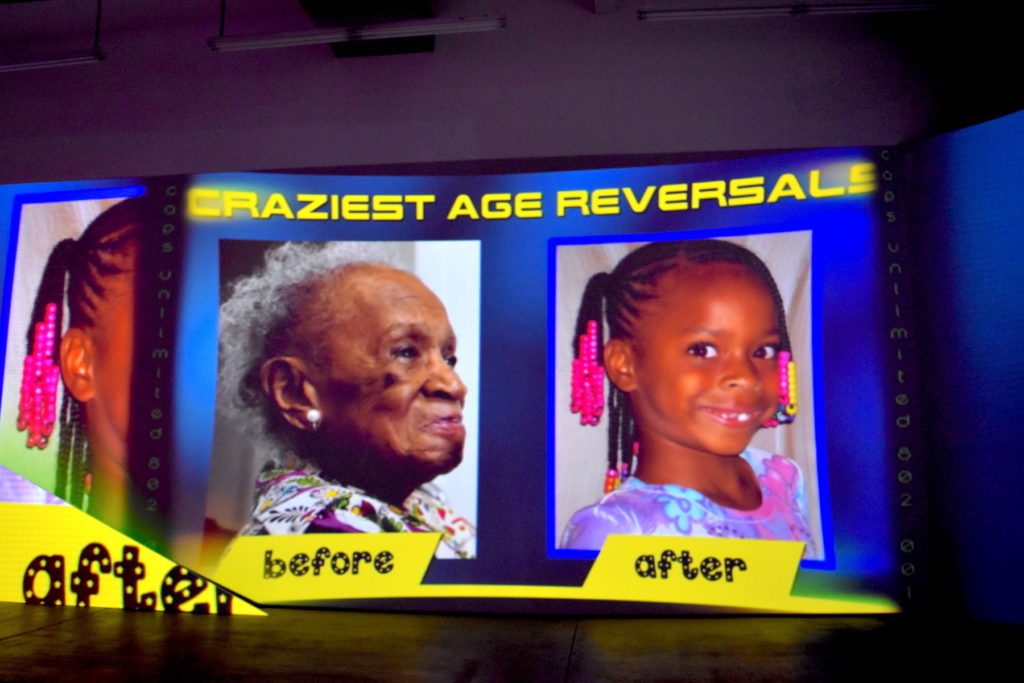
Installation view of Meriem Bennani,
Party on the Caps (2019). Image: Ben Davis.
I can imagine a complaint about this film: That for a work that
is quite evidently about something very horrible and
topical—America’s techno-powered global police state and the
criminalization of refugees—the moody but playful tone is off.
Despite dystopian intimations, nothing that happens in Bennani’s
video is even close to being as horrifying as what you’re reading
about in daily headlines. There’s a party. There are petty
conflicts and hierarchies but everyone seems to be at least getting
by, eating well (or at least eating crocodile branded cereal),
taking care of their families, and so on, in the shadow of those
faceless trooper drones.
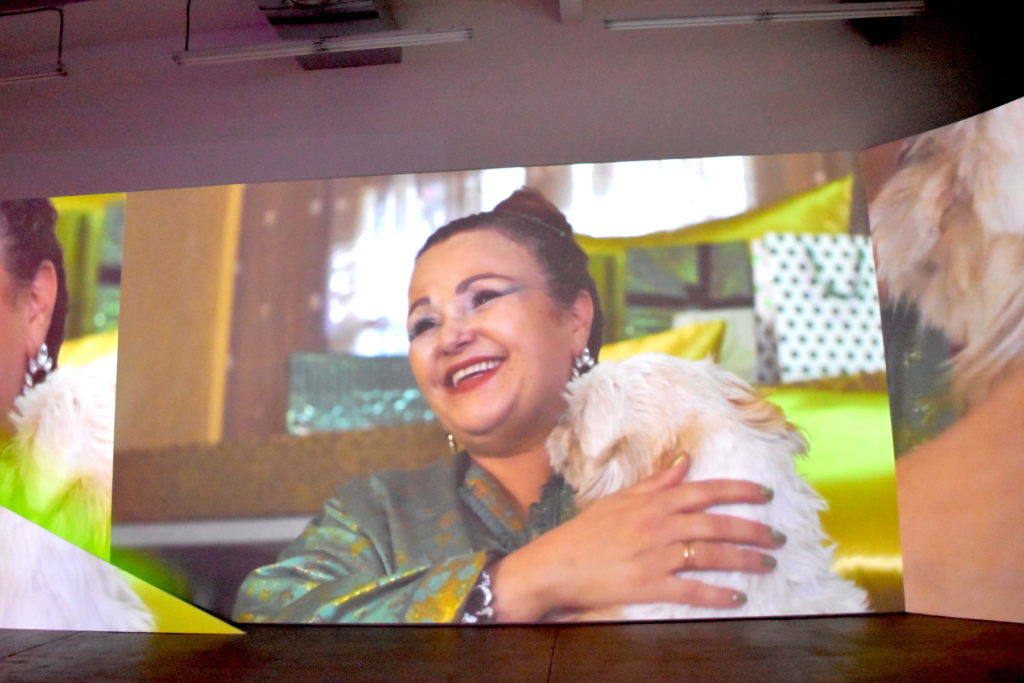
Installation view of Meriem Bennani,
Party on the Caps (2019). Image: Ben Davis.
“Dream-like” is an overused term, but Party on the Caps
really is dream-like in a strong sense. Certainly, in the way that
it circles through symbols and seems to obey its own sui
generis narrative logic. But also in that it seems like a very
personal vision: Bennani has cast her own mother in a key role, an
aspect that is symbolically important enough that the gallery is
handing out transcripts of the conversation Bennani had with her
bemused mother as she was trying to teach her the film’s dialogue.
So overall the video really reads as a rebus of present-day
personal anxieties, strained through sci-fi fabulation.
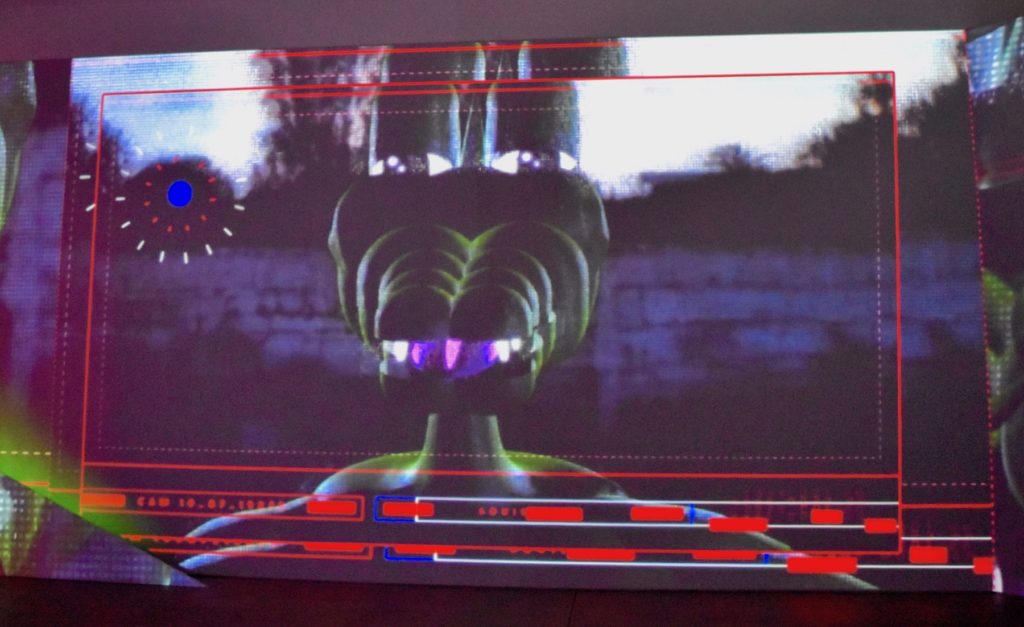
Installation view of Meriem Bennani,
Party on the Caps (2019). Image: Ben Davis.
It’s dream-like too in a way that is very difficult to capture
in art: the characters or events seem to be suffused by an
emotional resonance utterly different from what those characters
look like outwardly. The final, gloriously odd image of a dead-eyed
cartoon crocodile standing watch in the night, Terminator-like,
leaves behind an aftertaste of pronounced Surrealist
spookiness.
In fact, the aura of puzzling-ness and incongruity here seems to
be a reaction to the alarming and virulent demands of the present
moment. In an interview two years ago with Art21, in the wake of
Trump’s initial travel ban targeting majority Muslim countries,
Bennani spoke of the contradictory feeling of being deeply affected
by the news, as an Arab woman, while at the same time bridling at
being stereotyped and pigeonholed as an “Arab woman artist.”
“What this political climate does,” Bennani said, “is that it
asks you to think about your identity constantly. And I feel like
my reaction to that has been to make work that itself doesn’t stick
to one genre or identity. It has to do with me not wanting to
define myself into one thing.”
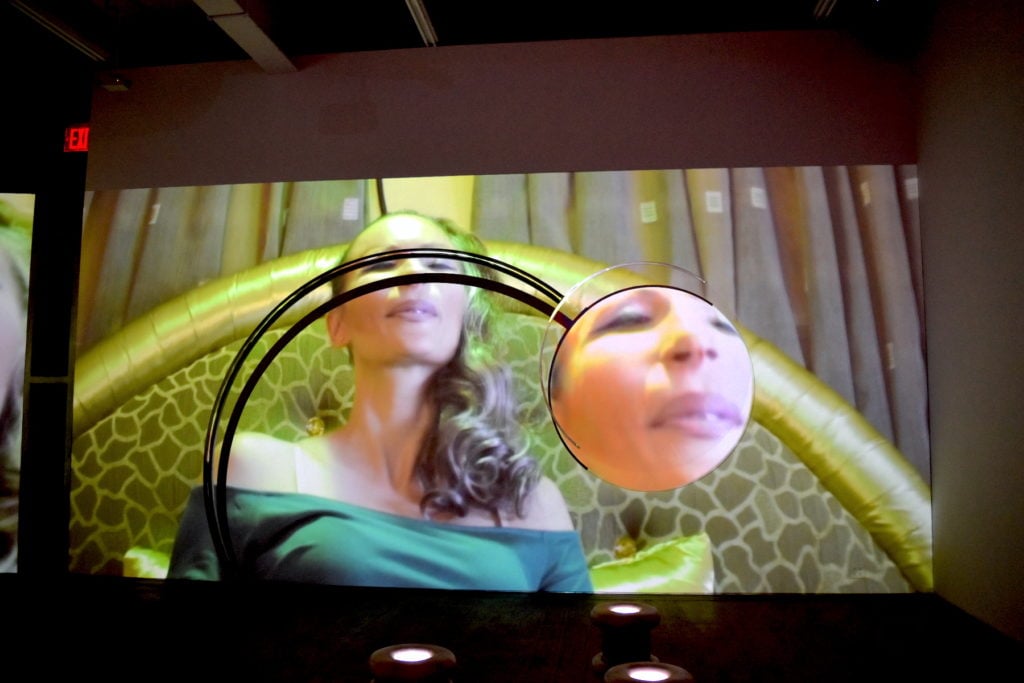
Installation view of Meriem Bennani,
Party on the Caps (2019). Image: Ben Davis.
Culture is overrun right now with dystopian imagery; it is the
default mis-en-scene of any future imagining. This is very
obviously accelerating because the present is full of horrors
that seem only to be looming larger.
For me, Bennani’s Party on the Caps, with its
combination of quirky personal symbolism, knowing sci-fi tropes,
and the everyday-ness of its depicted events—people coping, getting
by, going through the cultural rituals and social devices that make
life bearable—specifically cuts against the suggestion that it’s
a Black Mirror-ish prophecy about Things To Come.
It seems to me to serve a different function. It extrapolates
present-day anxieties into a sinister cartoon of a terrifyingly
broken world, but this actually doubles as almost a love letter to
the sustaining resilience of family and culture amid the chaos.
Bennani’s spooky but joking tone may represent something like
nervous laughter about whether these elements can ultimately be
held together. At any rate, I think you can say that the film’s
fantasy is balanced between giving a serious sense of a world out
of control and about domesticating dystopian thoughts with whimsy,
so that it is as much about coping with the present as it is about
peering nervously into the future.
“Meriem Bennani: Party on the Caps” is on view at CLEARNING,
through October 27, 2019.
The post Artist Meriem Bennani’s Latest Work Is All About
Imagining a Future in Which We Are Able to Cope With Our Disjointed
Reality appeared first on artnet News.
Read more https://news.artnet.com/exhibitions/meriem-bennani-party-on-the-caps-clearning-1660285
Further reading


Leave a comment