
The Condition of ‘Have-Not-Ness’: Why Performance Artist Pope.L Puts His Body on the Line and Embraces Vulnerability
In New York, verticality is the definitive modus operandi. Both
buildings and people perpetually strive skyward, driven by tenuous
dreams of upward mobility. “But, let us imagine,” the American
artist Pope.L proposed to fellow artist Martha Wilson in 1996, “a
person who has a job, possesses the means to remain vertical, but
chooses momentarily to give up that verticality?”
In the sweltering summer of 1978, he stopped supposing.
Momentarily suspending his own verticality and the privileges that
it implied, he donned a suit, placed his bare palms on the human
waste-tinged pavement of Times Square, and began to crawl. It was a
performance of “have-not-ness”—a condition of vulnerability in an
unforgiving landscape and an even less forgiving social order—that
he would repeat alone and in groups more than 30 times over the
course of his career.
“In the early days, I did not protect myself very well,” Pope.L
tells artnet news. “I crawled without protective padding—without
anything, really. Somehow I thought I did not matter.”
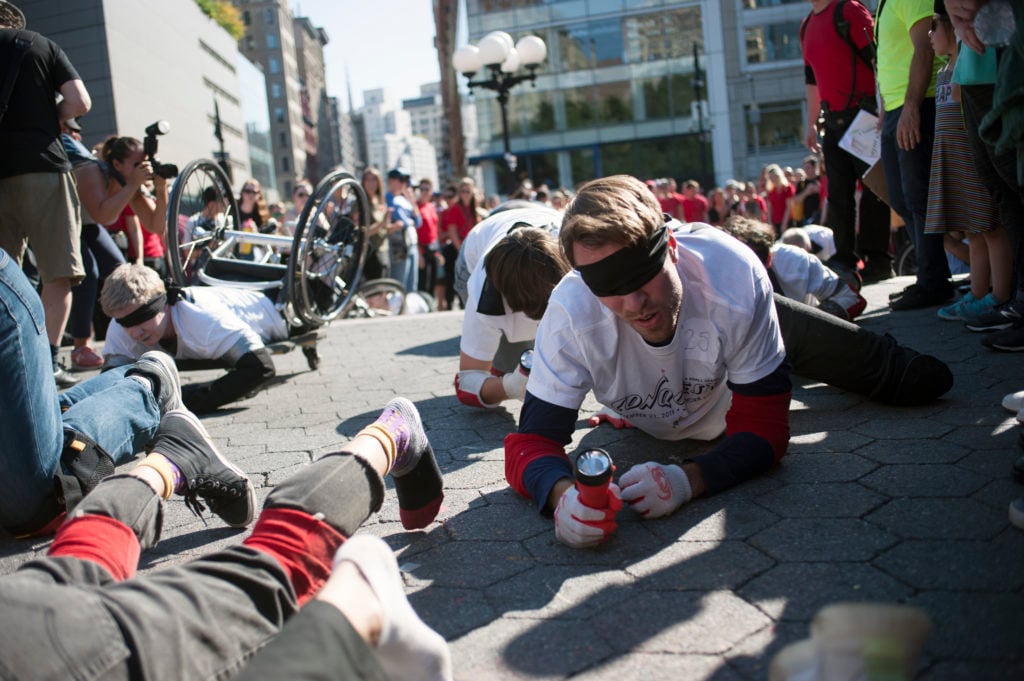
Performers in Pope.L’s Conquest
on September 21, 2019, in New York. Photograph by Amy C. Elliott
for Public Art Fund and the artist.
A Grand Pope.L Celebration
This fall, Pope.L is the subject of “Instigation, Aspiration,
Perspiration,” a trio of New York exhibitions that each highlight a
different aspect of the artist’s expansive, multi-disciplinary
practice.
Part one launched this past weekend with Public Art Fund’s
“Conquest,” a group crawl of
140 volunteers who willingly surrendered their own verticality,
sight, and shoes at the artist’s behest, dragging themselves over a
1.5 mile tract of Manhattan.
Next to come is “Choir,” a new sculptural commission to be
unveiled at the Whitney on October 10, and “member: Pope.L,
1978–2001,” a survey of performances through various documentation
and ephemera, opening at MoMA on October 21.
“An artist like Pope.L, who is outside the traditional
categories of museological presentation, really benefits from this
kind of multi-institutional attention,” says Public Art Fund
director Nicholas Baume.
Over the four decades of his career, Pope.L has painted, drawn,
sculpted, and made installations, but his best-known work has been
done largely outside institutional confines. He is a poet,
novelist, and playwright, as well as the former lead singer of an
’80s new wave punk band. (Among his influences, he lists Eric
Satie, PJ Harvey, Cecil Taylor, and his aunt Jenny.)
He has performed and directed on stage, and for two decades he
lectured on theater and rhetoric at Bates College in Lewiston,
Maine. Currently he is an associate professor at the University of
Chicago’s department of visual arts.
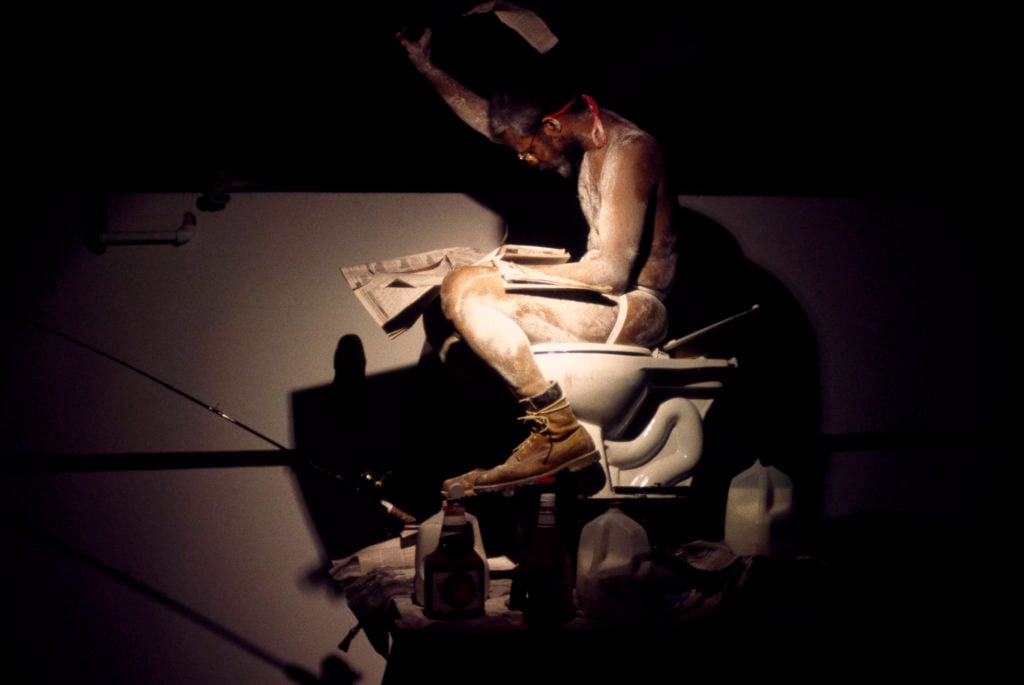
Pope. L. Eating the Wall Street
Journal (3rd Version) at the Sculpture Center in New York, in
2000. © Pope. L. Courtesy of the artist and Mitchell–Innes & Nash,
New York.
Embracing Lack
Pope.L was born in Newark, New Jersey, in 1955. He described his
childhood as a state of have-not-ness, marred by familial
homelessness and addiction. “Have-not-ness,” he has said,
“permeates everything I do.”
The artist goes into a willing state of have-not-ness through
the self-debasement of his body, which he puts to the test to
criticize, in absurd ways, dynamics of power, race, and class.
He has crawled through snow, ingested newsprint, and attempted
to sell dollops of warm mayonnaise. He has wrapped himself in
sausage links while passing out cash to strangers on the street. In
his 1996 work, Sweet Desire a.k.a. Burial Piece, he buried
himself upright, packed with dirt up to his shoulders, sweating
profusely for eight hours as a glass bowl of vanilla ice cream
melted in front of his face.
The presence of a black body in the performance art sphere was
revelatory for E.J. Hill, a Los Angeles-based artist. Before 2010,
when he came across the catalogue for Pope.L’s show, “The
Friendliest Black Artist in America,” Hill had only been taught
about the performance art of white artists, who had worked “in this
purportedly neutral, universal body that everyone has to imagine
themselves in,” he says.
In his unsparing assessments of race in America, Pope.L had
“added facets that weren’t being talked about in general terms—this
conceptual force field, this social construct that exists around
the body, the invisible padding that affects the way you move
through space.”
The optics of vanilla ice cream and other white props like
it—snow, flour, eggs, the white cardboard penis of his 1996 work,
Member a.k.a. Schlong Journey—were vehicles with which to
talk about race. In the 1991 piece, I Get Paid to Rub Mayo on
my Body, the slick coating of mayonnaise on Pope.L’s skin
functioned as a high-sheen whiteface that eventually dried to a
clear finish and rancid smell.
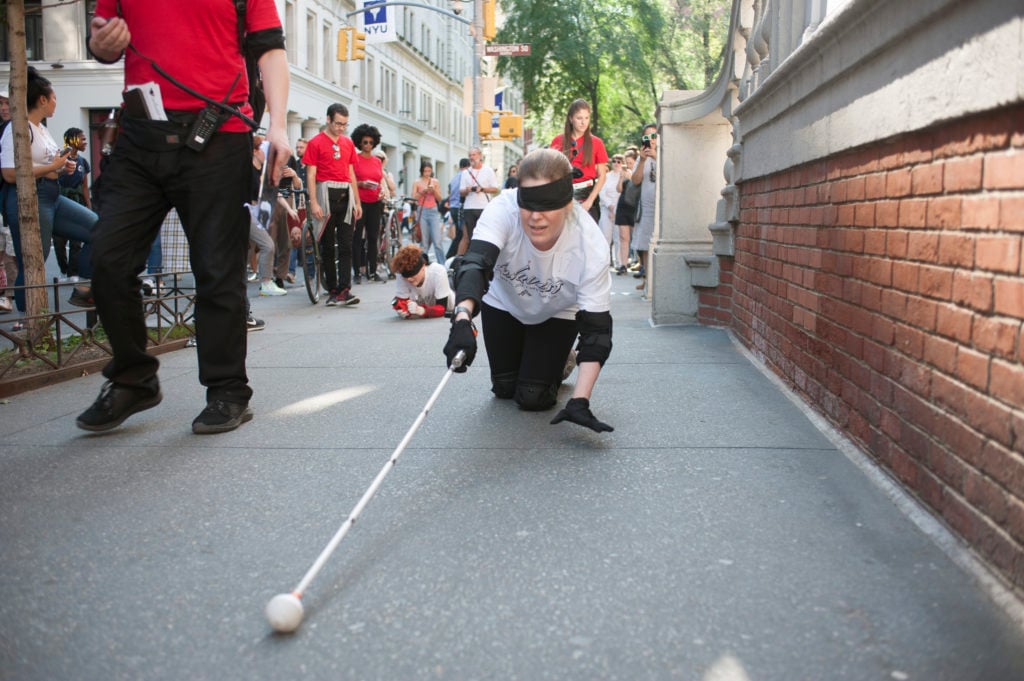
Performers in Pope.L’s Conquest
on September 21, 2019, in New York. Photograph by Amy C. Elliott
for Public Art Fund and the artist.
“Mayonnaise gave me a quirky material means to deal with issues
black people claim they don’t value very much,” he told Wilson.
“Whiteness.” At the Whitney, “Choir,” an upside-down fountain
evoking Jim Crow-era laws, is accompanied by field recordings of
black spirituals. Along with Pope.L’s recent work on the Flint,
Michigan, water crisis, the installation points to how access to
water in the United States continues to be racialized.
“For decades, he was under the radar, working his ass off and
making the sort of challenging, raw, intense, highly critical work
that no one was even coming close to making,” says the artist
Clifford Owens. In 2011, noting how the art historical record had
largely ignored the existence of black performance artists, he
solicited new work from 26 black artists for a show at MoMA PS1
titled “Anthology.” Pope.L’s contribution to the exhibition was a
simple set of instructions: “Be African-American. Be very
African-American.”
“When I first read [that], I said, ‘Man, he’s fucking with me,’”
Owens recalls, but he ultimately warmed to it. “It was a brilliant
score. What he was really tasking me with was to try and imagine
the imaginary construction of what an African-American is.”
For Pope.L, blackness was a state akin to have-not-ness, which
he called “a lack worth having.” He embraces lack as a binary
state, the simultaneous result of failure and opportunity, he has
said. “I am speaking to the dynamic of pain, loss, joy, radicality,
and possibility in the experience of being black.”
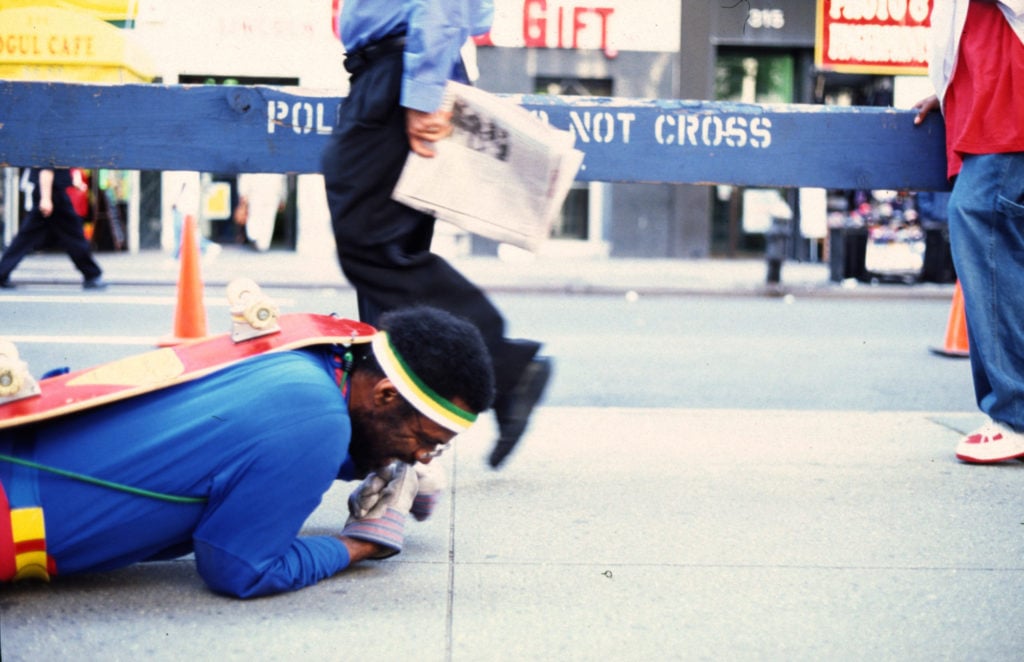
Pope.L, The Great White Way, 22
miles, 9 years, 1 street (2000–09). © Pope. L. Courtesy of the
artists and Mitchell–Innes & Nash, New York.
The Pain of Performance
These willing states of vulnerability have taken a toll. Pope.L
has suffered from dehydration and blocked circulation, the
ingestion of toxic chemicals, and the inevitable scrapes and
bruises that come with dragging oneself along cement. His mother’s
intervention eventually convinced him to take better care.
“Her criticism was [that] lack of care positioned the work
incorrectly. I agreed,” he says. “One of the most important things
I did to amend this, especially in the case of performances that
involved eating, was to reduce the number of times I
performed.”
At MoMA, where much of Pope.L’s work will be displayed in the
form of film and photo documentation (he often worked accompanied
by a camera person), the hazards of performance—the tension, the
endurance, the rancid smells—will exist solely in the viewer’s
imagination.
In the show’s catalogue, fellow performer Yvonne Rainer poses a
pertinent question: “Why the extended duration that produces such
punishment on your body when, say, a series of photos or a
ten-minute video might have a comparable effect?”
“Rainer is correct that the two are comparable—but they are not
the same,” Pope.L tells artnet News. “Some performances look
prettier or more seductive in pictures, but an electronic capture
of life has a different texture than a document of that life.
Documentation is as much about what is not there as what is there.
That’s what makes it interesting, frustrating, and empty. That’s
why my show at MoMA, if it’s about anything, it is about holes”—a
lack that viewers will revel in exploring.
The post The Condition of ‘Have-Not-Ness’: Why Performance Artist
Pope.L Puts His Body on the Line and Embraces Vulnerability
appeared first on artnet News.
Read more https://news.artnet.com/art-world/pope-l-profile-1661419
Further reading


Leave a comment