
Artificial Intelligence Is Revealing Secrets About How the Ghent Altarpiece Was Made—and Damaged
Researchers have harnessed the power of artificial intelligence
to decode x-ray images of the Ghent Altarpiece, the 15th-century
masterpiece by brothers Hubert van Eyck and
Jan van Eyck at the St.
Bavo Cathedral in Belgium.
Being able to read the x-rays can help identify damage to the
painting by showing areas where varnish or overpainting hides
cracks, paint loss, or other structural issues. The scans can also
teach researchers about the artists’ working methods, revealing the
physical structure of the canvas or panel and its supports, as well
as the different layers of paint used in its creation.
But because the Ghent Altarpiece’s panels are double sided, it
has been difficult to parse the x-ray images. A newly developed
algorithm has allowed scientists to deconstruct the data to create
two distinct images.
“This approach demonstrates that artificial
intelligence-oriented techniques—powered by deep learning—can be
used to potentially solve challenges arising in art investigation,”
said Miguel Rodrigues of the electronic and electrical engineering
department at the University College London in a statement.
The 12-panel polyptych painting, titled The Adoration
of the Mystic Lamb and completed in 1432, has been
undergoing
restoration at Belgium’s Royal Institute for Cultural
Heritage since 2012. As part of that work, the piece was
subject to hyperspectral imaging, macro x-ray fluorescence
scanning, and imaging x-ray radiography, as well as high-resolution
photography in both the visible and infrared spectrums.

The Ghent Altarpiece, front and back.
The missing panel was stolen almost 100 years ago. Photo by D.
Provost (closed Ghent Altarpiece) and H. Maertens (open Ghent
Altarpiece); courtesy of Saint-Bavo’s Cathedral, Art in
Flanders.
The study’s findings, published last week in the
journal Science Advances,
take a closer look at the outermost upper panels
of Adam and Eve, which feature two interiors from
the Annunciation scene when the altarpiece is folded closed.
As a 2-D representation of a 3-D object, x-rays flatten out a
variety of information, including the physical make-up of the work,
making it difficult to create a clear image of the paintings on
either side.
To better interpret this information, scientists turned to a
convolutional neural network–based self-supervised framework,
training a deep neural network with color photographs of the back
and front of the paints, as well as the x-ray of the entire panel.
As a result, the AI was able to develop an algorithm to reconstruct
x-ray images of both sides of the panel, separating the x-ray of
the two-sided paintings into two distinct x-ray images.
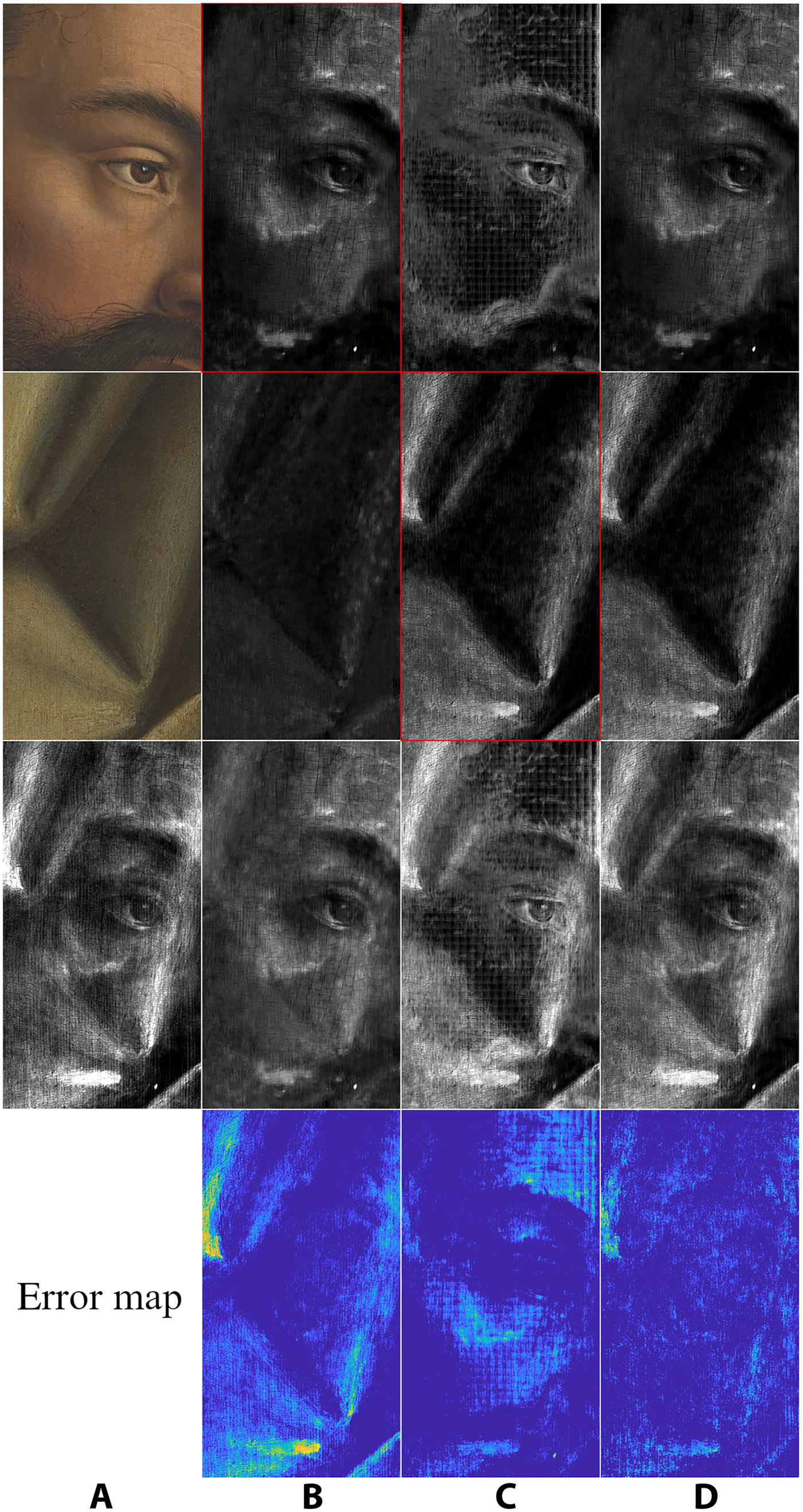
The algorithm interpreting the x-rays of
a detail of Adam on the Ghent Altarpiece. The first two rows show
the unmixed x-rays separating the two sides, while the third row
shows the original x-ray of the full panel. Courtesy of
KIK-IRPA.
The new method has only been used on two of the altarpiece’s
panels so far, but is expected to assist in the further study of
the famous work. Moving forward, it could also make it easier to
identify covered-up compositions on reused canvases, or changes an
artist made during a work’s creation.
The post Artificial Intelligence Is Revealing Secrets About
How the Ghent Altarpiece Was Made—and Damaged appeared first on
artnet News.
Read more https://news.artnet.com/art-world/artificial-intelligence-ghent-altarpiece-discoveries-1641157
Further reading


Leave a comment